
More than 50 years ago, the Club of Rome first pointed to the “limits” that economic growth faces in the long term due to increasingly scarce resources. At its core, the analysis stated that the excessive use of natural resources would, after several decades (from today’s perspective: now!), significantly impair economic growth and ultimately population growth as well.
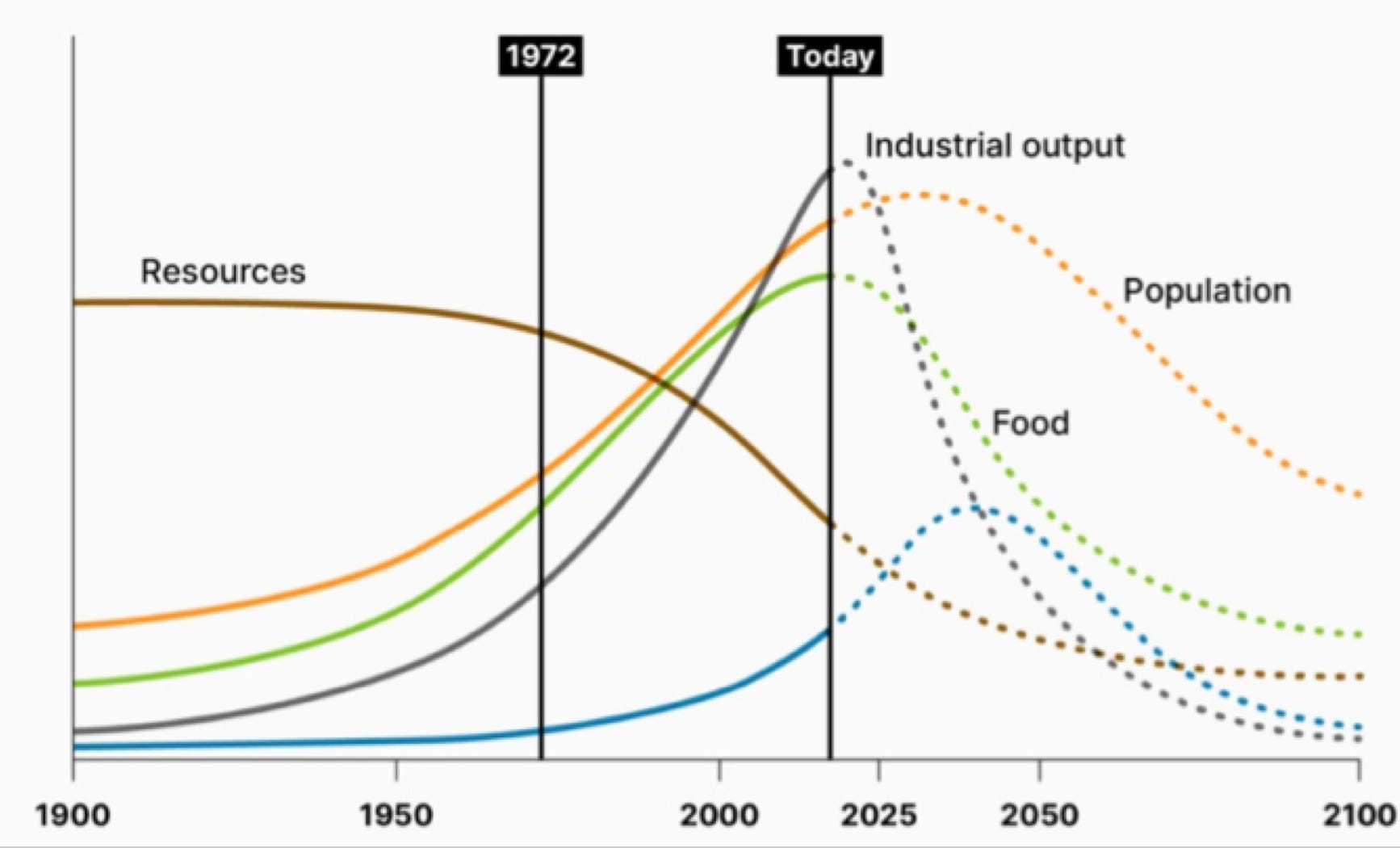
Figure 1: The concerns of the Club of Rome have materialized; source: Club of Rome, adapted from Meadows et al., The Limits to Growth, 1972.
Today, we appear to have reached this point. See also this recent post by Ugo Bardi. Growth, constrained by planetary and other limits, is increasingly becoming a source of conflict within societies and between states and regions. With this contribution I deal with the economic reasons for this and argue how conflicts are rooted in limits to global growth of the global economy.
In most parts of the world, no exponential growth can be seen any more, but “only” linear growth. That means that the economy does—on average and in the medium term— not grow by a certain percentage annually, but by a certain amount. In purely mathematical terms, this means that growth rates are declining.
But why is that so? As mentioned already earlier, global change is not only the result of material and cultural transformations but also of economic transformations. So let us look for economic reasons of this development. It is not us, who have been pointing out the negative consequences of economic growth for decades, who are to blame for declining growth rates. It’s the economy, stupid.
To better understand why the economy is growing less and less, we should look at the factors that make growth possible in the first place and why they are weak now: supply and demand. GDP means basically how much we produce and consume., which are on the global level two sides of the same coin. I admit that the following is a rather simplified description of economic relationships, but I believe it to be fundamentally correct and important.
Let’s start with supply. Producing more goods and services requires
(1) more labour,
(2) more capital,
(3) more natural resources and/or
(4) technical progress. All these factors develop weakly.
Ad 1) The “era of population growth is ending—and societies are unprepared”, argues Ugo Bardi in a new report to the Club of Rome, entitled “The End of Population Growth”. In 2024 EU population increased by 0.4% while aging on average, which means that the labour force isn’t really increasing.
Ad 2) While about 10 years ago, the ‘end of capital scarcity’ was being proclaimed, concerns about it did not diminish. The so-called Draghi-Report of the European Commission noted in 2024 that “a minimum annual additional investment of EUR 750 to 800 billion” is needed to finance research and innovation needed for more growth “corresponding to 4.4-4.7% of EU GDP in 2023.” In other words, we would need a lot more capital to sustain economic growth.
Ad 3) While natural resources are not geologically scarce, the investments required to meet the escalating demand are huge, which creates more competition for the additional financial means needed for increasing extraction.
Ad 4) According to the OECD, multifactor productivity, which measures technical and organizational progress in an broad sense, “made a negative or negligible contribution to GDP growth in 2023”.
Let us now look at the demand side. The economy can only grow when also demand increases:
(1) consumption,
(2) investment,
(3) government spending and
(4) export to other countries.
For decades, these were powerful drivers of growth: the population grew strongly, economies invested to meet rising consumer demand, and the government stepped in when demand declined and emerging markets were ready to absorb increased production in earlier industrialized countries. But now?
Ad 1) If the population is no longer growing (see above), consumer demand will not grow much either – especially in times of hardly any wage increases.
Ad 2) I have already mentioned above that capital shortages are slowing down investment.
Ad 3) ‘The government must save’ is the mantra almost everywhere today - quite apart from whether such a strategy is regarded as wise (which I don’t, by the way, and with which I will have to deal in a later post). In any case, austerity slows down an economy’s potential for growth.
Ad 4) One country’s exports are another country’s imports. Globally, therefore, they cannot be a driver of growth at all. For single countries or regions the advantages of an export strategy are shrinking as more countries pursue the same strategy.
The topic of ‘growth’ has been on my mind ever since I came across the report on ‘The Limits to Growth’ 50 years ago. At the University of Linz (more than 40 years ago), we were able to convince our professors to offer an interdisciplinary
seminar on the subject. The topic was in the air with the emergence of green movements – at university and even in the charts:
Here’s are the lyrics, translated with the help of DeepL from genius.com:
[Verse 1]
When the factory siren blares early in the morning
And the time clock moans lustfully as it punches
The neon sun shines in the assembly hall
And the forklift driver shows off with his forks
[Chorus]
Yes, then we spit on our hands again
We increase the gross national product
Yes, yes, yes, now we spit on our hands again
[Verse 2]
The nurse gets a huge fright
Another patient is gone
They amputated his last leg
And now he’s kneeling down hard again
[Chorus]
[Verse 3]
When Grandpa gets on his bike on Sunday
And secretly sneaks into the factory
Grandma is afraid he’ll collapse
Because Grandpa is working overtime again today
[Chorus]
[Instrumental]
[Verse 4]
A-a-at Christmas, everyone is lying around saying, ‘Phew-uh-uh-uh.’
The rubbish bin won’t close anymore.
The gift tables are getting more and more colourful.
And on Wednesday, the rubbish collection comes and takes all the junk away and says
[Chorus]
Now we’re spitting in our hands again.
We’re increasing the gross national product.
Yes-yes-yes, now it’s time to get back to work
[Bridge]
When the factory siren blares early in the morning
And the time clock moans lustfully as it strikes
Then one after the other is seized by a frenzy of work
And now they sing together in time with the beat of work-beat-beat-beat-beat-beat-beat
[Chorus]
Yes, now it’s time to roll up our sleeves again
We’re increasing the gross national product
…
Thirty years ago at the Wuppertal Institute, ‘growth’ was once again a hot topic: is there such a thing as green growth? During my time with the Sustainable Europe Research Institute (SERI) 20 years ago, we developed and calculated many scenarios on this topic. The conclusion at the time was that with the enormous investments required for a ‘green transformation’ and the fact that greening the tax system makes the economy more competitive economic growth is almost inevitable, unless – and this remains my credo to this day – the average working time is significantly reduced so that overall less consumer and investment goods need to be produced, which allows for greater wellbeing and at the same time less consumption of resources.
In 2007, I took part in the major Beyond GDP conference, organised by the European Commission, European Parliament, Club of Rome, OECD, and WWF, in Brussels, and in 2008 I helped to organized the first Degrowth conference in Paris. Twelve years ago, I co-authored the book ‘Wachstumswahn – Was uns in die Krise führt und wie wir wieder heraus kommen’ (Growth Mania – What is leading us into crisis and how we can get out of it) with Christine Ax, and five years ago I was responsible for SDG8 ‘Decent Work and Economic Growth’ at the University of Applied Arts Vienna as part of the major UniNEtZ project.
For 18 years now, the Growth in Transition initiative, which I now lead together with Sophia Kratz as chair, has been a key driver of the debate – both here in Austria and internationally. Today, I am working on an updated version of these debates, also in the context of an emerging Wellbeing Economy Hub in Austria and the advisory board of Donut Vienna – and of course together with many others as a member of the Club of Rome.
Today even UN Secretary General Antonio Guterres claims that the global economy must move past GDP to avoid planetary disaster. Anders Wijkman, Honorary President of The Club of Rome and Earth4All Transformational Economics Commission member, writes of GDP as a “doublebind”: “If GDP growth stops, financial markets falter, unemployment rises and governments panic. If GDP rises, the extraction of various natural resources increases and climate change accelerates while ecosystems are depleted. The de facto conclusion is that there is no secure future within today’s economic model and logic.” Both possible developments can be the source of conflicts. This dilemma is exacerbated in times of globally reduced rates of economic growth. Whereas in times of high growth rates it was primarily possible to redistribute gains, distribution conflicts are increasingly becoming a zero-sum game, thereby exacerbating the situation. Today, countries and regions are competing for energy and food, materials and workers.
Over the last decade, the idea that climate oriented policies drive growth was widely accepted and government programmes in many industrialized countries including the United States, Germany and the European Union with its “Green New Deal” made important steps possible towards reducing greenhouse gases even though the report Earth4All rightly described the progress as “too little too late”.
But now the wind has changed and brings us back to the concerns the founders of the Club of Rome had already 60 years ago. The fact that the world experiences slow or even no growth in almost all early industrialized economies is not a consequence of “green” policies and certainly not the fault of those who critically examine the concepts and empirical evidence of economic growth as I explained above.
In a limited world, however, the drive for growth becomes a source of even more conflicts over access to natural resources. Higher growth in some parts of the world make it more difficult for other regions to grow and, hence, economic competition increases, since economic growth needs a steady inflow of primary materials.
Nowadays, the defense industry is often seen and presented as a growth driver. Military armament is said to also create growth and jobs and at the same time accelerates the consumption of resources at the expense of other sectors (see also this earlier post of mine). But is armament really the right way to stimulate economic growth and create jobs? Arms procurement is part of government spending and is financed by taxes and debt (i.e. ultimately taxes to be paid later). While it does not seem politically expedient to raise taxes, the EU allows an increase in government debt specifically for this area. This is a purely political decision that prioritises arms procurement over the needs of other policy areas, which is something that can and should be discussed.
The arms industry is profitable primarily because states are willing to bear costs that are sometimes excessive („whatever it takes“). In any case, the employment effects of arms production are less significant than those of civil investments in areas such as education or health care. Christian Helmenstein, chief economist of the Austrian Federation of Industries, said recently on Austrian Radio Ö1 that ‘the figures are far from being able to compensate for the job losses in the automotive industry.’
It should also be discussed whether, in addition to weapons systems, equal investment should be made in non-military peacekeeping measures such as diplomacy. The latter cost the state only a fraction of military expenditure today.
However, the competition between social spending, climate investment and armament is not only about (tax) money but also about scarce natural resources that can be ‘invested’ in various ways. This exacerbates not only conflicts over these raw materials, but also political tensions that can lead to a vicious circle when armaments are used in such conflicts when the limits of further growth, that the Club of Rome has been warning about for more than five decades, materialize.
Conclusion and starting point for further consideration
The global hunger for raw materials, combined with the exceeding of limits, is intensifying regional, international and even global conflicts. Resource conservation and the fair distribution of wealth, income and life opportunities are therefore a necessary, though not sufficient, condition for lasting peace and thus a foundation for the positive development of companies.
From this perspective, committing to sustainability can also be understood as a contribution to peacebuilding. In this post I hope I have clarified some questions. But many more questions have arisen, which I will address in the coming weeks and months. So, please stay tuned!
Thanks for reading Blogposts by Fritz! This post is public so feel free to share it.
Wellbeing, growth and distribution
·
Jul 6

The great challenges of our time can be symbolised in 4 Cs: climate, capitalism, conflicts and computers (AI). The challenges are systemically intertwined and one of the interconnectors is that there are limits to further economic growth. I’ve discussed the reasons in my
Some Refernces:
Christina Anselmann (2020). Secular stagnation theories. A historical and contemporary analysis with a focus on the distribution of income. Cham: Springer.
Christine Ax und Friedrich Hinterberger (2013): Wachstumswahn: Was uns in die Krise führt - und wie wir wieder herauskommen. LUDWIG-Verlag bei Penguin.
Sandrine Dixson-Decleve , Owen Gaffney, Jayati Ghosh, Jorgen Randers, Johan Rockstrom und Per Espen Stoknes (2022): Earth for All: A Survival Guide for Humanity. A Report to the Club of Rome.
Friedrich Hinterberger (2025): How to Achieve a Wellbeing Economy from Macro to Micro. In Marisa Mühlböck (Ed): Sustainable Transformation and Well-being. The Role of Business for Individual and Collective Flourishing. Springer.
Meadows, Donella H., Meadows, Dennis L., Randers, Jørgen, Behrens, William W., III (1972): The Limits to Growth: A report for the Club of Rome’s project on the predicament of mankind. (https://collections.dartmouth.edu/archive/text/meadows/diplomatic/meadows_ltg-diplomatic.html).
No posts
Comments
Nothing yet. Say the first thing.
Sign in to join the conversation.