
Wars destroy. We are currently experiencing this first-hand on tv in our living rooms, on our computers and mobile devices. They destroy human lives, cities and land, economic capital, trust and hope. UNDP’s recent damage report covering the period from February 2022 till December 2025, for example, estimates a recovery and reconstruction needs in Ukraine of roughly 600 billion US$. The impacts are getting closer and talk of ‘World War III’ is appearing more and more frequently in the media.
But while the destruction we are currently witnessing in Ukraine, in and around Iran and in many other places of the world is difficult to bear, we must also recognise how much destruction of nature, infrastructure and human life we have already allowed during the preparations for these wars and those yet to come.
In his essay „The Environmental Footprint of War“ Joseph Hupy distinguished between three types of ‘environmental disturbances associated with war’:
(1) Environmental disturbance and destruction from weaponry.
(2) Direct consumption of resources such as timber, water and food to support armies, and
(3) Indirect consumption of resources by military industrial complexes that supply the war effort.
And it is the latter that I would like to focus on today.
Warfare and its preparation contributes heavily to material use, to emissions as well as material when huge amounts of resources are used in preparing for and engaging in armed conflicts. A vicious circle. Producing new weapons, constructing infrastructure, and conducting overseas missions demand vast amounts of raw materials, which in turn fuel new conflicts.
When war breaks out, it destroys not only human lives but also infrastructures such as homes, schools, hospitals, theatres, food, factories, power plants, cars and roads and hence indirectly the materials from which they were made. And when everything has to be rebuilt after the war, the extraction of resources begins anew.
I must admit that, given the current state of the world, I find it difficult to address the topic of ‘resource consumption through weapons.’ Isn’t this a secondary issue, considering that more and more people are talking about a Third World War?
‘Like any life cycle assessment, that of weapons and war must always be viewed in relation to opportunity costs,’ says Wolfgang Pekny. ‘A wind farm, for example, requires a lot of resources and energy, but after about a year, most of it has been “amortised” in terms of life cycle assessment.’ In the case of weapons we not just quantify the costa (in terms of money and resources) and their possible consequences (destruction and the need for reconstruction), but must consider possible benefits of a functioning military apparatus for deterrence and defence.
But there are also alternatives, such as diplomacy and peace building (and keeping), which might be less nature consuming and at least equally effective. Therefore I find it necessary to show the full complexity of the nexus between conflicts and the environment which is mainly triggered by the use of natural resources, especially materials.
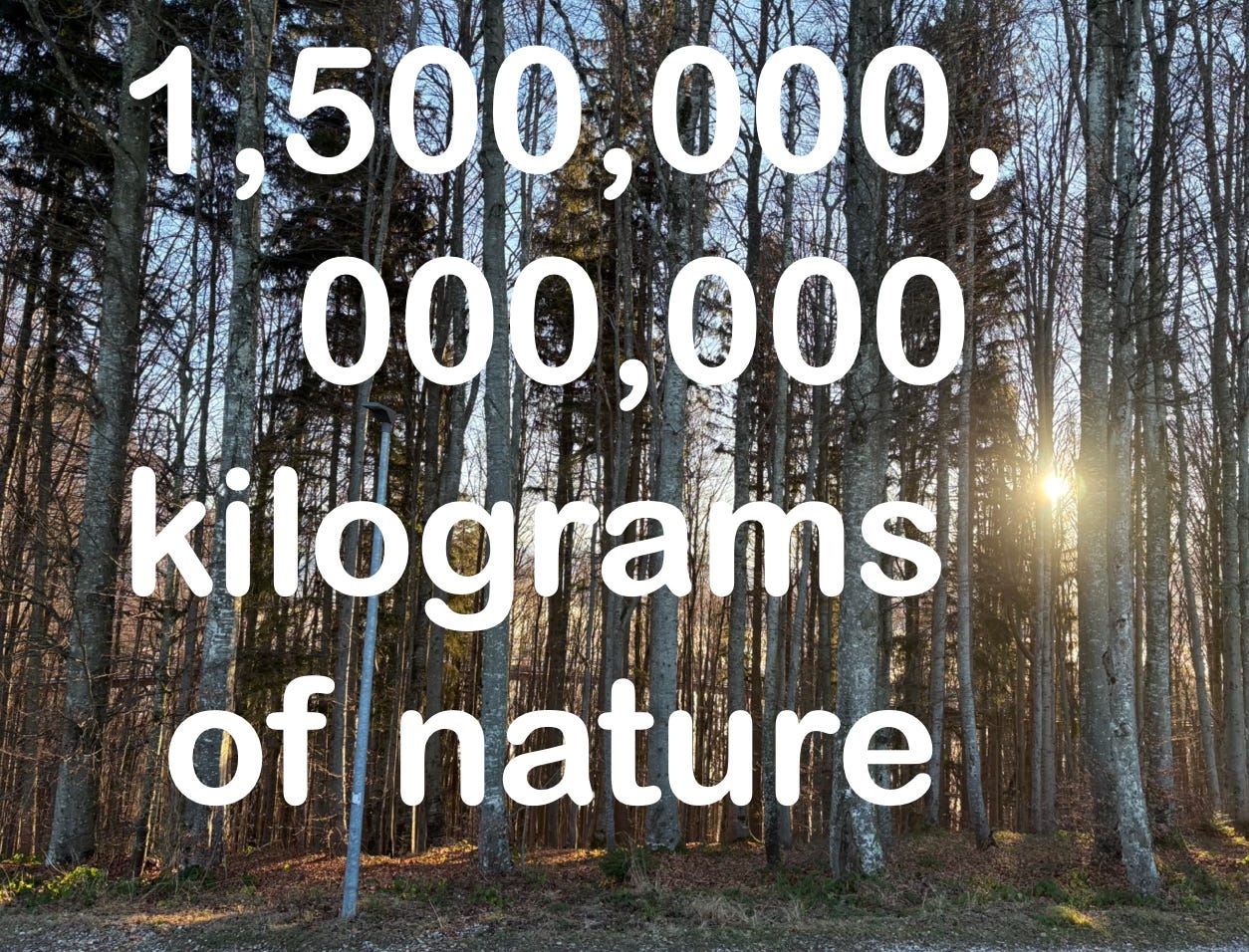
Empirical data for that is not easy to get. As a rule of thumb in line with the report of the UN International Resource Panel I calculate one euro or dollar to equal 1 kg of extraction somewhere in the world. According to the Stockholm International Peace Research Insrtitute SIPRI, global military spending is currently estimated at 2.7 trillion dollars. This figure includes operations, equipment, infrastrucrture as well as personell involved in current acts of war as well as preparations for possible future wars. The shares of these costs differ widely among countries. If we assume that personnel costs account for an average of 40% of total defence costs around 1,500,000,000,000 kilograms of nature was moved due to arms production and operations in 2024. SIPRI’s next annual report is due in April and will most probably show much higher figure for 2025! NATO, for example, estimates the growth rate in 2025 at 15.9%.
European defence spending (EU member states) has roughly doubled in the past 10 years to 326 billion (in 2024) per year, while 800 billion euros are to be spent on ‘additional defence capacities’ for the next 4 years according to the ReArm Europe plan Europe’, which was renamed ‘Readiness 2030’ after some criticism of this title. Assuming again a share of 40% personell costs, this would mean approximately half a gigatonne of resource extraction just for these extra investments.
For the following numbers I refer to Hans Holzinger’s blog post on “Climate crisis as a security risk – the military as a climate heater and resource squanderer” (in German) of last summer.
According to CEOBS, the British Conflict and Environment Observatory, which since 2018 has been focusing primarily on the environmental damage caused by conflicts, the military accounts for 5.5% of global emissions. In May 2025, CEOBS published a paper on the military’s contribution to the climate crisis, lamenting the fact that relevant data on this subject is often subject to secrecy. Emissions from the military are difficult to estimate since they are excluded from United Nations Framework Convention on Climate Change (UNFCCC). There is talk of the “military emissions gap.”
CEOBS estimates the additional annual greenhouse gas emissions resulting from the currently planned increase in military budgets in NATO countries alone, excluding the US, at 100 to 200 million tonnes of CO2 equivalent. According to Ukrainian researchers, GHG emissions, attributable to the first 24 months of war in Ukraine, have increased to 175 million tonnes of CO2e.
In October 2023, the Transnational Institute, together with other non-governmental organizations, presented the study “Climate Crossfire”: “According to the report, the NATO military alone produced nearly 200 million tons of CO2 emissions in 2021. By the end of the decade, they could reach nearly 300 million tons annually.”
Attac Austria estimates that planned growth rates of military spending will lead in 2030 to greenhouse gas emissions of almost 7 billion tons, which equals a quarter of what would be needed as a maximum emissions to acieve the Paris goals of 27 bn tonnes world wide. For Europe similar trajectories are projected by Attac.
Martin Auer, an Austrian author and ‘scientist for future’, quotes Neta Crawford, professor at the University of Oxford, who estimates 1.2 Billion metric tons of greenhouse gases the U.S. military emissions has caused from the beginning of the so-called “Global War on Terror” in 2001 until 2018.
A robust assessment of the environmental impact of armaments requires a granular, supply‑chain–oriented perspective rather than reliance on aggregated defense budgets or CO₂ metrics alone. As Reinhard Hubmann, supply chain manager in a large industrial company, emphasizes, defense spending must be disentangled into equipment, infrastructure, operations and personnel, with product groups clustered and assessed on a country‑specific basis. From a supply chain perspective, the defense industry’s core impact lies in its exceptionally high concentration of metals, critical raw materials, electronics and advanced materials in long‑lived systems that are removed from economic circulation for decades.
A reason why we might over estimate material consumption and emissions from armament using our rule of thumb that one dollar equals one kg of material lies I the limited competition between companies producing weapons and governments ready to buy overpriced equipment, says Hubmann. Although economically relatively small, the defense industry binds a disproportionate share of strategic resources, largely invisible in official statistics and often at the expense of civilian production under clear limits to growth, which I discussed in my recent post.
Sustainability in defense therefore requires moving beyond CO₂ figures towards a broader view of how resources are used over the long term - while recognizing that reporting is often complex, key data are missing, and unclear system boundaries make the true environmental impact difficult to measure.
Military CO2 emissions are comparatively the least significant problem, says environmental historian Verena Winiwarter. It’s like ‘if you had metastatic cancer and I asked you about the eczema on your cheek’. She illustrates the connections most clearly using the legacy of nuclear weapons production. Plutonium has a half-life of 24,000 years. Between 20 and 70 tonnes have been produced to date (depending on the source). That is enough for several thousand atomic bombs. American environmental historian Kate Brown therefore calls our planet ‘Plutopia’. The subtitle of her book is ‘Nuclear Families, Atomic Cities, and the Great Soviet and American Plutonium Disasters’.
In her lectures, Verena Winiwarter, member of the Austrian academy of sciences, describes in detail the conditions at the former Hanford plutonium plant on the Columbia River in the US state of Washington, which operated from 1945 to 1987. Since 1989, the site has been undergoing ‘clean-up’, ‘although this work is being massively hampered by systemic corruption’. I have to come back to this in more detail later.
In their book “Die Sicherheitslüge” (security lie), German authors Susanne Götze and Annika Joeres speak of a “’green’ military”, referring to attempts to connect military innovation with reduced energy consumption of their facilities, which they consider as “bluff” (p. 87).
As long it is not destroyed, military equipment is often very durable. The last “B52 Stratofortress” strategic bombers, for example, were built in 1962 for the U.S.Air Force and are planned to be decommissioned in the 2050ies after almost 100 years of use.
The Austrian ministry of defence published their second sustainability report in 2021. But neither data on the military’s use of resources can be found there nor a comprehensive reporting of the emissions it produces.
The other way round, civil activities are nowadays often connected or even justified with military arguments. Examples are the “improvement” of infrastructure such as railways in Germany or the bridge between Sicily and the Italian mainland. In European research projects such as HORIZON it was not permitted in the past. New regulation from the European Commission allows or even encourages such research for “dual use”, says Guenter Koch.
In this context, Maximilian Lakitsch, a peace researcher at the Institute for Legal Foundations at the University of Graz, has been appointed by the Austrian ministry of science as coordinator of an EU-wide initiative to strengthen peace research with the aim to systematically pool scientific expertise and make it available for use in political decision-making processes.
These were some initial findings of my research for the Taskforce on materials and consumption to drive sustainable resource use on “materials and conflicts” on which I will dig deeper in the coming months.
As my song of the week, I’m posting another one of my favourite anti-war songs from the 1980s, which has been stuck in my head for a few days and now found on YouTube.
Some References:
Kate Brown: Plutopia: Nuclear Families, Atomic Cities, and the Great Soviet and American Plutonium Disasters. Oxford University Press, 2015
Susanne Götze and Annika Joeres: Die Sicherheitslüge. Wie Europa sich mit Waffen schützen will – aber mit Öl & Gas erpressbar macht. Eine Streitschrift. München: oekom Verlag, 2025.
Joseph P. Hupy: The Environmental Footprint of War. Environment and History, Vol. 14, No. 3, pp. 405-421, 2008.
No posts
Comments
Nothing yet. Say the first thing.
Sign in to join the conversation.