
Bonjour tout le monde,
Sometimes, learning French means discovering that French makes a distinction where English doesn’t. Suddenly, you have to separate two ideas (or more!) that, until now, your brain had happily put into the same box.
And sometimes (not very often, let’s be honest), it’s the exact opposite. French uses one word where English uses several. And while that technically means less vocabulary to learn (yay!!), it doesn’t always make things easier. Your brain had a nice box for each of these ideas, and now it has to put them all into one. And you’re not entirely sure why.
Encore is a perfect example of that situation.
Most learners first learn that encore means again. And that’s true. But pretty soon, you come across a sentence where translating it as again makes absolutely no sense.
That’s because encore can also mean still, more, another and it appears in not yet.
The entire point of this lesson, is to help your brain understand the connection between those words, so it doesn’t feel weird putting them into one box: encore.
I love writing articles like this because I get to take vocabulary that can feel random at first and try to make some order out of the mess.
That’s actually one of the reasons I ended up studying linguistics. Language can look chaotic from the outside, but when you dig into it, you start seeing patterns, and logic underneath. I still find that fascinating.
So, let’s see if what this encore box, is made of.
The English use of encore for an extra song at the end of a show isn’t really used that way in French, at least not in France.
At a concert, people would usually shout: Une autre ! (short for une autre chanson.) You might also hear Bis !, but it’s much less common.

Let’s start with the easy one, and probably the meaning you already know.
Something happens, and then it happens one more time.
That’s encore = again.
Il a encore oublié ses clés. He forgot his keys again.
Elle a encore appelé ? She called again
Now look at this: J’habite encore en France.
I didn’t start living in France again. I just… never stopped living there.
And this is where English changes words. We no longer use again. We use still.
But French? Still encore.
Il dort encore. He is still sleeping
On est encore en vacances. We’re still on vacation
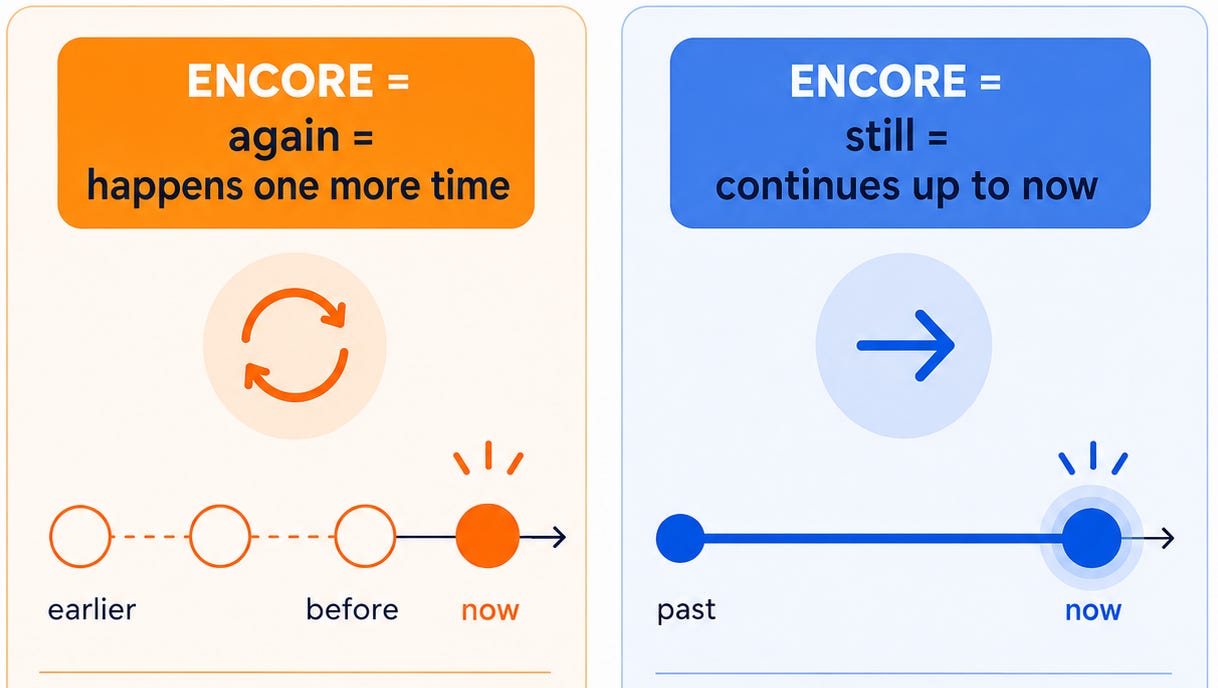
Again or Still ?
When encore is used with a verb, you can’t always translate it automatically.
It can describe:
the same activity continuing → still
the activity happening one more time → again
Take
il travaille encore
Without any context, I can’t tell you exactly what it means. Maybe he started working earlier and hasn’t stopped:
He is still working.
Or maybe he stopped, and now he has started again:
He is working again.
The context tells you which one makes sense.
So far, we’ve been talking about actions / verbs. But we can also use encore with things / nouns.
We’re having a coffee chez moi and I ask: Encore du café ?
This time, encore isn’t again or still. It means more. You already had some coffee, and I’m offering you an additional quantity of it.
Since we’re talking about more of something, we use du / de la / de l’:
The structure you’ll see: encore + du / de la / de l’ + noun
Encore du café ? More coffee?
Tu veux encore du pain ? Do you want more bread?
We use du / de la / de l’, barbarically known as partitive articles, with things like café / coffee, pain / bread, riz / rice, farine / flour, eau / water … basically things we think of as an amount rather than one individual item. Or, to use another slightly barbaric grammar term, uncountable nouns.
And there’s another sentence you’ll hear all the time:
J’en veux encore. I want more.
English can simply say I want more. In French, we still need something to stand in for the thing we want more of, and that’s where en comes in:
Tu veux encore du café ?
Oui, j’en veux encore.
If you want to understand exactly how en works, I wrote a full lesson about it here.
Now what if i ask you Encore un café ? instead of Encore du café ?
The first one means : More coffee? The second: Another coffee?
English changes from more to another. French, once again, keeps encore. What changes is the article.
Instead of du / de la / de l’, we use un / une because we’re adding one new item:
encore + un / une + noun
Encore un café ? Another coffee?
J’ai encore une question. I have one more question
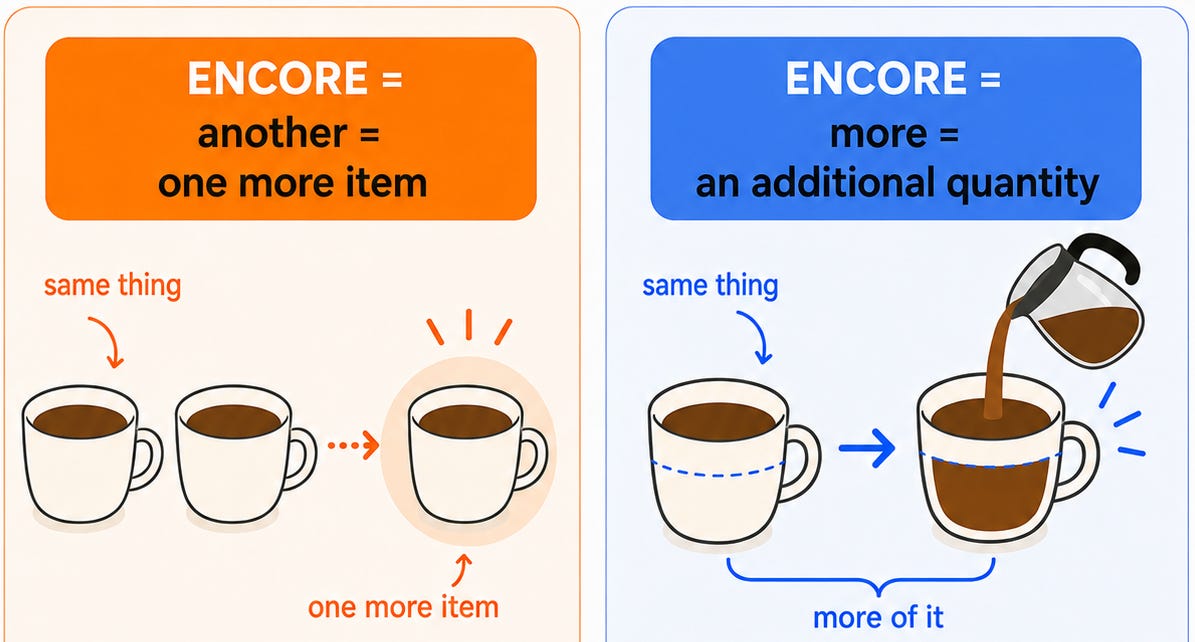
More or Another?
When encore is used with a noun, encore itself doesn’t change. It’s the article that tells us whether we’re adding a quantity or a new item.
Encore du café ? More coffee? → an additional quantity
Encore un café ? Another coffee? → one additional item
So encore hasn’t change at all. The little word after it has. Not sure it’s easier though!
And this is the last use: add pas to encore, and you get pas encore: not yet.
Here, we’re talking about something that hasn’t happened up to now, but could happen later.
For example:
Il n’est pas encore là. He isn’t here yet.
Je n’ai pas encore mangé. I haven’t eaten yet.
Elle n’a pas encore répondu. She hasn’t replied yet.
Tu as fini? Pas encore ! Have you finished? Not yet!
If you like seeing the structure, it looks like this:
(ne) + verb + pas encore
(ne) + auxiliary + pas encore + past participle
One small pronunciation detail: you may hear a liaison between pas and encore, with a z sound: pa-z-encore. You can make it, but you don’t have to.
Still or Yet ?
There’s a nice connection here with the still we saw earlier.
Compare:
Il dort encore. He’s still sleeping.
Il (ne) dort pas encore. He isn’t sleeping yet.
English changes from still to yet. French keeps encore and adds pas.
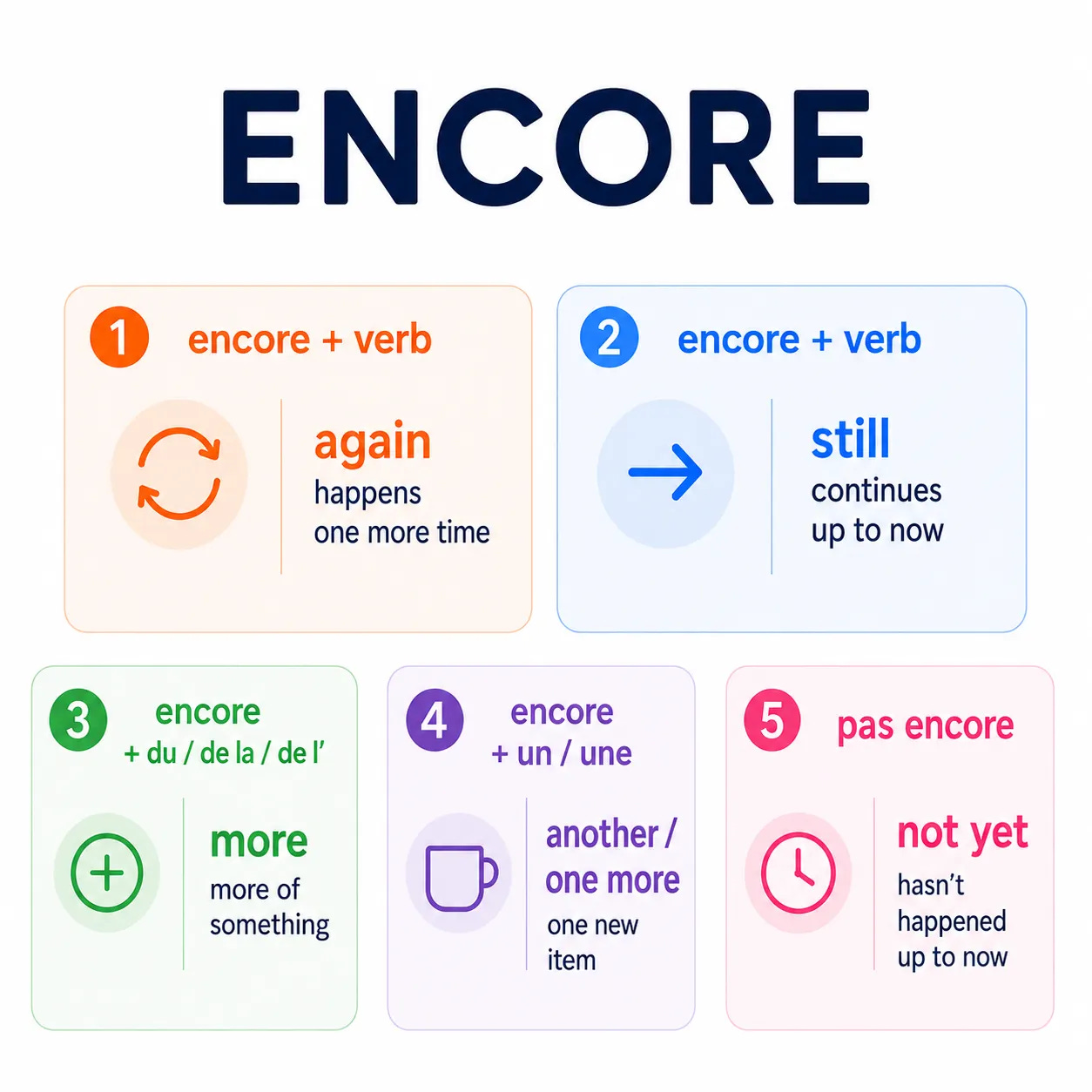
One last thing before I leave you.
You may have noticed that encore moves around depending on what’s attached to:
with a noun, it comes before it.
With a verb, it usually after the verb, or between the auxiliary and past participle in a compound tense.
I hope encore feels a little clearer now, and that I haven’t somehow managed to turn one small French word into an even bigger mess!
La rentrée (back-to-school) approche ici en France, les enfants retournent à l’école le 1er septembre. Pendant cette période, on a souvent en tête cette idée de devoir “reprendre les bonnes habitudes”. Je vous souhaite surtout de trouver encore un peu de temps pour ce qui vous fait du bien et vous procure de la joie.
Je vous souhaite à toutes et à tous une excellente fin de semaine.
Marie
Comments
Nothing yet. Say the first thing.
Sign in to join the conversation.