
You’re probably often hesitant when you have to use depuis, pendant, or il y a. I know all my learners stumble over this one.
The reason it’s confusing is that French doesn’t organize time the same way English does. Choosing the right word is only part of the problem. You also need to choose the right tense.
Why is it so confusing for English speakers? Well, because English often relies on the verb tense to tell you whether the action is still going on or not (I lived here for five years vs I have lived here for five years). It’s the verb that changes the meaning. French relies more on the time expression itself.
So hopefully, by the end of this article, you’ll understand the differences between depuis, pendant, and il y a. I also hope you’ll understand a bit better the difference between English and French tenses, especially what the present tense and the passé composé are actually used for.

Let’s start with depuis.
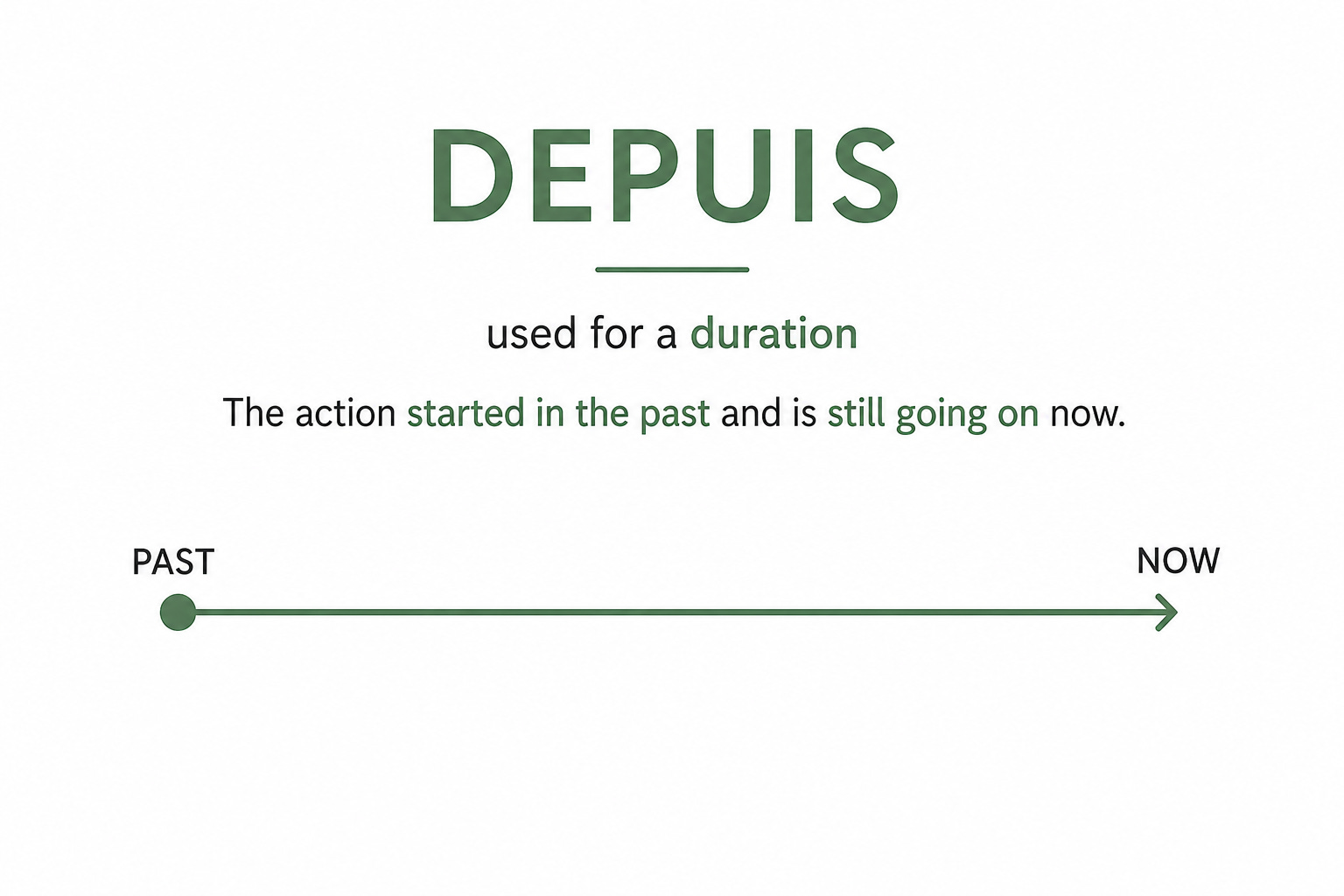
Depuis is used for a duration. The action started in the past and is still true now.
Exemples:
J’habite ici depuis cinq ans. (I have lived here for five years)
J’apprends le français depuis deux ans. (I have been learning French for two years.)
You probably noticed that I’m using the present tense in my examples, not the passé composé.
I know it can be confusing because the passé composé looks a lot like the English present perfect: I have lived vs J’ai habité.
But they are not the same tense.
This is where many learners make a mistake. Because the action is still true today, French uses the present tense, not the passé composé.
DEPUIS + PRESENT TENSE
The passé composé is only used for completed actions. If the action is still going on, the passé composé is no longer the right tense. With depuis, you have to use the present tense.
So depuis is used for a duration: an action that started in the past and is still going on.
Now, what about actions that started in the past but are now finished?
This is when we use pendant.
This time, the action is finished. It has a beginning and an end.
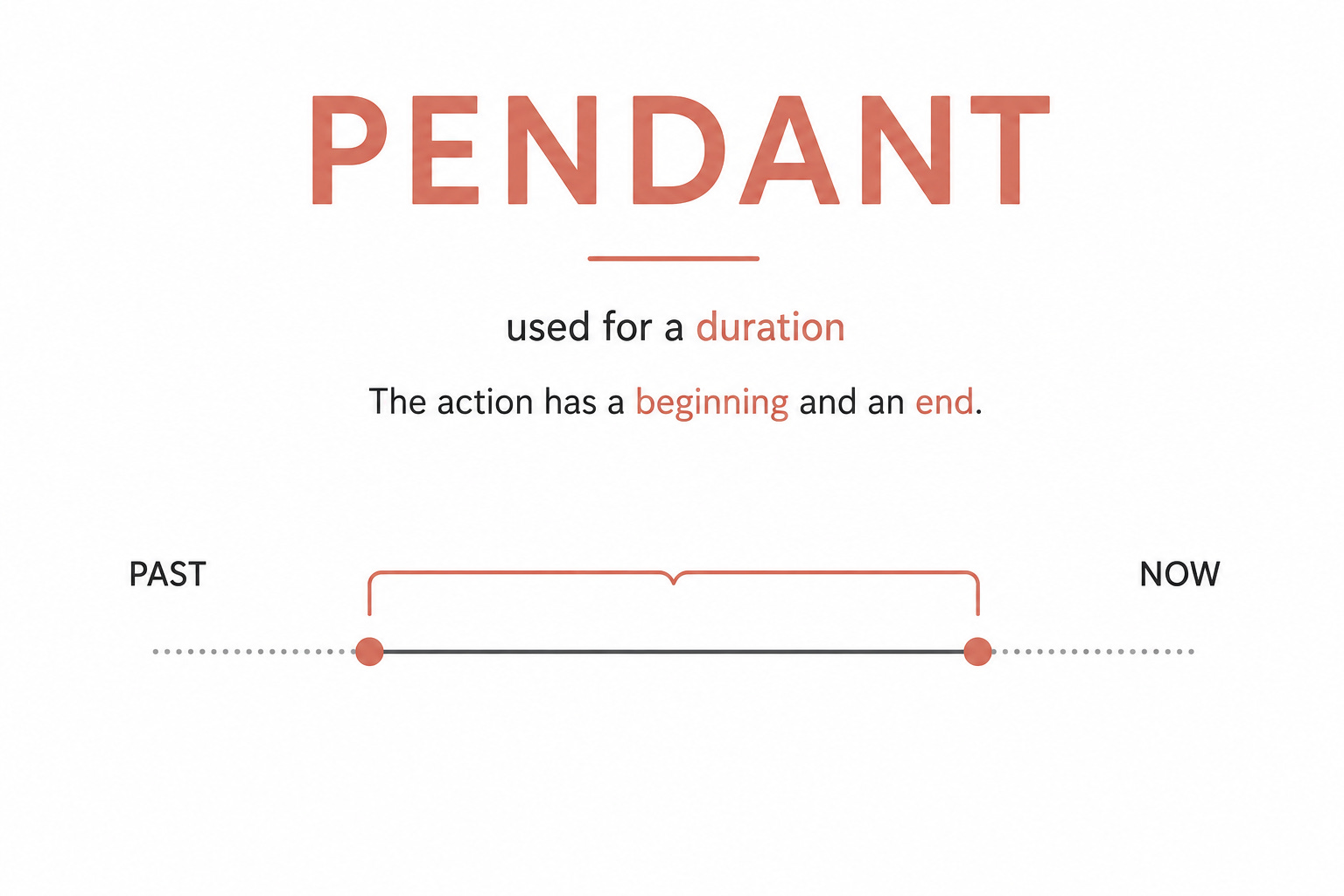
When pendant is used to talk about a completed duration in the past, you’ll use the passé composé.
Exemples:
J’ai habité ici pendant cinq ans (I lived here for five years.)
J’ai étudié pendant trois heures. (I studied for three hours.)
You can also use pendant to talk about a planned duration in the future. In that case, you’ll use the future tense.
Je serai en France pendant deux semaines. (I will be in France for two weeks.)
PENDANT + PASSÉ COMPOSÉ / FUTURE
For completed durations in the past, use the passé composé.
For planned durations in the future, use the future tense.
So, both depuis and pendant are used for durations:
Depuis started in the past and is still going on,
Pendant has a beginning and an end.
Il y a is not used for durations. It’s used for a point in the past, just like ago in English.
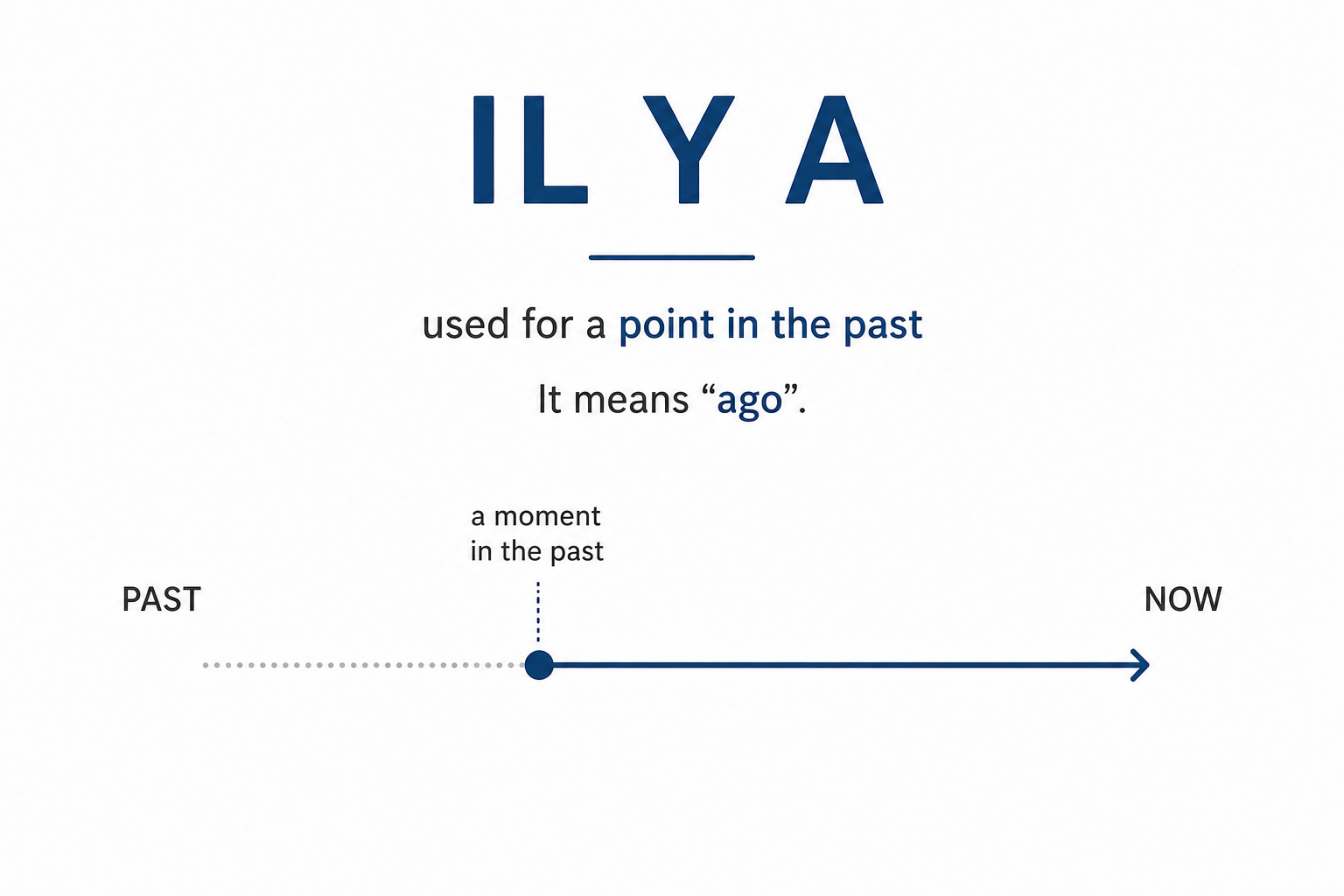
For that reason, il y a doesn’t usually create much confusion because it’s very similar to English.
Exemples:
Je suis arrivé il y a deux jours. ( I arrived two days ago)
Il est parti il y a une heure. (He left an hour ago.)
There’s another time expression, “ça fait”, which is very common in spoken French and is quite close to it’s been... in English. I’ll dedicate a whole article to that one because otherwise, I think it would be too much to cover here
Now let’s use exactly the same situation. Imagine I moved to Paris five years ago.
J’habite à Paris depuis cinq ans. (I’m still there.)
The action started five years ago and is still true today.J’ai habité à Paris pendant cinq ans. (I don’t live there anymore.)
The action lasted five years, but it is now over.Je suis arrivée à Paris il y a cinq ans. (I arrived five years ago.)
Here, we’re not talking about a duration at all. We’re simply saying when the action happened.
So, the next time you’re hesitating between depuis, pendant, and il y a, don’t try to translate them into English.
Instead, picture the timeline.
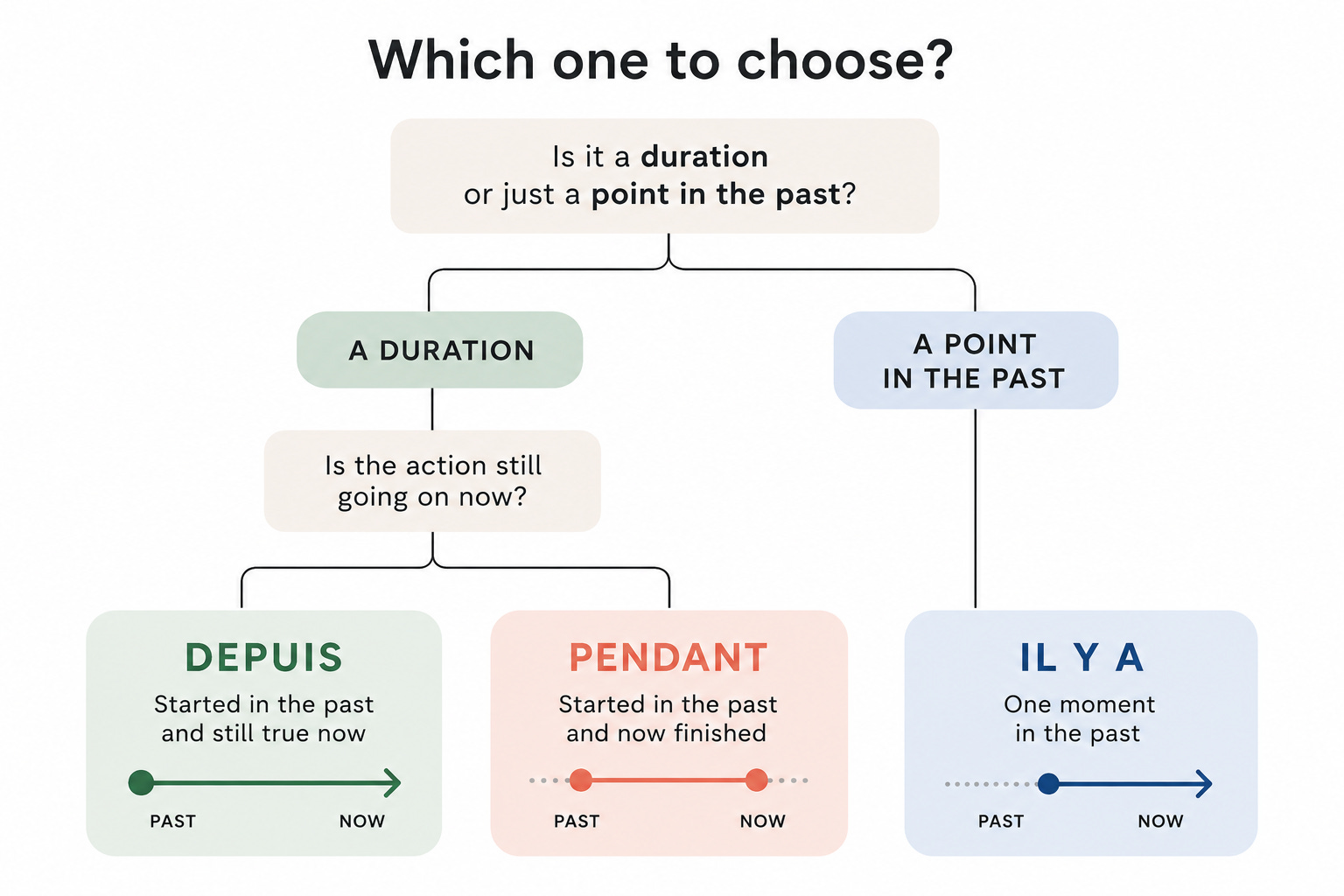
Is it a duration or one point in the past?
If it’s a duration, is the action still going on, or is it over?
Answer those two questions, and the right choice becomes much clearer.
Remember one last thing
If the action is still going on, you have to use the present tense.
The passé composé is for completed actions.
How would you translate this sentence?
I have been learning French for 15 years.
Write your answer in the comments!
P.S. Je prends quelques jours de vacances, donc la prochaine newsletter sera envoyée le 20 août.
Je vous souhaite un très bel été. À très vite !
Marie
Comments
Nothing yet. Say the first thing.
Sign in to join the conversation.