
What the heck is a bushel? I’ve been sifting through a lot of records from the early and mid 19th century looking for references to wheat and farming practices. Yields are almost always represented in bushels, just as they are today. But unless you cut your teeth on the family combine, you might not have any idea what a bushel looks like. I always assumed it was a kind of basket (hiding your light under a bushel and all that), but what size? Why are we still measuring wheat production in baskets?
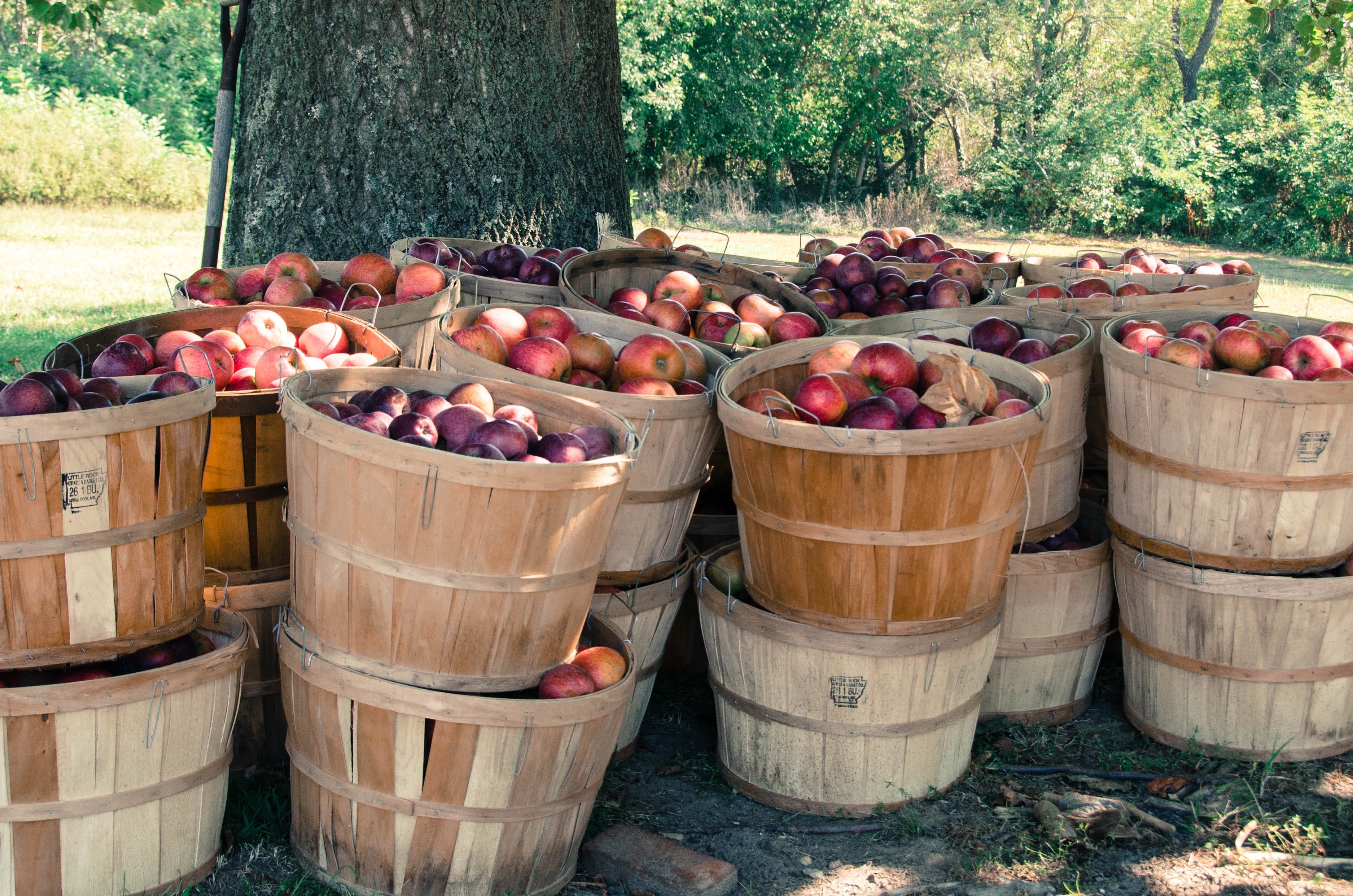
I thought bushels would be a simple thing to look up, but oh no, it’s the metric system all over again, but worse. A bushel was originally a measure of volume (a basket in fact) equivalent to about 8 gallons; now it’s usually, but not always, a standard measure of weight. How standard a measure? That’s complicated too — since different foodstuffs have different weights at the same volume, it’s specific to the product. So a bushel of wheat weighs 60 lbs; a bushel of oats only weighs 32 lbs.1 That’s in the United States, however. A UK bushel is almost 20% larger/heavier. Yup. Different countries, different bushels. It’s a wonder we can even talk.
By 1830, the Hudson’s Bay fields at Forts Vancouver, Nisqually, and Colville were yielding between 15 and 30 bushels of wheat per acre. Seed wheat was yielding 15 fold, so 1 lb of seed resulted in approximately 15 lbs of crop.2 These fields were cultivated by the people who eventually became the Frenchtown communities, meaning the French Canadian working men of the Forts and their mixed race families.
This is all very ball park, but let’s see what we can learn by rubbing these numbers together. In the 1830s, wheat was selling in Oregon for $.50-$.60 a bushel, which is the equivalent of $15-$20 a bushel in today’s dollars. In 2026, standard production wheat nets ~$5/bushel. At that price, just matching the 1830 real value of $360/acre would require yields of at least 72 bu/acre.
In other words:
Wheat yield per acre more than tripled between 1830 and 2026, but the real price per bushel collapsed by nearly three-quarters. Whoops — this means the dollar value yield per acre is actually lower in 2026 than in 1830.
Weirdly, the value of a pound of seed stays relatively constant. A pound of seed that returned 15 lbs of grain in 1830 now returns 50 lbs or more with modern farming techniques. So a 2026 bushel of wheat has lost three-quarters of its value as a commodity, but because of the radical increase in productivity, the corresponding pound of seed wheat has only lost about -4% of its value compared to its 1830 ancestor.
I couldn’t figure out a way to compare costs of production between those two scenarios, so you’re on your own for that one. I did find a video illustrating traditional oats harvest as an excellent exercise for your core muscles, however. I’ll stick that in below.
So what do we now know that I didn’t know four hours ago? Well, it hasn’t really gotten more lucrative to be a farmer (wait, I grew up on a farm, I already knew that). And wheat was a precious commodity in the 1830s, which we also already knew because of how incredibly quickly its cultivation spread between 1826 and 1850. I still don’t know why we are using bushels as a unit of measure today, except that tradition is a powerful thing, and we need a dry goods measure that expresses, however approximately, BOTH a weight and a volume — even if you have to do math in your head to use it.
But in real life, actual weight varies according to moisture content and other factors… so a bushel of oats weighs 32 lbs except when it doesn’t. Right.
Gibson, James R.. Farming the Frontier : The Agricultural Opening of the Oregon Country, 1786-1846. Vancouver : University of British Columbia Press, 1985. p 38.
No posts
Comments
Nothing yet. Say the first thing.
Sign in to join the conversation.