
A reminder to friends in the area — we’ll be holding a Frenchtown happy hour on August 12 at Reininger Winery from 3-5 pm, address 5858 Old Highway 12, Walla Walla, WA. This is a no-host gathering for Frenchtown friends to hang out and talk about history, and maybe look at a map or two. We hope you’ll join us, in part because Reininger is doing good things for our community — check out their fundraiser for Spokane fire relief.
Second reminder — make sure your calendar has the correct date for Rendezvous! We’ve heard from some organized folk who wrote the date down the very first time we talked about it, and then didn’t notice when it changed. So check your calendars, folks, Rendezvous is Saturday, September 26, 2026, from 12-4 pm, with free food from 1-3 pm, including delicious corn on the cob. There’s going to be a presentation about Frenchtown and the Baker railroad, a beading demonstration, a kid scavenger hunt, a teepee project, and history displays, and other goodies, oh my!
We asked and you answered — we’ve received donations of both tools and money for our new toolbox. Thank you to John from Union and Carolyn from Walla Walla! You make a difference with your support and with your friendship.
This newsletter frequently invites people to come visit the Frenchtown Historic Site in the Walla Walla valley, because that’s the center of our interpretive presence, and a place where we can come together in community in the present when we talk about the past. But Frenchtown Walla Walla was only one of several such points across the Pacific Northwest. In fact, the closer you look the more obvious it becomes that Frenchtown was as much a space as it was a place.
What does that mean? What makes “Frenchtown”? In the absence of an American term for Métis, if we define Frenchtown as a particular kind of kin community, a third space between Fort and Tribe, then it becomes possible to imagine “Frenchtown” as an identity-space independent of any one single location. The defining trait of these communities was their role as a material, cultural, and linguistic conduit between the Tribes and the Fort. The Fort system relied on the mixed families’ ability to act as interpretors. The families relied on the maternal kin network to increase their political and material value to the Fort system. The maternal kin network leveraged the connection to gain trade advantage over other families or tribes. In all of these exchanges, knowledge was as important as labor, or any material good.
Knowledge is a two-way street, however. We haven’t spent enough time looking at what the Indigenous partners took away from these early exchanges in the form of knowledge (as opposed to genocidal epidemics). Specifically, I think we need to look at labor.
That’s a teaser, because I’m not going to make you read a twenty-page epic about the labor practices of the fur trade in one sitting. But I want you to consider something. Indigenous labor is implicated in every single action of the system. It’s quietly in the background of every kind of activity. The voyageurs and the kanakas did immense work, sure. But their wives processed the furs and prepared food, and almost certainly helped with the portages. Their wives were partners in the interpretation. And when the activities of the Forts shifted towards agriculture, their wives (and sons and daughters and brothers-in-law, etc.) were right there.
Learning through doing is at the core of any system of apprenticeship. But lots of apprenticeships take place in the world without the official name, and in fact there are official and unofficial systems in place to gate-keep whether experiential knowledge will be recognized (and therefore valued) or not recognized (and therefore dismissed, to avoid any obligation of remuneration).
When Francis Heron was first in charge at Fort Colvile 1829-18311, he kept a day book of the activities of the fort, including who was employed at what task. Unlike many of the Chief Traders, however, Heron specifically listed the employment of “the women of the Fort”.
Aug 30th [1830] : Men and Women with the exception of four men, keep at gathering and carting home the wheat. We have large stacks made of it, one of 1500 and the other 1700 sheaves. […]
Sept 1 Four men have been employed at threshing pease and the rest, with the women, ocupied at gathering and carting home the wheat. […]
Oct 11 Four men with all the women of the place have been occupied at taking up the potatoes. One hunderd and ninety three kegs brought home. Two men employed at sawing planks for making a thrashing floor.
12 The same employment… the potatoes are so plentiful that we had to get Indian women to help us at the gathering of them, for which duty they receive each a milk turn full at night. Today 249 kegs were added to the shed.2
Heron is effectively describing a Frenchtown space. “All the women of the place” refers to the women connected to the fort through their husbands and fathers. Here, they are working the wheat and potato harvest alongside the men. Additional women were brought in as needed, and these women were paid… in seed. Maybe Heron thought he was paying them in food, but any woman working that harvest knew darn well that those small grains, those little potatoes, could be planted as well as eaten. She walked away that day not just with seed in her pocket, but also new knowledge of Euro-American agricultural practices in her head.
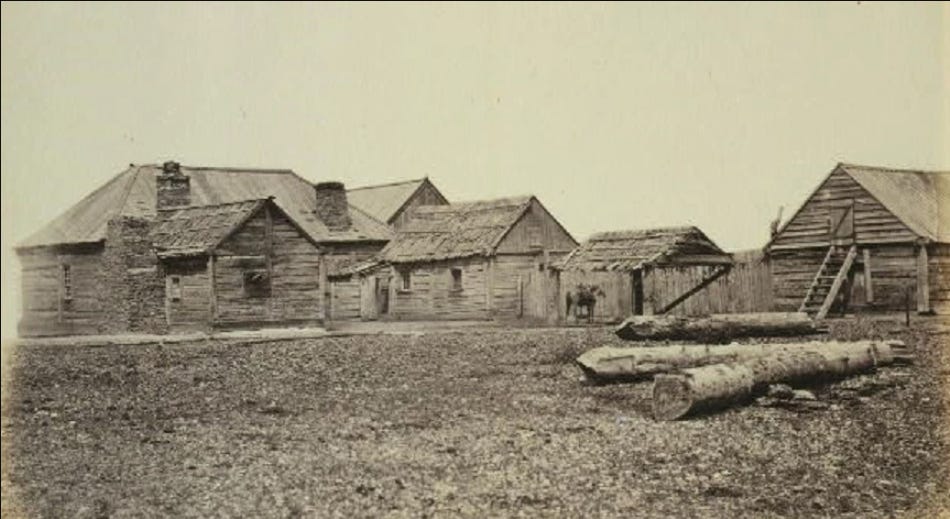
© Sarah Hurlburt on behalf of Frenchtown Historical Foundation.
“Francis Heron … was an Irishman, who entered the employ of the Hudson's Bay Company about 1810 as a clerk. His name appears as Nos. 180, 115 and 118 respectively in the list of employees of the Hudson's Bay Company, in America for the years 1821-1824. He was promoted to Chief trader in 1828, and was assigned to and stationed at Fort Colville, in 1830. The Minutes of Council for 1830 show that he applied for transfer of furlough for 1831, and that the application was referred to Dr. McLaughlin, Chief Factor of the Columbia District. It was evidently denied. … He left Fort Colville in 1833 for Fort Vancouver and later for Nisqually, where he succeeded Archibald McDonald, on June 27, 1833. At Fort Nisqually, it appears that he took an interest in the welfare of the Indians and endeavored to instruct them in the Christian religion. It further oppears that during this time Mr. Heron became a victim to strong drink, frequently keeping to his own room in solitary drinking.” See Lewis, William S., “Francis Heron, Fur Trader: Other Herons” The Washington Historical Quarterly, Vol. 11, No. 1 (Jan., 1920), pp. 29-34.
No posts
Comments
Nothing yet. Say the first thing.
Sign in to join the conversation.