
Editor’s Note: Energy Bulletin co-founder Roger Conrad and I recently held a Roundtable to discuss recent headlines regarding the US-Iran memorandum of understanding, and a (partial) reopening of the Strait of Hormuz.
Today’s EB update represents a transcript of the first part of that discussion with more to follow in coming days. I made some slight edits to inventory and production figures in the text to reflect the release of more statistics from EIA this week.
—EG
Roundtable Question #1: How has Operation Epic Fury and its aftermath changed the outlook for the stocks you cover?
EG: For the producers, and shale exploration and production (E&P) companies, commodity price direction is key to stock performance. These companies are, after all, in the business of producing and selling oil, natural gas and natural gas liquids (NGLs).
So let me frame what’s happening in the global oil market.
The bear case for oil heading into 2026 rested on a “super glut” early in the year as OPEC continued to boost output and return barrels to the market, winding down voluntary supply reductions. While OECD inventories – inventories in the developed world – looked close to normal heading into this year, there was concern about significant floating storage, mainly in the form of sanctioned tankers of Russian and Iranian crude ultimately destined for China.
We were never believers in the super glut narrative and argued much of this increased OPEC production was simply paper barrels – from September of 2025 into the first quarter of 2026, actual OPEC production lagged far behind official quotas.
Regardless, the bear case for oil heading into 2026 has now been shattered. According to the International Energy Agency (IEA), global observed inventories declined by an unprecedented 4.6 million bbl/day in May, up from a 2.5 million bbl/day decline in April. IEA’s latest estimates show a total decline in global inventories of 3.8 million bbl/day since the conflict started with 2.4 million bbl/day in declines from crude oil and 1.4 million bbl/day for refined products like gasoline, diesel and jet fuel.
The US is the world’s largest and most visible oil market:
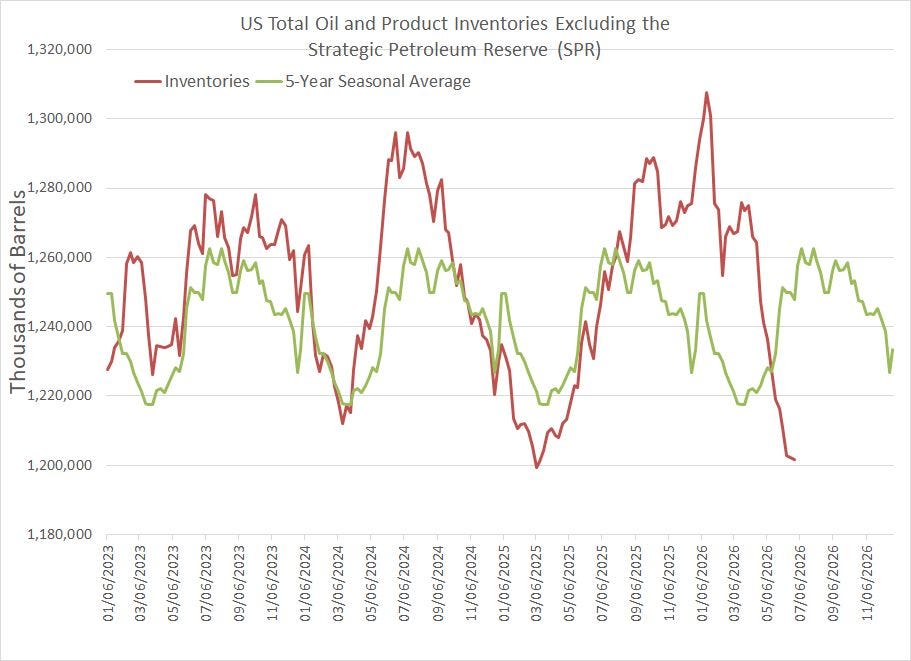
Source: Energy Information Administration
This chart shows total US inventories of crude oil and refined products excluding the Strategic Petroleum Reserve (SPR) since January 2023 plotted against the 5-year seasonal average, which I’ve extended through yearend to show the normal seasonal trend.
Typically, total inventories rise into the summer months as refiners seek to get ahead of peak demand summer driving season. This year, inventories have plummeted to near multi-year lows right as the US enters the peak of summer driving season. And that’s despite large releases from the US Strategic Petroleum Reserve (SPR).
Even if the Strait of Hormuz reopens completely to commercial traffic – a prospect that still looks shaky to say the least – it would take time for oil to be transported to markets and for the counter seasonal draw on US inventories to subside. In short, even in the most optimistic case, the US market looks increasingly tight.
That’s particularly true when you consider that US refining crack spreads – basically the profit margin for refiners – remain elevated, an indication of robust demand.
And then, of course, there’s the US Strategic Petroleum Reserve (SPR), which contained 325.655 million barrels as of June 26, 2026, down from a year-to-date peak of 415.442 million barrels on March 20, 2026. That’s a draw of roughly 89.8 million barrels over just 14 weeks or a little under 1 million bbl/day. In the most recent two-week period – through the week ended June 25th – the US withdrew almost 14.6 million barrels, a rate of a little over 1 million barrels per day.
The last time we saw the SPR under 330 million barrels was 1983.
A few factors have forestalled a much larger rise in oil prices in recent months.
First, US SPR releases and IEA-coordinated releases of similar strategic reserves from across the developed world, including Europe and Japan.
The problem is that the US SPR, alongside similar reserves in other countries, are already below comfortable levels and will ultimately need to be refilled. So, extra supply now to alleviate the Middle Eastern shock also means more demand later from governments seeking to refill their reserves.
Second, we are seeing demand destruction, particularly in Asia and Europe, while the US remains insulated from the worst of the supply shocks.
IEA estimates Chinese crude oil imports plummeted 40%, or about 4.6 million bbl/day, between February and May this year. China has been taking advantage of cheap oil prices since 2023 to build both its strategic petroleum reserve and (unofficially) mandate that refiners build commercial inventories as well. As a result, heading into the conflict, the country had the world’s largest combined state and commercial inventories of crude.
So that offered a supply cushion, and China has been drawing down its commercial inventories since the conflict began while leaving the state-controlled SPR largely intact.
However, China has also slashed refinery run rates by record amounts, meaning that it’s simply turning less oil into products like gasoline, petrochemicals and diesel. The government has curbed exports of refined products to neighboring Asian nations to offset some of that, but it’s also hitting the Chinese economy hard, impacting domestic travel, consumer spending as well as Chinese manufacturing which relies on both petrochemical inputs and diesel for transportation and logistics.
China will eventually need to release some of its strategic petroleum reserve to loosen the chokehold on the domestic economy or step up imports as the Strait of Hormuz reopens. The former path – depleting domestic inventories – would imply increased demand in future as the government seeks to refill those stocks. The latter, of course, would imply a surge in Chinese imports and further draws on global demand.
As we’ve said in the past, the global oil market is ultimately about supply and demand, balanced by price. High oil prices discourage demand and encourage supply; the opposite is true of low prices.
This year’s supply shock caused a spike in oil prices. Governments softened the blow by releasing strategic reserves; however, there has been a decline in demand, largely outside the US, due to rising prices and, in China’s case, government mandates -- basically forced demand destruction.
The problem with both of those levers is that they’re temporary. As soon as the Chinese and global economy recover, demand bounces back, and China can’t keep imports this low for much longer without devastating impacts on its domestic economy.
My view has been that there will need to be a more meaningful supply response, and that’s going to mean higher prices to incentive the needed capital spending. There has been no significant US production response. Per EIA’s more reliable monthly data, US oil production stood at 13.93 million bbl/day in April 2026, up less than 70,000 bbl/day from 13.864 million in October of last year. The latest weekly data, for June 26, 2026 shows production at just over 13.8 million bbl /day.
According to Baker Hughes, the US oil-directed rig count today stands at 440 rigs, which is up only 8 rigs from 432 active rigs a year ago. This is in keeping with what we heard from the producers when they reported their Q1 numbers a few weeks ago, a topic I covered at length in my May 10, 2026 Sunday Deep Dive video “The $95 Oil Question: Why US Shale Isn’t Blasting Off.”
Simply put, the US majors with extensive shale operations like Exxon Mobil (XOM) and Chevron (CVX) announced no changes to their shale development plans in response to the recent spike in oil prices. Some large independents like Diamondback Energy (FANG) essentially pulled forward some well completion activity into Q1/Q2 2026 to take advantage of higher oil prices without pushing full year capital spending (CAPEX) above their previous guidance range.
Per Halliburton (HAL) we are seeing an increase in activity from smaller, private operators; however, thanks to rapid industry consolidation, this cohort is much smaller than it was 2 or 3 years ago. So, any production uplift would be small and short-lived.
Finally, we still have no idea of the extent of the hit to Middle Eastern infrastructure. Heading into the conflict, OPEC had little real spare capacity and even with UAE now outside the cartel, and assuming Saudi adds barrels as the Strait reopens, that’s not enough supply to offset the 1+ billion barrels already lost due to the conflict.
There’s also a psychological impact – from an energy security standpoint, I continue to expect importers to be less willing to rely solely on Middle Eastern volumes. I expect we’ll see more countries seek to diversify their supply.
Ultimately, I am looking for oil prices to stabilize around $80/bbl in coming months and at those prices, there’s significant upside for the stocks we cover and recommend in the model portfolio.
To celebrate the July 4th weekend and make sure you don’t miss the upcoming parts of this deep-dive Roundtable series, we are extending our 30-Day Free Trial Offer through the holiday weekend!
Get full access to our complete model portfolios, alerts, and upcoming exclusive updates completely free for 30-days.
Tap Here for a 30-day Free Trial
RC: The outlook is more bullish than ever. There was a very compelling case for buying North American midstream well before Epic Fury. The spike in oil prices to well over $100 this spring convinced some to overpay for certain midstream stocks, particularly C-Corps. And I’m not at all surprised some of those gains have evaporated, following the announcement of an agreement to end the fighting in the Persian Gulf.
Hopefully the Strait of Hormuz becomes a reliable waterway again for shipping oil and gas. Shutting in 15 percent of global exports has been a serious economic blow to many countries. And that’s not good for anyone at the end of the day, in a world that depends on global trade.
But whatever happens in the Middle East now, Operation Epic Fury has turbo-charged the long-term case for buying North American midstream stocks. And that includes the C-Corps, which still trade at ridiculous premiums to MLPs that have better growth prospects.
Elliott highlighted three major long-term outcomes from the Persian Gulf conflict in our May 13th update “Energy’s Hidden Correlations.” Even if you’ve already read and digested that piece, it’s worth checking out again.
So far as North American midstream is concerned, their impact boils down to this. Oil and gas producers and global importers are ramping up their focus on sources of energy that are outside the Middle East. And this is happening at the same time electricity producers are boosting natural gas power generation on an unprecedented scale, to meet demand from artificial intelligence-enabled data centers.
I’m skeptical all 252 gigawatts of new gas generation that people are talking about will eventually get built. Less than 20 percent is actually in the construction phase. And major turbine manufacturers like GE Vernova (NYSE: GEV) say they’re fully booked into the next decade.
But gas is already at 43 percent or so of the US power mix. And the CEO of Kinder Morgan Inc (NYSE: KMI)—the biggest US gas pipeline company—forecast a month ago that LNG exports combined with electricity demand growth will boost US natural gas usage 26 billion cubic feet per day by 2030.
Total demand now is just 115 BCF per day. So that’s a combined 22.6 percent increase in less than five years from what’s already a big number. And getting that additional supply to market means a once-a-generation opportunity to build contracted pipelines, storage systems, gathering pipes, frac water recycling, processing facilities and compression systems—basically a lot of new midstream infrastructure.
Some of that incremental demand will be accommodated by existing pipelines and systems. But there’s only so much room for it at this point.
Kinder, for example, says its US-wide system utilization has risen from 70 to 75 percent a decade ago to over 90 percent now. And capacity utilization in particularly active regions like the Permian Basin is now estimated in the 95 to 100 percent range.
Higher utilization rates are the direct result of a decade plus of conservative midstream sector CAPEX. And shale discipline is still very much in force: Self-funding most or all of expansion projects remains the rule. And companies will lock up most or all capacity under long-term contracts before making final investment decisions.
It’s no exaggeration to say North American midstream companies will have an unprecedented opportunity to build capacity and lock in margins with long-term contracts the next 3 to 5 years. And that will power cash flow growth, dividends and share prices higher.
Investment would probably slow if oil prices crashed under $60 a barrel and stayed there for a while. But this is not the North American midstream industry of 2024-15. As with the shale producers that matter, there’s been tremendous consolidation, along with a focus on cutting debt and costs.
Like with the producers, it’s not just about how much oil, natural gas and NGLs a midstream company can bring to market. That’s certainly part of it. But only insofar as it affects the profitability of each barrel or billion BTU you bring to market.
The primary players in the Permian Basin now, for example, aren’t wildcatters and single pipeline systems. They’re major companies like ExxonMobil (NYSE: XOM) and Kinder Morgan. And that means decisions based on cash flow and margins, and as part of long-term planning. And they have the deep pockets to honor contracts for projects that may take several years to pay off.
Contrast that to back in 2013, 2014, when there were over a hundred US midstream companies basically begging for business from anyone. That world was extremely vulnerable to a sharp drop in oil and gas prices. The shale sector now really isn’t. And that means there’s no 2015-style meltdown ahead for North American midstream companies, even if oil and gas prices do come lower near-term.
So, to sum up, I think the aftermath of Operation Epic Fury has greatly increased what was already compelling long-term upside for our midstream favorites. And the knee-jerk selling because of apparent de-escalation in the Persian Gulf means many of the biggest potential winners are coming back on the bargain counter again.
Here’s a look at the Energy Bulletin Top 10 and the Free Market Speculator portfolios updated through the close on Wednesday July 1st:
Comments
Nothing yet. Say the first thing.
Sign in to join the conversation.