
“You cannot think your way out of what emotion got you into.”
A number landed this summer, and I haven’t been able to put it down.
In June, JAMA Pediatrics published a study run by the RAND Corporation. They asked just over a thousand young people, aged twelve to twenty-one, one simple question: do you use an AI chatbot for mental health advice?
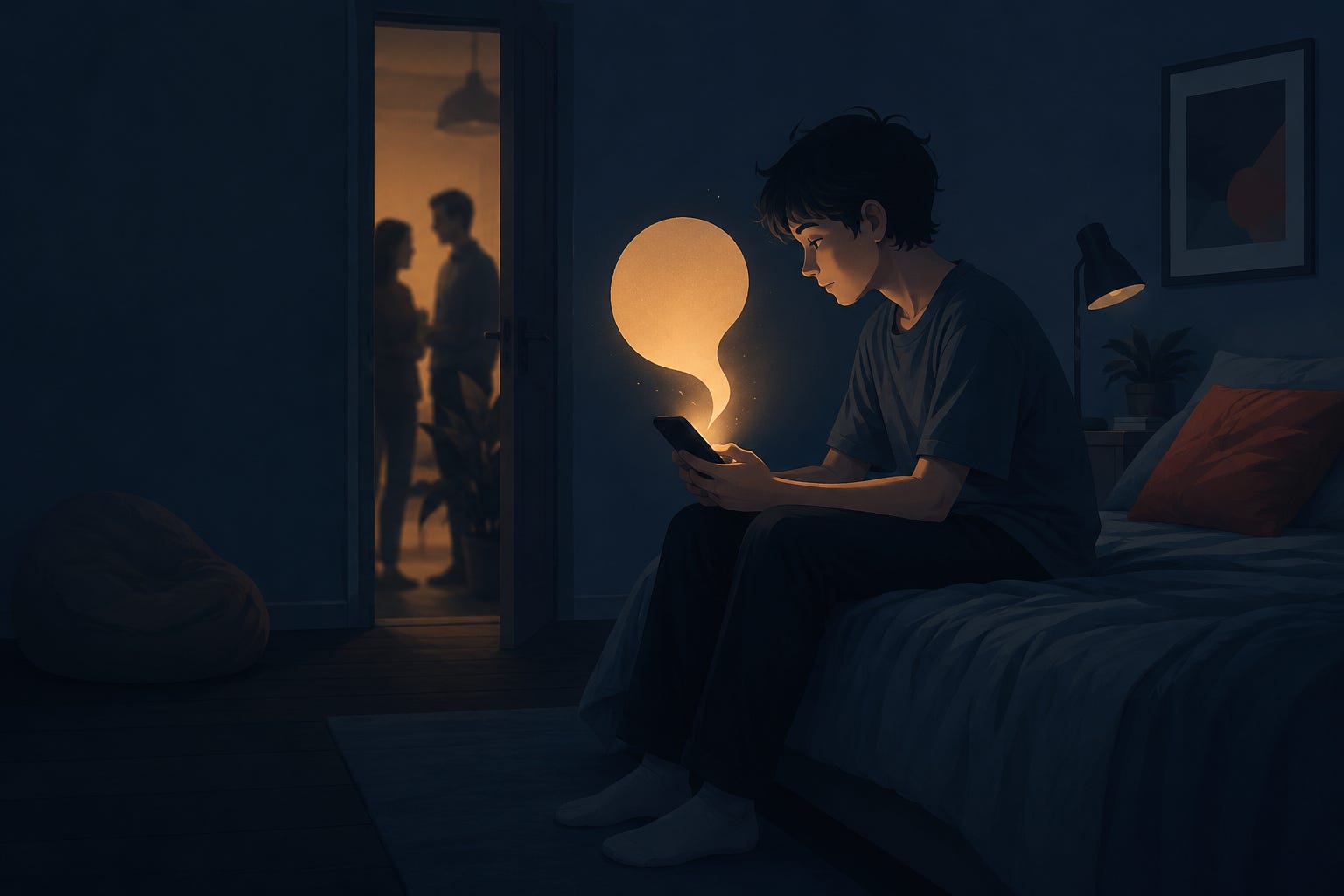
19.2% said yes. Nationwide, that’s around 8.2 million young people. A year earlier, it was 13.1 per cent, so it has leapt by more than 40 per cent in 12 months! 92% said the advice was somewhat or very helpful. And then there’s the line I keep coming back to: 63% had told nobody they were doing it.
Not a parent. Not a friend. Not a teacher. Nobody.
Now, the conversation that followed was entirely predictable, wasn’t it? Is it safe? Is it regulated? Should a machine be doing this at all? All fair questions, and I’m not going to pretend I have the answers to them.
But we are all staring at the wrong end of this story.
Why did 8.2 million young people choose to be heard by something that cannot listen?
Because it never flinches. That’s the plain and simple truth of the matter.
You see, when you tell another human being the thing you are most ashamed of, something happens on their face. A flicker. A half-second where the eyebrows move before they’ve decided what to feel. And you clock it — below conscious, faster than thought — and something in you files it away as evidence. There. I knew it. I’m too much.
The machine doesn’t flicker. No face to read, no silence to interpret, no worry that you’ve just handed someone a weight they’ll carry home to their own kitchen. It’s three in the morning, it is endlessly patient, and it will never, ever tell your mother!
So no; this isn’t a story about technology at all. It’s a story about how unsafe it has come to feel to be witnessed by another person — and that, I’m afraid, is on all of us. Not on them.
But here’s where I have to be straight with you, because it’s the whole reason I’m writing to you this week.
Even the perfect listener wouldn’t fix it.
Humour me!
Bring to mind someone you find difficult. Not a monster — just someone whose name arriving in your inbox makes your shoulders climb a little. Picture them standing about an arm’s length in front of you.
Now… did you decide to feel that?
Of course you didn’t! It arrived before you’d finished reading the sentence. No debate, no weighing up, no words — something out in front of you recognised something, and your body had answered before your conscious mind was even invited to the meeting.
Hold on to that feeling for a moment. It is the whole argument.
The thing that drives the symptom was never made of words.
Somewhere in your history, and it may be a moment so small that nobody would ever dream of calling it trauma, your system took a snapshot. A face, a tone, a room, a split second of this is dangerous. I call it an Emotional Memory Image; an EMI. It sits below conscious, outside of language, out in the space in front of you, and it has one job: to predict. Faster than thought, it scans what’s coming for anything resembling that original moment, and it fires the protection before you have had a chance to hold an opinion about it.
That is not a fault. That is your Unconscious Mind doing precisely what it was built to do, keeping you alive. It is, and always has been, on your side.
But you cannot talk it out of the room. Why not? Because it isn’t in the room where the talking happens.
Think of it like this. You can describe a house to me in perfect detail - every door, every window, the crack in the plaster on the landing. You can describe it for years. Beautifully. Accurately. Therapeutically. And not one word of that description will move a single brick.
Understanding is not interruption. It never has been.
Remember Dorothy? She walked all that way, through all of it, to stand in front of a booming voice and ask to be sent home, and the voice turned out to be an anxious little man behind a curtain with a microphone. Here’s the bit we always forget, though: the conversation didn’t get her home. It was never going to. What got her home had been on her feet the entire time.
I want to tell you about a young woman I’ll call Ellie. Details changed, of course, as they always are here.
Ellie was nineteen, and she could not walk into a lecture theatre. Not wouldn’t - couldn’t. Chest tight, throat closing, feet simply refusing at the door.
She had been talking to a chatbot every night for four months, and I’ll say this plainly: it had done a decent job! She arrived knowing more about her own nervous system than most adults I meet. She could explain anticipatory anxiety, safety behaviours, avoidance cycles. She’d been given breathing exercises, grounding techniques, and a lovely, gentle reframing of self-compassion. She had read all of it. She had understood all of it.
“So why,” she asked me, and I could hear exactly what it cost her to ask, “why do I know precisely what’s happening and still can’t get through the door?”
Because knowing is a conscious act, and the door was being closed by something that had never learned to read.
When we went looking, and we didn’t go looking with words, what we found was a split second. She was seven. A supply teacher, a wrong answer, thirty faces turning at once, and one sound: a single laugh. Half a second, perhaps less. Ellie had no conscious memory of it whatsoever. She would have told you her childhood was fine, and she’d have meant every word of it.
But her body had been walking into that classroom every single day for twelve years.
So, we interrupted the image. Not discussed it - interrupted it. She went to her lecture the following Tuesday and rang me afterwards to tell me the strangest thing had happened: nothing. Nothing had happened! She had simply walked in and sat down, like a person walking into a room.
Cheer up, I’m not here to take anybody’s machine away!
If a young person is at their lowest at two in the morning and something answers them kindly, then I am glad something answered. Ninety-two per cent found it helpful and I believe them. That is not nothing.
But if you love someone in that sixty-three per cent, the ones who’ve told nobody, then I would gently say this. They didn’t choose the machine over you. They chose it because it was there, and it was safe, and it asked nothing back. If you can manage to be those three things without flinching, you will do more than you know.
And if the talking hasn’t worked, for them, or for you, after all these years of doing it so diligently, so honestly, in such good faith, then please hear me: that is not your failure. The fact is; you were never given the wrong effort. You were given the wrong door.
The talking cure needs something to talk to. So, what happens when the thing that has been quietly running your life all this time never spoke a single word?
Full stop.
If you’d like to stop describing the house and actually move a brick, here is where to begin.
Download MindReset - it’s on Apple and Google, and it’s free to download. Open it up and start with the Stress programme. That one costs you nothing, and it is the doorway: it begins clearing your mind’s eye, that space out in front of you where these images have been sitting and predicting all this time. For a great many people, that alone changes the temperature of an entire week. And when you’re ready to go further, the rest of the programmes are waiting for you as in-app purchases.
No talking required. That’s the whole point!
And if this landed for someone you know, the one still knocking so politely on the wrong door, do send it their way. That is how this work reaches people.
Until next Friday - carpe diem!
Matt
Sources: McBain, R.K. et al., JAMA Pediatrics, June 2026; RAND Corporation press release, June 2026 (survey of 1,009 US adolescents and young adults, fielded November 2025).
No posts
Comments
Nothing yet. Say the first thing.
Sign in to join the conversation.