

People rarely move because they suddenly discover another country.
They move because the trade-offs in their current country have changed.
Capital moves toward opportunity. People move toward freedom, security, less taxes and a better life. Increasingly, both can move together.
Remote work has separated income from location. Investment migration has turned residency into a strategic asset. Rising costs, political uncertainty, changing tax rules, and geopolitical risk have made dependence on one country feel less secure.
The most valuable benefit of global mobility is not lower taxation or easier travel.
It is optionality.
A passport gives you identity. A second residency gives you a choice.
Global migration is no longer driven solely by economic necessity.
Founders, investors, professionals, retirees, and families are relocating because they can now optimize where they live independently of where they earn.
They are searching for different combinations of:
Lower living and healthcare costs
Personal and political security
Tax efficiency
Better education and lifestyle
Business and investment opportunities
Access to stronger travel documents
Protection against single-country risk
Americans are part of this shift. In 2025, at least 180,000 U.S. citizens relocated to 15 countries tracked by The Wall Street Journal. The actual number is likely higher because the United States does not comprehensively count citizens who leave.
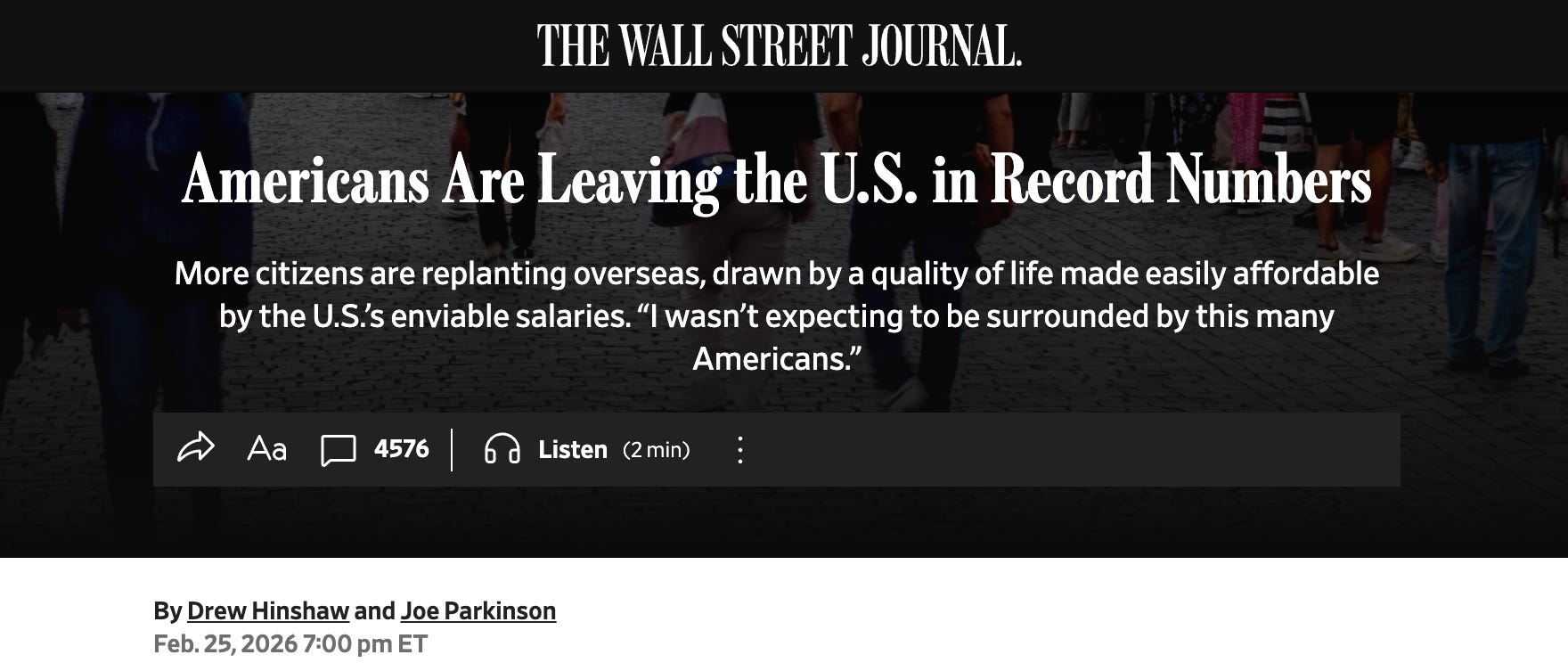
But this is not only an American story.
Europe, the Middle East, Latin America, the Caribbean, and Southeast Asia are competing for mobile people and capital. Countries are introducing founder visas, digital-nomad permits, investment residency programs, favorable company structures, and relocation incentives.
People are not merely emigrating. They are redesigning their geographical footprint.
The movement around the United States is happening in two directions.

Americans and U.S.-based families are exploring Portugal, Malta, Panama, Costa Rica, the Caribbean, the UAE, and other internationally connected jurisdictions.
Some are leaving permanently. Many are not.
They may want a second residence, an international property, another banking relationship, or the legal right to relocate if circumstances change.
The objective is not always escape. It is diversification.
However, moving abroad is more complicated than obtaining a visa. U.S. citizens generally remain subject to American tax and reporting obligations wherever they live.
Residency, taxation, business structures, banking, healthcare, succession, and property ownership must therefore be considered as one system.
The useful question is not simply, “Where should I move?”
It is, “Which combination of residency, tax position, business structure, and lifestyle gives me the greatest long-term flexibility?”
At the same time, international founders, investors, and families continue to pursue access to the United States.
They want access to American customers, capital, universities, banking, business infrastructure, and the world’s largest consumer market.
Available routes include:
EB-5 investment immigration
E-2 treaty investor visas
O-1 and EB-1 pathways
National Interest Waivers
U.S. company formation
Business acquisitions and partnerships
Direct capital deployment
This creates an interesting reversal.
Some people are moving away from America in search of lifestyle, affordability, and diversification. Others are moving toward it in search of scale, capital, and opportunity.
Global mobility is not simply an exodus or an influx. It is an exchange.
For most of history, residency and citizenship were inherited facts.
Today, they are increasingly becoming planned assets.
A second residency can provide the right to live in another country, establish a business, access education and healthcare, hold investments, or create a future pathway to citizenship.
For investors and internationally active families, that makes residency part of a wider portfolio.
You diversify assets because markets change. You diversify banking relationships because institutions fail. You diversify jurisdictions because laws, governments, and tax systems also change.
This is why investment migration is expanding beyond the ultra-wealthy. It is becoming relevant to founders, remote professionals, business owners, and families whose lives already cross borders.
Technology makes people more mobile. Regulation makes legal mobility more valuable.
That tension is likely to define the coming decade.
Probably - and it may accelerate.
Remote work is not disappearing. Businesses are becoming more international. Wealth is increasingly digital and portable. Families have access to more information about foreign residency, taxation, property, education, and healthcare than ever before.
Meanwhile, geopolitical competition is encouraging countries to attract selected forms of talent and capital.
But growing demand creates its own limits.
Popular residency programs are increasing investment thresholds, adding physical-presence requirements, restricting qualifying investments, and narrowing tax incentives. Some routes are being suspended or closed altogether.
Governments welcome mobile capital until housing pressure, domestic politics, or regulatory priorities change the equation.
The paradox is simple:
As more people seek mobility, the best mobility options may become harder to access.
A Plan B is most valuable before it becomes necessary.
When there is no immediate crisis, you can compare jurisdictions, organize documentation, structure investments, and make careful decisions.
When thousands of people suddenly want the same option, prices rise, processing times expand, and political pressure builds to close the door.
Residency rights also take time to mature. Some programs require years before permanent residence or citizenship becomes available.
Starting earlier creates more options later.
The point is not to make decisions from fear. It is to recognize that legal rights cannot always be acquired immediately—and today’s program may not exist under the same terms tomorrow.
The best time to build optionality is when you do not urgently need it.
The Freedom Business Summit 2026: USA Mobility Edition will examine both sides of this global movement on June 27–28, 2026.
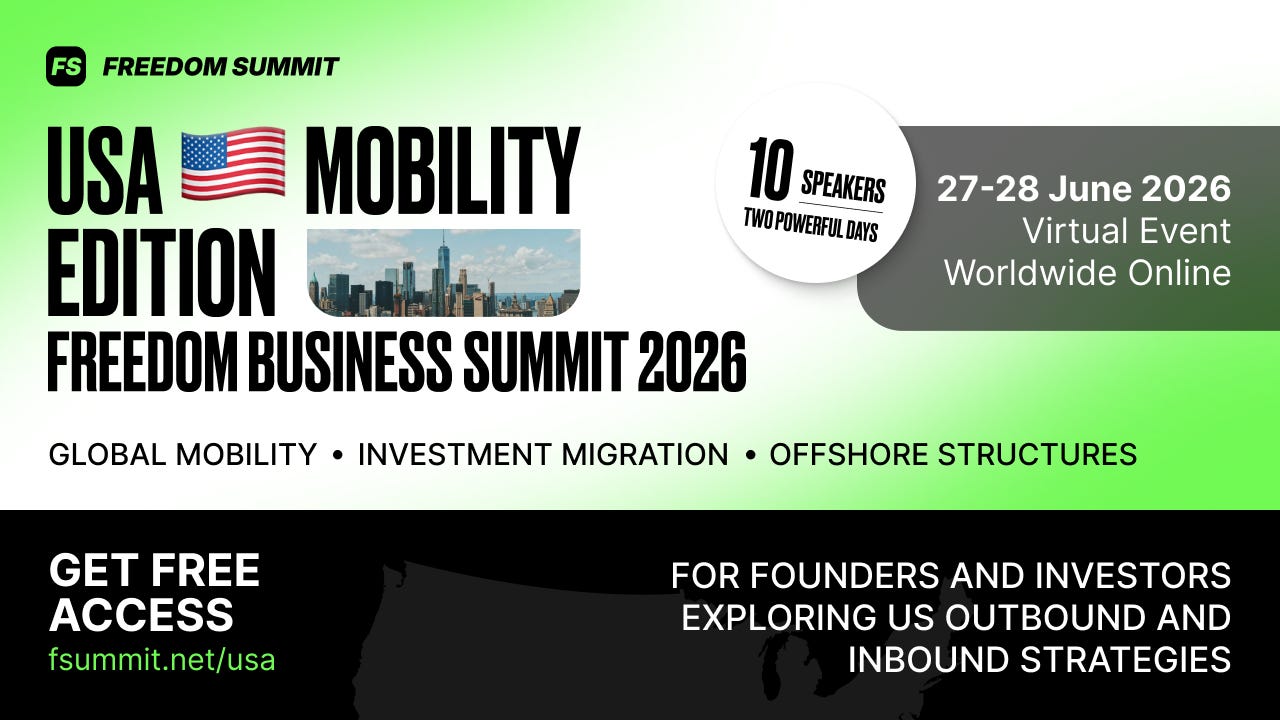
Freedom Business Summit 2026 – USA Mobility Edition is a two-day global virtual event focused on US inbound and outbound mobility strategies for founders, investors, and globally mobile individuals.
This online summit brings together entrepreneurs, high-net-worth individuals, immigration experts, and cross-border advisors to explore relocation from the United States, second residency and citizenship programs, international tax optimization, and global business structuring.
10+ expert sessions across 2 days
Actionable insights for residency, tax & relocation
Discover what’s working now in residency, tax planning and global mobility.
Saturday, June 27, from 11:00 AM EDT
Day one examines how international founders, investors, entrepreneurs, and families can enter and operate in the United States.
U.S. investor visa pathways - EB-5 project selection, investment requirements, due diligence, residency timelines, and risk assessment.
Building and operating a U.S. company - Entity selection, company formation, compliance, banking, taxation, asset protection, and international scalability.
Comparing E-2, EB-5, O-1 and National Interest Waiver routes - How the principal U.S. immigration pathways differ and which profiles they are designed to serve.
Second citizenship as strategic infrastructure - How an additional citizenship can expand travel access, improve security, and create eligibility for new investment and visa routes.
Investment immigration opportunities - How international investors can combine capital deployment, American market access, and long-term residency planning.
The U.S. investment immigration ladder - How temporary and investment-based routes may fit into a broader progression toward permanent residence.
Sunday, June 28, from 11:00 AM EDT
Day two focuses on people seeking residency, investment, tax-planning, and lifestyle opportunities beyond America.
Portugal residency and investment - The Golden Visa and D2, D7, and D8 pathways for investors, founders, remote professionals, and retirees.
Portugal after NHR - How to evaluate the country’s evolving tax environment without relying on outdated assumptions.
Malta residency and tax planning - European access, business connectivity, family relocation, retirement planning, and long-term residence.
European residency and citizenship strategy - Physical-presence rules, family eligibility, permanent residence, and potential pathways to citizenship.
The UAE as a global mobility hub - Residency, company formation, wealth structuring, and access to international markets.
Long-term relocation planning - How to coordinate immigration status, taxation, investments, healthcare, business interests, and family priorities.
Most people start by asking which country is best.
That is usually the wrong first question.
The better question is: How globally prepared am I today?
To answer it, we developed the Global Mobility Score Index - a structured assessment of your readiness to enter the United States or build an international footprint beyond it.
The assessment takes approximately three minutes and produces a personal score from 0 to 100.
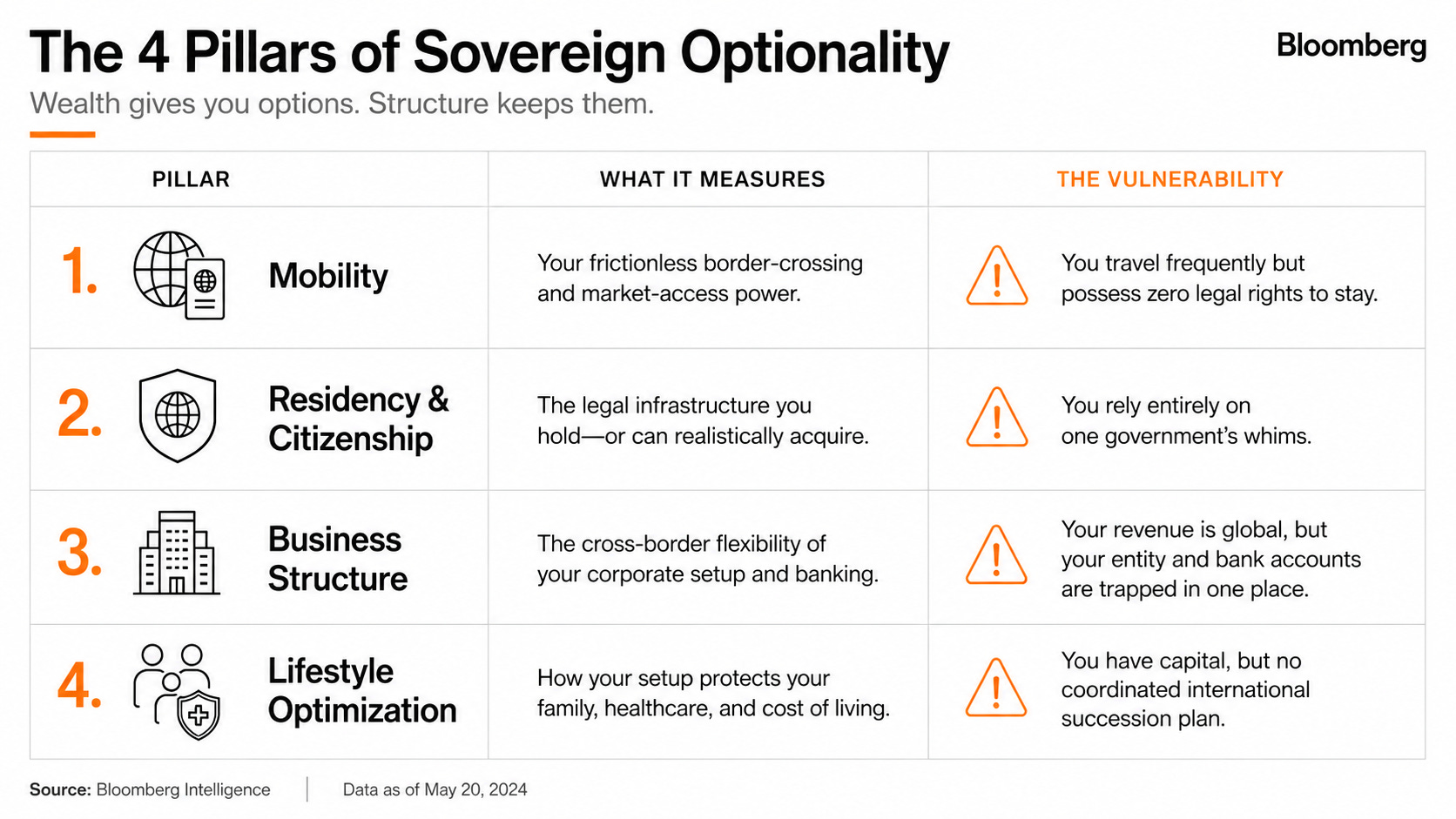
It measures four pillars:
Mobility - Your ability to cross borders, access markets, and respond when conditions change.
Residency and citizenship - The legal rights you hold - or could realistically obtain—to live beyond your current jurisdiction.
Business - The international flexibility of your company structure, banking, operations, assets, and market access.
Lifestyle - How well your mobility strategy supports your family, healthcare, education, safety, cost-of-living, and quality-of-life priorities.
Each pillar is scored out of 25. Together, they reveal both your current readiness and the gaps in your international strategy.
Someone may travel frequently but have no legal right to live elsewhere. A founder may serve global customers while keeping every company, account, and asset in one country. A family may possess significant capital but no coordinated residency or succession plan.
Mobility is not how often you travel.
It is how many real options you can exercise.
Get Your Personal Mobility Score Index in 3 Minutes & Build Your International Freedom Plan
Participants receive a personalized Mobility Playbook based on their nationality, current footprint, and objectives.
It can identify:
Relevant residency and visa programs
Suitable jurisdictions
International company structures
Legal tax-planning considerations
Asset-protection opportunities
Investment and relocation strategies
Practical next steps
The framework draws on data and responses from more than 500 participants across over 40 countries.
Its purpose is not to prescribe one destination. It is to transform a vague desire for greater freedom into a measurable plan.
The future of mobility will not be borderless.
It will be selectively open.
Countries will compete for certain investors, founders, professionals, and families while becoming more restrictive toward others. The people with the most freedom will not necessarily be those who travel most.
They will be those who prepared early enough to maintain choices.
The question is not only where people are moving and why.
It is:
Which options are available to you now - and how long will they remain open?
The Freedom Business Summit 2026: USA Mobility Edition takes place virtually on June 27–28, 2026. Registration includes live sessions, recordings, presentations, and event materials.
No posts
Comments
Nothing yet. Say the first thing.
Sign in to join the conversation.