
Most people in global mobility industry are talking about few places only - Portugal, Dubai, Malta, Caribbean, Greece and some LATAM countries.
But countries like Malaysia and Thailand are staying under radar and almost nobody takes them seriously.
That's a mistake. Let me explain why.
If you read this newsletter, you know my thesis: residencies and citizenships are assets. You accumulate them the way you’d build a portfolio - each one serving a function. Legal, Structuring, Tax or Lifestyle base.
I can tell, from own experience that Thailand and Malaysia are changing the rules of global mobility and quietly raising the bar. These two places are the best hidden bases you can experience right now.
Thailand and Malaysia are the real "Playground HQs."
They aren't trying to sell you a new passport. They are selling you a high-quality lifestyle for a fraction of what it costs in the US or Europe.
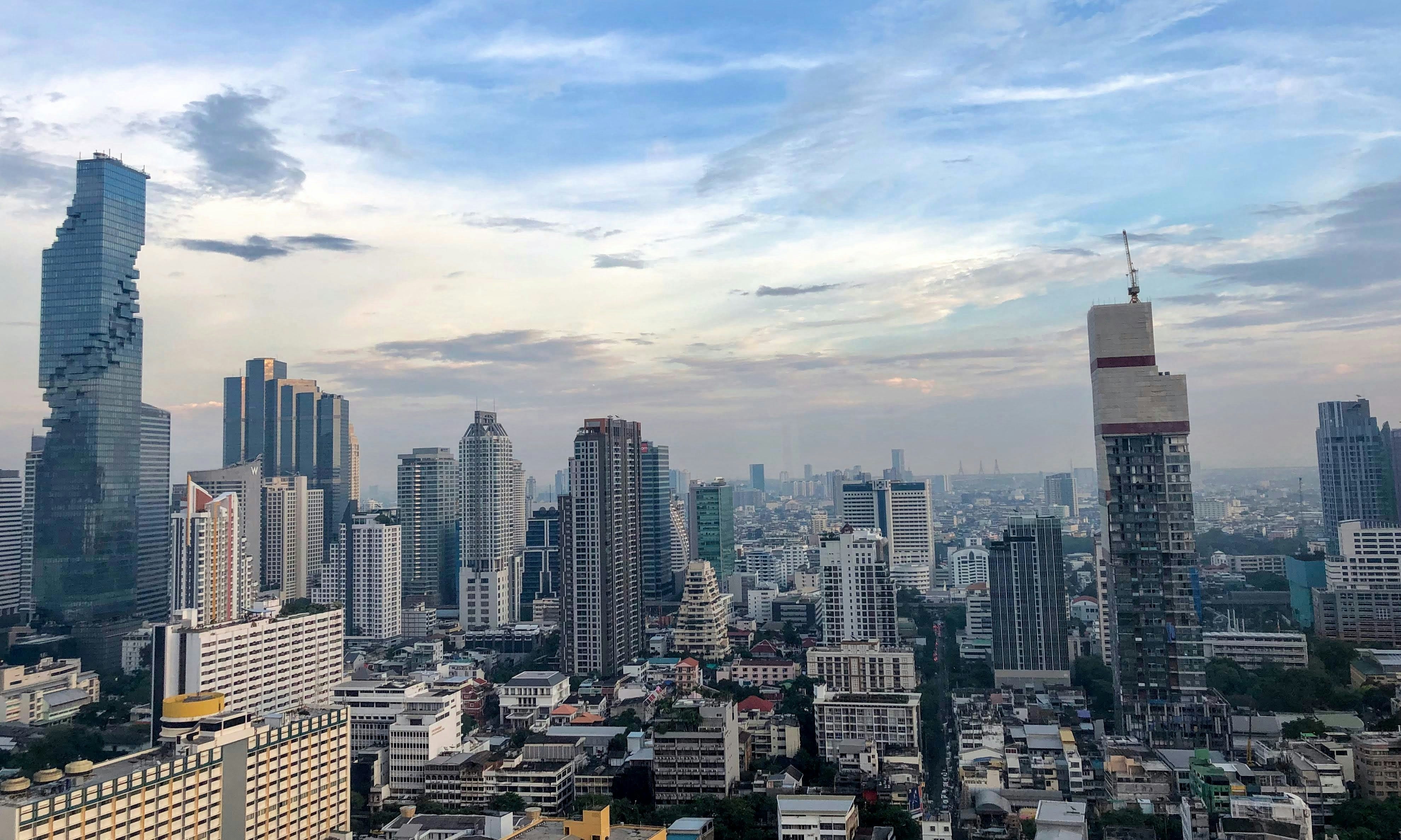
Thailand, especially Bangkok (BKK) is like the ultimate open-world game. Incredible food, fast internet, and massive energy.
You don't need me to sell you Bangkok. What you need to know is what changed.
For some time, it was hard to stay here long-term without doing annoying "visa runs" (leaving the country every month just to come back in). Now, they have two main options.
For years, Thailand had a reputation for being a place where people stayed… but rarely knew how long they could legally remain.
Border runs became part of expat culture. Visa uncertainty became almost a lifestyle.
That has changed dramatically.
Instead of relying primarily on tourism, Thailand is now building a layered immigration strategy aimed at attracting very different groups of global residents - from digital entrepreneurs to wealthy retirees, remote employees, investors, and highly skilled professionals.
The two most important pieces of that strategy are the Destination Thailand Visa (DTV) and the Long-Term Resident (LTR) Visa.
The DTV (Destination Thailand Visa) is the entry point, and it's arguably the best value long-stay visa in the world right now.
Rather than asking applicants to invest millions or become employees of Thai companies, it acknowledges a new reality:
Millions of people now earn their income remotely.
Instead of forcing those people into legal grey areas, Thailand created a visa specifically designed around modern work.
Five years, multiple entry, 180 days per stay, extendable in-country. That's it.
What it is: A 5-year golden ticket for remote workers, digital creators and it lets you stay for 180 days at a time.
The Price: You just need to show about $14,000 in a bank account.
The Catch: The government now checks to make sure that money has been sitting in your account for 3 to 6 months.
Applications are e-visa only, from outside Thailand.
The LTR Visa operates on an entirely different level.
Instead of targeting remote workers broadly, it focuses on attracting individuals expected to contribute significant capital, expertise, or economic value to Thailand.
It offers one of the strongest residence packages available in Asia.
Major Benefits
10-year renewable visa
Digital work permit
Fast-track immigration at participating airports
Annual reporting instead of 90-day reporting
Multiple re-entry privileges
No re-entry permit requirement
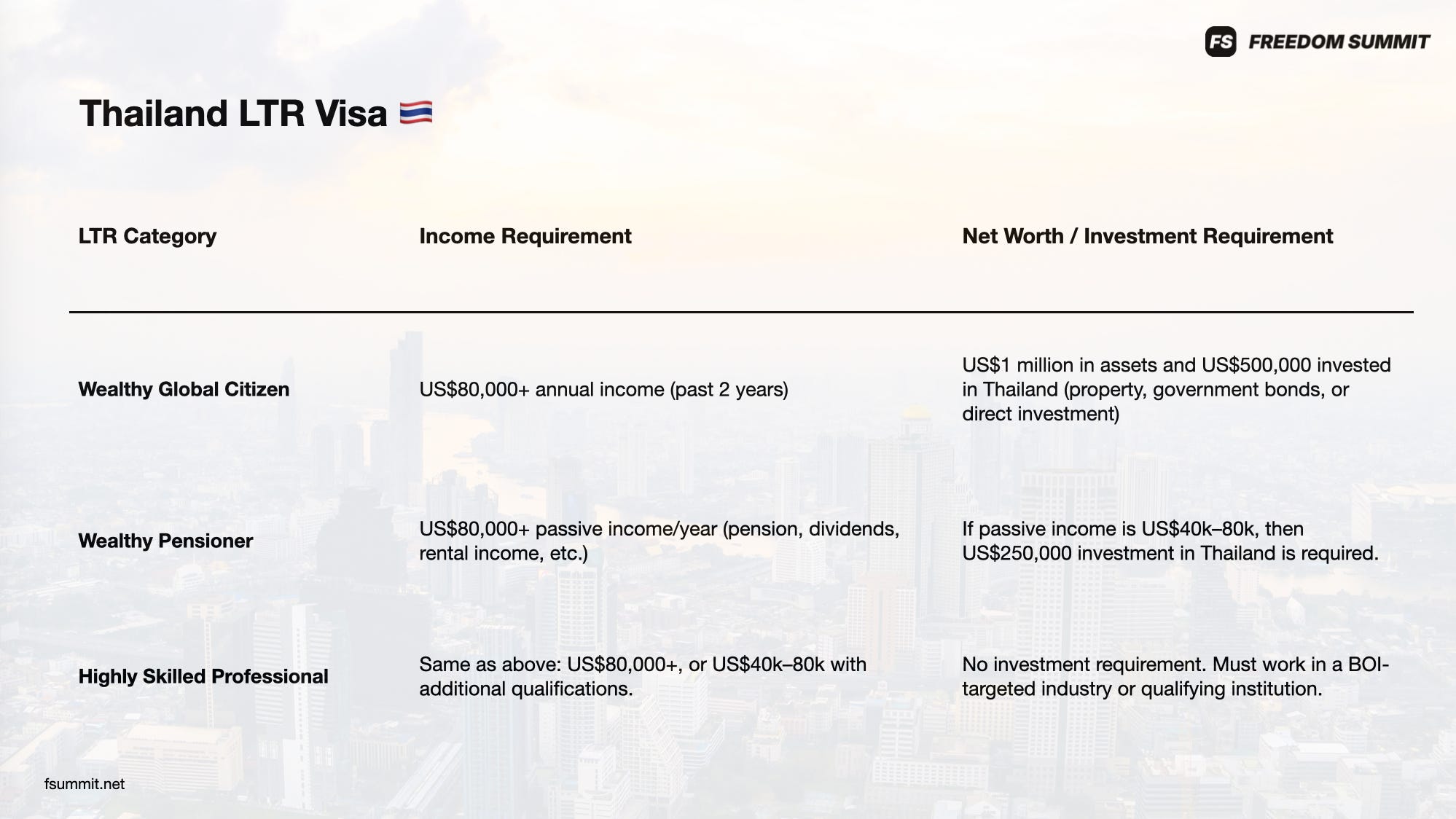
The Cheat Code: Thailand usually taxes money you bring into the country from outside. But if you get this LTR visa, you get total tax immunity on your foreign money. It’s a massive shield.
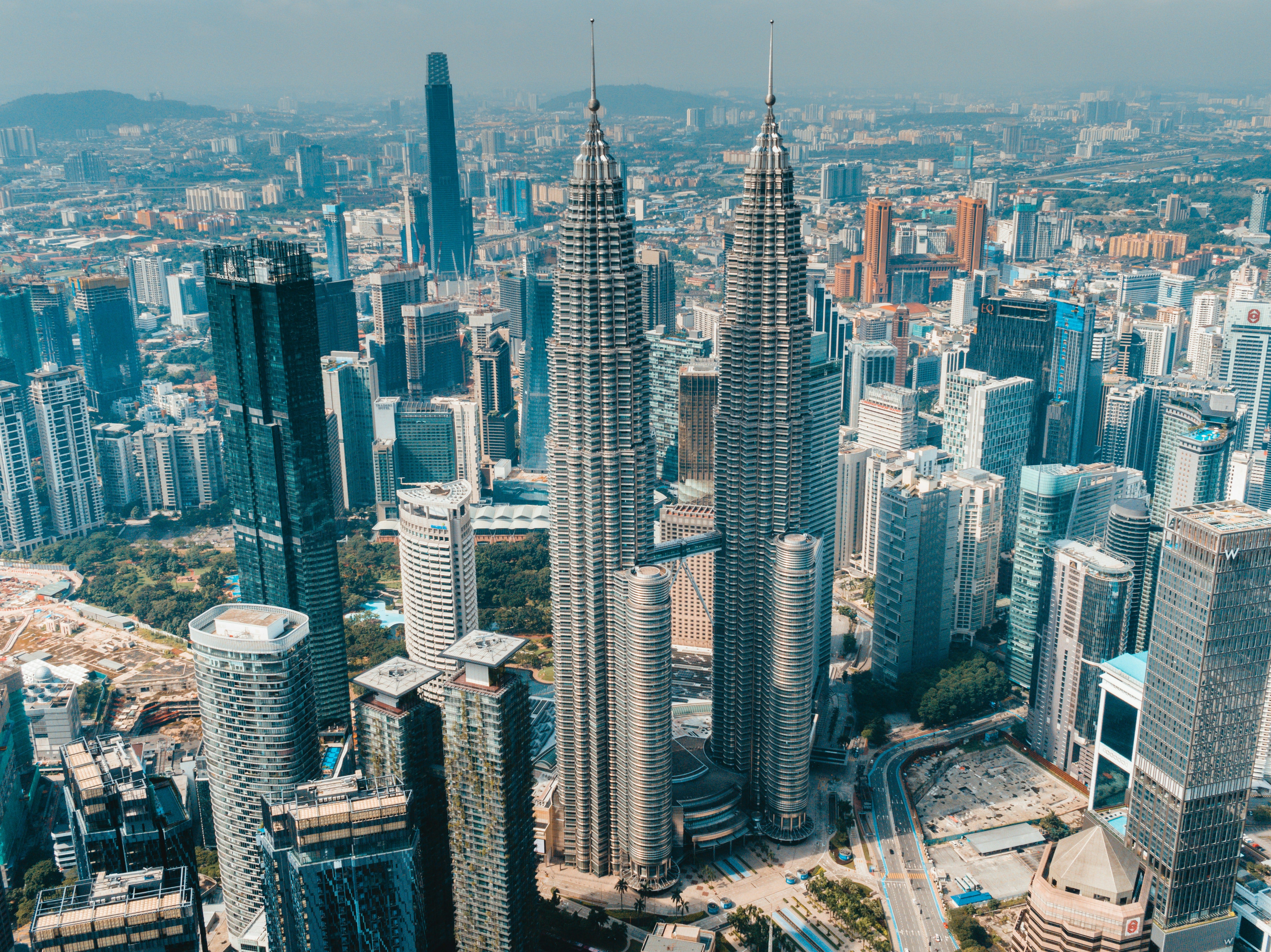
Surprisingly, but most of the people have no idea what Malaysia is about, but at the same time it has one of the most powerful passports in the world.
If Thailand is an exciting playground, Malaysia is a clean, organized tech hub. Specifically, the capital city, Kuala Lumpur (KL). Everyone speaks perfect English, the trains run exactly on time, and the buildings look like they are from the year 2050.
I believe, that Kuala Lumpur is the most underrated major city in Asia. World-class airport connectivity and infrastructure that mostly just works. Multi cultural vibes.
KLIA puts you 1 hour from Singapore, 2 from Bangkok and Jakarta, 4–5 from Hong Kong - because KL is AirAsia's home hub, those flights are often absurdly cheap.
KL is a real base. KLCC area is one of the best areas to stay with walking access to everything.
And the food. I'm not going to write a paragraph about the food. Just know that the Malay-Chinese-Indian triangle means you eat at a world-class level food every day indefinitely.
And the cost of living for the quality you get - is the best I’ve seen anywhere I’ve lived.
Thailand sells you a lifestyle. Malaysia sells you foundation.
Unlike Thailand, which has introduced multiple new visa categories over the past few years, Malaysia focuses on attracting three primary groups: remote professionals, investors, and long-term residents.
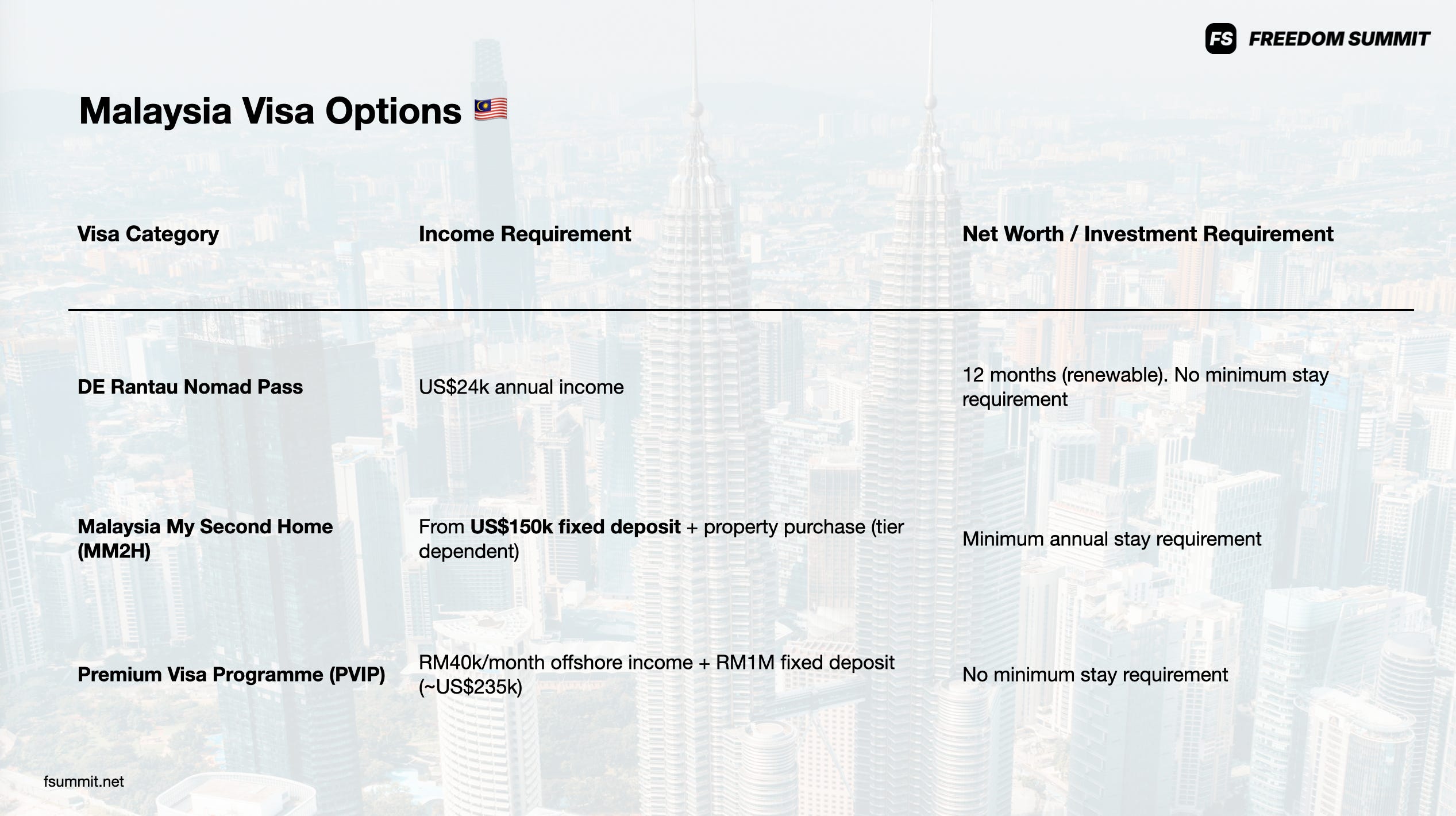
Malaysia launched the DE Rantau Nomad Pass specifically for remote workers, freelancers, and digital entrepreneurs.
Key Benefits
Valid for 12 months
Renewable for an additional 12 months
Dependents can be included
Ability to legally reside and work remotely from Malaysia
Access to DE Rantau hubs and partner coworking spaces
Financial Requirements
Annual income of at least US$24,000
Proof of remote employment, freelance work, or business ownership
Best for: Digital entrepreneurs, consultants, freelancers, startup founders, and remote employees.
One: the official processing time is 6–8 weeks. Real-world reports say 4–6 months. Plan your entry strategy around the slow case, not the advertised one.
Two: since May 2025, fees are non-refundable even if you’re rejected. And the top rejection triggers aren’t income - they’re sloppy documentation. The big one: your health insurance must explicitly name Malaysia in the policy. “Worldwide coverage” gets rejected. That single word costs people their application fee every week.
Three: you cannot convert from a tourist visa inside the country. Apply online, get approved, then enter - your 12 months start at the border, and your approval letter expires in 6 months flat, no extensions.
Malaysia’s flagship residency-by-investment program designed for retirees, investors, and globally mobile families seeking a long-term base.
Key Benefits
Long-term renewable residence (requirements vary by tier)
Ability to purchase property (subject to local thresholds)
Family members can be included
Access to Malaysia’s banking, healthcare, and education systems
Financial Requirements
The program was significantly revised in 2024 and now offers Silver, Gold, and Platinum tiers with different fixed-deposit and residency requirements. In general:
Fixed deposit from US$150,000
Property purchase required under most tiers
Minimum physical stay requirement applies
Best for: Investors, retirees, entrepreneurs, and families planning a long-term relocation.
Introduced in 2022, the Premium Visa Programme (PVIP) is Malaysia’s answer for affluent global citizens seeking a long-term base without committing to permanent residency.
Key Benefits
20-year multiple-entry residence visa
Renewable for another 20 years
No minimum physical stay requirement
Permission to live, work, study, and conduct legal business in Malaysia
Ability to purchase residential, commercial, and industrial real estate (subject to local rules)
Financial Requirements
Applicants must demonstrate:
Offshore income of at least RM40,000/month (RM480,000 annually)
A RM1 million fixed deposit with a Malaysian bank (approximately US$235,000)
After the first year, up to 50% of the deposit may be withdrawn for approved purposes such as property purchases, healthcare, or education.
Participation fee:
RM200,000 for the principal applicant
RM100,000 per dependent.
Best for: High-net-worth entrepreneurs, investors, family offices, and globally mobile individuals looking for a long-term Asian base without pursuing permanent residency.
How PVIP compares to MM2H
This is where many people get confused.
MM2H is primarily a lifestyle residency program with tiered investment requirements and some residency obligations.
PVIP is a premium long-term residence program for higher-income individuals. It offers greater flexibility, no minimum stay requirement, and explicit permission to work or conduct business in Malaysia.
The Tax Advantage
Malaysia has one of the region’s most attractive tax systems for internationally mobile entrepreneurs. Since it generally taxes local income rather than foreign income, it’s often a cleaner and more predictable base for people running businesses or managing investments across multiple countries.
Everything above, you could eventually piece together from visa websites. What comes next, you only learn on the ground. This is where the two months paid off.
Ground truth #1: what it actually costs to live in each city.
Rent. Bangkok: a modern one-bedroom starts from runs 18,000–28,000 THB ($500–800). Go prime - Thonglor, Ekkamai, Asok - and a well-furnished two-bedroom is 35,000–55,000 THB ($1,000–1,550).
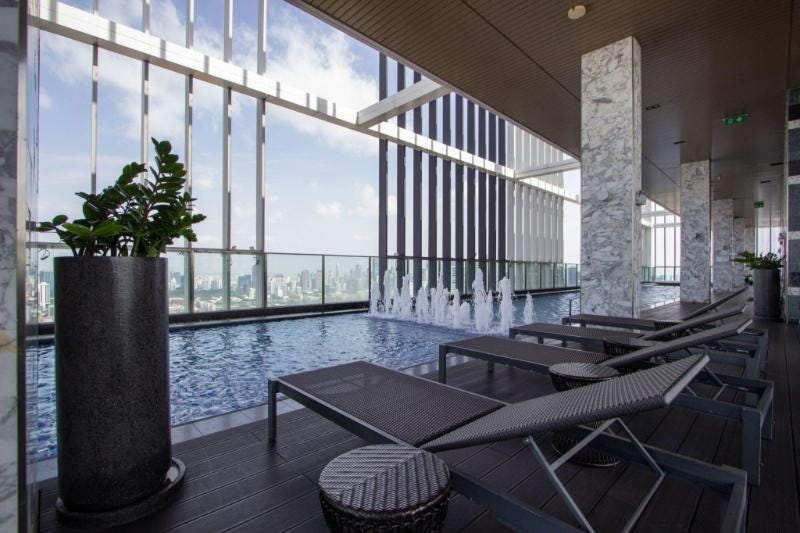
You live in the modern condo with gym, sauna, lounge and rooftop pool.
Kuala Lumpur, same search: $500–750 for the one-bedroom in Bangsar or near an LRT line, $900–1,300 for a two-bedroom walking distance from KLCC.

A comparable central condo runs 15–20% less in KL than in BKK - and the units are physically bigger.
KL gives you more floor space at the same price. In KL you get an actual home office. In Bangkok, the same budget gets you get better facilities with a better view.
Ground truth #2: banking - where the cheap visas hit a wall
One lesson became increasingly clear during my time in Southeast Asia.
A long-term visa is only part of the equation.
The real question is: Can you actually integrate into the country’s financial system?
Because once you’re living somewhere, you need more than the right to stay.
You need a local bank account. A payment infrastructure.
In Thailand, banking rules have become noticeably stricter.
While premium residence programs such as the Long-Term Resident (LTR) Visa and Thailand Privilege generally provide a straightforward path to opening local bank accounts, holders of the Destination Thailand Visa (DTV) have reported a much less consistent experience.
Thailand: the branch matters more than the bank. Policy interpretation varies wildly between branches of the same bank, so the golden rule is: rejected at one branch, walk to another - preferably in an expat corridor. The current ranking:
KBank (Kasikorn) - the most foreigner-friendly Thai bank in 2026. Major Bangkok branches (Asok, Thonglor) accept Non-Immigrant B holders even without a work permit, and the K PLUS app is the best banking app in the country, full English. First attempt goes here.
Bangkok Bank - the veteran choice. The main Silom Road branch near BTS Sala Daeng has processed expats for decades. Stronger SWIFT infrastructure if you’ll be wiring serious money - say, for a property purchase - and reliably accommodating for LTR and Privilege holders.
Malaysia follows a similar - but more structured - approach.
The DE Rantau Nomad Pass provides legal residence for remote workers, but banking access can still depend on individual institutions and documentation.
By contrast, Malaysia My Second Home (MM2H) and the Premium Visa Programme (PVIP) are designed with financial integration in mind. MM2H, for example, requires applicants to place a fixed deposit with a Malaysian bank as part of the application process, meaning banking is built into the residency journey rather than treated as a separate hurdle.
Malaysia: pick by function, not by luck. No branch lottery here; the system behaves the same everywhere.
Maybank - the country’s biggest bank, the most routine process for foreign residents, minimum deposits from a few hundred ringgit.
CIMB - my pick for anyone running a multi-country Southeast Asia setup: one banking group with retail networks in Malaysia, Thailand, Singapore, and Indonesia. (Fun fact: CIMB Thailand is also the only realistic Thai account option on a tourist visa - approval is inconsistent, but it’s the only door that’s even slightly open.)
HSBC / OCBC - if you want international-grade private banking on top.
That reflects a broader strategy.
Governments are increasingly separating access to the country from access to the financial system.
Entry is becoming easier. Full integration is becoming more selective.
Wrong question. And by now you know why.
Thailand is the play for maximum lifestyle per dollar with minimal commitment (DTV) - or a genuine tax-advantaged 10-year base if your numbers support the LTR. Higher upside, higher rule risk.
Malaysia is the play for a boring, English-speaking, territorial-tax operating base. And MM2H specifically makes sense if you were going to allocate to Southeast Asian property anyway - in which case the residency comes attached to an asset you already wanted.
My honest read after two months on the ground: these aren't competitors.
They're complements. A DTV plus a KL base covers Southeast Asia better than any single European golden visa covers Europe - at a fraction of the cost.
And if you need working local banking on day one, Malaysia is currently the more honest product: what it promises on paper is what you get at the branch.

Zoom out with me for a second, because this is bigger than two countries.
The center of gravity in global mobility is shifting. Europe is retreating: getting more complicated and more expensive.
Portugal stretching timelines, Spain gone. The Caribbean is repricing under pressure and the Schengen access soon will be under question.
Meanwhile, Asia is building. Thailand widening its LTR funnel. Malaysia formalizing its tiers. Even Cambodia - the region's only citizenship-by-investment program - just repriced from ~$250K to $1M+. That's not desperation. That's confidence.
The programs of the next decade won’t look like the programs of the last one. Fewer passports-for-donations. More residency products tied to real presence, real assets, real economies.
Thailand and Malaysia are early versions of that model - and they’re underpriced for one simple reason: the industry hasn’t moved its attention yet.
The question is whether you move before the crowd does.
Everything in this letter is analysis. But analysis without a starting point is just entertainment - and I don’t write for entertainment.
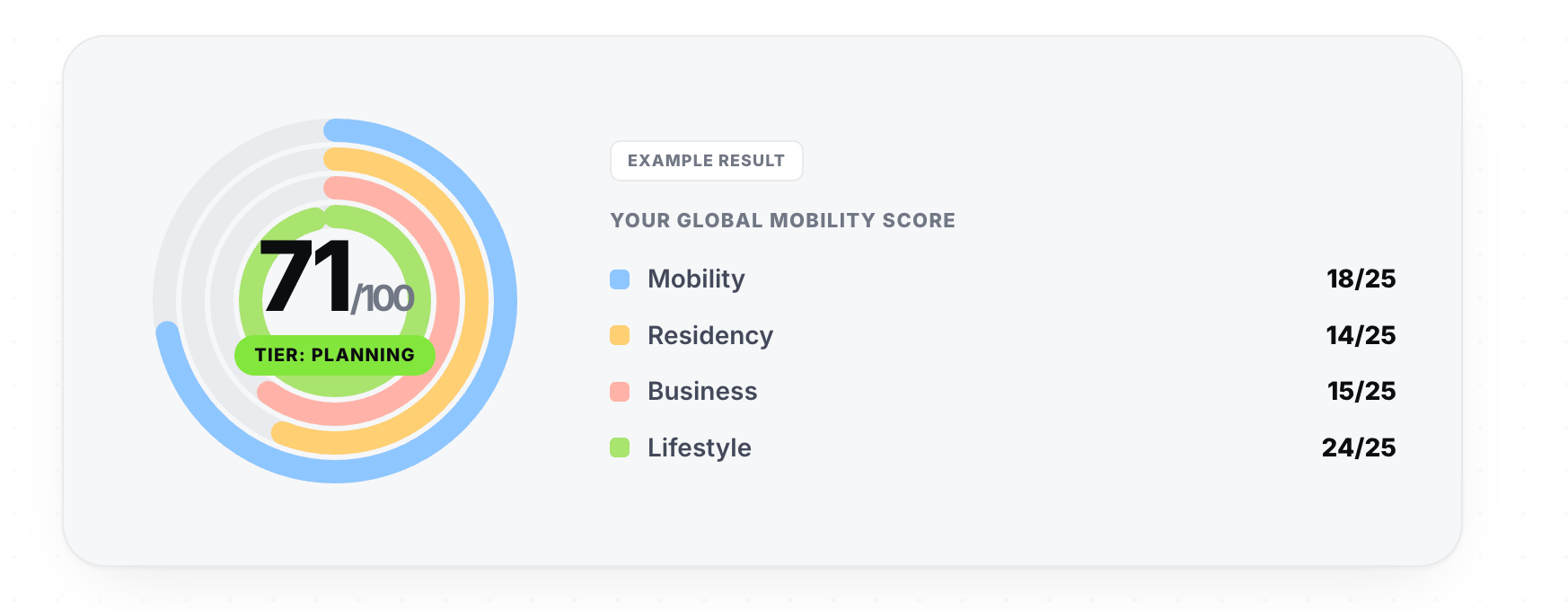
So here’s your starting point. We built a free assessment called the Global Mobility Score - the same scoring engine we use inside FBS Intelligence to qualify investor profiles for our partner firms across 16+ jurisdictions.
Here’s how it works: you answer a short survey - about 5 minutes - covering your capital position, timeline, motivation, family structure, and jurisdiction interests. The engine scores you across six weighted dimensions and returns a single number from 0 to 100: your Global Mobility Score.
What the number tells you:
Where you actually are on the mobility curve - not where you think you are. Most people overestimate their readiness on paper and underestimate their optionality in practice.
Which class of programs fits your profile right now - whether you’re a DTV-and-test-the-thesis profile, an MM2H-and-anchor profile, or ready for something bigger.
What’s blocking your score - because the gap between a 55 and an 80 is usually one or two specific, fixable dimensions, not some vague notion of “not being ready.”
It’s free. It takes five minutes. And it converts this entire letter from something you read into something you act on.
Get your free Global Mobility Score →
I run the Freedom Business Summit - events and market intelligence connecting investors with trusted residency and citizenship advisors across 16+ jurisdictions.
If Southeast Asia is on your map or any other jurisdiction, comment below.
I just spent two months building the network on the ground, and I'm happy to point you in the right direction.
No posts
Comments
Nothing yet. Say the first thing.
Sign in to join the conversation.