
Recently we’ve finished Freedom Business Summit 2026 US Edition and we have some interesting data to share.
Instead of running another panel discussion about "the future of global mobility," we did something different: we tracked the actual decisions of 364 founders earning between $350K and $1M+ per year.
We’ve analyzed raw insights and behavior that are exploring global mobility options and we identified two mobility flows - Inbound and Outbound Directions.
Outbound: US-based founders structuring their lives beyond the US
Inbound: Global founders positioning themselves to access the US market
All the numbers, data and insights that we received - come from actual behavior - people already planning, structuring, or executing.
They plan to move within 12 months
They earn around $350-500k-$1M Annually
They are already speaking to legal and tax advisors,
They are allocating capital toward a second residency
When you see hundreds of people, from different countries and industries, independently making similar decisions within similar timeframes - that’s where it gets interesting.
The Insight: Intent is the New Metric
You can look at this not even as a trend, but rather a directional shift.
Data shows not what they said they'd do someday. What they are actually doing right now.
So here is basically what we’ve done an what are the real insights we received.

Let’s start with the basics.
We live in the world, where "noise" is the default setting.
You get constant random opinions and "expert" predictions. That sounds sophisticated, but fail to provide a proof of concept.
Every week brings a new prediction about where "smart money" is going. Every LinkedIn thought leader has an opinion about the best passport or the hottest jurisdiction.
We chose to build something different: The Intelligence Data Layer - a framework that filters every data point through three specific lenses:
Behavior (The ‘What’): What are founders actually building today? Which jurisdictions are they structuring in right now - not planning to, not considering, but actively executing?
Intent (The ‘Why’): What is the core driver, true strategic goal and the destination. Moving from "escaping a system" to "choosing a better one."
Timeline (The ‘When’): How fast is the “Exit” happening? Our data shows a definitive move and timeframe.
The Intelligence Data Layer reveals where the people in the world are actually moving, giving you the clarity to act before the window of opportunity closes.
The Data Layer is the “Signal.”
We analyze and understand the actual movements of the global founders and we call them Modern Movers.
Think of the United States as the center of a global arbitrage system.
We view global mobility through the lens of a System Upgrade.
You are essentially upgrading the "Hardware" and the "Processor" of your life to eliminate a single point of failure.
There are two distinct flows - Inbound and Outbound - centered on the United States.
Some founders are exporting their lives to better “hardware” (safety and lifestyle), while others are importing their businesses to a more powerful “processor” (the US market).
This isn’t just a change of location;
Both flows move toward a singular result: Jurisdictional Independence.
They are choosing the best country for each part of their life - earning in the US, structuring in Malta, and living in Portugal or Greece.
The vast majority of our founders are currently focused on moving out from the US.
These are predominantly US-based entrepreneurs who earn in the world’s most powerful currency but have realized they are "single-threaded."
The Risk: Having your business, banking, and family all tied to one jurisdiction.
They are looking for Residency and Passports (46%) in the EU to ensure their family has a “Plan B” that is completely independent of the US political and economic cycle.
Income → stays connected to the US
Residency → moves elsewhere
Safer environments. Lower costs. Better lifestyle.
A smaller but highly strategic group is focused on moving in.
For global founders, the US isn't a place to "escape" to - it's a tool to scale and import their businesses to access the world's deepest capital markets.
They are accessing the US market, primarily through the E-2 Treaty Investor Visa and EB-5 Visa
E2 Treaty Investor Visa - offers rapid processing and a lower entry barrier (typically starting at $100k–$150k).
For those from non-treaty countries (like India or China), the Grenada or Türkiye passport serves as the "Tactical Bridge." By acquiring citizenship in a treaty country first, they unlock the US market in months, not years.
The EB-5 Immigrant Investor Program (The Legacy Play): For those looking for a permanent “North Star” for their family, the EB-5 is the gold standard.
The Requirement: A minimum investment of $800,000
Forget the laptop-and-backpack archetype.
The modern mover of 2026 is a CEOs, a consulting firm founder, a project engineer running a lean, location-independent operation. 84% earn between $150K and $350K annually.
They have capital - but they deploy it with discipline.
This is the Modern Movers: a group that values efficiency and institutional trust.
They are builders.
More importantly: 53% are relocating with their families. This is the single most important data point in our entire dataset.
When a founder moves alone, it's a lifestyle experiment. When a founder moves with a family, it's a structural decision. It means they're evaluating schools, healthcare systems, and the quality of sidewalks. It means the decision has to work for a decade, not just a sabbatical.
Out of the 364 founders:
84% earn between $150,000 and $350,000 per year
Many run lean, location-independent businesses
Over half are planning with family in mind
They have enough capital to move - but they still think carefully about efficiency.
The Demographics:
84% earn between $150K and $350K per year. Not ultra-high-net-worth. Not trust-fund wealthy.
They have enough capital to move. What they're optimizing for now is efficiency - the highest return on every dollar, every decision, and every year of their life.
The Family Factor:
Crucially, 53% are relocating with family. This shift marks the move from “escaping the system” to “choosing a better one.” They are looking for top-tier schools, safe streets, and cultural depth.
The Single Jurisdiction Factor:
60% explicitly identified this as their core problem: everything they've built - their business, their banking, their family's future - runs through a single passport.
In business, we call this a single point of failure. In life architecture, most successful people have never thought to apply the same logic.
They realize that having their business, banking, and family life tied to one passport is a single point of failure in an increasingly volatile 2026 landscape.
The Direction of Movement:
Majority of Modern Movers based in the US and 89.3% are focused on Outbound strategies. They are keeping their US income streams but decoupling their physical presence and looking towards Europe.
The Timeline:
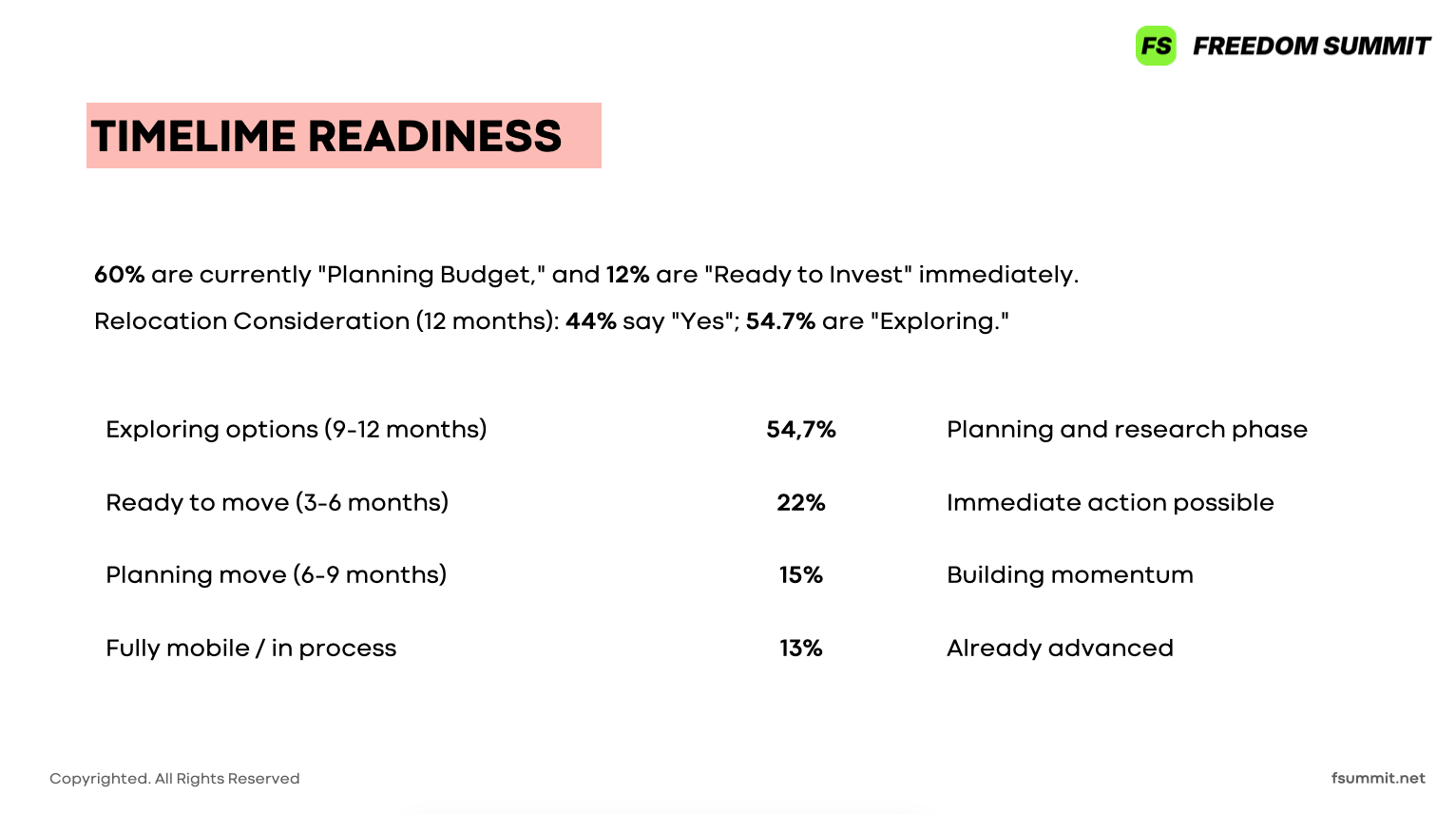
This is not a “someday” dream. 44.6% are ready to act within 12 months, and 49.3% are currently vetting trusted service providers.
The Definition of Ownership:
In the old world, status was defined by owning a home or a car. For the 364 founders we surveyed, status is Optionality and Mobility.
Ownership now means owning your options. The right to decide which government's services you subscribe to. The ability to move your family to a better system if the current one deteriorates.
That is the asset they are building.
Not a second passport as a trophy. A Sovereign Stack - set of jurisdictional relationships that gives them optionality no single government can revoke.
Here's a counterintuitive finding.

We have often discussed the frustrations of the "Old World" - the legendary European slowness and the layers of bureaucracy that can make even a simple bank account opening feel like a marathon.
The reasoning: slowness is a byproduct of stability.
Systems that change slowly are systems that can be trusted. Rules that were true five years ago are likely to still be true five years from now. For a founder building a 10-year family plan, predictability is worth more than speed.
Europe is the ultimate “Safe Haven” asset.
Europe offers what cannot be bought elsewhere: institutional predictability, safety for the next generation (53% are relocating with family), and an unmatched lifestyle aesthetic.

1. Predictability: Rules change slower. Systems are more stable.
2. Safety for families: Over 53% of founders are relocating with family. This is not a solo decision anymore.
3. Lifestyle quality: This matters more than people admit. Walkable cities. Healthcare. Education. Culture.
Here’s the simplest way to understand it: The US is where money is made. Europe is where life is lived.
For the American founder, Europe is a hedge - a way to diversify away from domestic risk while maintaining a Western-standard operational base.
So where are they going?
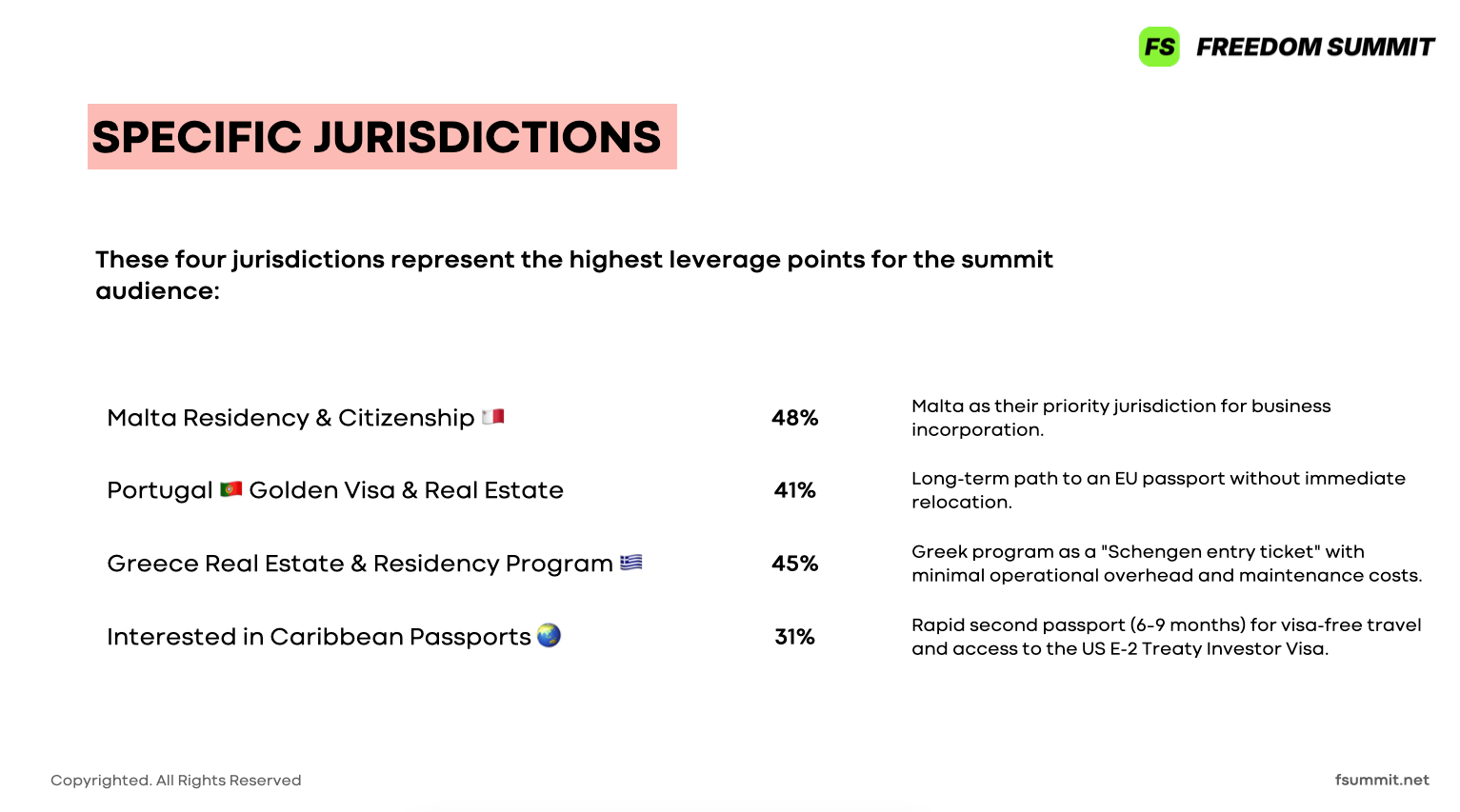
The three jurisdictions dominating our data:
Malta 🇲🇹: The undisputed leader for business incorporation (33%) and residency options. It is the “Gold Standard” for licensed, transparent Europe structuring.
Portugal 🇵🇹: The premier “Plan B” for those seeking long-term citizenship with minimal physical stay requirements.
Greece 🇬🇷: The “Hard Asset” anchor. For those who want a tangible real estate investment in exchange for seamless Schengen mobility.



Here's the thing about intelligence data: it reveals not just where people are going, but when the window closes.
Let’s look at things in this way.
We are living now in the time of New Freedom Economy - where sovereignty is a service and mobility is the ultimate leverage. It is a shift in the "social contract" between high-performance individuals and nation-states.
If Golden Visa 1.0 was about "buying a house to get a passport," Golden Visa 2.0 is about investing in a system to secure a future.
It is the professionalization of residency. Investors becoming more smarter, while governments implement more restrictions and increasing timelines.
The investors aren’t trying to beat the restrictions - they are building their Sovereign Stack. They understand that a harder-to-get residency is actually a more valuable, more stable asset in the long run.
Based on the intelligence from our 364-founder insights and current legislative shifts, here is the roadmap vision for the next 18-24 months.
The Shift from Passive Assets: The era of buying a condo in Lisbon or a villa in Athens to get a residency card is coming to an end. Governments across Europe are rewriting the rules to favor productive capital over passive real estate investment. The programs that exist today are better than what will exist in 18 months.
The Digital Border: With the rollout of ETIAS (Q4 2026) and the Schengen Entry/Exit System, the "grey areas" of physical presence are disappearing. Your day-counts will be tracked with biometric precision.
The Talent Track: Expect more "Start-up Visas" and "Innovation-Linked" pathways. Governments want your brain, not just your bank account and Europe will do the same.
The 12-Month Window: The current backlog (over 40,000 applications in Greece alone) and rising investment thresholds mean the "cost of waiting" is at an all-time high. For the 44% of founders in our survey ready to act, the window to lock in current rules is closing fast.
Europe is not closing its doors, but it is fundamentally changing who it lets in and how.
It is becoming an “Exclusive Club” where the entry fee is shifting from buying land to investing in the economy.
For those who secure their position now, these residency permits are acquiring the status of a “Safe Haven Asset.” As the world becomes more fragmented and volatile, a European “Plan B” is an asset that will only appreciate in value.
If you are one of the 44% currently planning your move, the data is clear: execution beats information. The best time to build your fail-safe was yesterday; the second best time is today.
Before you do anything else - before you talk to a lawyer, before you research jurisdictions, before you build a spreadsheet of programs and costs — you need to answer one question honestly:
Are you Outbound or Inbound?
This is not a philosophical question. It is a structural one, and it determines everything that follows.
If you are US-based, earning in dollars, and your entire life - business, banking, family - runs through a single American jurisdiction, you are playing the Outbound game.
If you are outside the US, looking at the American market as the most powerful distribution channel, capital network, or credibility multiplier for your business - you are playing the Inbound game.
These two games have completely different timelines, different investment requirements, different legal pathways, and different partner profiles.
Identify your game. Then go deep on that game only.
Every month you spend in research mode instead of execution mode is not a neutral decision. It is a decision to pay more, wait longer, and operate with fewer options.
The 44% of founders in our data who are ready to act within 12 months are not more informed than you. They are simply more honest about the cost of inaction.
Here is the mental model to understand:
Your sovereign stack is not a purchase. It is infrastructure.
You would not run a business without legal structure, accounting, and banking. You would not launch a product without distribution.
But millions of high-performing founders are running their entire life - their income, their family's security, their long-term optionality - through a single government's terms and conditions, with no backup and no alternative.
That is not a lifestyle choice. That is an unmanaged risk.
Act wisely.
No posts
Comments
Nothing yet. Say the first thing.
Sign in to join the conversation.