
I’ve spent five years bouncing between Portugal and Southeast Asia.
The contrast is sharp and difference is very noticeable.
That’s when I realized something simple but profound: geo-arbitrage is a real leverage.
While Europe remains beautiful, but it feels like a museum under an open sky and it is not developing fast enough.
Relocate to Southeast Asia - you gain mobility, speed, optionality, and a deeper quality of life. You can hire faster, build faster, recover faster.
Daily life is just more simpler and easier here and m
any relocate to Southeast Asia to benefit from higher quality of life overall.
So the question is:
Is the ‘short Europe, long Southeast Asia’ trend only getting stronger?
All indicators - talent inflow, visa innovation, infrastructure growth - suggest the answer isn’t just yes.
The shift is already happening, and the smartest entrepreneurs are moving to Southeast Asia.
Naval has an interesting take on location and leverage:
“You should be using leverage. Leverage can come from capital, location, people, or products with no marginal cost of replication (code and media).”
But not many understand how to play it in the right way.
Code, Media, Capital, and Location - can dramatically magnify your individual output.
A growing number of digital entrepreneurs relocate to Southeast Asia to benefit from geo-arbitrage and better and higher quality of life overall. That’s what Southeast Asia can offer now, while Europe can not.
This is the new geography of leverage. And it’s changing the place where high-output people choose to live and build next.
Europe looks and feels like a museum under open sky. Every time you travel back to Europe from Asia - it feels like traveling back in time.
Yes, it is elegant, tasty, but it is old.
There are: Housing scarcity. Service scarcity. Energy scarcity. Everything is “fully booked,” “come back next week,” or “fill out this form.”
Europe’s cost of living is up, too much bureaucracy, it is slow and very inefficient.
Yes, Europe is fantastic for banking, residency, stability - absolutely, but it often feels structured and limited.
While Southeast Asia has better optionality, feels more flexible, it is more dynamic, has better networks, lower cost base and higher personal output.
Europe is still the king of long-term residency, stable paperwork, and eventual citizenship. If you want a legal “home base,” Europe is still a smart move.
But for high-speed living, high-leverage execution, and maximum optionality, the play is simple: Southeast Asia.
Why SEA can offer more abundance and optionality compare to Europe ?
In Southeast Asia optionality means you always have multiple paths open.
You can switch apartments in a day. Change cities in a week, or even days with the same level of comfort. Easily order food or delivery with Grab and it just feels naturally fast.
Abundance is engineered into the Southeast Asia system:
Almost everything is available immediately
Service is fast, polite, and omnipresent.
Housing markets actually have supply.
Logistics don’t need a project manager.
Same-day solutions are normal.
Basically, you can operate everything and handle all basic services super fast just exchanging messages on Whatsapp. It is that simple.
You can arrive with almost no plan and still slip into a comfortable, convenient routine.
SEA is an operating base, not a forever home.
SEA cities are effectively built for global mobility - because they want it.
It’s where you build, but not where you retire. Still, Europe is better for this. But the question - are you ready to retire now ?
If yes, then probably Europe is a solution, but if not - look into SEA.
So, the question is where to move. What we have on a table - Thailand, Bali (Indonesia), Malaysia, Singapore and Vietnam.
Massive undervalued gem. Modern infrastructure, culturally diverse, and close to Singapore without the price tag. Good food, good apartments, good healthcare. Quietly becoming the region’s basecamp for location-free founders.
Residency Options:
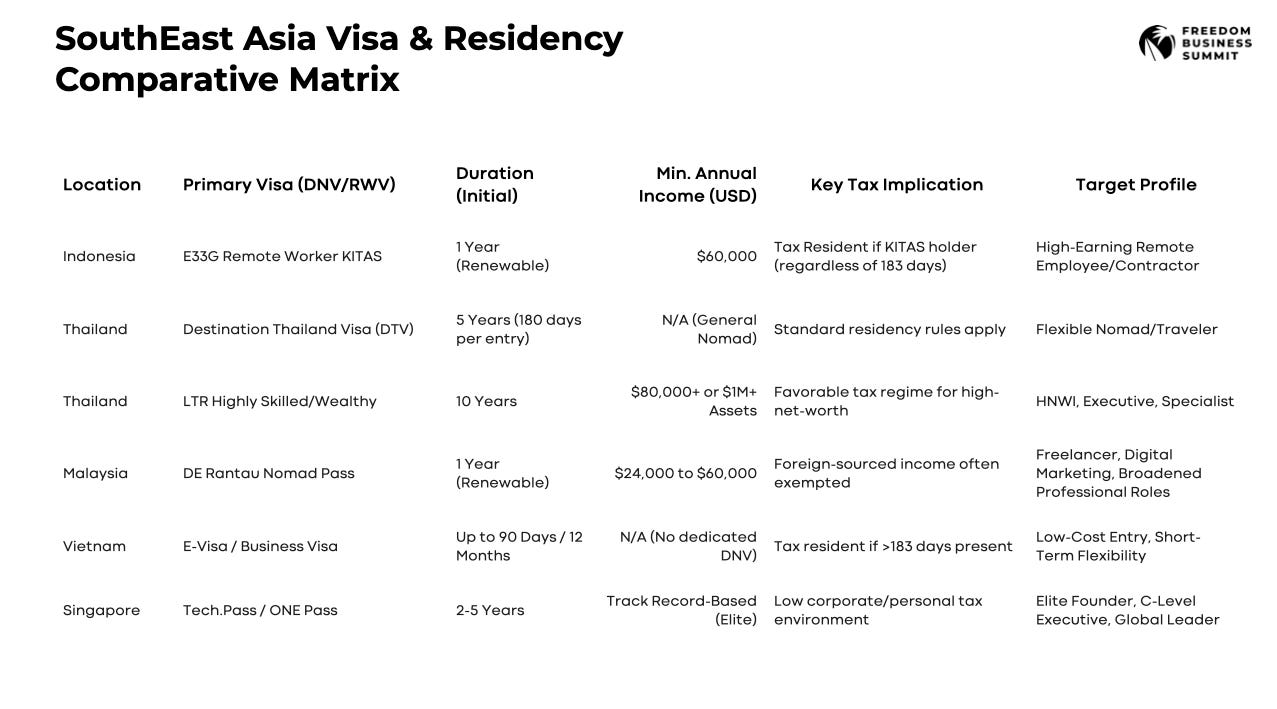
Malaysia My Second Home (MM2H): Long-term residency through a mix of fixed deposits and property, starting around $150K.
DE Rantau: A digital-professional visa for digital people and founders. Stay 3–12 months, renew once, total 24 months.
Why founders like it: English-friendly. Solid banking. Low taxes. Family-friendly rules.
The real advantage: Stability without bureaucracy. You can set up, operate, and live calmly. The country of affordable luxury.
Malaysia’s primary competitive advantage is its tax structure for remote workers - the government often exempts foreign-sourced income from taxation.
Bali is the capital of wellness, creativity, community, founders everywhere. The number of incredible interesting people moving to Bali from all over the world is just incredible.
Great for building lifestyle-first companies or creative projects. Jakarta is the business engine: huge market, investors, deal flow.
Good residency options in Indonesia.
Of course, it has it cons: Not ideal for scaling a serious company unless you operate mostly online. Traffic and infrastructure can be messy.
Residency options:
Second Home Visa (Kitas): 5–10 years of residency with $130K in funds or $1M in luxury real estate.
E33G Visa: For remote workers or offshore-company founders. $60K annual income + $2K in the bank. Valid 1 year, renewable once.
Bangkok is chaos with purpose: cheap, fast, creative, efficient. You can get anything done at 2am. Phuket and Chiang Mai have their different vibe. Amazing weather, fitness culture, and good quality of living.
Visas are decent but can be bureaucratic unless you go for Elite. Harder to build a long-term legal base compared to Malaysia or Singapore. The “fun lifestyle” can be a distraction if you lack discipline.
Residency:
Destination Thailand Visa (DTV): 5-year, multi-entry. Stays of 180 days, extendable. Financial proof around $15.5K.
Long-Term Resident Visa (LTR) : 10-year residency for high-income earners. $80K annual income (or $40K with an advanced degree).
Why founders like it: Flexible. Fast. Easy to reset life and get to work.
The real advantage: It’s the simplest path to long-term “base life” in Thailand.
Zero chaos. Ultra-efficient systems. Strong rule of law. Fast company setup. Global banking hub. You can network just by standing in line for coffee. Great for founders who need stability, capital, and partners.
On the other side it pricey. Small. Not much “wild creativity” unless imported. If you want beaches, chaos, or spontaneity - this is the opposite.
Residency:
EntrePass - residency for entrepreneurs building an innovative or venture-backed business. No massive capital needed. What matters is real substance: tech, IP, traction, or credible investors.
Global Investor Program GIP - permanent residency through investment. Put $7.3M into your own company (and hire 30 people) or $18.3M into an approved fund. Citizenship becomes an option after 2 years of PR.
Why founders like it: Best infrastructure in Asia. Best banking. Best stability.
The fastest growing country across SEA: young population, fast-growing economy, cheap everything, huge talent base (tech, design, engineering). Places like Ho Chi Minh and Da Nang are top choices.
Language barrier is real. Infrastructure improving but inconsistent. Visa policies are not clear yet.
Residency:
The Vietnam Investor Visa has four categories based on contributed capital. DT1 requires about $4.2 million, DT2 ranges from $2.1 million to $4.2 million, DT3 from $126,000 to $2.1 million, and DT4 under $126,000.
The visa is valid for up to 5 years and can be extended to 10 years.
What makes it attractive: Low-cost, high-energy business hub.
Most people choose a city for lifestyle; Location shape your behavior and outcomes.
If you want maximum ease + modern infrastructure → Malaysia
If you want maximum speed + capital access → Singapore
If you want maximum creativity + community → Bali
If you want maximum energy + growth → Vietnam
If you want maximum lifestyle + chaos → Thailand
You pick the base. The base shapes your growth. And the region gives you opportunities.
SEA treats crypto like a growth industry. Europe treats crypto like a taxable asset class.
Thailand just dropped a move every crypto trader dreams about 0% capital gains tax on crypto profits (yes, zero).
Here’s the real deal: from January 2025 to December 2029, Thailand will not tax crypto profits made through exchanges or brokers licensed by the Thai SEC.
That means if you trade Bitcoin, Ethereum, or any alt Thai-approved platform, your profits are 100% yours.
Europe taxes capital gains. SEA mostly doesn’t.
Let’s break it down.
1. Capital Gains
SEA → mostly not taxed (Singapore, Malaysia, Thailand for licensed trades)
Europe → usually taxed
2. Active Trading / Business Income
SEA → taxed only when clearly business activity
Europe → more aggressive classification and monitoring
3. Residency Strategy
SEA → residency gives you better tax conditions
Europe → residency locks you into high tax obligations
Capital Gains in Europe
Most European countries treat crypto like any other asset:
Capital gains are taxable when you sell or swap
Rates vary from ~0% (rare) to 30–50%
Some countries distinguish between “private wealth” and “professional trading”
Common patterns:
Holding for >1 year sometimes reduces the tax
Frequent trading often gets classified as “professional income” → higher taxes
Staking, mining, yield farming are usually taxable events
Examples:
Germany: No capital gains tax if holding >1 year (for private individuals).
France: Flat ~30% on crypto capital gains.
Spain: 19–28% depending on gain size.
Portugal: Once tax-free; now taxes short-term crypto gains at 28%.
If crypto is a big part of your portfolio or income:
Thailand (licensed exchanges) → zero tax window until 2029
Singapore → globally elite no-capital-gains jurisdiction
Malaysia → holds quietly tax-free for individuals
Europe → capital gains almost always taxed unless special loopholes apply
Southeast Asia gives you tools for optionality and lower tax.
Europe gives you tools for stability and credibility, but at a higher tax cost.
This contrast is exactly why so many founders are now designing hybrid lifestyles:
SEA for optimizing wealth. Europe for optimizing structure.
SEA isn’t a “forever home.” It’s a launchpad. A base for mobility only.
Citizenship is basically impossible. Residency is easy. Belonging isn’t.
None of these countries will give you a passport unless you marry into the system or bring $5–$10M+ of investment.
You will always be an outsider (“bule,” “farang,” “expat”)
You’ll always be a guest. Locals are warm, but you’re still the foreigner
Visas and regulations can change overnight
Policy volatility is real. Not dangerous, but unpredictable.You don’t have Western-style legal protections
Rule of law works - until it doesn’t. You need to understand the limits. Basically, you have zero rights here.You can’t own freehold land in most SEA countries
Long-term real estate plays are leasehold, nominee structures, or corporate vehicles.Climate pressure
Humidity, monsoon seasons, pollution spikes in some cities (Bangkok, Jakarta)Safety is surprisingly high
Way safer than the US and most of Europe in daily life.Healthcare is excellent for private care
Malaysia, Thailand, Singapore have world-class hospitals with very affordable price tags including dentistry.
This is the real map. The upside is huge, but the trade-offs are also a real deal.
In most Southeast Asia countries, non-residents can’t open a traditional bank account anymore.
You’ll need one of the following:
Local residency (work permit, long-term visa, digital pass, spouse visa)
A local company (even better if it has substance)
A regional residency (Singapore PR, Malaysia MM2H, Thailand Elite, etc.)
Without those, your banking options are limited to fintech and multi-currency accounts. Foreigners can open accounts if they show long-term visa + local address.
Short-term visas? Big no.
Malaysia is becoming the secret hack for crypto-friendly people and global nomads.
Europe still wins in one critical domain: paperwork.
Residency options are predictable. Banking is clean. Tax are high, but transparent. Regulation, though heavy, is at least understandable.
If you need a long-term legal foothold and a “parent jurisdiction” for your life, Europe still offers one of the safest and most stable setups on the planet - Portugal, Greece, France or Spain.
Europe is a fantastic residency and banking base… but a surprisingly inefficient place to run your daily life, thanks to its mañana mindset that slows everything down.
Southeast Asia is the opposite: an incredible lifestyle and productivity base… convenience, safety, healthcare, and abundance.
But a hard place to ever get true long-term status or citizenship.
Think of life setup like an investment portfolio. You want the highest return on time, money, and freedom.
That means splitting your residency strategy into an 80/20 model:
80% Southeast Asia, 20% Europe.
The 80% lives in SEA because that’s where leverage actually happens: Bali, Thailand, Malaysia - these hubs stretch every dollar, every hour, every idea. You buy back time, you buy back and optionality.
It’s the closest thing to “high-output living” you’ll find right now. Life feels light.
The 20% is Europe your admin base.
Europe gives you banking stability, high-trust institutions, excellent residency frameworks, and the kind of regulatory clarity you simply can’t get in emerging markets.
Southeast Asia wants you. Europe tolerates you.
Indonesia, Thailand, Malaysia - all launching new, founder-friendly visas at a pace Europe can’t match. That tells you where governments see future value: mobile professionals who build, spend, and stay flexible.
SEA gives you speed, affordability and day-to-day ease.
Europe offers stability but drains time through slow systems and bureaucracy.
The smart move is not choosing one or the other - it’s mixing both Southeast Asia with Europe. That’s the new residency stack. That’s the modern freedom portfolio.
Important to notice:
The window won’t stay open forever. As SEA matures, the arbitrage shrinks. More regulations. Higher minimums. More people competing for the same residency programs.
Build your 80/20 residency portfolio before the price go up.
No posts
Comments
Nothing yet. Say the first thing.
Sign in to join the conversation.