
BC Healthcare Workers & Political Discrimination Series
Human rights law has a concept for what happens when the person making a decision against you has already expressed personal hostility toward the group you belong to. It is called decision-maker animus — and it is one of the most powerful forms of evidence in a discrimination case. You do not need to prove the decision-maker acted solely on discriminatory grounds; you only need to establish that discriminatory intent was a factor (Fraser v. BC Ministry of Forests, Lands and Natural Resource Operations (No. 4), 2019 BCHRT 140).
The reason animus carries such weight is evidentiary. Discrimination is rarely announced. Decision-makers almost never record an intention to treat a protected group adversely, and tribunals have long recognized that direct proof of discriminatory purpose is the exception rather than the rule. What a complainant can usually point to instead is a pattern — of differential treatment, of shifting justifications, false pretenses, and, where it exists, of contemporaneous statements revealing how the decision-maker regarded the affected group. Public statements of contempt are the rarest and most probative item in that catalogue, because they collapse the usual inferential distance between conduct and motive. With that framework in mind, consider two public statements made by Dr. Bonnie Henry.
Three months before the October 14, 2021 mandate, during a public briefing, Henry stated: “I have very little patience for people who aren’t immunized in health care” (Global News, 2021).
This was not a statement of epidemiological principle. Henry did not say “unvaccinated healthcare workers pose a higher transmission risk.” She said she has very little patience for them — a statement of personal sentiment about a defined group of workers.
One detail of this date requires attention. July 27, 2021 was not an arbitrary point in the scientific calendar. On that same day, Fauci was briefing President Biden on CDC data showing that vaccinated people with breakthrough infections carry viral loads in the nasopharynx equivalent to those of unvaccinated infected people (Fauci, 2026, p. 823; see Post 6). That equivalence was the reason CDC had urgently revised its masking guidance for vaccinated people the previous week. The science that would, over the following months, dissolve the binary vaccinated/unvaccinated transmission distinction was being briefed directly to the President of the United States on the same day Henry expressed frustration with unvaccinated workers. There is no evidence Henry had access to that specific briefing. But her “very little patience” was expressed at a moment when the scientific premise underlying her impatience was being privately dissolved at the highest levels of North American public health science.
Readers who began with Post 1 of this series will recall the number: 3,325. That was how many BC healthcare workers — nurses, aides, technicians, and support staff who had worked through the pandemic’s most dangerous months — were placed on unpaid leave when their mandate deadline expired. If you are encountering this series for the first time, Post 1 tells their story in detail. November 1, 2021 was the day their careers were effectively ended.
Henry’s statement at that day’s press conference was this: “If people are in our health-care system and not recognizing the importance of vaccination, then this is probably not the right profession for them, to be frank” (CBC News, 2021).
Rather than acknowledging the human cost of that outcome, or expressing any regret about losing experienced workers during a staffing crisis, Henry used the occasion to question whether those workers belonged in their profession at all.
In Fraser v. BC Ministry of Forests, Lands and Natural Resource Operations (No. 4), 2019 BCHRT 140, the BC Human Rights Tribunal found political discrimination where the decision-maker expressed that she “did not want Mr. Fraser and the ‘baggage’ that came with him” — a reference to his union activities. The Tribunal found this expression of animus was evidence that the complainant’s union activities (a protected ground under political belief) were a factor in the adverse treatment he received.
The structural parallel is close: a decision-maker who expresses that unvaccinated healthcare workers have “very little patience” from her and are in the “wrong profession” is a decision-maker who has, on the public record, expressed personal contempt for the group whose livelihoods her October 14, 2021 order would terminate.
Henry’s two statements did not emerge in a vacuum. The contempt she expressed was the provincial face of a climate that had been deliberately constructed at the national level — through federal political leadership and through mainstream media amplification — and it was a climate conspicuously unsupported by the scientific bodies formally responsible for advising on exactly these questions.
On August 26, 2021 — seven weeks before BC’s October 14, 2021 PHO — the Toronto Star, Canada’s most widely circulated newspaper, published the following on its front page:
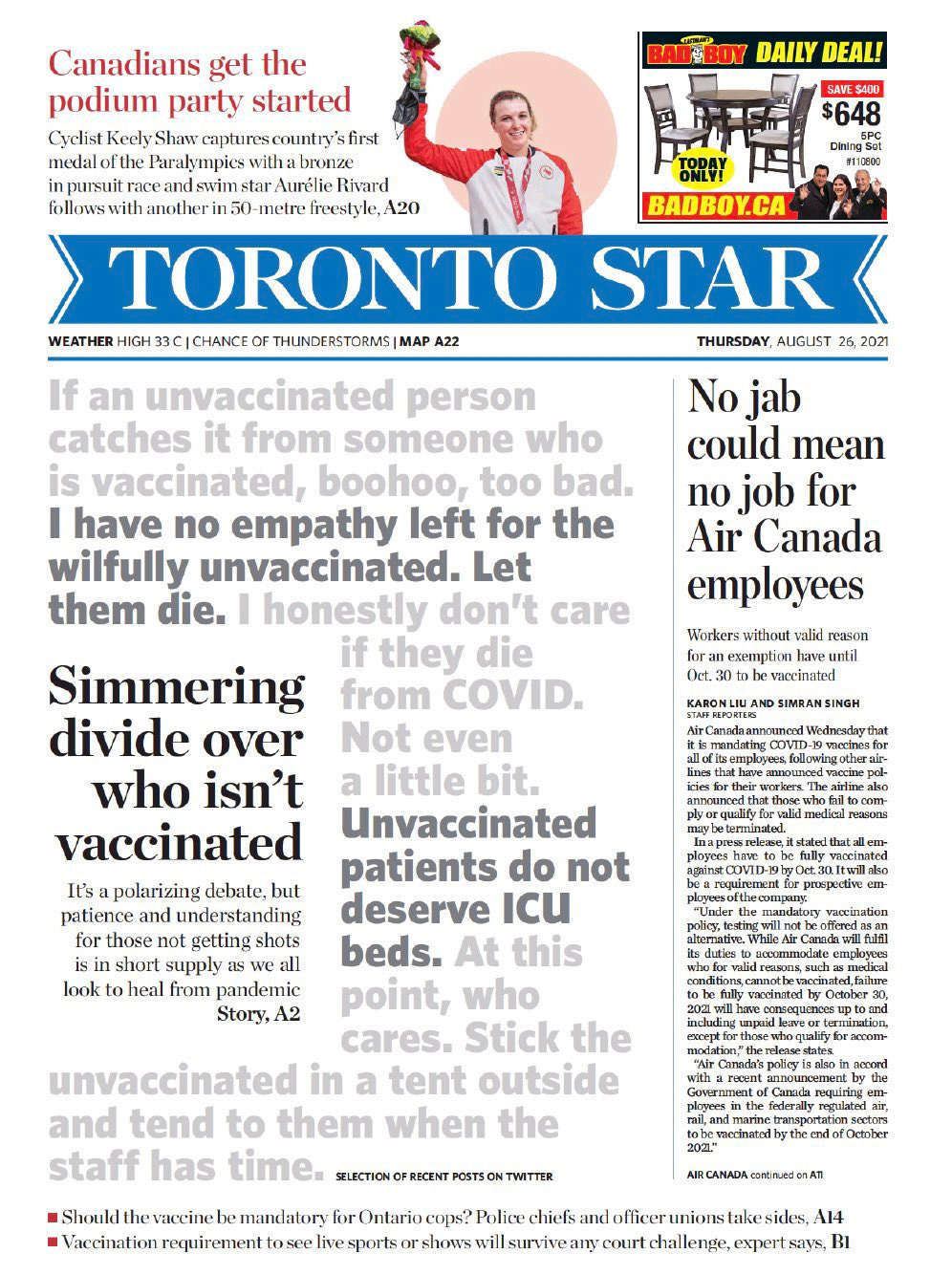
The statements on that front page were not attributed to fringe accounts. They were presented as a representative sample of Canadian public opinion — selected, formatted, and placed at the top of the country’s most widely read newspaper. “Let them die” and “unvaccinated patients do not deserve ICU beds,” printed in large display type, communicated a specific social verdict: that withholding care from people who had not been vaccinated was a position worth platforming and amplifying. This was August 2021, before BC’s mandate had been issued, before 3,325 healthcare workers had been placed on unpaid leave, before a single nurse had lost her career under this policy. The climate-setting was complete before the order was signed.
The most prominent political voice in that climate was the Prime Minister of Canada.
During the 2021 federal election campaign, Justin Trudeau made vaccine mandates a central platform — not as a narrowly technical public health measure, but as a moral and political one. On August 31, 2021, he stated: “They are putting at risk their own kids and they’re putting at risk our kids as well… What about my choice to keep my kids safe?” (CBC News, 2021a; Global News, 2021a). The construction frames the unvaccinated not as people making a personal medical choice but as a direct threat to children — an emotionally charged claim made at a moment when, as Post 6 documents, the world’s leading infectious disease official had privately recorded that there was “still no direct data either way” on vaccinated transmission (Fauci, 2026, p. 812).
On September 16, 2021, Trudeau escalated in a French-language interview with Radio-Canada. He described those who declined vaccination as: “These are extremists who don’t believe in science. They are often misogynists, also often racists. It’s a small group of people that muscles in and we have to make a choice… Do we tolerate these people?” (Trudeau, J., 2021). The characterisation of people who declined a medical product as “misogynists” and “racists” has no scientific basis. It is a moral condemnation of a defined group, deploying the language of social exclusion rather than public health.
On October 6, 2021 — eight days before BC’s PHO — Trudeau held a press conference announcing federal vaccine mandates (CPAC, 2021). The conditional logic was explicit:
“If you’ve done the right thing and gotten vaccinated, you deserve the freedom to be safe from COVID-19, to have your kids safe from COVID, to get back to the things you love.” (CPAC, 2021, at 10:42)
The implication — unstated but structurally unavoidable — was that those who had not done “the right thing” did not deserve those freedoms. On exemptions, he was direct: “Exemptions, whether they’re medical exemptions or otherwise, will be exceedingly narrow, specific, and to be honest, somewhat onerous to obtain… simply having a personal conviction that vaccines are bad will not be nearly enough to qualify for an exemption” (CPAC, 2021, at 30:14). Deputy Prime Minister Freeland, at the same event, framed the unvaccinated as an economic threat: “a minority of people cannot sabotage Canada’s economic recovery and cannot allow the fourth wave or other variants to cause real problems for us all” (CPAC, 2021, at 24:09).
Freeland’s “economic sabotage” claim warrants scrutiny it received only after the mandates had already been enforced. The assertion that unvaccinated workers were sabotaging Canada’s economic recovery was a demonstrably false factual claim: Canada’s economy had already recovered to pre-pandemic levels at the time she made it. As documented in these posts drawing on Statistics Canada’s own data: Canada Lost at Least $152 billions of Economic Activity Due to the Pandemic and Coercive Vaccine Mandates Were Predicated on Economic False Pretences, coercive vaccine mandates were imposed during a period of economic recovery, not economic peril — and the dismissal of thousands of workers was carried out against a workforce that had sustained essential services through the pandemic’s most dangerous months (Acker, 2023; Acker, 2024). The “economic recovery” Freeland framed the unvaccinated as threatening had already materialized. This was not a public health argument. It was an economic claim — and the evidence available to the government at the time did not support it. Like the transmission-risk framing examined throughout this series, the economic-sabotage framing supplied a justification for coercion whose factual basis could not survive contact with the government’s own statistical record. It constitutes a further instance of what this series has been documenting: a mandate whose stated grounds, examined against available evidence, do not hold.
These statements were made eight days before BC’s PHO terminated the employment of thousands of healthcare workers.
The private diary of the US National Institute of Allergy and Infectious Diseases Director places this rhetorical climate in international relief — not as evidence of what Canadian officials knew or coordinated, but as documentation that identical dynamics were operating simultaneously at the highest levels of North American public health governance at precisely the same moment.
The institutional contempt parallel. On September 29, 2021 — two weeks before BC’s PHO — Fauci recorded his response to Dr. Matthew Memoli, a senior NIH Clinical Center scientist who had publicly refused the NIH’s vaccine mandate. Memoli was a credentialed infectious disease researcher who had argued in formal correspondence that mass vaccination would select for variants, and had released his position paper to congressional committees and the press. Fauci’s characterisation in his personal diary:
“Matt Memoli has now gone completely rogue. He is turning into a complete Scott Atlas.” (Fauci, 2026, p. 889)
Earlier in the same entry, Memoli’s views are described as “the incredible nonsense that he is spewing” and “his craziness” (Fauci, 2026, p. 889). Fauci wrote that Memoli was “an infectious disease person who doesn’t want to vaccinate people, who thinks mandates are unethical” — framing his colleague’s scientific position as self-evidently absurd rather than as a legitimate scientific disagreement (Fauci, 2026, p. 889). The anticipated institutional outcome was termination: “The problem with this is that the new rule from the federal government is that if he does not get vaccinated he is going to get fired unless he has a religious exemption” (Fauci, 2026, p. 890). The institutional response was equally instructive: “We have decided that we are not going to do anything with him; we are not going to approach him; we are not going to even talk to him about this since I know from my experience that if we do anything, he will say that we are trying to muzzle him” (Fauci, 2026, p. 889). The management strategy for professional dissent was not engagement; it was strategic silence designed to prevent the dissenter from claiming suppression — while the institutional machinery of the mandate proceeded toward his dismissal.
Memoli was not a BC healthcare worker. His situation was at NIH. The value is the institutional parallel, not an identity of circumstances. Bonnie Henry’s “Probably not the right profession” and Anthony Fauci’s “gone completely rogue” own words describe the same institutional response to professional disagreement with vaccination policy: the dissenter’s position is not engaged on the merits; it is characterised as incompatible with the institution, and the institutional apparatus proceeds toward removal. The contempt that the Toronto Star printed and that Trudeau voiced on the national political stage had its private institutional counterpart in the diary of the man who led the US federal public health response.
The messaging architecture parallel. The September 8 diary entry reveals the political layer. On that date, Fauci was in the Oval Office reviewing Biden’s upcoming pandemic speech, and he recorded the messaging problem they were navigating:
“He was struggling with the issue of how we can say that the unvaccinated people or an impediment to where we want to go without discouraging the vaccinated people from feeling that even though they are vaccinated they are powerless to be able to lead a normal existence so long as the unvaccinated people are continuing to propagate the spread of the virus. I suggested to him that instead of saying that the 25% of the population that are unvaccinated are hindering the 75% of the population that are vaccinated, he should focus on the fact that the unvaccinated people are not harming the vaccinated people physically but they are preventing us from returning to a normal life.” (Fauci, 2026, pp. 868–869)
Fauci’s advice was explicit: do not say the unvaccinated are physically harming the vaccinated — because that framing is too direct and risks a messaging problem. Instead, frame them as an obstacle to collective return to normalcy. Trudeau did both. Freeland’s “a minority of people cannot sabotage Canada’s economic recovery” deployed the obstacle framing Fauci had recommended to Biden. But Trudeau also committed the violation Fauci had specifically warned against: his August 31 claim that the unvaccinated “are putting at risk their own kids and our kids as well” was exactly the direct-harm framing Fauci had counselled Biden to avoid, and his September 16 characterization — “extremists,” “misogynists,” “racists,” “do we tolerate these people?” — went further still, into a register of social condemnation for which there is no public health precedent. The social contempt that followed — the front-page “let them die” headlines, the “do we tolerate these people?” framing, the political polarization that culminated in the Freedom Convoy — was precisely the messaging problem Fauci had identified: when the framing shifts from “this group is impeding our return to normalcy” to “this group are moral pariahs whose social standing is in question,” the resulting contempt becomes politically ungovernable and detaches entirely from any legitimate public health rationale. The rhetorical architecture Fauci workshopped at the White House on September 8 was running at the federal Canadian podium on October 6 and at BC’s PHO signing table on October 14. There is no evidence of direct coordination. What the diary documents is a shared rhetorical frame operating simultaneously at the highest levels of US and Canadian public health governance — and in Trudeau’s case, an iteration of that frame that overran the very caution Fauci had himself prescribed.
The trajectory continued into 2022. In January of that year, as the Freedom Convoy gathered in Ottawa to protest federal vaccine mandates, Trudeau described the participants as a “small fringe minority” holding “unacceptable views,” and specifically characterised them as including “people who wave swastikas” (CBC News, 2022a). Workers who had lost their careers under the BC and federal mandates were among those supporting the convoy. The Macdonald-Laurier Institute, one of Canada’s most prominent policy research institutes, subsequently examined this episode in a broader assessment asking whether COVID vaccine mandates in Canada were a mistake — and raised the question that the front-page headlines, the “let them die” sentiment, and the “do we tolerate these people?” framing together provoke: whether the nation had momentarily set aside the central lesson of WWII’s history about what follows when official and media rhetoric designates a defined group as unworthy of equal moral standing (Macdonald-Laurier Institute, 2022). That question has not yet been answered with the seriousness it deserves.
That this framing was understood to be politically driven rather than scientifically grounded was stated publicly, including by medical professionals. Dr. David Jacobs, President of the Ontario Association of Radiologists, was asked about Trudeau’s “fringe minority” characterisation at a parliamentary committee hearing: “It was a uniquely unhelpful thing the prime minister did when he said that… It was politically driven. It did not help anyone in the health care industry. It did not convince anyone to change their mind” (Grewal, 2022; Western Standard, 2022).
Against the political and media campaign described above, the scientific institutions formally responsible for Canada’s vaccine policy declined to endorse coercive mandates and, in at least one case, explicitly endorsed the opposite.
Canada’s National Advisory Committee on Immunization (NACI) is the body mandated to advise federal and provincial governments on vaccine policy. At the House of Commons Standing Committee on Health (HESA) on March 23, 2022, NACI’s Medical Advisor, Dr. Bryna Warshawsky, was asked directly whether NACI had made any recommendation about vaccine mandates. Her answer: “NACI doesn’t make recommendations with regard to mandates. That’s provincial, territorial and federal jurisdiction. NACI provides recommendations with regard to what vaccines should be used and how they should be used for Canadians, but mandates are not within its scope” (Standing Committee on Health, 2022a). The governments that designed and enforced those mandates did so without a recommendation from Canada’s official national immunization advisory body.
At the same HESA committee session, Dr. Shirin Kalyan, Professor of Medicine at the University of British Columbia — BC’s own principal medical university — testified: “It is clear, especially with Omicron, that the vaccines we have cannot really be relied upon to prevent either transmission or infection… This really questions the validity of the current vaccine mandates for travel within and outside of Canada” (Standing Committee on Health, 2022b). A UBC Professor of Medicine was testifying before a House of Commons committee that BC’s own vaccine mandate framework rested on a premise the available evidence no longer supported.
At the federal level, Dr. Howard Njoo, Deputy Chief Public Health Officer of the Public Health Agency of Canada, told reporters on January 21, 2022 that vaccination should remain voluntary: “From a public health perspective, we want people to be sort of informed and make that a voluntary choice to get a vaccine” (True North, 2022; Blacklock’s Reporter, 2022). On the day he made that statement, BC’s mandate had been actively terminating healthcare workers for more than two months.
A closer examination of Dr. Warshawsky’s testimony reveals a distinction that governments imposing mandates have never directly addressed. When she told the HESA committee that mandates were “not within [NACI’s] scope,” she was describing a policy limitation — not a legal one. NACI has no statutory basis. It is not constituted by any Act of Parliament. It is an external advisory body established by, and reporting to, PHAC — specifically its Vice-President of the Infectious Diseases Programs Branch — under Terms of Reference that PHAC itself writes and can amend or rescind at will. No law creates NACI, because NACI was never constituted by law. Its current scope — vaccine science and programmatic advice, not coercive measures — is defined entirely by a policy document PHAC drafted for itself.
PHAC is an entirely different institution. PHAC is a statutory body, established and empowered by the Public Health Agency of Canada Act, S.C. 2006, c. 5. The Chief Public Health Officer created under that Act holds considerably broader mandate than the Terms of Reference PHAC assigned to NACI. The CPHO routinely makes public statements about masking, physical distancing, isolation requirements, and other restrictive measures during health emergencies, all within statutory authority. There is no provision of the Public Health Agency of Canada Act that barred the CPHO from stating a view — as an opinion, as a recommendation, as a public health determination — that mandatory vaccination would be effective in a given outbreak scenario. The CPHO did not make that determination. PHAC did not make that recommendation. That was a choice.
The significance of that choice cannot be overstated. NACI’s silence on mandates was not a constraint imposed by law; it was a limitation PHAC wrote into its own advisory body’s terms of scope, and PHAC could have amended those terms at any time. PHAC’s own silence was not a legal limitation either; it was a policy judgment by a statutory authority that possessed the power and the mandate to provide exactly the kind of scientific endorsement governments were claiming. When federal and provincial governments imposed mandatory vaccination without a recommendation from the body empowered by statute to provide that endorsement, they did not act on scientific authority. They acted in the absence of it — and presented as scientifically grounded a measure that Canada’s own statutory public health authority had declined to endorse. That gap between the claim of scientific necessity and the absence of any scientific recommendation from the institution empowered to supply it is a further demonstration of false pretence at the institutional level.
The picture this creates is precise — and it traces a pattern. Canada’s national immunization advisory body made no recommendation on mandates; its silence was a policy choice, not a legal constraint. The statutory authority that created NACI, and that possessed the power to make that recommendation, chose not to. BC’s own Professor of Medicine testified before Parliament that the existing mandates lacked evidentiary validity. The country’s Deputy Chief Public Health Officer said vaccination should remain a voluntary choice. And, as documented above, the Deputy Prime Minister’s economic rationale for those mandates — that unvaccinated workers were sabotaging Canada’s economic recovery — was deployed against a backdrop of economic recovery that the government’s own statistical record confirms had already occurred. The “extremist,” “misogynist” framing of those who declined vaccination was not derived from any of these scientific authorities. The economic justification was not grounded in the available economic data. What the public record produces, taken in full, is not an anomaly but a pattern: scientific claims and economic claims presented as grounds for coercion that the relevant authorities had not endorsed, and that the available evidence did not support.
The two Henry statements establish that animus existed. The next two sections do something different in purpose: they test whether the mandate’s stated public health rationale — transmission risk in healthcare settings — actually explains what the order did. This is the pretext inquiry. If the stated rationale fails that test, the animus evidence becomes more legally significant, because pretext is how discriminatory motive conceals itself in practice. A neutral-sounding public health justification that does not actually account for the pattern of enforcement is not a justification; it is a cover.
The pretext test has two dimensions. The first is consistency: did the transmission rationale apply equally to everyone it should have applied to?
If Henry had “very little patience” for unvaccinated workers because of transmission risk, one would expect that concern to apply equally to physicians, who have identical patient contact. Instead, as examined in Post 5, physicians were given five months of additional time, a softened compliance standard, and ultimately saw their mandate abandoned entirely (Vancouver Sun, 2022). Henry’s “very little patience” was expressed — and enforced — against nurses and hospital support staff. It was not enforced against physicians.
The only material difference between nurses and physicians is not their transmission risk, their patient contact, or their vaccination status. It is their union affiliation. Nurses are organized through the BC Nurses’ Union, which in December 2019 successfully challenged Henry’s flu vaccination policy in arbitration (Di Castri, Henry B., et al., 2020). Physicians are not subject to the same collective bargaining structures.
Henry’s own published papers identify unions as one of three “powerbrokers” whose cooperation determines the success or failure of coercive vaccination policies (Di Castri, Henry B., et al., 2020). When BCNU won in 2019, the union removed itself as a cooperative powerbroker. The 2021 PHO eliminated the accommodation BCNU had won. The differential enforcement — immediate termination for nurses, eventual abandonment for physicians — is consistent with an order targeted at a specific institutional relationship, not a neutral public health measure. The transmission rationale does not explain the differential. The union relationship does.
The second dimension of the pretext test is persistence: what happened to the mandate when its own author publicly abandoned the scientific premise that justified it?
On January 21, 2022, Dr. Henry publicly acknowledged that the Omicron variant required a fundamental rethinking, stating that “we have to change our way of thinking” and that the measures now appropriate were “much more like how we manage other respiratory illnesses even — influenza, RSV, or enteroviruses that cause the common cold” (as cited in Doak Shirreff Lawyers LLP, 2022, p. 1).
Henry was saying, in January 2022, that COVID-19 had evolved to behave like influenza. Yet BC’s influenza policy — the one BCNU challenged and won — permitted masking as an alternative to vaccination. If COVID was now like influenza, the logic of the flu policy should have restored the mask alternative and, with it, the employment of thousands of workers. Instead, in March 2022, Henry moved to expand the vaccine mandate to additional health professionals (Doak Shirreff Lawyers LLP, 2022, p. 1). She acknowledged COVID was like the flu; she simultaneously expanded a mandate far more extreme than anything BC had imposed during fifteen years of flu policy — against the same unionized workforce she had already described in the terms above.
A genuine public health rationale would have softened when the science it rested on dissolved. This one accelerated. The mandate was deepened at the precise moment its own author publicly abandoned its scientific premise. If transmission prevention was the real driver, dissolving the transmission premise should have dissolved the mandate. Instead, it expanded. That is what persistence of enforcement without persistence of rationale looks like. (Post 9 examines how Henry’s own January 2022 statement dismantled the mandate’s stated public health justifications point by point.)
The BC Human Rights Code, s. 13, prohibits discrimination on the basis of political belief in employment (Human Rights Code, R.S.B.C. 1996, c. 210). Political belief, as the BC Human Rights Tribunal held in Maatz v. Interior Health Authority, 2026 BCHRT 27, includes a sincerely held belief about government overreach in the context of medical autonomy (Maatz, 2026, paras. 15–16). The right to refuse healthcare on any grounds is codified in s. 4 of BC’s Health Care (Consent) and Care Facility (Admission) Act, R.S.B.C. 1996, c. 181. This is not a fringe position. It is the law of British Columbia.
When the decision-maker behind a public health order has expressed on two separate occasions that she has “very little patience” for the workers it targets, and those workers hold a political belief — codified in BC statute — about their right to make healthcare decisions for themselves, the elements of a political discrimination claim begin to assemble.
The broader context does not diminish that assembly. It intensifies it. A decision-maker who expresses animus toward a protected group is legally culpable regardless of whether others were expressing the same sentiment. What the national context establishes is something analytically distinct: the animus was culturally sanctioned and institutionally promoted, which means the usual professional check on such language — the awareness that expressing contempt for a protected group before making a decision adverse to that group creates legal exposure — was not operating. The normalization of contempt for the unvaccinated made it less likely that anyone inside the system would identify Henry’s statements as legally significant before the order was issued.
It is important to be precise about what the two Henry statements are and are not. Standing alone, they do not determine the lawfulness of the October 14, 2021 order — that question is addressed elsewhere in this series: Post 6 examines the five factual premises embedded in the order’s Whereas clauses and finds that not one survives contact with the available evidence, which is a separate and significant defect in an instrument whose legal authority rests entirely on the accuracy of those stated findings of fact. What the two statements do, independently, within the animus analysis, is this: Henry did not confine herself to the epidemiological case for immunization; she expressed a personal judgment about the worth and professional belonging of a defined group of workers — that she had little patience for them, and that they were probably in the wrong profession. She did so as the very official who would decide their fate, on the day their removal was announced. In the language of the Fraser analysis, this is the kind of contemporaneous expression a tribunal treats as circumstantial evidence that a protected characteristic was a factor in the adverse treatment. It does not have to be the only factor. It has only to be one of them.
The Physician Contradiction and the Omicron Contradiction bear on a further legal question — one that human rights law does not fully capture, but that the Criminal Code of Canada does. Section 361(1) of the Criminal Code defines a false pretence as “a representation of a matter of fact either present or past, made by words or otherwise, that is known by the person who makes it to be false and that is made with a fraudulent intent to induce the person to whom it is made to act on it” (Criminal Code, R.S.C. 1985, c. C-46, s. 361(1)). The order’s Whereas clauses are representations of fact — specific findings that the PHO stated as the legal basis for what followed. Post 6 documents that the central transmission-risk premise was backed by no records in the Province’s possession and was privately unresolved at the international level. The Physician Contradiction shows that the stated transmission rationale was not applied consistently to everyone it should have applied to. The Omicron Contradiction shows that the mandate was expanded precisely when Bonnie Henry publicly dissolved the scientific premise underlying it. Whether the gap between the stated factual premises and the evidentiary record — taken together with the pattern of selective and accelerating enforcement — meets the standard set out in s. 361 is not a conclusion this series draws. It is a question the record makes impossible to ignore.
The next post turns from what Henry said about the workers to what her own orders said about the mandate — and shows how, within five weeks, the second order quietly contradicted the first.
Acker, L. (2023, December 23). Coercive vaccine mandates were predicated on economic false pretences [Substack post]. Freedom and Investing. https://freedomandinvesting.substack.com/p/truckers-vindicated-by-statistics-canada
Acker, L. (2024, January 21). Canada lost at least $152 billions of economic activity due to the pandemic [Substack post]. Freedom and Investing. https://freedomandinvesting.substack.com/p/canada-lost-at-least-152-billions
Blacklock’s Reporter. (2022, January 21). Deputy chief public health officer says vaccination must remain voluntary [News report].
CBC News. (2021, November 1). COVID-19 in British Columbia: November 1, 2021 [News article]. https://www.cbc.ca/news/canada/british-columbia/covid-19-bc-nov-1-2021-1.6232619
CBC News. (2021a, August 31). Trudeau calls out ‘anti-vaxxers’ for putting kids at risk as campaign event is disrupted by protesters [News article]. https://www.cbc.ca/news/canada/sudbury/trudeau-sudbury-laurentian-election-stop-1.6159866
CBC News. (2022a, January 26). Trudeau describes unvaccinated as ‘fringe minority’ with ‘unacceptable views’ [News article]. https://www.cbc.ca/news/politics/trudeau-unvaccinated-canadians-covid-hospitals-1.6305159
CPAC. (2021, October 6). PM Trudeau and Deputy PM Freeland announce mandatory vaccination for federal public servants [Video recording, CPAC press conference].
Criminal Code, R.S.C. 1985, c. C-46.
Di Castri, A. M., Halperin, D. M., McPherson, C. M., Nunn, A., Farrar-Muir, H., Kwong, J. C., & Henry, B. (2020). Narrowing the policy gap: Lessons from years 2 and 3 of the British Columbia influenza prevention policy. Human Vaccines & Immunotherapeutics, 16(6), 1354–1363. https://doi.org/10.1080/21645515.2019.1692561
Doak Shirreff Lawyers LLP. (2022, March 2). Letter to the BC Ministry of Justice and Attorney General re: expanding vaccine mandates [Legal correspondence]. https://www.scribd.com/document/886877023/AGBC-Expanding-Vaccine-Mandates-2022-03
Fauci, A. S. (2026, July 25). Tony’s diary package [Personal diaries, released by U.S. Senate Subcommittee on Investigations]. Senate Committee on Health, Education, Labor, and Pensions. https://www.paul.senate.gov/wp-content/uploads/2026/07/2026.07.24_Tonys-Diary-Package.pdf
Fraser v. BC Ministry of Forests, Lands and Natural Resource Operations (No. 4), 2019 BCHRT 140. https://www.canlii.org/en/bc/bchrt/doc/2019/2019bchrt140/2019bchrt140.html
Global News. (2021, July 27). “I have very little patience for people who aren’t immunized in health care”: Dr. Bonnie Henry [Video]. https://globalnews.ca/video/8064533/i-have-very-little-patience-for-people-who-arent-immunized-in-health-care-dr-bonnie-henry
Global News. (2021a, August 31). Trudeau condemns anti-vax protesters, accuses them of endangering others [News article].
Grewal, S. (2022). Doctor criticizes Trudeau’s ‘unhelpful’ comments on the unvaccinated. Toronto Sun. https://torontosun.com/news/local-news/doctor-criticizes-trudeaus-unhelpful-comments-on-unvaccinated
Health Care (Consent) and Care Facility (Admission) Act, R.S.B.C. 1996, c. 181.
Human Rights Code, R.S.B.C. 1996, c. 210.
Maatz v. Interior Health Authority, 2026 BCHRT 27. https://www.canlii.org/en/bc/bchrt/doc/2026/2026bchrt27/2026bchrt27.html
Macdonald-Laurier Institute. (2022). COVID vaccine mandates in Canada were a mistake: Are we ready to learn the right lessons? https://macdonaldlaurier.ca/covid-vaccine-mandates-in-canada-were-a-mistake-are-we-ready-to-learn-the-right-lessons/
Public Health Agency of Canada Act, S.C. 2006, c. 5.
Standing Committee on Health. (2022a). Evidence, Meeting No. 12, 44th Parliament, 1st Session [Testimony of Dr. Bryna Warshawsky, Medical Advisor, National Advisory Committee on Immunization]. House of Commons of Canada. https://www.ourcommons.ca/DocumentViewer/en/44-1/HESA/meeting-12/evidence
Standing Committee on Health. (2022b). Evidence, Meeting No. 12, 44th Parliament, 1st Session [Testimony of Dr. Shirin Kalyan, Professor of Medicine, University of British Columbia]. House of Commons of Canada. https://www.ourcommons.ca/DocumentViewer/en/44-1/HESA/meeting-12/evidence
Toronto Star. (2021, August 26). Front page [Newspaper front page, print edition]. Toronto Star Publishing. Available via PressReader: https://t.prcdn.co/img?file=10382026080300000000001001&page=1&width=360&retina=2
Trudeau, J. (2021, September 16). Interview by J. Snyder [Television interview]. In La semaine des 4 Julie. Productions J; Noovo.
True North. (2022, January 24). Public health deputy chief says vaccination must remain a voluntary choice. https://tnc.news/2022/01/24/public-health-deputy-chief-says-vaccination-must-remain-a-voluntary-choice/
U.S. Senate Subcommittee on Investigations, Committee on Health, Education, Labor, and Pensions. (2026, July 25). Reading room [Government document portal]. https://www.paul.senate.gov/readingroom/
Vancouver Sun. (2022, March). Hospital workers say double standard at work as doctors not forced to get vaccinated. https://vancouversun.com/news/local-news/hospital-workers-say-double-standard-at-work-as-doctors-not-forced-to-get-vaccinated
Western Standard. (2022). ‘Unhelpful’ when Trudeau called unvaxxed a ‘fringe minority,’ health committee hears. https://www.westernstandard.news/news/unhelpful-when-trudeau-called-unvaxxed-a-fringe-minority-health-committee-hears/article_36c8d184-c5f8-599a-8867-754847bebdd6.html
Comments
Nothing yet. Say the first thing.
Sign in to join the conversation.