
BC Healthcare Workers & Political Discrimination Series
How do you measure whether a vaccination policy worked? The obvious answer is to look at disease outcomes. Did fewer patients contract influenza? Did fewer healthcare workers fall ill? Were hospitalizations reduced? These are the questions epidemiology exists to answer, and they are the questions a public health measure must ultimately be judged against.
Dr. Bonnie Henry has a different answer — and she put it in writing. In a 2020 paper she co-authored in Human Vaccines & Immunotherapeutics, she wrote, “The success of these types of policies in preventing influenza is difficult to measure. In the absence of a measure of influenza prevention, success has been described as high vaccine coverage and staff support for the policy” (Di Castri, Henry B., et al., 2020).
Read carefully, that sentence is extraordinary. Dr. Henry concedes that success cannot be measured by the stated public health objective — preventing influenza. And so success is redefined. It becomes compliance: high coverage rates, and staff acceptance of the policy. Under this definition, a policy that coerces workers into vaccination is “successful” precisely when those workers comply — regardless of whether a single patient is actually protected from illness. The metric is obedience, not health.
This is not the first time in this series that a senior public health official has said the quiet part plainly. In the second post, Dr. Patty Daly — Chief Medical Health Officer for Vancouver Coastal Health — was recorded conceding, one day before the terminations began, that the mandatory vaccination policy "was not designed to prevent transmission but rather to create an incentive to improve vaccination coverage and get higher vaccination rates" (as cited in Doak Shirreff Lawyers LLP, 2022, p. 2). Dr. Henry's written formulation and Dr. Daly's spoken one converge on the same admission. Dr. Henry says success is "high vaccine coverage and staff support"; Dr. Daly says the objective was "to create an incentive to improve vaccination coverage." Two of the province's most senior public health figures, in different registers, described the same policy in the same terms — as an instrument for driving up a coverage number, not for demonstrably interrupting disease.
Here it is worth naming an interpretation the reader can weigh: this is the reasoning of an official for whom the policy has become the objective, rather than the health outcome the policy was meant to serve. When success is defined as adherence to a measure — rather than by the measure’s effect on disease — the official has adopted the frame of mind of an advocate committed to a program, not that of a scientist testing whether the program works. That is a disposition, not a crime; but it is the disposition that makes every subsequent decision in this series legible. Once compliance is the goal, resistance becomes the problem to be solved — and the people who resist become the obstacle.
This was not an isolated turn of phrase. Dr. Henry co-authored at least three published papers studying British Columbia’s influenza vaccination-or-mask policy (Di Castri, Henry B., et al., 2020; Henry B., Manuel et al., 2002; Henry B., McPherson et al., 2018). Read together, they reveal a systematic, decades-long project to implement and refine coercive healthcare-worker vaccination as a management tool — with unions, physicians, and the Ministry of Health identified as the three key “powerbrokers” whose cooperation was necessary to make the policy stick (Henry B., McPherson, et al., 2018).
That framing matters, because it tells us how the architects of the policy understood their own task. This was not, on the evidence of the papers, primarily a scientific exercise in measuring disease reduction. It was an exercise in institutional change management: identifying the actors who held power, and figuring out how to bring them onside.
There is one more fact worth keeping in view about the origins of this body of research. Both of the case-study papers were themselves products of the same public health establishment whose policy they examined. The phase 1 qualitative study and its years-2-and-3 follow-up were funded by the Public Health Agency of Canada and the Canadian Institutes of Health Research, under the same grant number, PIR 124309 (Di Castri, Henry B., et al., 2020; Henry B., McPherson, et al., 2018). That provenance by itself should inform how the reader understands them. The research documenting, evaluating, and refining the coercive framework was commissioned and financed by the federal public health apparatus that promotes such immunization programs. It is, in that sense, the policy studying itself.
Why would a public health official define success as compliance rather than as disease prevented? The most parsimonious explanation — offered here drawn from Dr. Henry’s own published record — is that she had known for the better part of two decades that the measurable public health payoff of influenza immunization programs was thin, and that coverage was the one metric that could reliably be made to move.
The record supporting that inference begins long before the BC policy. In 2002, Dr. Henry co-authored a study in the Canadian Journal of Emergency Medicine asking whether Ontario’s newly launched universal influenza immunization program — a $38-million initiative, the first of its kind in the world — could reduce emergency department volume (Groll & Henry, 2002). Examining five tertiary-care hospitals across five influenza seasons, the study found that influenza accounted for just 0.34% of emergency department visits, that acute upper-respiratory illness accounted for only 4.4% of visits during flu season, and that there was no significant correlation between community influenza rates and emergency department (ED) volume. Bonnie Henry’s and Groll’s conclusion was blunt: “Based on this study, a universal influenza immunization campaign is unlikely to affect ED volume” (Groll & Henry, 2002).
It is important to state precisely what that paper does and does not say. It is a study of emergency department volume, not a wholesale verdict on influenza vaccination — and the authors are careful on exactly this point, allowing that “while universal influenza immunization may have health benefits for a population, it is unlikely to reduce ED volumes or overcrowding” (Groll & Henry, 2002). The narrow, documented finding is that one widely promoted justification for mass influenza immunization — relieving pressure on hospitals — was not borne out in the data. The broader reading is that Dr. Henry understood early in her career how difficult it is to demonstrate concrete population-level benefits from these programs.
That difficulty surfaced again in Dr. Henry’s own evaluation of the BC policy. In 2019, she was a co-author of a study in Vaccine measuring the impact of the province’s mandatory vaccinate-or-mask policy on healthcare-worker absenteeism (Henry B., Murti et al., 2019). The logic of the test is simple: if the policy worked as advertised — fewer infected workers, fewer sick days — absenteeism during influenza season should have fallen after the policy took effect. It did not. Using payroll and sick-time records for more than 130,000 healthcare workers across seven BC health authorities, the study found that the predicted mean sick rate during influenza season actually rose slightly after the policy, from 4.392% to 4.508%, and that among workers who did take sick time, the amount taken during flu season was roughly 4% higher post-policy (rate ratio 1.038, 95% CI 1.030–1.045) (Henry B., Murti et al., 2019).
The one metric that moved decisively was coverage. Over the same period, vaccination rates among acute-care staff climbed from 40% to 75%, and among long-term-care staff from 57% to 79% (Henry B., Murti et al., 2019). The compliance goal was met; the health-outcome goal — measured here as reduced absenteeism — was not. Bonnie Henry et al. are cautious, attributing the year-round rise in sick time to factors beyond the policy and calling for further research. But the pattern is precisely the one the “success is compliance” formulation would predict: the number that could be made to move was coverage, and so coverage became the measure of success.
Read against that backdrop, the observation that healthcare workers took more sick time during flu season after the policy is hard to reconcile with the policy’s public health rationale. A measure justified as protecting patients by keeping the workforce healthy did not, on Dr. Henry’s own data, produce a workforce that was demonstrably healthier or more present. The coverage number rose; the outcome the coverage was supposed to buy did not follow it.
In the phase 1 qualitative case study, Dr. Henry and her co-authors identify three groups of “powerbrokers”: the Ministry of Health, physicians, and unions (McPherson et al., 2018). The word choice is significant. A “powerbroker” is not a scientific body. It is a political actor — an entity that controls levers of institutional influence. Dr. Henry’s published framework for implementing vaccination policy is, on its face, explicitly political: it asks who controls the levers of institutional power, and how those actors can be maneuvered into supporting the policy.
The papers do not shy away from the resistance this project encountered. On physicians, the phase 1 study records:
Non-physician participants frequently identified physician response as challenging during policy implementation. It was unclear how the physician group was engaged in planning for the policy, beyond medical health officers. Participants commented that some physicians took issue with the ‘enforcement’ nature of the policy; some openly resisted the policy and questioned the evidence for policy effectiveness. (Henry B., McPherson et al., 2018)
And, more pointedly: “Participants also explicitly referred to many physicians as engaging in a ‘power play’ when some threatened to withdraw their services if vaccination was required” (Henry B., McPherson et al., 2018).
The resistance was not limited to physicians. The papers document that clinicians across professions — including nurses — objected to the policy on scientific grounds. As the 2020 paper records: “Physicians and nurses were consistently identified by participants as groups that continued to resist the policy due to doubt about the scientific evidence supporting it” (Di Castri et al., 2020).
One participant quoted in the research put the scientific objection in stark terms:
“There’s not great evidence that this is an appropriate policy. What is out there is being pooh-poohed by our public health but without just saying that this is a biased study, well really, Cochrane is biased? And then what is put forward as being the source of truth is from an equally or you could argue more biased source.” (Participant 21) (Di Castri et al., 2020)
The reference to Cochrane is telling. The Cochrane Collaboration produces what is widely regarded as the gold standard of systematic reviews in medicine — rigorous, transparent syntheses of the available evidence. When frontline clinicians cited Cochrane reviews as evidence against the flu vaccination policy, Dr. Henry’s framework did not engage that evidence as a legitimate scientific challenge. It treated the clinicians’ skepticism as a barrier to be overcome. The paper itself notes that the Ministry of Health’s evidence “had been held up in arbitration” (Di Castri, Henry B., et al., 2020) — a reference to the very arbitration proceedings, described in the previous post, that the BC Nurses’ Union would eventually win.
The papers are candid about the nature of the coercion. Dr. Henry’s research explicitly describes the policy as a “policy of choice but with consequences” — and defines those consequences as reaching up to termination (Di Castri, Henry B., et al., 2020). This is not the language of public health persuasion. It is the language of employment discipline. The “choice” on offer is illusory when the consequence of refusing is the loss of one’s livelihood.
An earlier study in the same body of work quotes its own survey data on healthcare worker attitudes, and the workers’ understanding of the arrangement is revealing: “Additional findings from the focus groups suggest that HCWs believe that the main purpose of influenza vaccination programs is to protect residents’ health at the expense, potential harm, and burden of responsibility of the staff” (Henry B., Manuel et al., 2002).
The workers understood exactly what was being asked of them. They were being told to bear a personal risk — without, in their view, full disclosure of what that risk was — in service of a goal defined increasingly in terms of coverage and compliance. Their objection was not ignorance. It was informed disagreement about who bears the burden of a policy whose benefits, as the papers concede, are “difficult to measure” (Di Castri, Henry B., et al., 2020).
There is a natural experiment buried in this history, and its results are unambiguous. What happened to flu vaccination rates when Dr. Henry’s coercive framework was finally dismantled?
The BC Centre for Disease Control tracks annual influenza immunization rates by occupational group (BC Centre for Disease Control, n.d.). From a pre-pandemic average of approximately 75%, vaccination rates among BC healthcare workers collapsed once the coercive structure was gone. By the 2023–24 season, the influenza vaccination rate among physicians had fallen to 17%, and among nurses to 37% (BC Centre for Disease Control, n.d.).
These are not the vaccination rates of a workforce that was persuaded by evidence and chose to protect its patients. They are the rates of a workforce that had been coerced, and that — the moment the coercion was lifted — voted with their arms. The dramatic drop is itself evidence for the point Dr. Henry’s own papers concede: that “staff support for the policy” was never genuinely won. Compliance had been extracted, not earned, and it did not survive the removal of the consequences.
Dr. Henry’s published research presents a coherent theory of institutional change. In that theory, compliance is the metric, “powerbrokers” are the targets, and professional scientific skepticism is a barrier to be managed rather than a challenge to be answered. It is a theory about how to make a policy succeed politically — not about whether the policy prevents disease, a question her own papers acknowledge is “difficult to measure” (Di Castri, Henry B., et al., 2020). And, as her own earlier and later research suggests, it is a theory built by someone who had reason to know the measurable health payoff was elusive — from the emergency-department data in 2002 to the absenteeism data in 2019 (Groll & Henry B., 2002; Henry B., Murti et al., 2019).
That theory was rejected by Arbitrator Hayes in 2015. It was challenged and defeated by the BC Nurses’ Union in 2019. And in October 2021, rather than being abandoned, it was escalated — the accommodation removed, the consequence sharpened from a mask to a termination.
Placed on a single timeline, the public record can be read as one continuous trajectory: from identifying unions as “powerbrokers” to be managed, to advocating “consequences” for the non-compliant, to — after two institutional defeats — the vaccinate-or-terminate order and the language of professional exclusion. The reading of these events as a single escalating pattern is the author’s interpretation; each individual entry is drawn from the public record cited throughout this series.
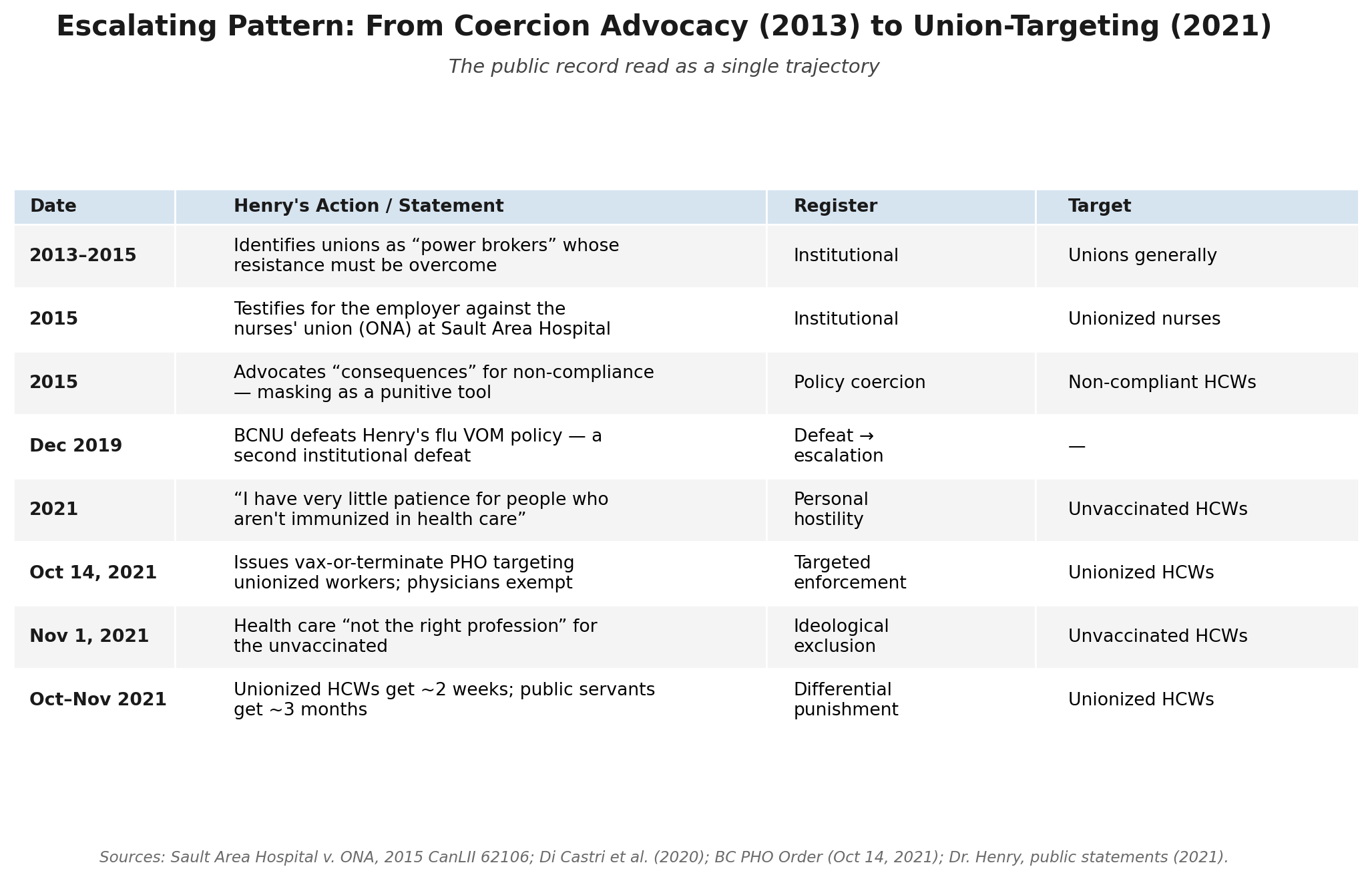
Figure 1. The characterization of “register” and “target,” and the framing of the sequence as a single trajectory, are the author’s; the underlying statements, rulings and orders are on the record. Sources: Sault Area Hospital v. ONA, 2015 CanLII 62106; Di Castri, Henry B., et al. (2020); BC PHO Order (Oct. 14, 2021); Dr. Henry, public statements (2021).
The next post examines the mechanics of that escalation, and the question it raises with unusual clarity: why did nurses have eleven days to comply, while physicians had five months?
BC Centre for Disease Control. (n.d.). Immunization data reports. http://www.bccdc.ca/health-professionals/data-reports/immunizations
Di Castri, A. M., Halperin, D. M., McPherson, C. M., Nunn, A., Farrar-Muir, H., Kwong, J. C., & Henry, B. (2020). Narrowing the policy gap: Lessons from years 2 and 3 of the British Columbia influenza prevention policy. Human Vaccines & Immunotherapeutics, 16(6), 1354–1363. https://doi.org/10.1080/21645515.2019.1692561
Groll, D., & Henry, B. (2002). Can a universal influenza immunization program reduce emergency department volume? Canadian Journal of Emergency Medicine, 4(4), 245–251. https://doi.org/10.1017/S1481803500007466
Manuel, D. G., Henry, B., Hockin, J., & Naus, M. (2002). Health behavior associated with influenza vaccination among healthcare workers in long-term-care facilities. Infection Control & Hospital Epidemiology, 23(10), 609–614.
McPherson, C. M., Halperin, D. M., Henry, B., Di Castri, A. M., & Kwong, J. C. (2018). Examination of the British Columbia influenza prevention policy for healthcare workers: Phase 1 qualitative case study. Human Vaccines & Immunotherapeutics, 14(8), 1883–1889. https://pmc.ncbi.nlm.nih.gov/articles/PMC6149879/
Murti, M., Otterstatter, M., Orth, A., Balshaw, R., Halani, K., Brown, P. D., Hejazi, S., Thompson, D., Allison, S., Bharmal, A., Dawar, M., Hoyano, D., Lee, V., Naus, M., Pollock, S., Bevanda, J., Coughlin, S., Fitzgerald, J., Keen, D., . . . Henry, B. (2019). Measuring the impact of a mandatory province-wide vaccinate-or-mask policy on healthcare worker absenteeism in British Columbia, Canada. Vaccine, 37(30), 4008–4014. https://doi.org/10.1016/j.vaccine.2019.06.007
Comments
Nothing yet. Say the first thing.
Sign in to join the conversation.