
In the last installment of Tell-Tale Tuesdays, I looked at “Hop-Frog,” one of Edgar Allan Poe’s final published stories. For this week, I thought I’d go back to the beginning and take on his first published story, “Metzengerstein.”
As much as I love Poe, there are stories of his that I don’t care to read, and this is one of them. It tells the tale of two houses, a prophecy, and a young baron. Frederick Metzengerstein has inherited the mantle of his family and immediately plunges into debauchery. One night, as he ponders the tapestry of one of his ancestors that seems to reach out for him, the stables of the rival Berlifitzing family go up in flames. That very same day, a strange, fiery horse, similar to the one in the tapestry, appears at the estate. It is, at first, believed to have escaped from the Berlifitzing stables, but when they fail to claim it, Frederick does. He develops a total obsession for the horse, which leads to his ultimate ruin.
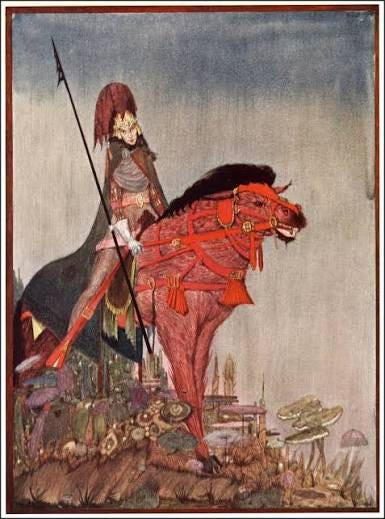
There’s a good story in there, but ultimately, it’s not very well told, or at least not up to the level that I expect of Poe. It is the yarn of a young writer who has not yet honed his craft to a razor’s edge. It shows a great deal of promise of what’s to come but falls far from the mastery that he would achieve in later years.
The text is dense and more than a bit detached from the tale, delivered more as historical account than a story. There are passages that seem to wander wordily. While no one would ever accuse Poe of being terse or even mildly conservative in his prose even at the height of his career, “Metzengerstein” seems to be rife with superfluous descriptions and asides that don’t add much to the tale and really send the reader in a different direction.
Somewhere in the middle of the story, we begin to see flashes of Poe as we know him, and it also contains the ambiguity that he would come to master, leaving more questions unanswered than not. It’s my understanding that he revised this story many times over the course of years. I’m honestly not sure whether the version in my collection is the final, but it matches pretty well with one that I found online which claims to be the final.
“Metzengerstein” is certainly worth reading, but there’s also a reason that this is only the second time over the years that I’ve read it. Will I revisit it again? Probably not.
No posts
Comments
Nothing yet. Say the first thing.
Sign in to join the conversation.