
We are two days from the Feast of the Dormition of the Theotokos. This Fast has been walking us, all month, toward a single, sustained meditation.
\What does it look like when a human life is so thoroughly given over to God that even the body itself becomes the vessel of His glory? We saw it on Mount Tabor. We are about to see it again at the falling asleep of the Mother of God.
Today St. Paul gives us the theological backbone for the whole thing.
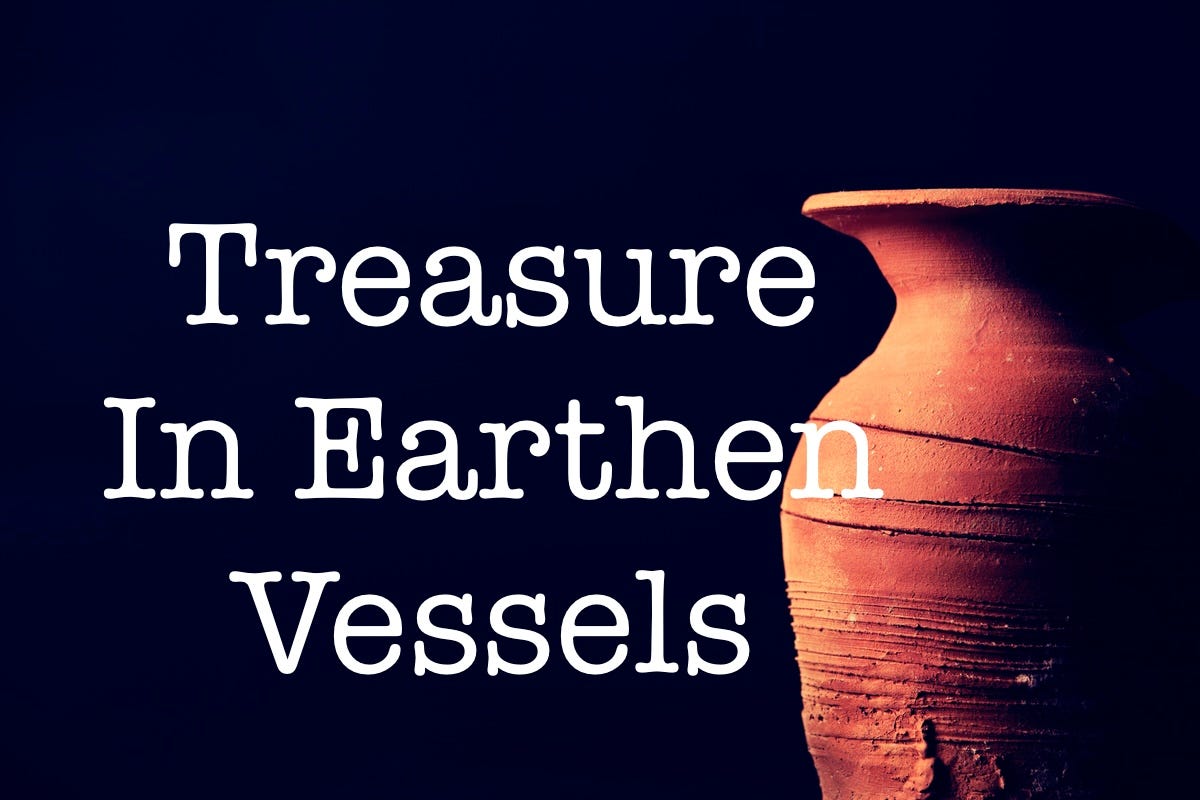
“We have this treasure in earthen vessels, to show that the transcendent power belongs to God and not to us.”
He is writing to the Corinthians, a congregation gifted enough to be dangerous. They had spiritual experiences, articulate speakers, impressive displays. And Paul, who founded that church and loves it, keeps having to remind them that none of that is actually the point.
The point is not the vessel. The point is the treasure inside it.
Brethren, having this ministry as we have received mercy, we do not lose heart. We have renounced disgraceful, underhanded ways; we refuse to practice cunning or to tamper with God’s word, but by the open statement of truth we would commend ourselves to every man’s conscience in the sight of God. And even if our gospel is veiled, it is veiled only to those who are perishing. In their case the god of this world has blinded the minds of the unbelievers, to keep them from seeing the light of the gospel of the glory of Christ, who is the likeness of God. For what we preach is not ourselves, but Jesus Christ as Lord, with ourselves as your servants for Jesus’ sake. For it is the God who said, “Let light shine out of darkness,” who has shone in our hearts to give the light of the knowledge of the glory of God in the face of Christ.
But we have this treasure in earthen vessels, to show that the transcendent power belongs to God and not to us. We are afflicted in every way, but not crushed; perplexed, but not driven to despair; persecuted, but not forsaken; struck down, but not destroyed; always carrying in the body the death of Jesus, so that the life of Jesus may also be manifested in our bodies. For while we live we are always being given up to death for Jesus’ sake, so that the life of Jesus may be manifested in our mortal flesh. So death is at work in us, but life in you.
St. Paul is not writing this from comfort. He is writing it from the middle of genuine suffering, real affliction, real persecution.
And he is not writing it to complain. He is writing it to explain something that only makes sense from inside the Faith. Weakness is not an obstacle to the Gospel. It is where the Gospel, the Good News, becomes visible.
First, real integrity means refusing every shortcut, even the ones that would make ministry easier.
“We have renounced disgraceful, underhanded ways; we refuse to practice cunning or to tamper with God’s word.”
This is St. Paul drawing a hard line. He could manipulate. (Don’t we all have experiences of religious manipulation?) He is clearly intelligent enough to do it skillfully. He could tamper with the message to make it more palatable, more marketable, more likely to draw a crowd in Corinth, a city that prized rhetorical performance above almost anything else. He refuses.
This reminds me of what a dear friend of mine told me when I was about to convert to Orthodoxy. He admitted that the Orthodox were “probably right” but, and these were his words, “it’s not marketable!”
This is the same integrity we have been circling around all month, the difference between shrewdness and wisdom, between manipulation and genuine love. St. Paul commends himself “to every man’s conscience in the sight of God.” Not through clever packaging. Through open, unadorned truth.
This costs him something. The open statement of truth is rarely the easiest path. But it is the only path that actually transmits what he received rather than a performance of it.
Next, the treasure is Christ, and the vessel carrying Him is meant to be humble precisely so the power is unmistakably His.
“We have this treasure in earthen vessels, to show that the transcendent power belongs to God and not to us.”
An earthen vessel, in St. Paul’s world, was a cheap clay pot. Ordinary. Breakable. Nothing anyone would admire on its own. And Paul says this is exactly what we are, and exactly why the arrangement works.
If the container were impressive, we would credit the container. Because the container is cracked, ordinary, and obviously insufficient on its own, whatever light shines through it can only be credited to the “Treasure” inside. This is Paul’s whole theology of weakness. Not weakness as a spiritual technique to be admired for its own sake, but weakness as the precondition for the glory being unmistakably God’s rather than ours.
This is what the Theotokos herself embodies most fully. She did not become the Mother of God because she was powerful, wealthy, or influential. She was a humble young woman in an obscure village. And precisely because the vessel was so utterly surrendered and so utterly ordinary, the world got to see, unmistakably, that the power belonged to God. Her Dormition, which we are about to celebrate, is the completion of this pattern: the earthen vessel, having carried the treasure faithfully her whole life, is finally glorified completely, body and soul, because she never once tried to make the glory about herself!
Now, stop reading for a moment and let that insight seep deep within you!
Finally, affliction does not have the final word, because the life of Jesus is being manifested precisely in and through the suffering, not despite it.
“Afflicted in every way, but not crushed; perplexed, but not driven to despair; persecuted, but not forsaken; struck down, but not destroyed.”
Notice the pattern. St. Paul does not say these afflictions do not happen. He says they do not have the final word. Every blow lands, and none of them finishes the job, because something else is happening simultaneously. The death of Jesus is being carried in the body precisely so the life of Jesus can be manifested in that same body.
This is the theological key to the entire Christian understanding of suffering. It is not that suffering is good in itself. It is that suffering, united to Christ, becomes the very place where His Resurrection life becomes visible. Paul is not describing a stoic endurance that grits its teeth and survives. He is describing something genuinely miraculous: a life so joined to Christ’s death and Resurrection that the affliction itself becomes transparent to the life shining through it.
This is the peace available to every Christian who has united their own suffering to Christ’s. Not the absence of affliction. The presence of Christ’s Resurrection life inside the affliction, unmistakable and undefeated.
Today we commemorate St. Maximus the Confessor, one of the greatest theologians in the history of the Church, who died on this day in 662 AD in exile in the region of Lazica, present-day Georgia. St. Maximus had been a high-ranking secretary to the Byzantine emperor before renouncing that career to enter monastic life. When the Monothelite heresy, which denied that Christ possessed a full human will alongside His divine will, gained the support of the imperial court, St. Maximus stood almost entirely alone in defense of Orthodox teaching.
For his refusal to compromise, his tongue was cut out, and his right hand was severed, so that he could neither speak nor write in defense of the truth. He was then exiled, where he died shortly afterward. At the time of his mutilation, he and a small handful of disciples were nearly the only voices in the entire Eastern Church still defending Christological orthodoxy.
St. Maximus is the living commentary on today’s Epistle. Struck down, but not destroyed. His body, an earthen vessel in the most literal and brutal sense, mutilated and broken, could not carry his message in the way it once had. And yet the truth he had defended outlived the empire that tried to silence him. Within a generation, the Church vindicated everything he had suffered to protect.
The treasure survived because it never depended on the vessel’s strength in the first place.
As we approach the Feast of the Dormition, take an honest look at where you have been trying to make the vessel impressive rather than letting the treasure shine through its cracks.
Where have you been relying on your own cleverness, your own strength, your own performance, rather than the open and simple truth of Christ? Where has an affliction in your life felt like the final word, when in fact it may be the very place Christ’s Resurrection life is trying to become visible?
Then pray simply:
“Lord Jesus Christ, I am an earthen vessel. Let the cracks in my life reveal Your treasure rather than my own inadequacy. Let whatever afflicts me become the place where Your Resurrection life is manifested, so that the transcendent power is unmistakably Yours.”
Being Orthodox on Purpose means embracing our weakness as earthen vessels so completely that the treasure of Christ within us becomes unmistakable, and trusting that affliction never has the final word where His Resurrection life is at work!
P.S. You are a guide of Orthodoxy, a teacher of piety and modesty, a luminary of the world, the God-inspired pride of monastics. O wise Maximos, you have enlightened everyone by your teachings. You are the harp of the Spirit. Intercede to Christ our God for the salvation of our souls.
A Special “THANK YOU” for your prayers for Fr. Barnabas and family as we traveled this summer. Fr. Barnabas and family are back from their pilgrimage in Greece and working with the Ionian Village Summer Camp program. Stay tuned for a special report about this amazing journey we will share with our paid supporters soon!
I Want to Join the Support Team!
Fr. Barnabas Powell is the parish priest at Sts. Raphael, Nicholas, and Irene Greek Orthodox Church in Cumming, GA. He is also the founder of Faith Encouraged Ministries and produces the Faith Encouraged Daily Devotional on Substack. Watch the Faith Encouraged YouTube Channel here - https://www.youtube.com/@FaithEncouragedTV

No posts
Comments
Nothing yet. Say the first thing.
Sign in to join the conversation.