
Listen to this from St. Peter of Damaskos: “Patient endurance kills the despair that kills the soul; it teaches the soul to take comfort and not to grow listless in the face of its many battles and afflictions.”
The despair that kills the soul. Powerful.
How often have I sat with someone so despondent they could only say, “What’s the use.” No wonder the Fathers name despondency among the deadly passions.
And I can already hear the objection. “Great, now even my depression is a sin.”
But remember what “sin” actually means from an Orthodox point of view. Not the breaking of a rule that makes God angry at you, but a wound that draws His loving healing toward you, if only you will let it. So how do we break the power of despondency over our lives?
“This slight momentary affliction is preparing for us an eternal weight of glory beyond all comparison.”
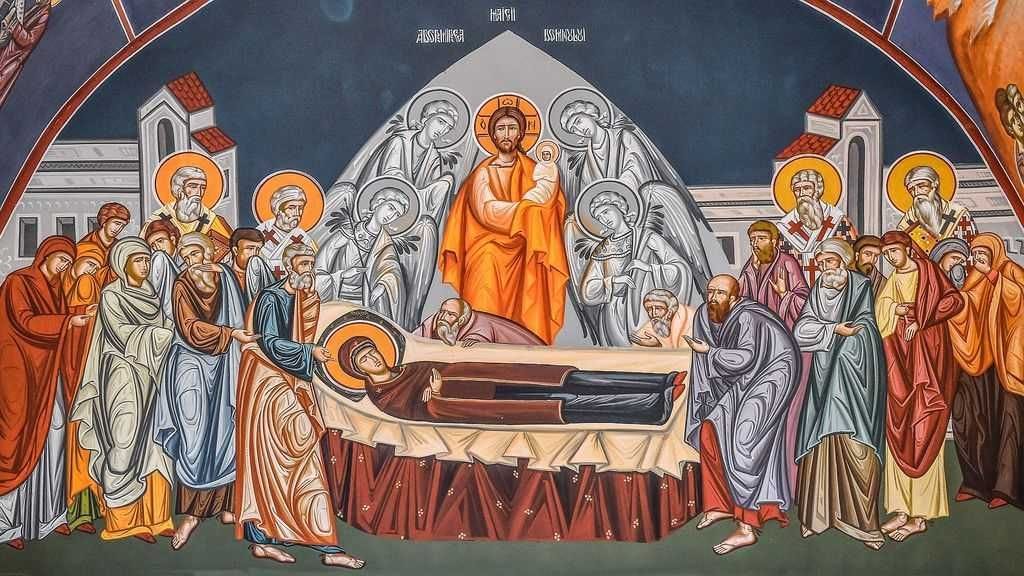
Tomorrow the Church celebrates the great Feast of the Dormition of the Theotokos, sometimes called the Summer Pascha, because it proves once again that Christ has conquered death, this time by receiving His own mother’s soul and body into heaven.
Today, on the eve of that feast, St. Paul hands us the theological key to defeating despondency for good.
Brethren, since we have the same spirit of faith as he had who wrote, “I believed, and so I spoke,” we too believe, and so we speak, knowing that he who raised the Lord Jesus will raise us also with Jesus and bring us with you into his presence. For it is all for your sake, so that as grace extends to more and more people it may increase thanksgiving, to the glory of God.
So we do not lose heart. Though our outer nature is wasting away, our inner nature is being renewed every day. For this slight momentary affliction is preparing for us an eternal weight of glory beyond all comparison, because we look not to the things that are seen but to the things that are unseen; for the things that are seen are transient, but the things that are unseen are eternal.
St. Paul is writing this while suffering real persecution for his ministry among the Gentiles. He had been a respected religious scholar with a secure future, and he threw it all away to preach an illegal religion built around a crucified carpenter.
Something kept him from despondency in circumstances that would have crushed most people. What did he know that we so often miss?
First, Paul kept his eyes fixed on the goal rather than on the storm, and that fixed gaze is what despondency cannot survive.
“We look not to the things that are seen but to the things that are unseen; for the things that are seen are transient, but the things that are unseen are eternal.”
My friend, Photios, used to tell me, “Believers believe. That’s just what believers do.”
Paul believed with his whole heart that God would finish the task of bringing him into His presence forever. His eye was fixed not on the affliction pressing in around him but on the destination waiting ahead of him.
Imagine how your own outlook would change if you took your eyes off the momentary trouble and fixed them on the actual goal of your life, to be God’s companion forever.
The first honest question worth asking is whether that is genuinely your goal, or whether you have quietly set the bar lower. If the bar has been lowered to mere comfort, mere survival, mere avoidance of pain, then despondency has an easy target.
Next, Paul knew that what could currently be seen was never the whole story, and that hidden reality made his present suffering bearable rather than merely tolerable.
Some who watched St. Paul’s life shook their heads. “What a waste. He threw it all away.” Paul knew this was not true.
His present difficulties were not “worthy to be compared” to what awaited him. And this was not wishful thinking or a coping mechanism. His hope for the future actually made his present life better. It made his troubles bearable. It made his heart rejoice, even in chains.
This is because St. Paul knew God was not going to waste a single tear, a single hardship, a single painful moment. Every dark moment was being transformed, even as it was happening, into “an eternal weight of glory beyond all comparison.”
With that kind of hope alive in the heart, despondency simply does not have room to operate. Despondency thrives on the lie that the present suffering is the whole story, the final word, the permanent condition. Paul refuses that lie because he has actually seen what lies beyond it.
Finally, the outer nature wasting away and the inner nature being renewed daily is not a contradiction. It is the very shape of Christian hope.
“Though our outer nature is wasting away, our inner nature is being renewed every day.”
This is happening simultaneously.
The body ages, weakens, and eventually fails. This is simply the reality of living in a fallen and mortal world.
But at the very same time, in the very same person, something else is happening. The inner person, the soul being formed by grace, is being renewed daily.
This is the Orthodox lifestyle in its essence. We are being acclimated to eternal life even while our mortal bodies continue their natural course toward death. The spiritual disciplines, prayer, fasting, almsgiving, confession, the Eucharist, are not merely coping mechanisms for enduring a difficult life.
This is the heart of the Good News. Not merely that death will eventually be undone, but that the renewal is already underway, today, in you, regardless of what your outer nature is currently experiencing.
Fighting despondency, then, is not a matter of willing yourself to feel better. It is a matter of committing seriously to the disciplines that actually renew the inner nature daily, so that the eyes stay fixed on what is unseen and eternal rather than on what is seen and passing away.
Today the Church begins the Forefeast of the Dormition, entering into the joy of tomorrow’s great feast a day early, just as we did before the Transfiguration. Tomorrow we will celebrate the falling asleep of the Theotokos, and her bodily assumption into the glory of her Son.
This feast is sometimes called the Summer Pascha because it is, in its own way, another proof of Christ’s total victory over death. If death could not hold the Mother of God, the one who bore Him in her own body, then death has genuinely and finally lost its grip on humanity itself. What happened to her is the pattern and the promise of what awaits every faithful soul.
This is the ultimate answer to despondency. Not merely a comforting idea, but a demonstrated reality, glorified this week in the calendar of the Church. The eternal weight of glory St. Paul describes is not abstract theology. It has a face. It has a Name.
And tomorrow the whole Church will leap for joy, clapping hands and shouting in radiant jubilance, because she has already arrived at what the rest of us are still journeying toward.
Today, if you are gripped by a lack of hope, if life has narrowed to the point where you see no way out, stop and do something genuinely difficult.
Refuse the lie that there is no hope. And then do the harder thing still: move toward freedom from despondency through the daily, unglamorous practice of the disciplines of the Faith. Prayer today, even a short one. A small act of almsgiving. An honest confession of where despondency has taken hold. These are not magic. They are the ordinary means by which your inner nature is renewed, day by day, until the eternal weight of glory becomes more real to you than the affliction pressing in right now.
Then pray simply:
“Lord Jesus Christ, renew my inner nature today, even as my outer nature wastes away. Fix my eyes on what is unseen and eternal, and let the hope of Your Mother’s glory, which awaits all who are faithful, break the power of despondency over my heart.”
Being Orthodox on Purpose means fixing your eyes on the unseen and eternal rather than the seen and passing away, trusting that every affliction is being transformed into an eternal weight of glory beyond all comparison!
P.S. In faith, O you people, leap for joy while clapping your hands; and gather in gladness on this day with longing and shout in radiant jubilance. For the Theotokos comes nigh to departing from the earth unto the heights; and we glorify her with glory as the Mother of God in our unceasing hymns
A Special “THANK YOU” for your prayers for Fr. Barnabas and family as we traveled this summer. Fr. Barnabas and family are back from their pilgrimage in Greece and working with the Ionian Village Summer Camp program. Stay tuned for a special report about this amazing journey we will share with our paid supporters soon!
I Want to Join the Support Team!
Fr. Barnabas Powell is the parish priest at Sts. Raphael, Nicholas, and Irene Greek Orthodox Church in Cumming, GA. He is also the founder of Faith Encouraged Ministries and produces the Faith Encouraged Daily Devotional on Substack. Watch the Faith Encouraged YouTube Channel here - https://www.youtube.com/@FaithEncouragedTV

No posts
Comments
Nothing yet. Say the first thing.
Sign in to join the conversation.