
At the outset, Andy Burnham said he would “spend political capital” on the quest for better care for the elderly. But building the ‘National Care Service’ he proposed when he was Gordon Brown’s Health Secretary requires plenty of financial capital, and he has none left to spend. It would cost £6bn a year for a country already living on the fiscal edge due to its inability to contriol spending. All this takes us to the first serious obstacle of the Burnham premiership.
The Prime Minister has spoken as if the real problem is one of political consent and he has tried cross-party consultation, pointing out how the Tories and Labour have both promised this reform. A brief history:-
In 1997 Blair set up the Sutherland Commission which, recommended free personal care across the UK; only Scotland did it.
Gordon Brown’s ‘National Care Service’ proposed when Burnham was Health Secretary in 2009. It was dropped amid the “death tax” row of the 2010 election.
The Dilnot Commission returned with a plan in 2011 which David Cameron legislated for, only to halt at implementation.
Theresa May put a version of it in her 2017 manifesto and abandoned it within days: the “dementia tax” row cost her a majority. Finishing the job was a 2019 Tory pledge, never honoured.
Boris Johnson raised a tax and legislated for £86,000 cap in 2021, his successors unwound both concluding it would cost a bomb and not add a single bed.
So is it time to get it done with one final heave?
Dementia is a cruel disease, placing a huge burden on families and spouses: in my family, and millions of others. To many, care is in crisis. But to cap the costs of care homes for a country with a burgeoning over-80s population was a financial stretch when the idea was proposed by Dilnot. Since then, the spending has spiralled pushing a tax burden to post-war high. It’s crushing growth and living standards. We don’t have the capacity to do the basics, let alone embark on a new NHS for care homes. This is a brutal truth, but a truth nonetheless.
When we see a crisis, we borrow rather than fix. Louise Casey, author of the latest official review into all this, writes in The Times says that “these are difficult questions…”
…but this country has fixed difficult problems before. The NHS was created in the aftermath of war. During the pandemic, we showed again that, when the moment demands it, this country can act with urgency to find bold solutions to national challenges. The lesson of our history is not that big problems are impossible to fix; it is that we can only do so when governments take responsibility, the country faces them honestly and the public have a real say in the answer. We now need to do in peacetime what previous generations did in wartime: face the problem and fix it.
She is right to say we have faced two big recent challenges - Great Financial Crisis and in Covid. Our response was to borrow our way out of the problem. We printed and borrowed money on a staggering scale, and that’s why we’re a mess now.
The Bank of England’s balance sheet keeps the score: quantitative easing built to £375bn through the crisis years and the lockdown era drove it towards £900bn. Unwinding that is the work of years, not months - the balance is still above £600bn today. New money is easy to conjure in a panic; the real resources for a permanent new arm of the state are far harder to find.
When the UK massively borrowed cash on international markets, it do so with a fatal sweetener: we offered lots of inflation-protected safety deals. More than any G7 nation. It was our way of getting the debt away: saying that, if inflation went up, we’d pay more interest. The UK government became a massive hedge on inflation not going back up. When it did (the UK now has the G7’s worst inflation) the bill for all of our previous borrowing came in.
Look at the below: it shows the gap between expectations and reality. Back in 2022, the OBR thought we’d be paying £34bn in debt interest by now. But rates returned, globally, and it hit £115bn in 2022/23. The need to find that extra cash has crushed public finances. Oddly, this is never spoken about in Westminster in spite of it being the main fiscal fact. The main political strategy has been to pretend it’s not happening.
The grey lines above show the varying OBR forecasts. First we thought low rates would take debt interest to a multi-decade low, in spite of all of the debt! Then we thought it would spike, but return very low. Only at the last estimate has reality bit. And that reality is horific.
Rather than belt-tightening, the UK government is still already living way beyond its means - with spending far in excess of tax raised - because successive governments have discussed “fiscal headroom” (how they can max out borrowing) rather than balancing a budget. For Burnham to talk about the next big splurge now indicates he is still adjusting to all this.
This time, we’re not getting away with it as much. Markets are nervous: they see a debt-addicted country showing no sign of breaking its addiction. Every debate seems to be ‘how can we spend even more?’ The UK is now being charged more interest on its borrowing than any G7 country. If this spikes, Burnham will be facing a fiscal crisis.
The fiscal imperative is defence: that needs to be remedied before we can discuss more welfare. It’s worth remembering that another side effect of this QE was asset inflation which pushed house prices up and ended up concentrating wealth amongst pensioners. Leaving homeowners far better placed to meet shocks. Is it too much to expect millionaires to cover the costs of their own personal care? Some 22pc of pensioners have assets of over a million pounds. Before the GFC it was 14pc (in today’s money).
What’s more, I’m not sure that more care homes is the obvious future of our society: the world offers other models of looking after the elderly in their final years, especially within families. Nor is it clear that such homes should be free at the point of use. A relative of mine is in a care home in Sweden, and the family is paying about £1,000 a month for first-class care. It’s privately-run and subsidised by the local authority. I’m not sure that the UK model deserves more cash to be poured into it.
‘The prerequisite of any solution,’ said the 2019 Tory manifesto, ‘will be a guarantee that no one needing care has to sell their home to pay for it’. So it is framed here not as healthcare but an asset protection scheme. This is where it gets problematic: should the average person with average assets (£180k) pay more tax to protect the estate of millionaires and their families?
The Kings Fund, an outfit arguing for higher health spending, explicitly expresses the problem in terms of asset erosion with a graph showing how various schemes would protect assets of the wealthy. The biggest savings go the richest people.
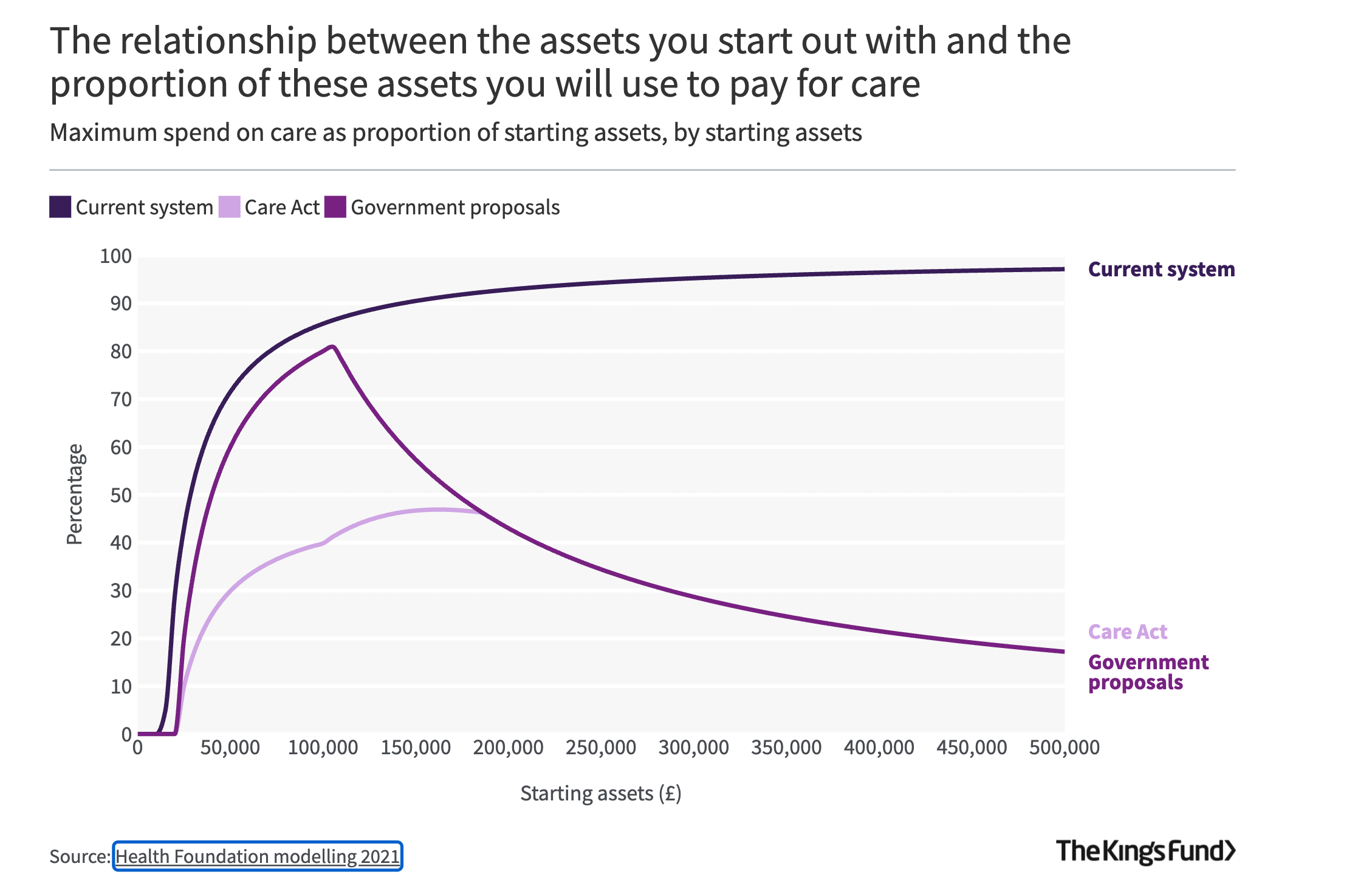
It could well be that asset protection does become a function of the UK welfare state, but when we cannot afford to defend the realm it can’t take priority.
A leading article in The Times put it well:-
Mr Burnham’s response is that England requires an NHS-style “National Care Service”. That model would cost an estimated £18.5 billion a year. It is simply unfeasible and overlooks more efficient alternatives….If Mr Burnham is to stay true to his party’s fiscal pledges, he will face another tough problem: persuading defiant Labour MPs that significant spending cuts are in order.
My guess is that Burnham, too, will realise this and that his consultation on social care will be over quite soon.
Comments
Nothing yet. Say the first thing.
Sign in to join the conversation.