
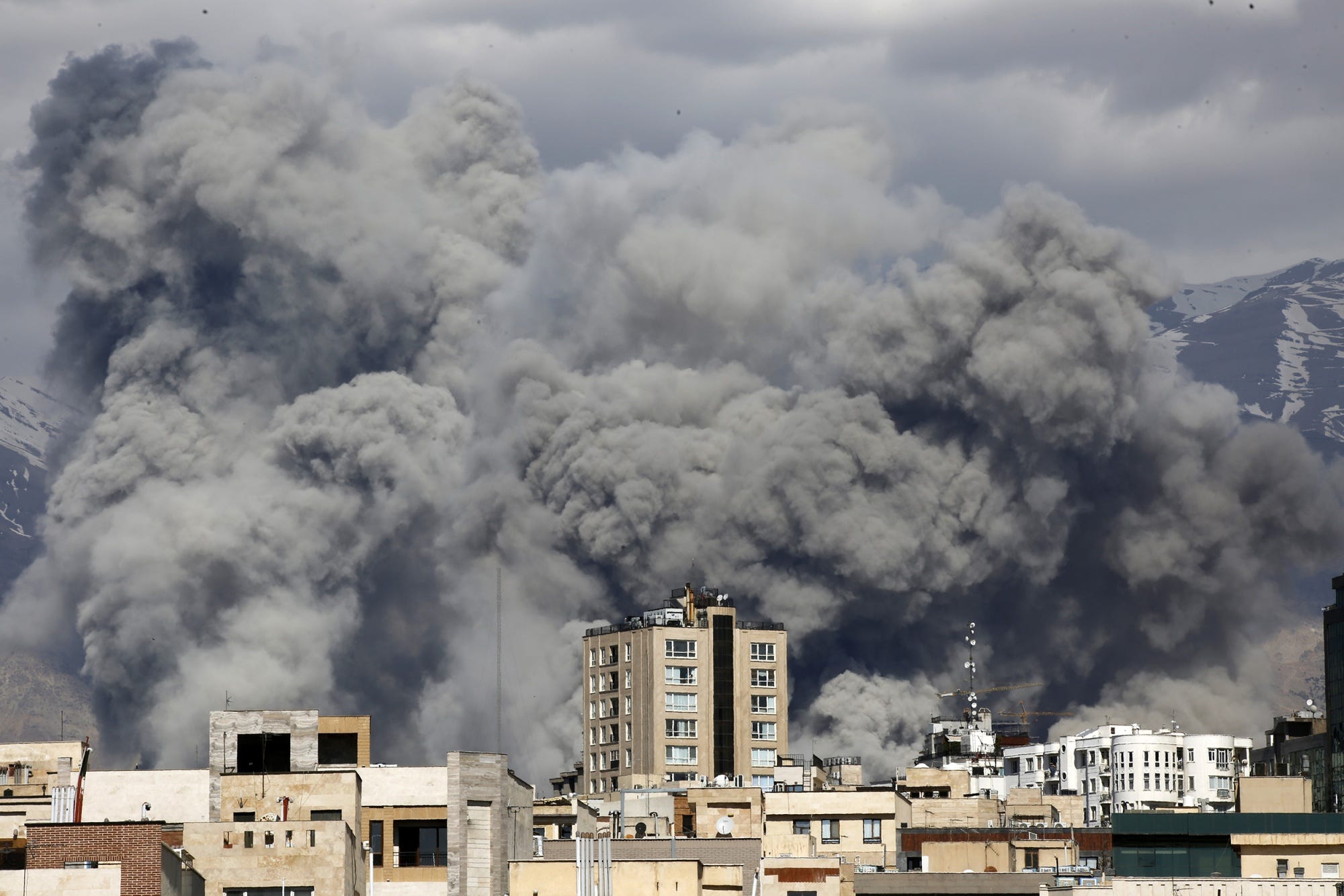
2,300 are dead across the Middle East as a result of our new war, most in Iran. At least 13 American soldiers are dead. As we leave the third week of war, there are no signs of it slowing down — Trump yesterday asked for $200 billion more in funding for the war in Iran, despite poll after poll suggesting the majority of the US public is not interested. There’s a lot to say about it all, so we pulled together a bit of recommended reading to help make sense of it all.
On the “sale” of war:
Eskandar Sadeghi-Boroujerdi in the London Review of Books on the lack thereof this time: “The rhetorical labour that accompanied the invasion of Iraq, however flawed or dishonest, has largely been abandoned. Even senior US military officials have struggled to explain how the campaign’s objectives would be achieved swiftly or decisively. The assumption of inevitability has replaced the burden of argument.”
Peter Feaver last year warned us about Trump’s inclination to disregard public support saying — “Every other president has tried to make strong public arguments for why they’re doing it, and present evidence and testify in Congress and do all these things to try to make the public case. And this administration has not done that.”
Politico had an interesting piece this week on the communications front the White House has decided to engage with: “A second senior White House official who is also closely involved in the video-making effort described it as a collegial, creative endeavor. ‘We’re over here just grinding away on banger memes, dude,’ said the person, also granted anonymity to speak candidly. ‘There’s an entertainment factor to what we do. But ultimately, it boils down to the fact that no one has ever attempted to communicate with the American public this way before.’”
In a pertinent series of 1991 essays titled The Gulf War Did Not Take Placet, French sociologist and philosopher Baudrillard argued that the virtual has overtaken the actual so that it was hard to distinguish between the experience of what truly happened in the conflict, and its stylized, selective misrepresentation: “The media promote the war, the war promotes the media, and advertising competes with the war. Promotion is the most thick-skinned parasite in our culture. It would undoubtedly survive a nuclear conflict. It is our Last Judgement. But it is also like a biological function: it devours our substance, but it also allows us to metabolise what we absorb, like a parasitic plant or intestinal flora, it allows us to turn the world and the violence of the world into a consumable substance. So, war or promotion?”
On the longstanding legacy of American wars this one builds off of:
Séamus Malekafzali on the legacy of Obama’s drone wars in The Drift: “When questioned about drone strikes on boats in the Caribbean on December 2, Republican Speaker of the House Mike Johnson hit back with an obvious response: ‘One of the things I was reminded of this morning is that under Barack Obama, President Obama, he had — I think there were 550 drone strikes on people who were targeted as enemies of the country, and nobody ever questioned it.’”
Our interview with Samuel Moyn last year on how we have made an effort to make war less brutal, and in doing so, have abandoned some of our moral outrage: “Barack Obama, in his Nobel Peace Prize address, says, “I’m not bringing peace. People are too evil for that.” His new goal, a more believable one, is control and domination, and the achievement of strategic ends and self-defense with less violence than before. And what does that say about us? I think what it says about us is that we are less willing to give up our desire for control than we are our desire to inflict bodily harm.”
And on the implications of these wars. We often revisit our interview from earlier this year with J.G.P. MacAdam, a veteran and an incredible writer, on his time in Afghanistan: “I’m not a pacifist, but I do wonder whether war as political violence—or even just violence—really does always have a political end. Some violence doesn’t seem to have any political purpose at all. The violence I took part in, in Afghanistan, didn’t have any real diplomatic or political end game, aside from the paper veneer of democracy in Afghanistan, or whatever we were trying to do there, I’m still trying to figure that one out.”
And on the economic motivations that underly it all:
We spoke last fall with Michael on the post-war economic order the U.S. maintained dominance over: “This was the creation of the International Economic Order after World War II, the post-war economic order. This refers to the set rules and institutions, chiefly the IMF and the World Bank and the GATT, that form the basis of post-war global finance and trade, and that generally privilege the United States above all countries and the global north over the global south.”
And Edward Ongweso Jr. had great reporting this week on how the U.S. is trying to maintain that dominance (with A.I. as its new oil), how this war is jeopardizing the infrastructure maintaining this set up, and who continues to benefit: “The system persists not because it benefits “America” or “Saudi Arabia” in the aggregate but because it benefits the specific people who control capital allocation in both countries: American financial elites get cheap capital inflows, Gulf ruling families get a safe liquid store for their surpluses and a political relationship with the world’s dominant military power. Fault lines run along class, rather than national, lines.”
No posts
Comments
Nothing yet. Say the first thing.
Sign in to join the conversation.