
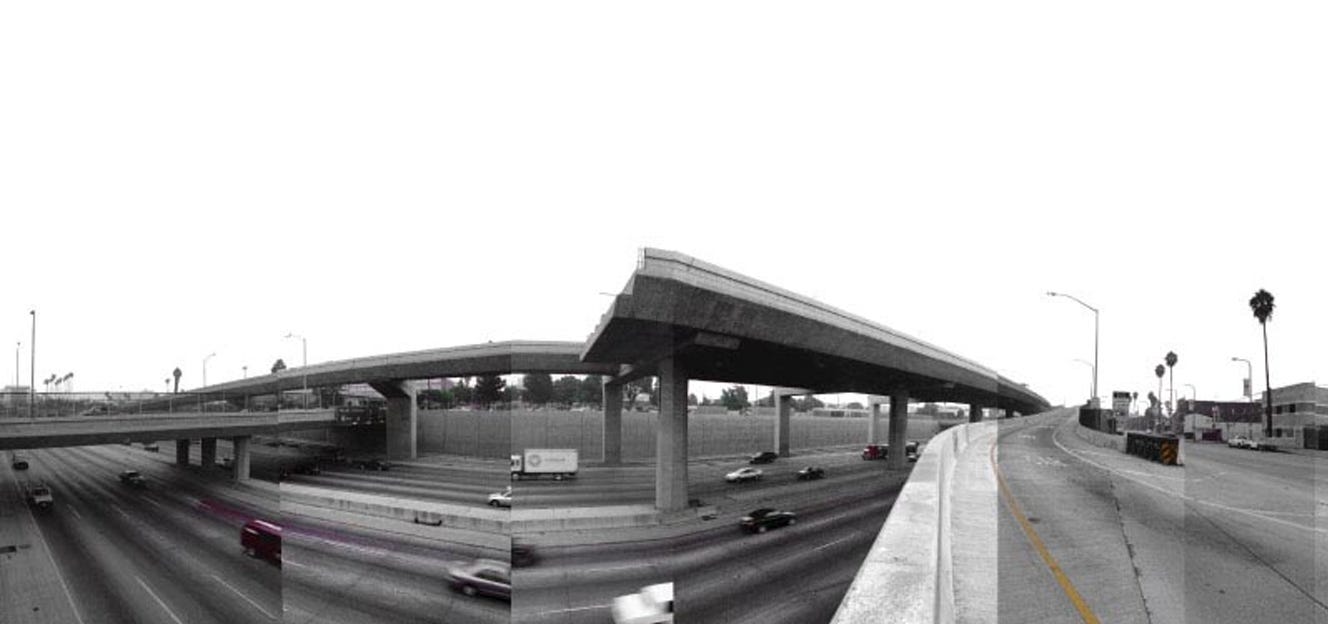
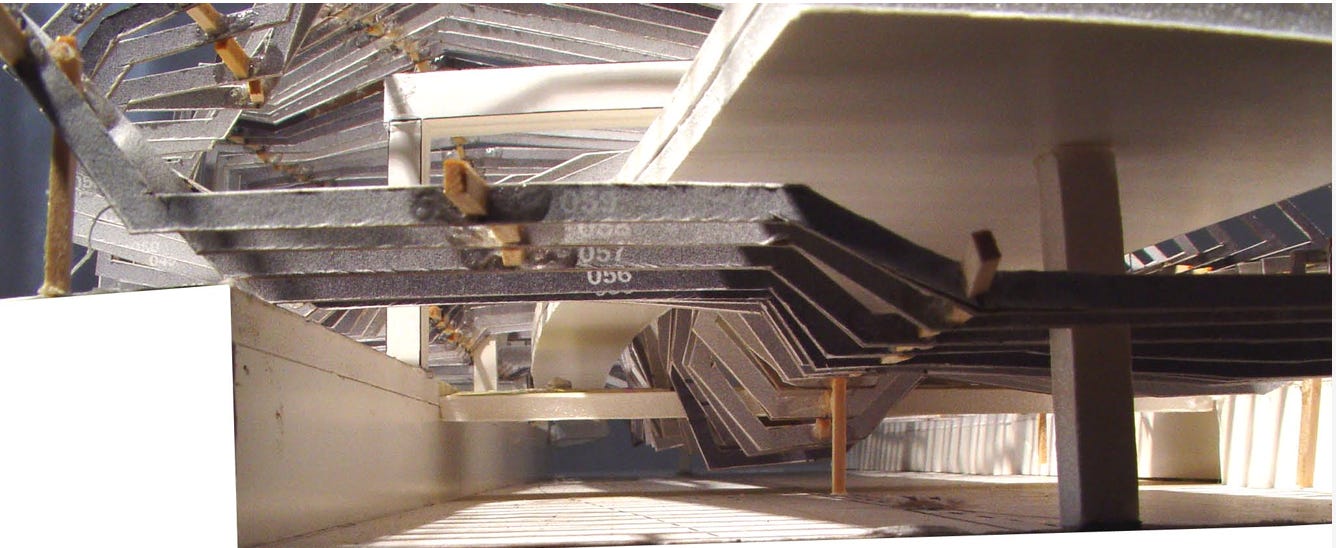
Our interview today is with architect and designer Daveed Kapoor, continuing our Place Issue. Kapoor is a wealth of knowledge on the regulatory make-up that underpins the design of Los Angeles, and we had a lot of fun getting into the weeds with him. We spoke about “Concrete Utopia”, cars as suits, and the Federal Highway Administration.
This interview was conducted by Noelle Forougi for franknews, and condensed for clarity. Help keep frank free and for the public by subscribing below or donating here.
Can you start by introducing yourself, your work, your background?
I’m Daveed Kapoor. I’m an architect. I’ve been practicing architecture in Los Angeles since around the year 2000. Our practice is called utopiad.org — pretty cheesy name we came up with when I was a young kid. “Ad” plus “utopia,” which is actually Latin for “no place.” It’s all about this path towards an ideal future through pragmatic practice in the present.
I had all these grand designs when I went to architecture school; utopian projects like turning the city into a park, with buildings inside forests of columns with public trails. But my practice has been doing bars and nightclubs, residential projects, as well as a lot of placemaking work like parklets and plazas.
We created some of the first parklets in Los Angeles — which is converting parking spaces into public open space, and underutilized portions of the roadway into plazas, like Sunset Triangle Plaza. We created this People Street kit of parts for parklets and plazas. We also do houses, multi-family buildings, office buildings, commercial work, stuff like that.
How have you seen the urban planning and design landscape change over the roughly 20 years you’ve been working here? Or not changed?
It really has changed. Making streets more for people instead of cars, embracing public transportation, biking, walking, park space — there’s been so much investment in creating public open space. It’s not all from the design community as much as it is from public health and social justice people, but everything is much more integrated. In the past 20 years I’ve seen a lot of cross-disciplinary collaboration, a blurring of lines between landscape and architecture.
But I would say that architects in the United States are one of the weakest professions. If you compare to Switzerland, architects are building the buildings themselves and designing the city — that’s what I got into it for. I thought, we’re going to shape the city. But actually here it’s real estate developers and city planners with the power.
What’s the difference in how that’s set up in other places?
It’s all about a hyper-capitalist mode of development where real estate prices need to constantly increase. And architects aren’t really about that. We’re just trying to make good, lasting places so people have good places to live. But we have this system of property lines. Maybe other societies don’t have as rigid separations.
You look at an American downtown, and you see all these separate towers. It would be structurally feasible to interconnect them, sharing egress and connecting levels, but that would require sharing, and it’s just legally impossible unless you buy all the properties yourself or have some agreement.
Or, if there was a stronger city planning from the top down?
We actually have a very strong city planning component. LA is an over-planned city. There are so many public planning reviews here. Our public process is really onerous, and the people who show up are the people who can afford to show up. It’s not really representing the interest of the community — most people are just too busy to even know about these things, and they’re not participating. So it’s a privileged few. It’s a nuts process.
Meanwhile, in Denmark, in Scandinavia, they are creating these green street networks with no cars, trees, stormwater capture, shade, bike and public transport infrastructure, even toilets. Why aren’t we doing that?
Why aren’t we? I get the capitalism argument of it all. But on a more local level…
No.
He breaks it down well in that book. LA is just a microcosm of the whole nation.
If you look at how the roads are developed – since the New Deal the Federal Highway Administration has been converting local streets into highways – funded by the federal gas tax. Once a road receives a federal-aid designation, it qualifies for federal funding, but those dollars require increasing speed limits. The auto and oil industry lobbied heavily for this – knowing they would make more money if the roads are faster. This rubric still exists.
I was a pedestrian advocate for a decade with Los Angeles Walks. We were trying to mobilize residents to request these safety improvements in their neighborhoods. Everyone wants a crosswalk, but they can’t do it. Why? Because there’s this metric called level of service that roads have to live up to continue to receive federal funding. Basically, when you decrease vehicle speeds, by adding a crosswalk, you cause delay, which reduces the level of service, and then they lose funding for the roads.
How many roads does this affect?
L.O.S. was technically repealed from CEQA in 2019, however: transportation project planners will be allowed "discretion" on which measure to use--so they could choose to stick with the outdated and discredited Level of Service metric. From what I hear from my friends who work at LADOT, the engineers still hold on to their car-brain mindset. It applies in their minds to almost every street.
It’s totally crazy when you get into it. Which is why I’m just doing private developments now. I’m not doing city or public projects.
You find it harder to make a good project with public money and these federal-level regulations?
Yeah, it’s really structural. It comes from the federal level, from the way we get money to operate our cities and maintain our roads.
Joe Linton writes about this all in detail…. It goes all the way down to the way they’re not repairing asphalt, just patching it, because if they fully repave a street, they have to install pedestrian and bicycle facilities. Changing the configuration involves getting rid of parking, getting rid of vehicle travel lanes. A city council person will get murdered if they do that. And people in LA are really vicious about their parking spaces and their cars, because that’s the only form of mobility allowed here.
I mean, they have a transit system, I love it, it’s great, but it lets you down every time. I got stuck waiting 20 minutes yesterday for a trip that was supposed to come in one minute. It could work. It used to work.
Actually, let me show this diagram — I use it in every talk. It’s the history of LA roads.
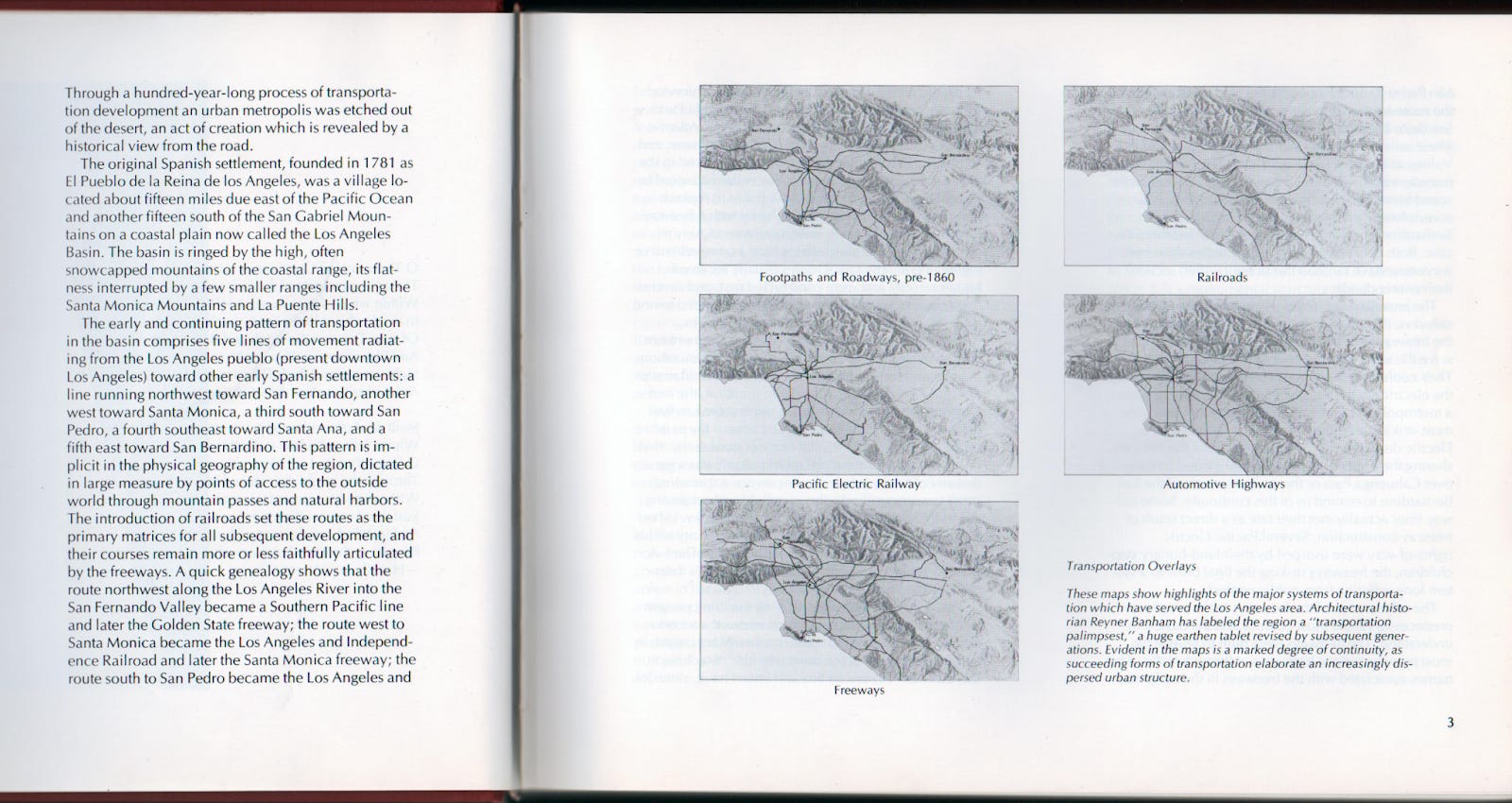
You know, it started with footpaths. The Spanish settled on existing paths; they walked on native trails. Then came the railroads. The Huntington streetcar system was built by real estate developers to sell land. They had these brochures: buy these plots, we’ll build a kit home for you. After they sold the land, they didn’t care about running the transit. It was never really public transportation. It was always a private system. The county tried to buy it, but Huntington wouldn’t sell. Then it went bankrupt around World War One, and service got crappy.
When cars came, traffic was already so bad people wanted to get rid of the streetcars. And there was this other force — LA was even then the number one oil-producing city in America, and we made a lot of cars. So buying a car was actually, like, sticking it to the rich railcar executives.
Tesla vibes.
Matthew Roth really documents all of this — it’s his PhD dissertation from USC’s history department. It’s really long but it’s awesome. I feel like someone should make a movie out of it. There’s just so much in it.
What ways are there, locally, to push back on this. I guess I’m always caught up in how complicated urban planning is as a lay person. It feels like there are solutions people always talk about, but we’ve already built the cities this way, and it’s going to take millions of dollars to change these things, and we barely have the will to pay for trees in LA.
What’s there to do? The train extensions are good, but until they run every six minutes and after midnight…
The worst enemy — and this is an American and global planning pattern — is Euclidean zoning. Do you know what that is?
Basically segregating residential and commercial uses in zoning?
Right. I understand where it came from — people didn’t want factories nearby — but we have so many other laws now that deal with toxicity.
And a lot of it is noise: there’s a history of LA city zoning ordinances limiting outdoor restaurant space. Why aren’t there more outdoor dining spots in LA? Because there was a rule that limited outdoor dining to 50% of your indoor dining area. It’s really hard to create a big outdoor space under that constraint, though there is some workaround now after the Covid Al Fresco program.
Getting rid of Euclidean zoning, and allowing residential and commercial to coexist, matters because not having food or commercial facilities in a residential neighborhood forces you to drive. But homeowners in LA don’t want that.
There’s a building in my neighborhood that used to be a shop, it got converted to housing, and now people want to convert it back. And neighbors are like, no way — someone’s going to come and park in front of my house. Cars are killing everything.
This obviously isn’t the biggest issue with cars, but since moving here — I am like, why are they so big? Why are we not driving something at least half the size?
Yes! That’s exactly what radicalized me against cars. It’s geometry — we don’t have space. Our roads aren’t getting bigger. You’re not going to tear down all these buildings. And cars are getting bigger. It’s the plague of our time.
People use their car as their suit. In New York, people invest in good clothes. Here, people invest in a good car, because that’s their suit. Which is pretty sad.
Even when you try to take something into your own hands – try to green the block for example, that proves challenging bureaucratically.
We are trying to plant a tree on our block and … actually, you will know the answer to this …. how do I dig up concrete to plant a tree and make sure I am not going to hit a utility pipeline or something?
Call Dig Alert. 811. They will come survey and make sure there’s no utilities before you dig.
There are also a lot of tree wells that have been paved over. People paved over them because there’s no city watering program for maintenance. Those are easy to reopen. You can tell by looking at the sidewalk — there’s often a patch. There’s supposed to be a tree well every 16 feet or so per street design standards, but in reality they’re not all there.
The Urban Forestry Department is so sad to work with. They do not care about planting more trees.
Why?
Because it’s more work for them. I’ve had meetings with them for new buildings and they’re like, this site should have nine trees, but right off the bat you’ve got a power line, a utility box, a driveway, a curb cut — so really you only need three. They’re not fighting for more trees, they’re fighting for fewer.
That is so crazy.
The person with the most power is your city council member. Figure out who that is, work with their field deputy for that zone — they may get back to you, or they might not. Make a campaign contribution and they’ll be a little more motivated <laughs.>
Yeah, people keep telling me the mayor is kind of a dead end job here.
Way less powerful than the New York mayor. City council members are far more powerful — they have their individual fiefdoms. It’s a weak mayoral system.
It was partly because the water engineer was really powerful — the DWP operates kind of like a public-private organization. And then there’s the Bureau of Engineering under Public Works, which includes sanitation, engineering, street services, street lighting, trees. They build the roads. But separately, the LA Department of Transportation paints the roads and controls the signals. In New York, DOT does both of those.
So what does that mean for the mayor and what decisions they can make?
If a mayor wanted to transform our roadways for people space instead of cars, they would face opposition stemming from the competing agendas of BOE and LADOT. Historically, as Matthew Roth detailed in Concrete Utopia, BOE has been obsessed with cars and has been the number one receiver of Federal Highway Admin money for road projects. They secure that money by increasing vehicle speeds through widening roadways or easing turn radiuses.
It’s all so dense.
The complexity is intentional — it obfuscates change and supports the existing status quo.
The planning code itself was formed by the wealthy to limit access to the city and ensure it stays as it is. Sorry, I’m getting deep into it.
No, no it’s all so helpful!
This is like a therapy session for me.
<Laughs> Happy to have you any time for one.
No posts
Comments
Nothing yet. Say the first thing.
Sign in to join the conversation.