

The most successful natural resource miners don’t believe Earth is 6000 years old. The truth is that gas companies, gold miners, and AI chip manufacturers depend on millions of workers who understand that the universe is billions of years old. If gas companies only hired religious fanatics, they would have nobody to search for oil that is, in essence, biological material that is 100s of millions of years old. If oil companies couldn’t find oil, they couldn’t turn a profit. Now let’s turn from companies to government.
Government, when mixed with religion, creates the opportunity for government to directly or indirectly punish people for their beliefs. Government that has a state sanctioned religion, such as Saudi Arabia’s state religion of Islam or Russia’s more loose collaboration with the Orthodox Church, is known as a theocracy. Theocracies can punish citizens if they hold beliefs that differ from the state. Try being an out spoken Christian in Saudi Arabia, or in a same-sex relationship in Russia. Public practice of Christianity is not legal in Saudi Arabia (source: U.S. State Department Archive 2023 Report on International Religious Freedom). In Russia, social pressures of the extremely conservative Orthodox Church, mean that Russia has one of the most hostile societies towards gay people on Earth, in which people are silenced, oppressed, and physically abused.
Benjamin Franklin, at the Constitutional Congress in 1787, was asked by Elizabeth Willing Powel: “Well, Doctor, what have we got, a republic or a monarchy?”
Benjamin Franklin responded: “A republic, if you can keep it.”
(Source: National Parks Service September 17, 1787: A Republic, If You Can Keep It)
Benjamin Franklin did not reply “a monarchy” or “a theocracy.” There is a specific reason for that. The framers of the U.S. Constitution were aiming to provide us a secular republic. John Adams, himself a very religious man, signed, under the leadership of President Washington, the Treaty of Tripoli in 1796, which included the sentiment:
“…the United States of America is not in any sense founded on the Christian Religion…”
(source: Treaty of Tripoli, 1796, Yale Law School)
The framers of our nation understood that a government that sanctioned one religion over others, or even that a government that collaborated with religious institutions was a danger to at least a fraction of society, and therefore was a danger to the entire country.
What are Russia and Saudi Arabia getting wrong? They’re both excluding large fractions of their populations from participating in society, and therefore, the economy. They’re literally turning away customers. I’d love to visit Saint Petersburg and Moscow someday, but I won’t because I’m gay, and I’d rather not go to jail for traveling there with my husband. Saudi Arabia is missing out on the contributions of its Christian population, as well as international collaborations with members of one of the world’s largest religions.
I haven’t even mentioned how the strongly patriarchal societies of both Russia and Saudi Arabia suppress the contributions of women to their economies, which represent half their populations. These countries shoot themselves in the foot with their religious shortsightedness. And repressive sentiments about the role of women have reached the U.S. through Evangelical organizations such as Turning Point USA.
This plot from the website Our World in Data shows that per capita GDP is higher in countries that have more women involved in their work force. Most European countries and the United States benefit from this trend. Examples of countries with the lowest female participation rate in the work force are Afghanistan, Syria, Palestine, and Pakistan, which are also some of the most theocratic countries. There are countries that buck this trend, however, because they fall into one of a couple of categories:
They are petrol states which do not have to rely on the productivity of citizens for national GDP, such as Saudi Arabia and Russia. These countries can sell natural resources, and large portions of the population simply don’t have to work to produce GDP. This arrangement benefits those in power.
They have a high female labor force participation rate, but this labor is not formal employment. This means that women are working informally supporting their communities by making clothes or food, but not being hired as programmers or managers. This is the case in countries like Congo and Uganda.
This is not to say that women shouldn’t still be able to choose whether they want to contribute to society by raising children from the home. The point here is that countries with the highest GDP provide women with the freedom to choose their careers through access to education, healthcare, and a legal framework that provides them defense mechanisms against abusive home relationships. Theocratic policy tends to force women into the home-making role, provides no mechanisms for escape from oppressive marriages, and excludes women from both working in the economy as well as contributing to it with their commercial purchases.
I want these essays to reach beyond sympathetic readers. Research suggests exposure to information outside our usual media environment can produce learning and moderate attitudes, while conformity experiments show group pressure weakens when people respond privately (Broockman & Kalla, 2025; Asch, 1956). That’s why I use paid social media advertising: meeting someone in their scroll gives them room to explore an unfamiliar idea on their own terms. My writing stays free; reaching new audiences does not. You’re not paying for more access to my writing; you’re helping distribute it. If you think that’s worth doing, a $5/month subscription helps fund the outreach that makes it possible.
We do not yet have a theocracy in the United States, but we have a government that is deeply collaborative with extremely conservative religious institutions, such as Evangelical organizations, (source: White House Faith Office, and Peter Smith, Associated Press). The White House Faith Office is led by Paula White-Cain, the President’s Evangelical “Spiritual Advisor,” who deifies the President publicly, and also believes she can summon armies of angels (sources: The Independent, USA Today). Mrs. White-Cain also is a Christian Nationalist businesswoman whose ministry’s website has several links, including one to donate, with no indication whatsoever that the organization provides any public charity work, such as providing food or shelter (source: Paul White Ministries). What’s worse, is that the model of Paula White Ministries is common through out the United States. The auspices of deeply held faith are wielded nation wide, not to do the most good for the most people, but to stir up emotion and collect the most money possible, kind of like the NFL.
What effect does this have on society? Evangelicals make up about 20% of the U.S. population (source: Pew Research Center). People who hold these beliefs occupy public office at all levels of our government, and are affecting economies, education systems and healthcare throughout the country.
But the most zealously religious governments are concentrated in a few geographic regions, nationwide, so we can assess their performance. Let’s first determine which states are the most religious:
We can see in this map that Arkansas, Louisiana, Mississippi, Alabama, Tennessee, and North and South Carolina, along with Utah and South Dakota are the most religious states. Because of this their state legislatures and governorships likely are more religious than average as well.
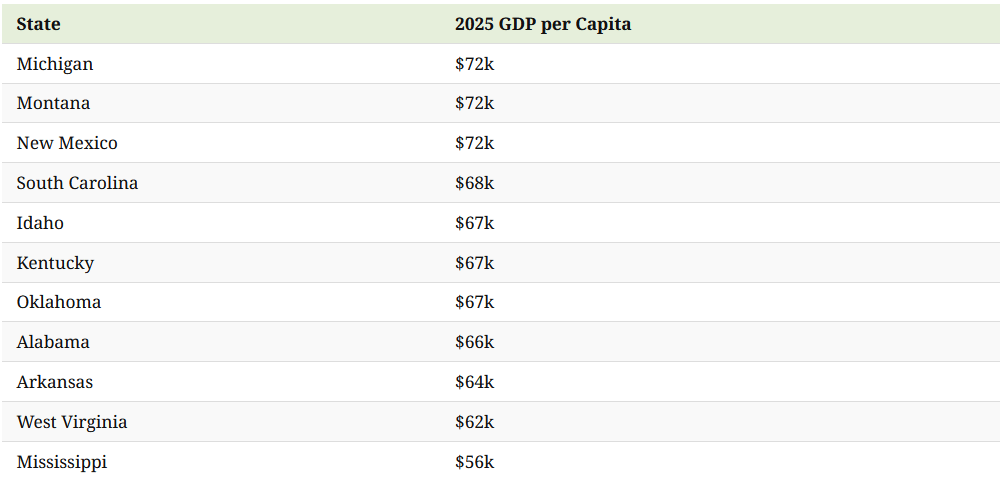
Let’s look at the states with the lowest and highest per capita GDPs (sources: Visual Capitalist (2026) / U.S. Bureau of Economic Analysis (2024).
LOWEST GDP PER CAPITA:
HIGHEST GDP PER CAPITA:
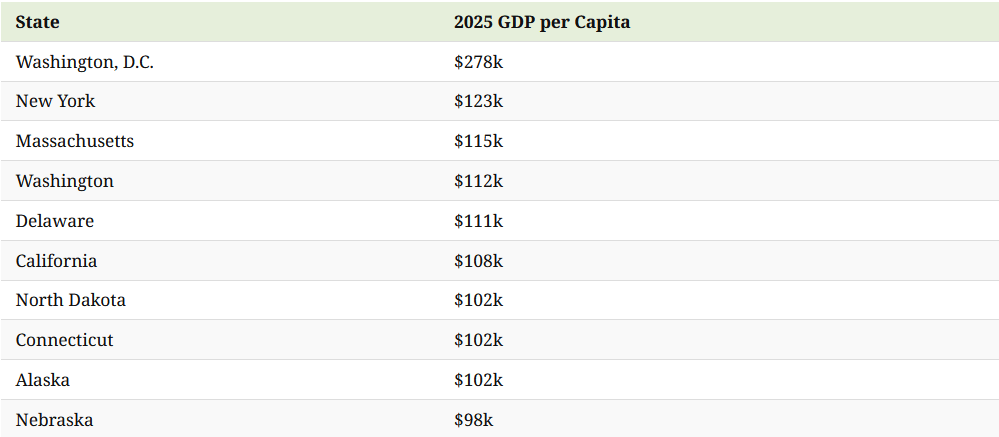
Plainly stated, the more religious the state, the lower the per capita GDP. One could counter that states with great total GDPs, like Texas and Tennessee, buck this trend. I would argue that if you take away places like Austin and Nashville, with large concentrations of secular work forces, these states would be more similar to Mississippi in performance.
Now, lets look at the healthiest and unhealthiest states (source, Visual Capitalist (2026):
Again, plainly stated, the most religious states have the worst health, with Alabama, Mississippi, Arkansas and Louisiana making up places 46-50 in this list. The healthiest states New Hampshire, Massachusetts, Vermont, Connecticut, and Utah.
What is the common thread here? Is there a causal relationship between GDP and health and the prevalence of religion?
Yes, there is. The governments of religious states invest the least in the well being of their people. These governments simply do not invest in policies that maximize access to healthcare, good food, and education on healthy habits and care. The government policies of religiously conservative states favor corporations, which can provide bad healthcare and bad food to their populations. The result is that these populations live less healthy lives.
One could make the argument that it is up to the individual to live a healthy life. This is correct in theory, but there should be a halfway meeting between individual responsibility and government support. When all people can access is gas station or Walmart-quality food because they live in a rural area, couldn’t there be some collaboration between government and local food and healthcare providers to help all Americans? Because of the leanings of religious conservatives to support corporations over people, rural communities are being cut off from healthy living as grocery stores and satellite clinics are closing nationwide.
Now, what’s the correlation between religious zealotry and GDP? I suspect it is likely tied to the education level of these states. Because, like with healthcare, similar investments are not made in public education, there are less likely to be qualified workers for an increasingly technical and scientific economy. Also as a result of both of these, highly educated and trained workers from around the country are less likely to want to move to highly religious states.
The case of Galileo is an example of what negative interaction between the scientifically educated and religious fundamentalism can do. Religious fanatics threw Galileo, the inventor of the telescope, in jail. All this did was slow the rate of invention and the progress of science. It did not stop discovery from happening. Science prevailed anyway, because it’s true, and you can utilize and profit from scientific discovery. The principles of telescope design are used today from our cell phone cameras to spy satellites. Religious fanaticism is a dead end that is always eventually outflanked because it is simply not sustainable.
You can expand this analysis of GDP and public health of U.S. states outward to countries. The most theocratic countries have the worst GDPs, and the worst societal well being (think of Afghanistan). The most secular countries have the highest GDPs (think Japan, France, Germany, etc).
The framers of the U.S. Constitution understood the vast shortcomings of theocracy and the dangers of government collaboration with religious organizations. The U.S. economy has survived with very religious segments of its population for nearly its entire history because we’ve made a strong effort to separate religion and government.
This concept is breaking down, however, and the relationship between government and religious organizations is becoming closer. The Secretary of Defense believes the invasion of Iran is a mission from his evangelical Christian god. It should worry all of us that evangelicals believe that global war and the destruction of Israel will bring back Jesus Christ, according to a literal interpretation of the Book of Revelation. It should also be noted that we don’t know which “John” wrote the Book of Revelation and that it was added to the New Testament as an afterthought and almost didn’t make it into the Bible at all. Yet our foreign policy is informed by a literal interpretation of a 1700 year old rendition of the Apocalypse.
More damage is being done outside of the Department of Defense. Science budgets are being cut nationwide. Universities are under attack. The quality of healthcare anyone can obtain is declining, regardless of how wealthy one is. Our GDP will suffer as a result of all of this.
All this said, however, we do not have before us a black and white argument. We should not strive to remove religion from society. Beliefs such as the Buddhist framing that pleasure, and also suffering, are temporary, can give us hope through tough times. Messages to care for the sick, poor, outcast, and migrating strangers uplift all of us. Messages that the death of our bodies is not the end, and that all of us are redeemable in the eyes of the universe, that therefore we should all be redeemable and worthy of God’s love, that if God can forgive, surely we as well are called to do so, are messages that, on the whole, are good for society. Further, religious communities provide just that for those of us on the lonelier side of life: community.
Religion at its best can provide individuals and society a foundation of community and virtue on which we could choose to build an uplifting and inclusive society. Religion at its worst provides a permission structure of exclusion, judgement, exploitation, and oppression. Religion is a potent tool, and can be used for good as well as evil. Because it can be manipulated and leveraged by leaders for evil is exactly why the framers of the U.S. Constitution wanted the United States to be a secular republic with no strong connection to religion.
I want these essays to reach beyond sympathetic readers. Research suggests exposure to information outside our usual media environment can produce learning and moderate attitudes, while conformity experiments show group pressure weakens when people respond privately (Broockman & Kalla, 2025; Asch, 1956). That’s why I use paid social media advertising: meeting someone in their scroll gives them room to explore an unfamiliar idea on their own terms. My writing stays free; reaching new audiences does not. You’re not paying for more access to my writing; you’re helping distribute it. If you think that’s worth doing, a $5/month subscription helps fund the outreach that makes it possible.
Broockman, D. E., & Kalla, J. L. (2025). “Consuming Cross-Cutting Media Causes Learning and Moderates Attitudes: A Field Experiment with Fox News Viewers.” The Journal of Politics, 87(1), 246–261. https://doi.org/10.1086/730725
Asch, S. E. (1956). “Studies of Independence and Conformity: I. A Minority of One Against a Unanimous Majority.” Psychological Monographs: General and Applied, 70(9), 1–70. https://doi.org/10.1037/h0093718
Comments
Nothing yet. Say the first thing.
Sign in to join the conversation.