
Thanks to everyone who participated in the poll for paid subscribers to decide the next Lunch Box story arc. This is a story from the option that got the most votes. There was a lot to cover so Part 2 comes next and covers tom yum noodles at Wat Phrathat Doi Suthep USA and the thali plate at the BAPS Shri Swaminarayan Mandir.
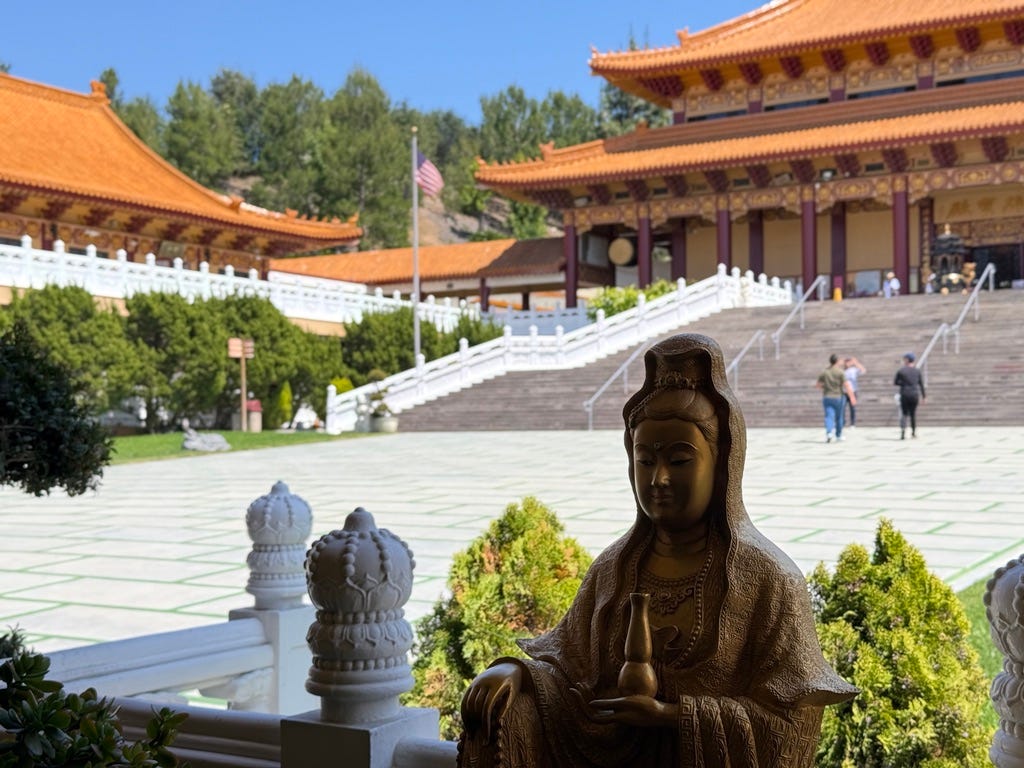
The four counties of Los Angeles, Orange, San Bernardino and Riverside roughly converge in a set of hilly suburbs surrounded by some of the worst freeway traffic and air pollution in the state.
It’s a place I associate with punishing 5 a.m. traffic jams and strip mall parking lots so large you can travel for miles without leaving them. But this area’s hefty parcels and panoramic valley views have become fertile grounds for massive religious monuments, a sacred landscape wrought by diaspora, permissive zoning and affordable land.
Hsi Lai Temple, a $30-million, 15-acre monastery and at one point the largest in North America, is about 20 miles from the BAPS Shri Swaminarayan Mandir, a $100 million, 20-acre campus encompassing a Hindu cultural center and architectural museum. A dozen other temples dot the neighborhoods between them including the 7.3 acre Wat Phrathat Doi Suthep USA, a Thai Buddhist temple founded in 1971. There’s even a scale replica of Pharaoh Ramses II mid-vigil over the 71 Freeway, a chunk of missing rubble reproducing the flood damage to the original Abu Simbel Temples in Egypt. It’s the facade of an Egyptian restaurant and banquet hall that never opened.
You can dine at three temples in a single day (and visit the Egyptian building) for a pan-Asian combination food crawl/pilgrimage.
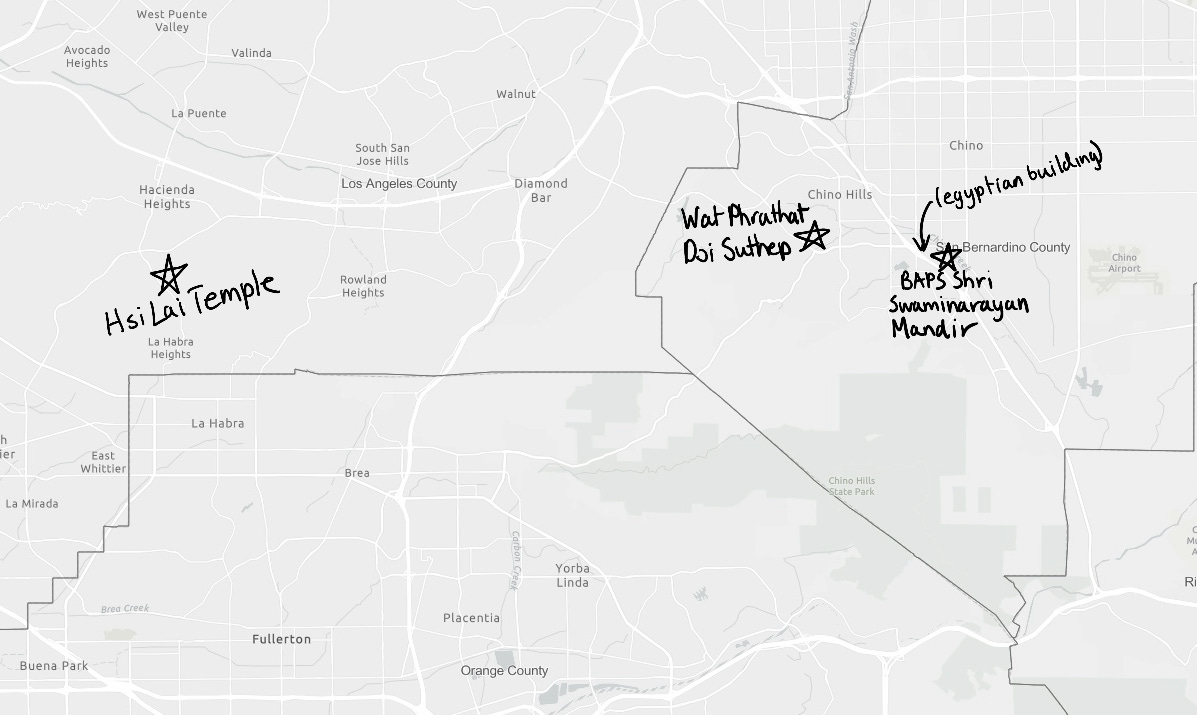
Hsi Lai serves a daily vegetarian lunch buffet for $10. The BAPS Shri Swaminarayan mandir includes a quick-serve satvik restaurant on site as well as extensive inventory of dry goods, grains and snacks under a house label at an on-site grocer. Wat Phrathat Doi Suthep hosts a Sunday daytime food market with more than a dozen vendors selling tea, fruit, desserts, various soup noodles and pad thai from a flattop grill.
This area - encompassing Rowland Heights, Hacienda Heights, Diamond Bar and Chino Hills - can be one of the most interesting places to eat in Southern California. It’s a transitional region between the four counties where new immigrant cultures cross-pollinate. In the outlying suburbs there are Asian grocery stores attempting to sit the fence between Taiwanese and Korean shoppers, strip malls split evenly between Chinese and Indian restaurants and plenty of new Americans whose impressions of the country are still fresh and tender.
Part 1: Hsi Lai Temple Vegetarian Buffet
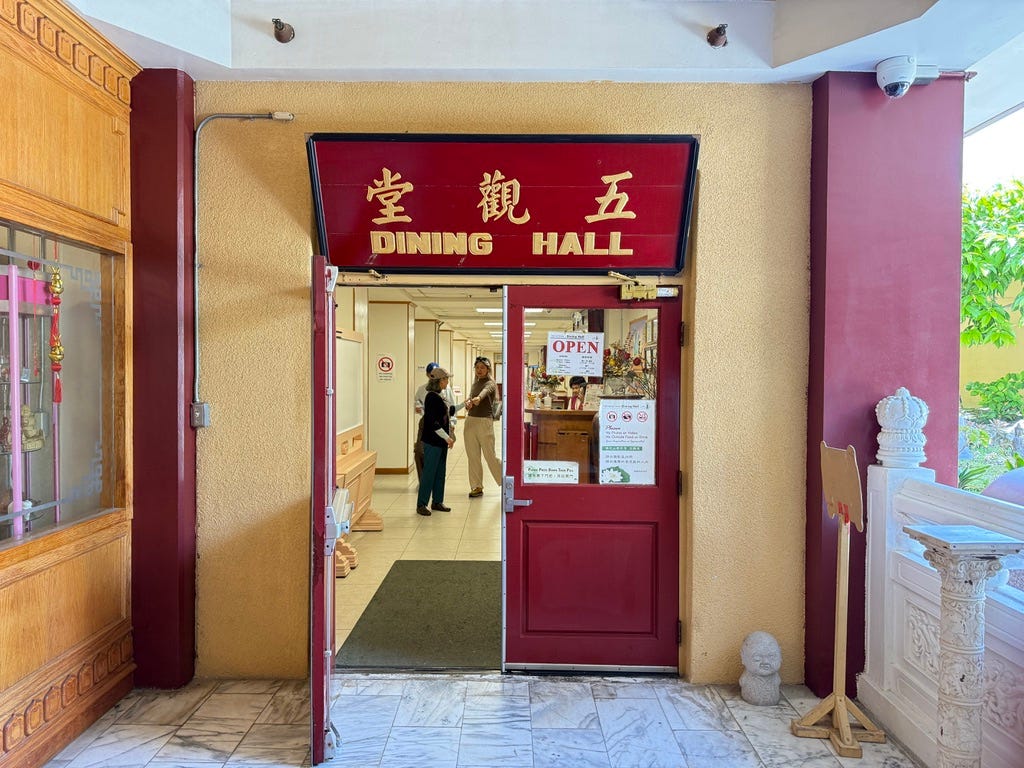
Each meal at Hsi Lai Temple begins with the Five Meal Contemplations. It’s a Tang Dynasty mindfulness practice designed to direct the diner’s attention to the effort behind the the meal, spark contemplation and support spiritual progress. You don’t have to recite them or anything, but they are emblazoned upon the wall behind the buffet as a reminder.
The Taiwanese Buddhist monastic order of Fo Guang Shan administers 40 temples around the world and each serves meals as part of a community outreach practice, said Venerable Huize Shih, a member of the temple’s interfaith and outreach team.
Feeding people creates good will, Shih said. Fo Guang Shan’s founding master Hsing Yun teaches that the kindness of a drop of water should be repaid with a fountain.
In Buddhist thought, food is healing medicine, so the flavors of the menu, which change daily, present mild, natural vegetal flavors. There’s lots of cured, dried, and fresh soy-based products you usually see only in Chinese home cooking.
Buddhist dietary restrictions vary in rigor, but vegetarianism in East Asian cultures is casual and widespread, often combined with a diet that includes meat. In my household, soy products shift the meal’s focus away from meat, which is typically more of a flavoring agent, like garlic or onions. We ate vegetarian after my grandfather died as part of a mourning observance. It never felt like a sacrifice, because there seemed to be a entirely separate genre of restaurants catering to mourning families like ours. We feasted on stuffed, baked, fried, and torn flatbreads, seasonal greens and soy products of every shape, color and texture.
In the San Gabriel Valley, mourners observing vegetarian rituals create stable demand for restaurants like Temple City’s Happy Buddha Kitchen, San Gabriel’s Vege Valley, Veggie Life and Buddha Vegetarian, both in South El Monte (these restaurants come and go, but their names almost always use this combination of words). But people also eat vegetarian for a feeling of general health and cleanliness, the same reasons someone living on the west side of Los Angeles might go for a wheatgrass shot.
Hsi Lai’s recipes are created and prepared by an all-volunteer staff and most of the ingredients are donated by devotees of the temple.
Each buffet has hot tea, steamed rice, noodles, fresh fruit, a soup, and a selection of stir fries and greens. It’s all-you-can-eat, but with the Five Meal Contemplations looming so large, gorging yourself would be a challenge.
Staffers do recommend that you arrive early in case they run out. The buffet runs 11:30 a.m. to 1:30 p.m. on weekdays, closing at 2 p.m. on weekends. The dining room has the trappings of a banquet hall but you’ll bus your own dishes and pour your own drinks.
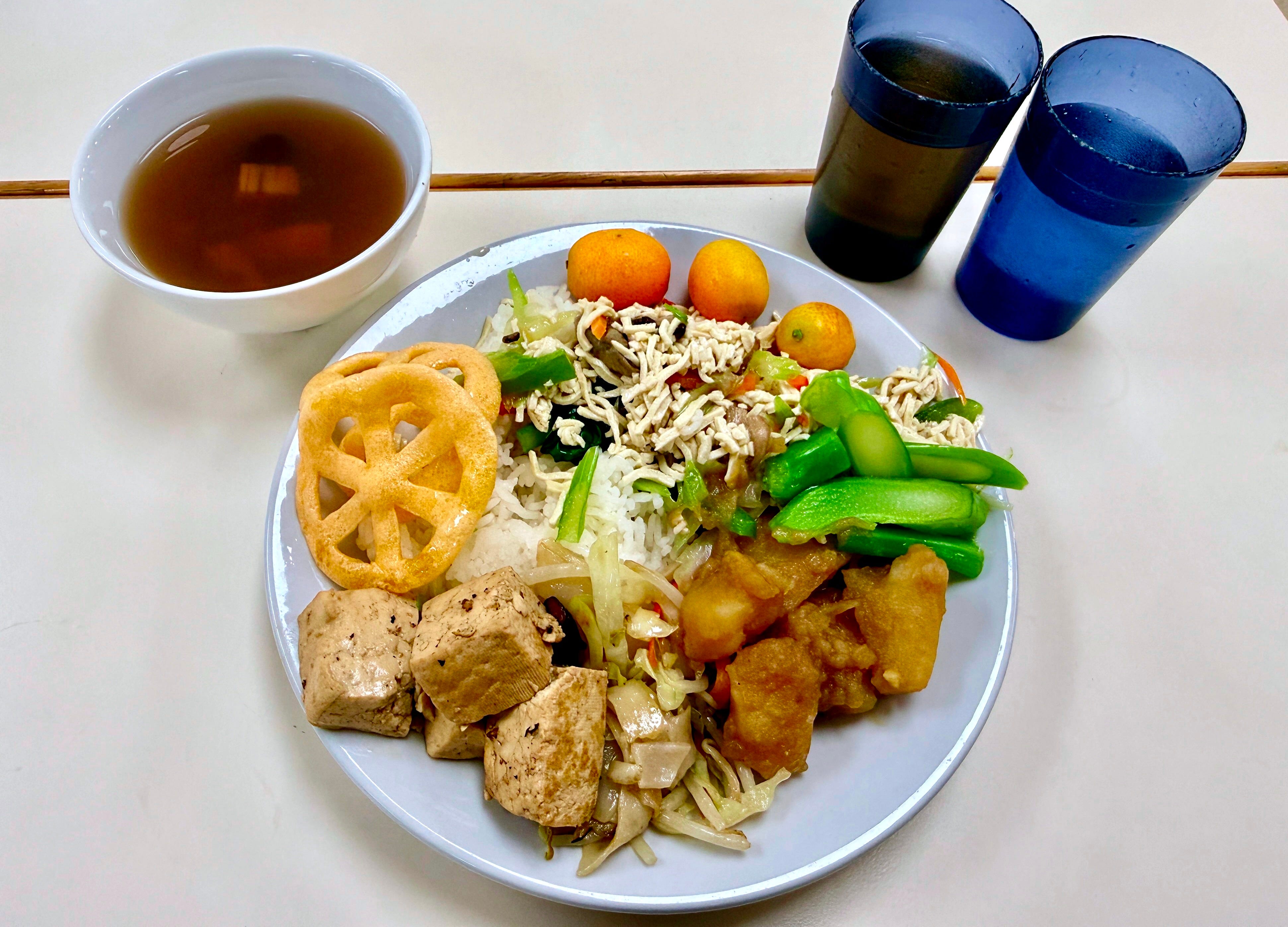
I risked immodesty for seconds of the stir fried flat rice noodle, as well as the rich, satisfying braised tofu. A soft stewed curry potato dish dialed back the spice, flavored with what tasted like a single corner of roux block. I finished with a fragrant soup of jujubee, ginger and lotus root. It’s subtle cooking that works with the ingredients’ natural flavors without using garlic, onions and other dominant flavors; a meditation break for my overstimulated American palate.
On major Buddhist holidays, there’s Laba congee, a porridge of rice, grains, nuts sweetened with dried fruit and red bean, yangzhou dumplings and steamed buns in the shape of the longevity peach, in honor of Buddha’s birthday.
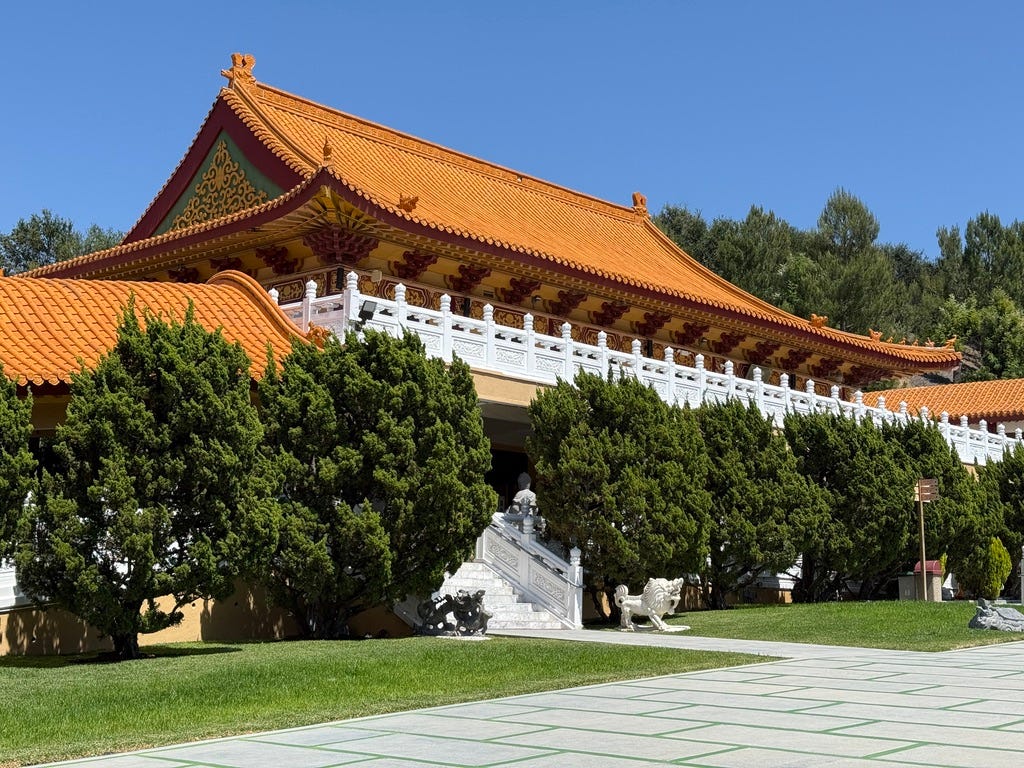
Hsi Lai is just one of many Asian religions that have found roots in the San Gabriel Valley and its large Asian immigrant population. One study by the University of the West found more than 100 Asian Buddhist temples in the San Gabriel Valley alone.
Researchers found that most common originating countries among them were Taiwan (23), Vietnam (18), and mainland China (13). More than 40 percent were branches of a homeland religious organization, but just as many, if not more, were independent, locally-founded family temples established by renovating homes, churches and strip malls.
More than 40 percent were branches of a homeland religious organization, but just as many, if not more, were independent, locally-founded family temples established by renovating homes, churches and strip malls.
Hsi Lai, which translates to “coming to the West” is celebrating the order’s 60th anniversary this year after a decades long struggle to find a permanent home. Yun, order's founder, was first offered a location in Chinatown, but the donated parcel was zoned residential and could not be redeveloped. With $30,000 of donations, they rented temporary facilities in Gardena and Maywood before breaking ground on the Hacienda Heights property.
Locals opposed the project in more than hundred meetings and public hearings. Many were genuinely afraid of constant proselytization and alarmed at the size of the project, but others found the temple an offensive cultural presence and were unafraid to say so. Racial slurs and stereotypes about Asians eating dogs inevitably made their way into public comment.
Fo Guang Shan responded by reducing the size of the project, axing a nine-story Buddha statue and pagoda from the design and reducing the square footage of the project from 50,000 square-feet to 15,000. And after a full decade of construction, the temple opened its doors in 1988.
Over time, the temple’s monks earned a reputation as quiet, engaged members of their communities. They helped organize and fundraise for an effort to closing a La Puente landfill and testified in favor of saving a local elementary school. They established a chorus, a symphony orchestra and a school. And it was a challenge for residents concerned about food odors to find any issue with the mild flavors in the temple’s healthful vegetarian buffet.
Hsi Lai’s lunch now has a regular non-Chinese clientele, Shih said. Many of them are members of other religious traditions prohibiting meat, dairy, onions and garlic. Whatever we believe the paths to enlightenment may be, everyone seems to agree that the food to fuel the journey should be served in a buffet.
PART 2 coming soon: Samosas and the thali plate at BAPS Shri Swaminaryan Mandir, and Luang Por “Abbot” Noodle at Wat Phrathat Doi Suthep USA
Previously, on Lunch Box:
Comments
Nothing yet. Say the first thing.
Sign in to join the conversation.