
We spend an extraordinary amount of energy on one question: what should I eat? And almost none on another question that might matter just as much: when?
It’s an easy thing to miss, because a meal feels like a fixed object. So many calories, so much carbohydrate, so much protein, does this or that to your blood sugar. But it isn’t fixed. The same plate of food is, in a real and measurable sense, a different meal to your body - depending on the time it arrives. And once you’ve seen the evidence for that, a lot of otherwise baffling things, like the clean eater who’s still tired, the good diet that isn’t shifting the numbers of whatever metrics you’re tracking, start to make sense.
Start with the finding that reframes everything. In a tightly controlled study, researchers gave healthy adults identical meals at different points in the day and measured what happened. Eaten in the biological evening, the same food produced postprandial glucose around 17% higher than in the morning - a pure effect of internal body-clock time, independent of what people had done or eaten beforehand. Same food, same person; only the hands on the clock moved. Their body simply handled the evening meal less well.
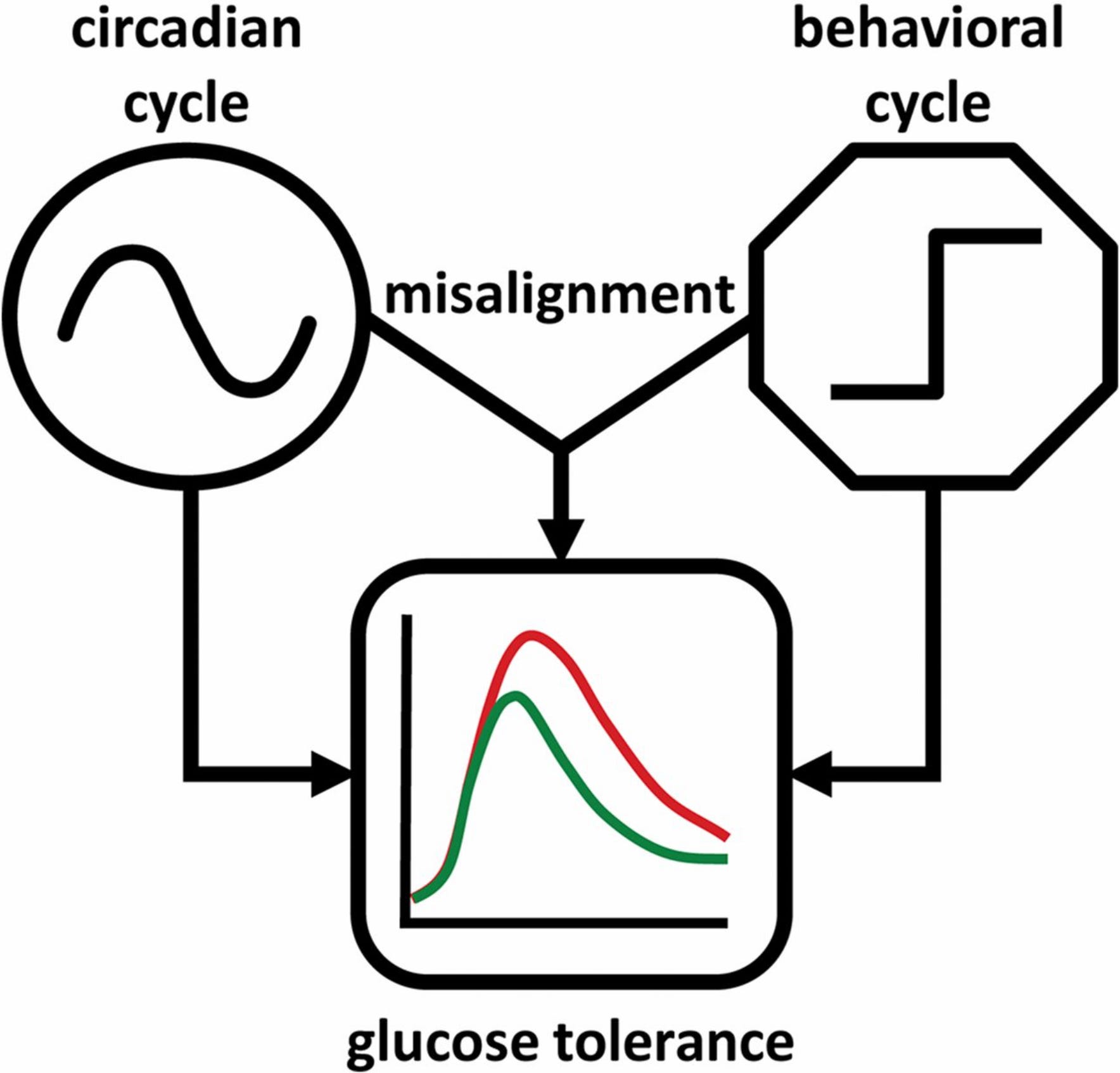
Morris et al., 2015
That happens because you don’t run on a single clock, but you run on a network of them. A master clock in the brain, set largely by light, keeps overall time; but your liver, pancreas, gut and muscle each carry their own clock too, and those are set heavily by when you eat. Through the active, daylight part of the day, your system is primed for food: insulin works efficiently, the pancreas responds crisply. As night approaches, that machinery winds down for rest and repair: insulin becomes less effective, the response becomes slower. Eat a large meal late, and you’re asking your body to do heavy metabolic work at precisely the hour it’s least equipped for it.
There’s a second problem with late eating, beyond “insulin works less well at night.” Eating late sends your liver and pancreas a daytime signal “we’re active, we’re eating” while your brain, reading the darkness, sends the opposite one. Your internal clocks drift out of step with each other. That state has a name, “circadian misalignment”, and your metabolism dislikes it.
The clearest real-world evidence sits with the people whose clocks are chronically scrambled: shift workers. Pooling the studies, shift work is associated with a modestly increased risk of type 2 diabetes - a relative risk of around 1.10 across a systematic review and meta-analysis. These are observational studies, so they can’t perfectly isolate timing from everything else that comes with night work, and I’d never want to overstate a single figure. But the direction is consistent, and it fits the biology: when eating and the body clock fight each other night after night, metabolic risk goes up, not necessarily because the food is worse, but because the timing is.
If timing can work against you, it can work for you too, and this is the part I find genuinely encouraging. In a small proof-of-concept trial, men with prediabetes shifted their eating earlier in the day, with food intake and body weight deliberately held constant. Because no one lost weight, any benefit couldn’t be attributed to weight loss. Their insulin sensitivity improved anyway. Their blood pressure improved. The only variable that moved was when they ate.
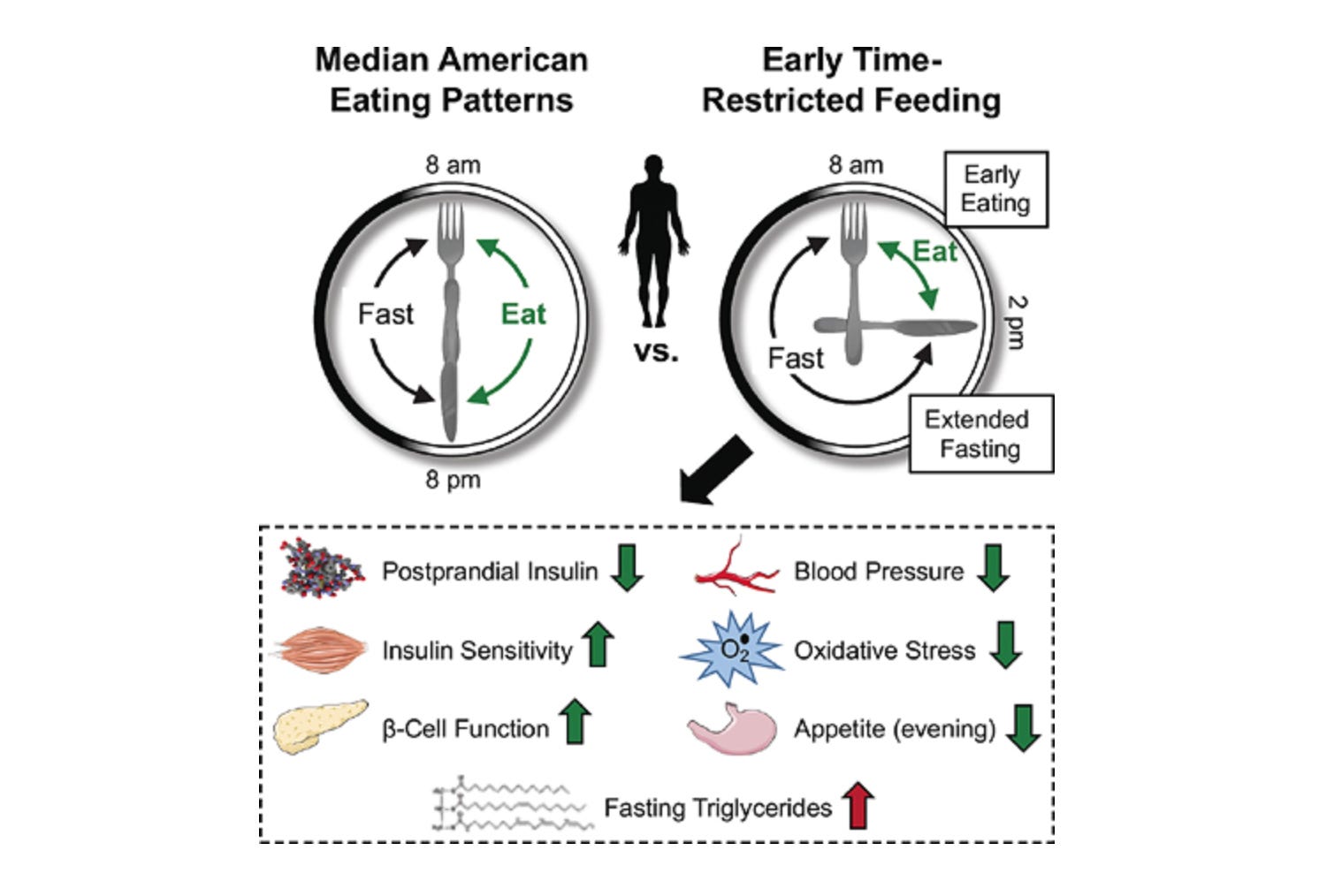
Sutton et al., 2018
I’ll be honest about that study: it was a small study, and the eating window it used was more extreme than anything I’d suggest. The men finished eating by mid-afternoon, which is neither necessary nor something I’d ask of anyone. The value isn’t in copying the protocol. It’s in the principle it demonstrates quite clearly: moving food earlier in the day is working with your biology, and it can move the needle without asking you to eat less at all.
None of the below is about restriction. It’s about rhythm - giving your body its food, light and rest when it’s expecting them.
Morning light, early. A few minutes of outdoor light after waking sets the master clock. Outdoor light, even under grey cloud, is far brighter than indoor lighting, and it’s the cleanest signal you can give your system that the day has begun.
Anchor the day with breakfast. A protein-rich breakfast, reasonably early, feeds your body when it’s best set up to handle food, and tends to quieten the afternoon slump and evening grazing on its own.
Shift the balance earlier. If your biggest meal is late, ease it earlier and lighter over time, and leave a gap before bed. A gentle shift, not a rule, and never a cut-off to feel anxious about.
Keep a rough rhythm. Roughly regular meal and sleep times give your clocks a reliable steady signal without being rigid about it.
And a word for anyone who can’t do much of this (shift workers, new parents, people whose schedules aren’t their own): this isn’t something you need to beat yourself up about. The biology is universal; the way it fits your real week is personal, and there’s almost always a gentler version that helps. This is exactly the kind of thing worth talking through with someone who can see your actual constraints.
If you’ve cleaned up what you eat and still don’t feel the way you’d expect, when may be the missing piece, and it’s often a kinder, easier lever to move than the food itself.
If you’d like to spot the pattern in your own days, my free guide Is Your Blood Sugar Working Against You? Ten Signs Most People Completely Miss is the place to start. And if you’d like a proper conversation about your own rhythm and numbers, my free 30-minute Metabolic Audits are open this month.
Thank you for being here.
See you next week,
Frances x
Frances Norgate
Qualified Nutrition and Lifestyle Advisor
francesnorgate.com
Comments
Nothing yet. Say the first thing.
Sign in to join the conversation.