
When I first started my home organization business, I thought everyone else had some secret up their sleeves that allowed them to be successful.
I truly thought that in order to “make it” as an entrepreneur, I needed a business degree, an investor, years of experience and knowledge, or at a minimum, a perfect plan to follow.
These beliefs made me overwhelmed because the reality was that I had none of those things. What I did have was a dream, a skill set, access to Google, and grit. As it turns out, grit can take you further than you think.
In the beginning, I spent so much time worrying about the wrong things. I thought I needed to know everything before I started, when in reality, I only needed to know enough to take the next step.
If you have a dream about starting your own business but feel like you don’t have the experience, education, or money to make it happen, this article is for you.
Before we dive in, I want to be transparent about one thing. Today, I do have a business degree. But I didn’t have one when I started my first business and I had not even attended a single class when I started building my brand.
Since that time, I have earned my degree, and I’m genuinely grateful for the knowledge it gave me. It helped me understand the “why” behind many of the decisions I’d already been making through trial and error.
But here’s something I also learned: a business degree can absolutely make you a more informed entrepreneur, but it isn’t what qualifies you to become one.
I think of it like learning to drive. Knowing how to drive a Formula 1 car would undoubtedly make you a more skilled driver, but you don’t need that level of training to get yourself from point A to point B. In the same way, a business education can sharpen your skills, but it’s not a requirement to build something you’re passionate about.
Most of what went into building my business didn’t come from a textbook. Taking action, making mistakes, solving problems, and learning along the way was far more informative than a college essay ever could be.
Here are the lessons I wish someone had sat me down and told me before I ever started.
Stop waiting to feel qualified.
One of the biggest misconceptions about entrepreneurship is that confidence comes before action. That’s just not true. Confidence is built by doing the things we feel unsure about.
Every successful business owner was once someone who had never sold a product, never made a website, never filed paperwork, and had no idea what they were doing.
The entrepreneurs we look up to today are people who started before they knew everything. Taking a risk is part of the journey, even though it can feel uncomfortable.
Your first business will not be your last.
This is something more people need to hear. The first designs you create, your logo, your color palette, your pricing model, or your business strategy probably won’t stick. Entrepreneurship is a lot of trial and error. Some strategies sound great in theory and then they flop in practice. Your pricing in the beginning may reflect your initial value, but that value changes as your business evolves. Therefore, so should your pricing.
These changes are not indicative of failure. They are indications of feedback. Businesses change because the needs and desires of people change.
“Done” will always win over perfect.
Seeking perfection is one of the quickest ways to kill your momentum.
When I first started, I thought everything had to be polished before anyone could see it. I spent far too much time tweaking tiny details that had almost no impact on whether someone would actually buy from me.
Every day you spend perfecting a logo, rewriting your website for the tenth time, or waiting until your product feels “ready” is another day you’re not learning from real customers.
The only way to know what works is to put it out into the world and allow space for feedback. Seeking perfection delays that feedback.
Instead of perfection, aim to launch something valuable. You can always improve what’s already in motion, but you can’t improve something that never gets shared.
The biggest shift that changed everything…
There is a lot of hard work and long hours that go into being an entrepreneur, but working harder is not always the thing that moves the needle. Once I was able to stop obsessing over tiny details and started following a simple framework, everything became so much clearer.
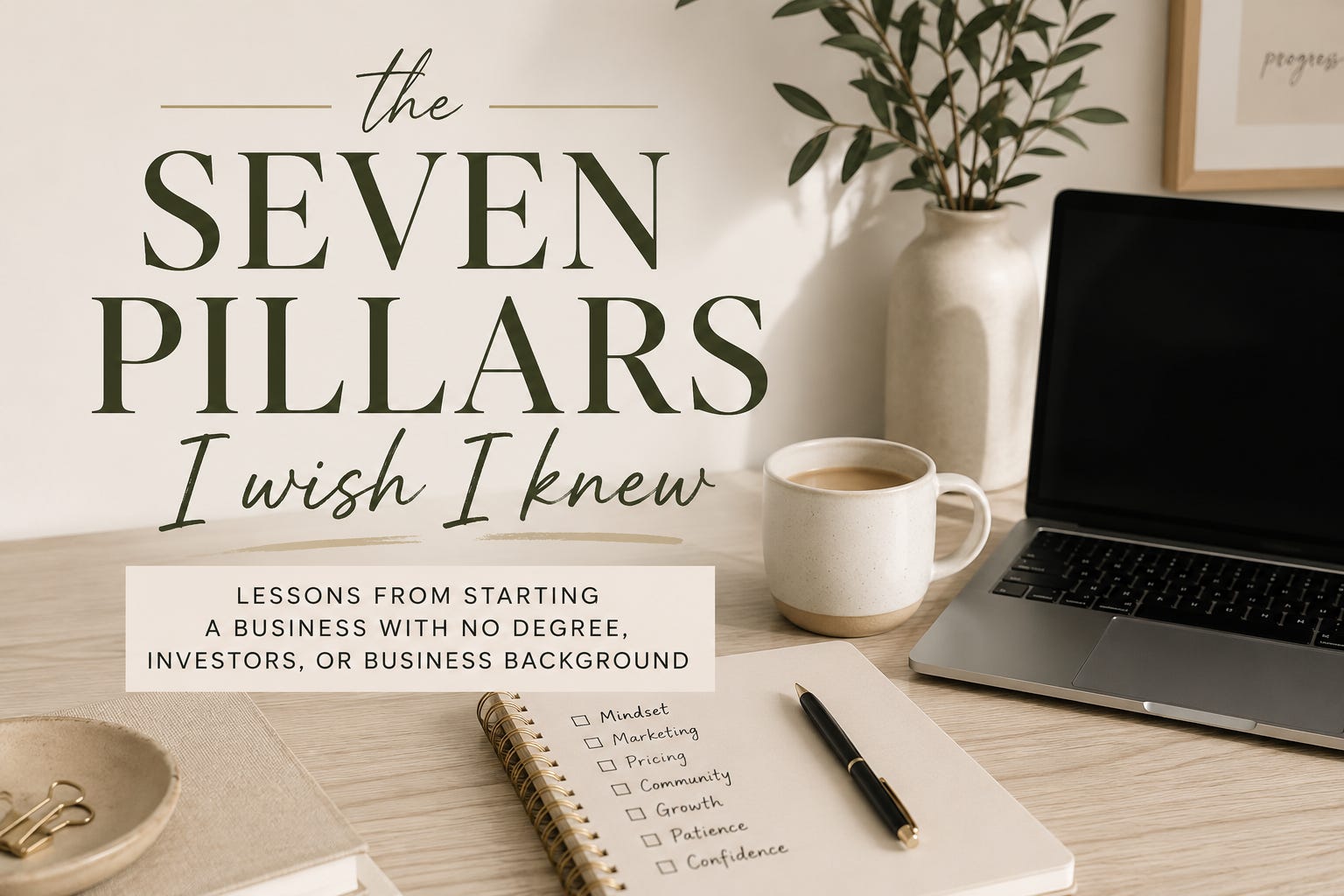
The next seven lessons completely changed the way I approached building my business. Looking back, they’re the exact framework I wish someone had handed me before I spent months learning everything the hard way. They would have saved me countless hours of trial and error (and probably a lot of money too).
Inside the full article, I break down the seven foundational pillars that helped me move from simply having an idea to actually building a business. Here’s a preview of what you’ll learn:
1. Learn marketing before branding.
Why understanding your customer and the problem you solve matters more than spending months perfecting your logo, colors, or website.
2. Validate your idea before spending money.
How to test whether people actually want what you’re offering before investing your time and money into something that may not have demand.
3. Focus on one platform and master it.
Why trying to grow everywhere at once can slow you down, and how learning one platform deeply can create more momentum.
4. Build a customer list from day one.
Why creating relationships with potential customers early can become one of the most valuable assets in your business.
5. Charge before you feel ready.
How to stop hiding behind preparation and start learning from real customers, real feedback, and real sales.
6. Keep your business ridiculously simple.
Why focusing on one audience, one problem, and one clear offer is often the fastest path to growth.
7. Stay in your own lane.
How to avoid comparison, stay focused on your own progress, and continue building even when it feels like everyone else is ahead.
Let’s get into it!
Comments
Nothing yet. Say the first thing.
Sign in to join the conversation.