

If you tried to read “RWA tokenization” as one cohesive market in 2025, you probably came away with a contradictory story. The headline numbers went up. The chain landscape got noisier. And every other week a new “yield stablecoin” launched that was either a Treasury wrapper, a cash management fund token, or a derivatives basis trade wearing a stable UX.
The cleaner way to read 2025 is to separate two things that the industry still mixes too casually:
Distribution vs representation: Is the blockchain actually the distribution layer (wallet-held, transferable, composable), or is it a representation layer sitting on top of existing institutional ledgers?
Tokenized cash vs tokenized yield: Are we talking about dollars (the settlement rail), or yield-bearing instruments (the portfolio leg that sits behind the dollar UX)?
RWA.xyz formalized the first distinction with a useful framework: distributed assets are those where onchain investors can subscribe, hold, and manage the asset directly via wallets or custodians, whereas a large fraction of “tokenization” is better described as represented assets that mirror TradFi structures without behaving like bearer instruments on public rails. rwa.xyz+1
Once you use that lens, the 2025 story stops being messy and starts being obvious.
Stablecoins won distribution. Yield won mindshare. And 2026 is setting up to be about under-the-hood baskets.
At year-end, RWA.xyz’s network league table for distributed RWAs excluding stablecoins still reads as Ethereum-first, with a long tail behind it:
Ethereum: about $12.86B in distributed RWA value
BNB Chain: about $1.93B
Solana: about $0.83B
Arbitrum: about $0.74B
Stellar: about $0.70B
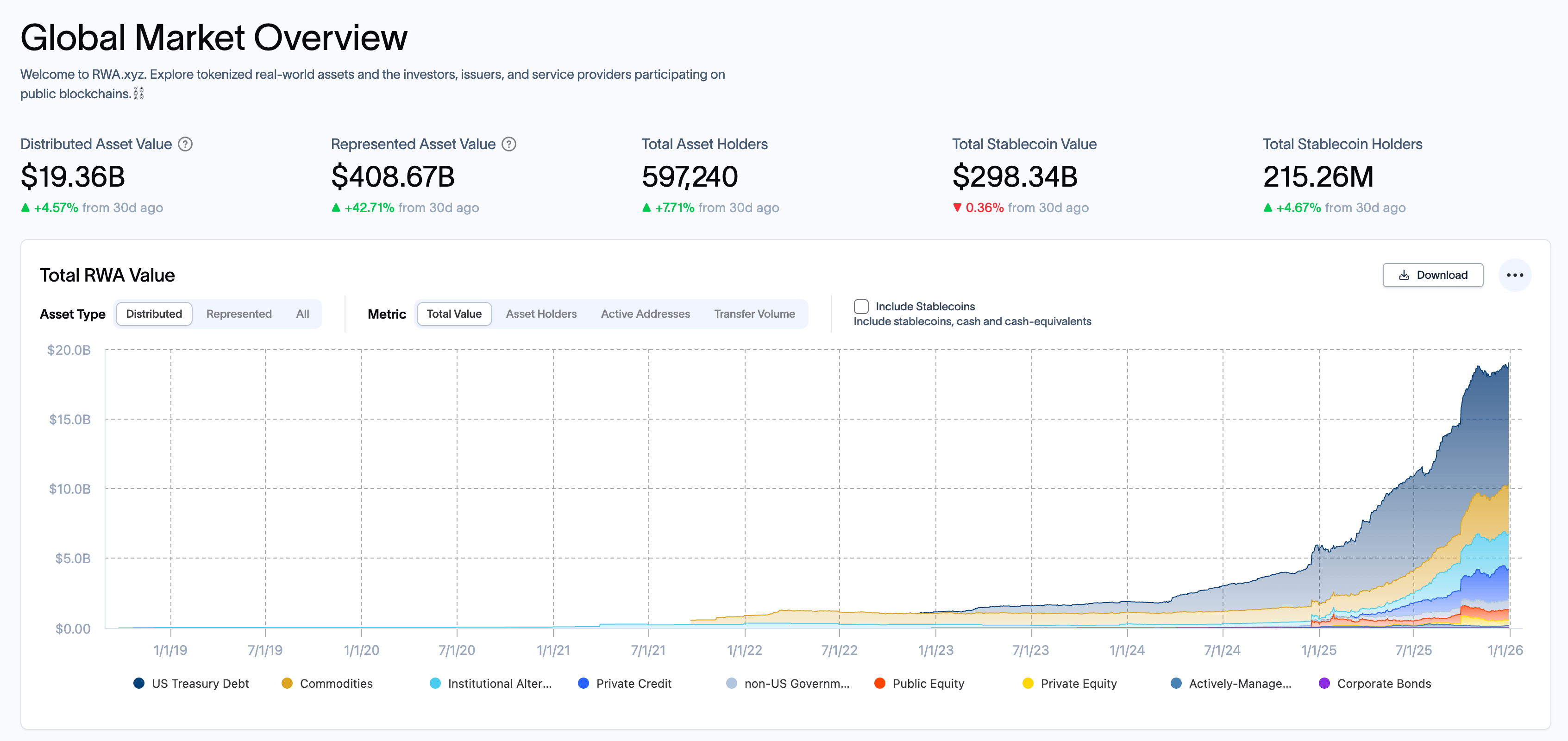
Total distributed RWA value (excluding stablecoins): about $19.05B (Dec 23, 2025)
Regulated issuance optimizes for standards, custody integrations, and programmable transfer controls, and Ethereum and Ethereum-adjacent environments continue to be the most institutional-default surface for those requirements.
Stablecoins distribute where settlement is cheapest and most reachable. That is why the stablecoin float concentrates on a small set of “payment and exchange settlement” venues rather than following the same pattern as RWA issuance. In practice, the market still behaves like:
RWAs: issuance and programmable compliance cluster on Ethereum and adjacent environments
Stablecoins: payments and exchange settlement sprawl across the networks that minimize cost and maximize distribution
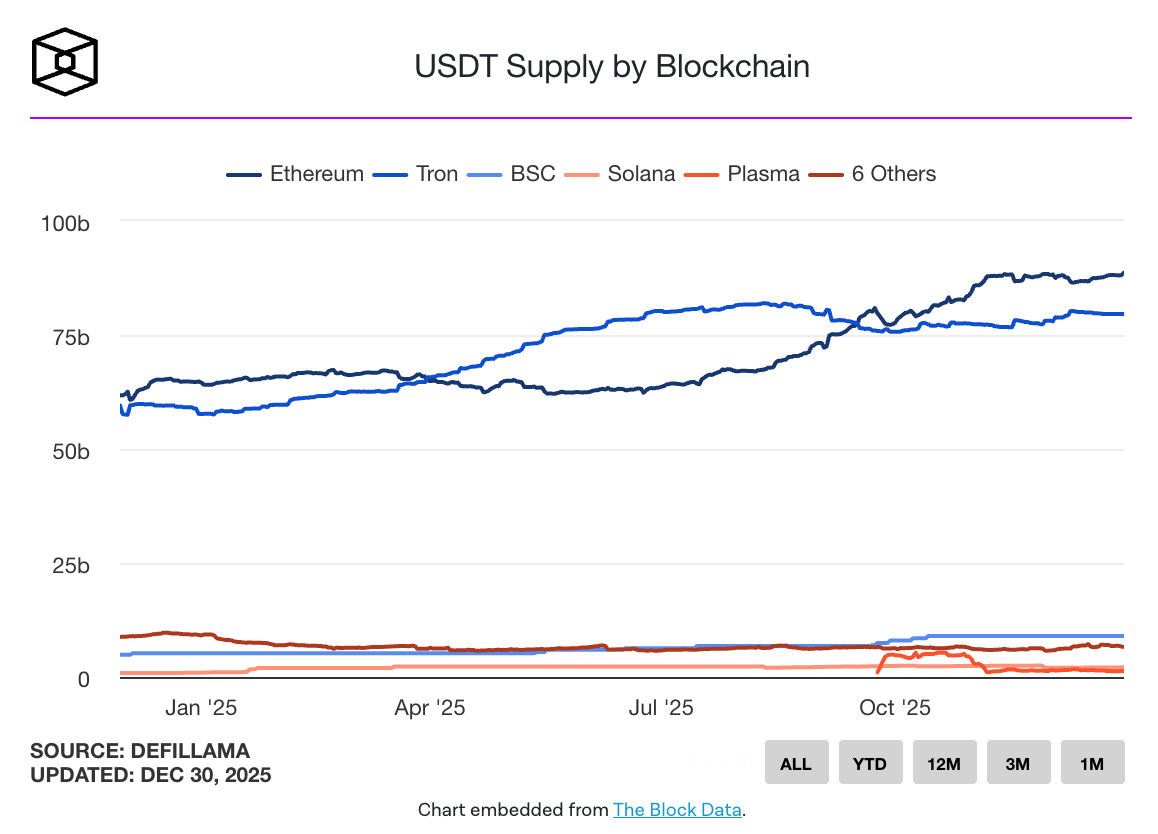
In 2025, this showed up most visibly in USDT’s split between Ethereum and Tron, with leadership oscillating as flows moved between “DeFi adjacency and institutional comfort” (Ethereum) and “payments-dominant, low-cost settlement” (Tron). The Block
A lot of apparent share movement was definitional, not fundamental. Early-2025 snapshots that treated “represented” and “distributed” as the same bucket made some L2 footprints look much larger than what was actually distributed to wallets and transferable as onchain instruments. By late 2025, the industry became stricter about what counts as truly onchain-distributed value, and the numbers snapped back toward Ethereum concentration for distributed RWAs.
That tightening is healthy. If you are building products for 2026, you care about the tokenization that behaves like infrastructure: enforceable transfer rules, lifecycle events, investor eligibility, and cash-flow logic that actually settles in code.
There are two correct answers depending on whether you include stablecoins.
This is still the uncomfortable truth for a lot of “tokenization” narratives: the killer app remains tokenized cash. Late December 2025, RWA.xyz tracks stablecoins at roughly $298B–$299B in value and well over 200M holders. RWA.xyz
Once you look at non-stablecoin RWAs, 2025’s gravity wells were:
Tokenized U.S. Treasuries: about $9.0B by Dec 23, 2025
Private credit: earlier 2025 snapshots placed private credit ahead of treasuries among non-stablecoin RWAs
Commodities (notably tokenized gold): durable demand, but still not the core growth engine
Tokenization scaled where it reduced friction for instruments that already have massive demand. Cash is always in demand. T-bills became the default “onchain risk-free leg.” Credit is the highest-yield real-economy segment, so it pulled attention and allocations as soon as distribution got workable.
Stablecoins are not adjacent to tokenization. They are the base layer demand surface.
Stablecoins are the settlement leg for most tokenized subscriptions and redemptions
Stablecoins are dominant onchain collateral, which means they anchor leverage, liquidity, and risk transmission
Stablecoins are also a business model: reserve income, distribution incentives, and platform partnerships all route through stable balances
This matters because it reframes the “next” stablecoin battle. The next phase is not just who can mint dollars. It is who can fund distribution sustainably, offer differentiated treasury products, and stay inside the regulatory perimeter that is hardening around payment stablecoins.
The phrase “yield-bearing stablecoin” is analytically sloppy, but the user intent underneath it is real: holders want stable value plus a claim on a yield source.
In 2025, the market satisfied that intent through three recurring patterns:
Tokenized treasuries and cash-equivalents as the most institutionally legible yield leg
Tokenized treasuries grew from roughly $5.2B (April 2025 snapshots) to roughly $9.0B (Dec 23, 2025), around 70%+ growth across 2025 on that metric alone.Savings wrappers on existing stablecoins
These are not always new stablecoins. They are wrappers (rebasing, vault shares, savings tokens) representing a claim on stablecoins deployed into a yield source. The critical point is that the yield is produced by taking an explicit position somewhere else, not by magic.Synthetic designs that package basis and hedged collateral yield
Some reached meaningful scale in 2025, which is why the “yield stablecoin” narrative became dominant. The steelmanned takeaway is not that synthetics are the future. It is that user demand for compounding dollars is intense, and “stable + yield” forces you to confront tail risk honestly.
So yes, yield exploded in mindshare. The investable, 2026-relevant insight is to separate durable structure from cyclical yield trades.
Yield is compensation for risk, and 2026 product design will reward teams that state the risk clearly and build the wrapper accordingly.
A practical taxonomy that covers most of what mattered in 2025:
A token represents a claim on an issuer, trust, SPV, or fund holding yield-bearing assets. Yield shows up via NAV appreciation, rebasing, or distributions. Risks include duration, liquidity mismatch, issuer and custody risk, and legal enforceability.
This mechanism has scaled because it is the most legible bridge from TradFi cash management into onchain workflows, and it pairs naturally with stablecoin settlement.
Stablecoins are deposited into lending markets. Borrowers pay interest, suppliers receive it net of protocol fees. Risks include smart contract risk, liquidation mechanics, utilization volatility, and correlation spikes in stress.
This matters for 2026 baskets because it is composable and liquid, but the yield is a market rate, not structurally guaranteed.
A system holds yield-bearing collateral and hedges price exposure in derivatives markets. Yield is the residual: staking yield plus basis or funding, minus hedging costs. Risks are exactly where critics focus: basis compression/inversion, hedge gaps, and liquidity disappearing in stress.
Tokens represent a claim on cash flows produced by a real-world asset or business, with revenue distributed via onchain logic, often in stablecoins. Risks include operational and underwriting risk and liquidity constraints. The upside is that cashflow can be less correlated to crypto leverage cycles, which is precisely what some allocators want.
This mechanism is where “under-the-hood baskets” get interesting in 2026, but only if engineered for transparent underwriting, enforceable structure, and disciplined liquidity management.
The most important regulatory trend for 2026 is that payment stablecoins are being treated as money-like instruments, and money-like instruments are not supposed to behave like savings products.
The U.S. GENIUS Act was signed into law on July 18, 2025. Congress.gov+1
Among other constraints, reputable legal summaries of the Act emphasize that payment stablecoin issuers are prohibited from paying “interest or yield” to holders solely for holding the stablecoin. Arnold & Porter+1
MiCA institutes uniform EU market rules for crypto-assets, including ARTs and EMTs, under supervision by EU institutions. ESMA+1
Legal and industry commentary has consistently highlighted MiCA’s constraints around “interest” or “remuneration” for holders of these payment-like tokens and, in some cases, CASP-level restrictions as well. Lexify+1
The scalable design is not “one token that is both money and yield.” It is:
a payment stablecoin for transactions and settlement, and
a separate yield-bearing instrument (fund token, deposit token product, savings wrapper, basket token), with explicit disclosures, eligibility gating, and redemption rules
This is not just regulatory hygiene. It is also good market structure. It stops users from confusing a payment instrument with an investment claim, and it allows issuers to build risk buffers and manage liquidity without pretending the base dollar token is a savings account.
When large institutions ask for private blockchain solutions, they are typically asking for:
transaction privacy and selective disclosure (position sizes and treasury flows are sensitive)
identity, permissioning, and deterministic governance
operational compatibility with post-trade reality (netting, reconciliation, corporate actions)
regulatory boundary management across jurisdictions and client segments
The important point: private chains are not a substitute for stablecoin distribution. They are an issuance and settlement layer that increasingly needs a clean interface into public networks where liquidity, wallets, and global distribution live.
Three 2025 signals are hard to ignore:
DTCC selected the privacy-focused Canton Network as a tokenization partner, explicitly pointing toward privacy-enabled, institutional-grade settlement. CoinDesk+1
J.P. Morgan’s Kinexys piloted a permissioned USD deposit token (JPMD) on Base (Ethereum L2), which is basically the “hybrid by design” pattern: permissioned asset behavior deployed in a public ecosystem for connectivity and settlement adjacency. JPMorgan Chase+2CoinDesk+2
Tokenized MMF infrastructure moved further into production-grade workflows, including the BNY Mellon and Goldman Sachs collaboration on tokenized money market fund shares, built for collateral utility and settlement efficiency. Reuters+1
Private and permissioned rails make our core 2026 thesis stronger in four ways:
Segregated sleeves become operationally easier (payments sleeve vs yield sleeve)
Treasury management confidentiality improves (less real-time strategy leakage)
The partner universe expands (many regulated partners will not touch open DeFi)
The payment vs investment boundary becomes sharper by design
This is why “hybrid by default” is likely a real theme for 2026: distribution wants public rails, regulated issuance wants controlled rails, and the winners will build the interface between the two.
The distribution reality is brutal: wallets, fintechs, and stablecoin issuers will not integrate dozens of single-asset yield tokens. They will distribute portfolio products that look like one balance to the user and one integration to the partner.
In other words: the 2026 product is a cash management token or savings balance whose engine room is a transparent, risk-scoped basket of yield-bearing instruments. Yield then gets allocated according to the product’s regulatory posture and competitive strategy: some yield goes to users, some stays with the issuer, some funds distribution incentives, and some funds risk buffers.
This is not “a stablecoin that magically yields.” It is an investment wrapper sitting next to a payment rail, designed to satisfy both the user’s desire for compounding dollars and the regulator’s desire for clean classification.
If 2026 is about baskets, those baskets need yield legs that are:
stablecoin-denominated in distributions (unit-of-account coherence)
legally structured and enforceable
compliance-controllable (eligibility, transfer restrictions where required)
operationally predictable (cashflow cadence, reporting, underwriting discipline)
That is exactly the wedge where real-economy cashflow tokens become interesting again, provided they are engineered like finance products rather than marketed like memes.
Fractalized’s product design maps directly to that requirement:
Stablecoin distributions: dividends are distributed periodically (typically quarterly) in stablecoins such as USDT, designed for predictability and reduced currency risk
Two-tier token design and gated yield eligibility: yield goes to verified wallets, while liquidity can remain broader, which is a clean embodiment of the “payments vs investment” boundary at the wallet level
Liquidity design and onchain transparency: wTOKEN eligibility, router-driven trading, and onchain distribution logic give you a practical story for “auditable yield,” not opaque carry
Positioned correctly, Fractalized is not “yet another RWA.” It is both a tokenization engine and a tokenized yield asset factory that stablecoin issuers and fintech distributors can plug into as a basket component when they want real-economy yield under the hood, with enforceable structure and stablecoin settlement.
In a world that is increasingly hybrid by default, this positioning gets stronger if Fractalized leans into deployment flexibility: permissioned issuance surfaces for regulated distributors, plus controlled interfaces to public rails for liquidity where allowed. That is where institutional demand is going.
2025 taught the market a basic hierarchy:
Tokenized cash is the distribution rail.
Tokenized yield is the adoption wedge.
Baskets are the scalable UX.
Hybrid rails are how regulated capital actually shows up.
The winning builders in 2026 will be the ones who can manufacture yield legs that are auditable, enforceable, and deployable across public and permissioned environments.
Core market data and frameworks
RWA.xyz, “A New Framework for Tokenized Assets: Distributed & Represented”: https://rwa.xyz/blog/a-new-framework-for-tokenized-assets-distributed-and-represented rwa.xyz
RWA.xyz market dashboard: https://app.rwa-xyz.com/ RWA.xyz
RWA.xyz Treasuries dashboard: https://app.rwa.xyz/treasuries RWA.xyz
DefiLlama stablecoin API docs: https://api-docs.defillama.com/ api-docs.defillama.com
DefiLlama stablecoin chains endpoint (raw): https://stablecoins.llama.fi/stablecoinchains stablecoins.llama.fi
The Block, “Ethereum reclaims USDT lead with $80 billion supply, surpassing Tron”: https://www.theblock.co/post/371697/ethereum-reclaims-usdt-lead-surpassing-tron The Block
Institutions, permissioned rails, and hybrid architectures
CoinDesk, “DTCC Picks privacy focused blockchain Canton Network for tokenization”: https://www.coindesk.com/business/2025/12/17/wall-street-giant-dtcc-picks-privacy-focused-blockchain-canton-network-for-tokenization CoinDesk
Canton Network press release (DTCC / Digital Asset / Canton): https://www.canton.network/canton-network-press-releases/dtcc-and-digital-asset-partner-to-tokenize-dtc-custodied-u.s.-treasury-securities-on-the-canton-network canton.network
J.P. Morgan (Kinexys), “Pilots First USD-Denominated Deposit Tokens”: https://www.jpmorgan.com/payments/newsroom/kinexys-usd-digital-deposit-tokens JPMorgan Chase
Financial Times, “Deposit tokens are not a payments breakthrough”: https://www.ft.com/content/db096e7b-2692-4425-a576-2e91d730cda1 Financial Times
Goldman Sachs press release (BNY + Goldman tokenized MMF solution): https://www.goldmansachs.com/pressroom/press-releases/2025/bny-goldman-sachs-launch-tokenized-money-market-funds-solution Goldman Sachs
Reuters, “Goldman, BNY team up to launch tokens tied to money market funds”: https://www.reuters.com/markets/wealth/goldman-bny-team-up-launch-tokens-tied-money-market-funds-2025-07-23/ Reuters
Regulation: payment stablecoins vs yield
U.S. Congress, GENIUS Act text (Public Law 119–27): https://www.congress.gov/bill/119th-congress/senate-bill/1582/text Congress.gov
The White House, “The President Signed into Law S. 1582”: https://www.whitehouse.gov/briefings-statements/2025/07/the-president-signed-into-law-s-1582/ The White House
Arnold & Porter (analysis referencing interest/yield prohibition): https://www.arnoldporter.com/en/perspectives/advisories/2025/07/new-stablecoin-legislation-analyzing-the-genius-act Arnold & Porter
ESMA, MiCA overview: https://www.esma.europa.eu/esmas-activities/digital-finance-and-innovation/markets-crypto-assets-regulation-mica ESMA
Lexify, ESMA staking Q&A discussion of “interest/remuneration” framing: https://lexify.io/the-future-of-staking-in-the-eu-esma-answers/ Lexify
Ledger Insights on MiCA remuneration constraints: https://www.ledgerinsights.com/the-eus-mica-stablecoin-regulation-prevents-remuneration-or-does-it/ Ledger Insights
No posts
Comments
Nothing yet. Say the first thing.
Sign in to join the conversation.