

Last year I came across a peculiar part of the Śrīmad Bhāgavatam. It spoke of three interdependent supports of experience and agency, referred to as the three puruṣas.
Now one may think, I know the three puruṣas. But no—this is something different.
The Śrīmad Bhāgavatam is a magnificent work that uses such discussions to press a deeper question: what—or rather who—is the ultimate source and support of all that exists?
Across its twelve books, the Bhāgavatam unfolds ten subjects, each meant to lead the reader toward the tenth and final one: āśraya, the ultimate shelter of everything.
The first puruṣa described here is the adhibhautic puruṣa—the physical body itself. This includes the material sense organs: the eyes, ears, and so on. Although the term puruṣa is used, it does not refer here to a conscious person, but to the embodied structure through which perception becomes possible.
The second is the adhyātmic puruṣa—the self, the soul, the ātmā. This is the conscious experiencer who inhabits the body, much like a driver sits within a vehicle and makes use of its instruments.
The third is the adhidaivic puruṣa. This refers not to a different kind of being, but to the another ātmā functioning in the role of a controller—as a deva presiding over the senses. In this framework, a deva is not ontologically distinct from an ordinary living being; the difference lies in function and empowerment, determined by the karmic placement of the individual.
A helpful analogy is the device, the user, and the internet—or the appliance, the user, and electricity. None of these has meaning in isolation. A device without a user is inert; a user without power is ineffective.
In the same way, the controlling deities have no role without a physical body through which perception occurs. The “lord of sight” has no meaning apart from the eye and the conscious perceiver. The body has no significance without a self within it. And the embodied soul, so long as it is not liberated, cannot perceive without both bodily instruments and divine facilitation.
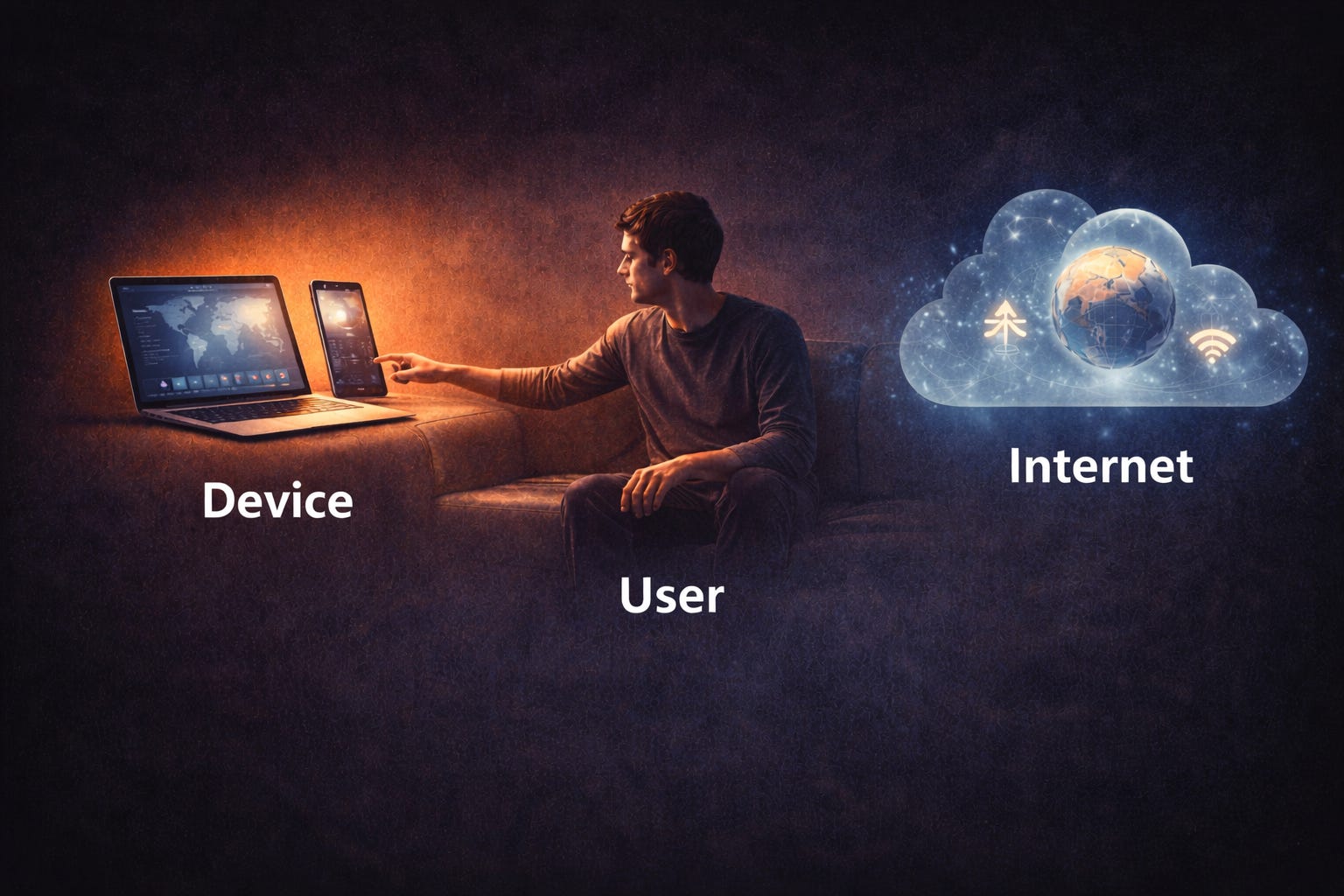
Each of these—body, experiencer, and controller—is interdependent. In the absence of one, the others cannot even be properly understood. None is self-sufficient. None qualifies as ultimate.
One who takes the body alone (adhibhautika) as the support of all adopts a materialist worldview, reducing reality to matter and mechanism.
One who takes the controlling deities alone (adhidaivika) as ultimate becomes what the Vedas call a karmī—a religious instrumentalist who seeks order, power, or reward within the world, but not transcendence beyond it.
And one who takes the ātmā alone (adhyātmika)—as an isolated, self-sufficient witness—to be ultimate slips into impersonalism, mistaking the experiencer for the final ground and closing the heart to what lies beyond the self.
The Bhāgavatam then presses the unavoidable question: who made them interdependent?
That which depends on others for its very intelligibility cannot be the final shelter. Interdependence itself points beyond itself. Therefore, the text concludes that there must be a reality that is not interdependent—one who is independent, self-established, and capable of assigning all these roles.
This ultimate reality is called svāśrayāśrayaḥ—the shelter of even those things that appear to be shelters themselves. That supreme shelter is the Supersoul, Paramātmā, and ultimately Bhagavān, Śrī Kṛṣṇa, the source even of Paramātmā and Brahman—the one who sees all without assistance and upon whom all seeing depends.
Thus, the three puruṣas are not the conclusion of the Bhāgavatam’s inquiry. They are the setup. By showing that even perception, control, and embodiment are dependent realities, the Bhāgavatam leads the reader to its final subject: āśraya, the Supreme Person, upon whom everything else rests.
Comments
Nothing yet. Say the first thing.
Sign in to join the conversation.