
Writing this was inspired by my teachers, ācāryas, mentors, and students. My first inspiration to memorize chapters came from learning from H.H. Prahlādānanda Swami, whose love for reading and absorption ever inspires me. For devotees such S.B. Keshava Swami, Gauranga Darshan Prabhu, Bhurijana Prabhu, Vaisesika Prabhu and our Ācāryas who make studying an eternal adventure, and for my students, particularly those at Wisdom of the Sages in our shloka group, such as Dana K., who drive me to go deeper.
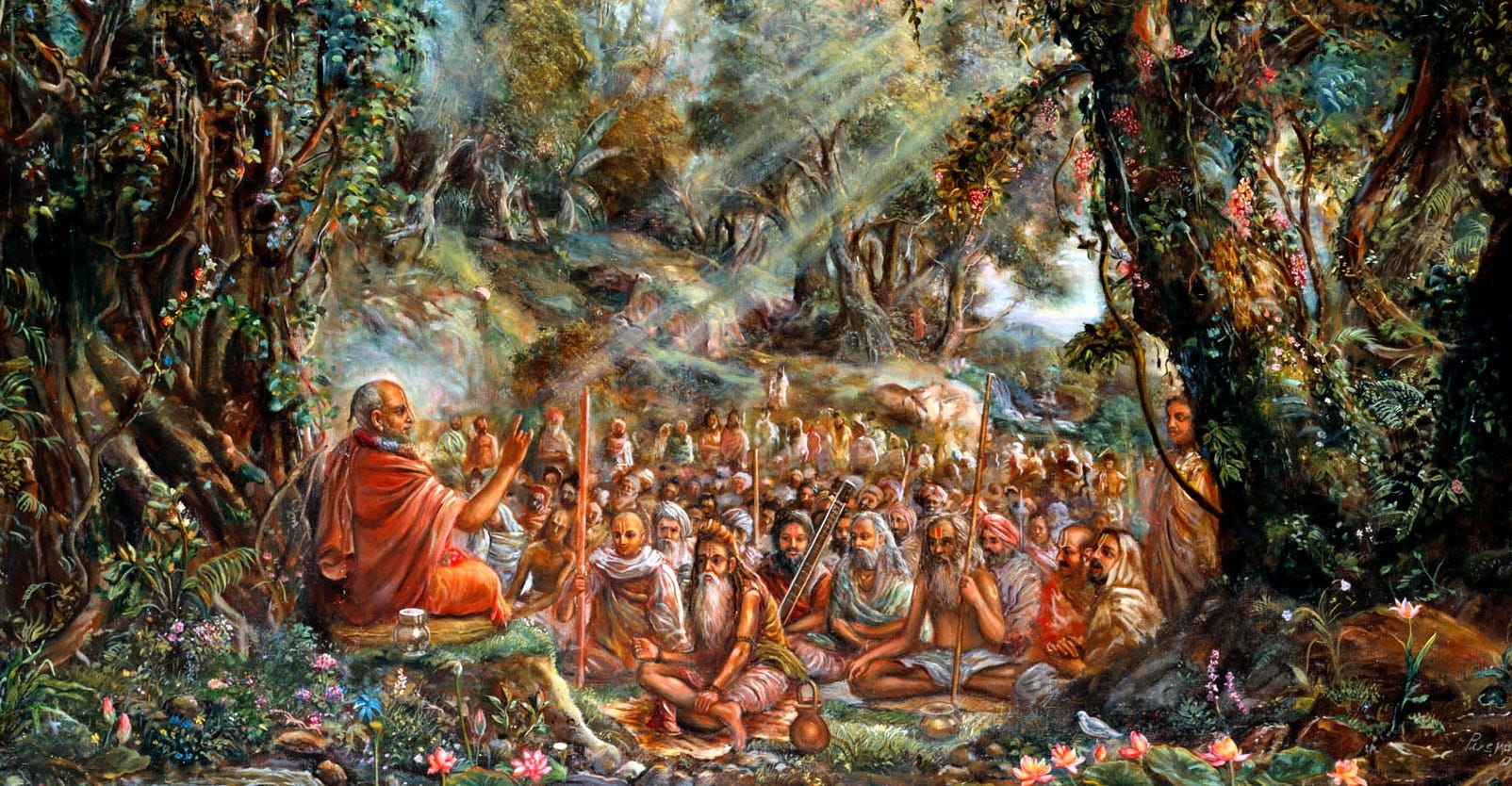
The whole world is vibrating with the sounds of questions and answers. The birds are chirping, "Where is the worm?" The child is asking, "Where do babies come from?" The inquisitive are wondering, "How can I be truly happy?" Commercials are answering, "This product will fully satisfy you," and everyone is asking, "What is the weather today?" However, thousands of years ago, great sages asked the most essential questions, knowing that a person can be truly satisfied only by so inquiring. Those great inquiries fructified in the wonderful discourse known as the Śrīmad-Bhāgavatam, beginning with chapter two of the first Canto.

Respect opens the door of truth, tasting for yourself confirms it.
In order to get good answers, we must always examine the efficacy of the source. Throughout time, various methods of epistemology have been employed to this end, and one of many such methods is śabda, or testimony. If I want to learn about Japan from NYC, it cannot be done by the extension of my senses through a telescope, nor by educated guesses. Rather, I must rely on a source, a testimony, which I can sufficiently test and taste for myself. In the Vedic system, both blind faith and blind doubt are to be rejected.
To have an answer but to avoid questions is blind faith,
and to have questions but to avoid answers is blind doubt.
Thus, both honor and respect are important elements in expressing doubts to one's teacher. One must at least hypothetically accept the theory as valid and then taste-test the results. Therefore, in these first five verses, to be in a proper learning space, both the speaker and the questioners are honored for their dignified qualities and questions.

Divine service is the essence — knowledge and detachment follow.
In the first chapter of Śrīmad Bhāgavatam, the ancient sages approached the great sage, Suta Goswami, and put forth six essential questions; four of them are answered in this second chapter. The first two questions were about what the highest and most progressive goal of life, and they also asked him to present the essence, the crème de la crème, of spiritual wisdom. Two of the other questions are also answered in this second chapter. Namely, why the Lord appears as an avatār and how the Divine interacts with matter in the material universes. Suta, being an emissary of ancient Vedic wisdom, responded that pure loving service to Divinity is the highest and that this service to God, AKA Krishna, carries with it the results of all the other spiritual paths, namely spiritual knowledge (jñānā) and detachment from the worldly (vairāgya).

Fulfillment dawns as Divinity unfolds — from light, to form, to face to face.
Suta continues expanding upon what the highest goal is, what is most valuable in life, the highest aspiration. Given that the body is temporary and therefore ultimately transient, Suta starts by stating that if your religious practices are based on attaining bodily comforts i.e., “give me this day my daily bread,” then you’re wasting your time. True religion caters to the eternal soul. In other words, we shouldn’t waste our time focusing on something that will fade away in time. Why worry so much about a rental car? You’re only connected to it for a short time. Better to worry about your Self, that part of you that lives forever. Life is about connecting to higher truth, the Divine. Suta describes that the Supreme entity can be understood in three levels of realization. The comparison is like seeing a mountain which, at first, from a distance, appears only two-dimensional. As you get closer, it begins to take shape, but still the details remain distant. But when directly on the mountain, one gets an up-close and detailed view of all it has to offer. So, similarly realization of God begins as a pervading energy without the hint of personality. It further progresses to an understanding of God that is pervading but also possessing personhood and intelligence. Then in the final stage, one recognizes the full features, that God is the perfection of all that we find in this world and beyond. Therefore, form, beauty, intelligence, power, detachment, notoriety, all opulences are expressed fully in that Supreme being. This depth of understanding comes with the approach of the heart, Bhakti, and brings with it the by-products of a natural detachment from the temporary as well as an awareness of spiritual reality. Thus, one should absorb oneself in love of God and thereby cut ties with all the karmas of their past by this internal transformation.
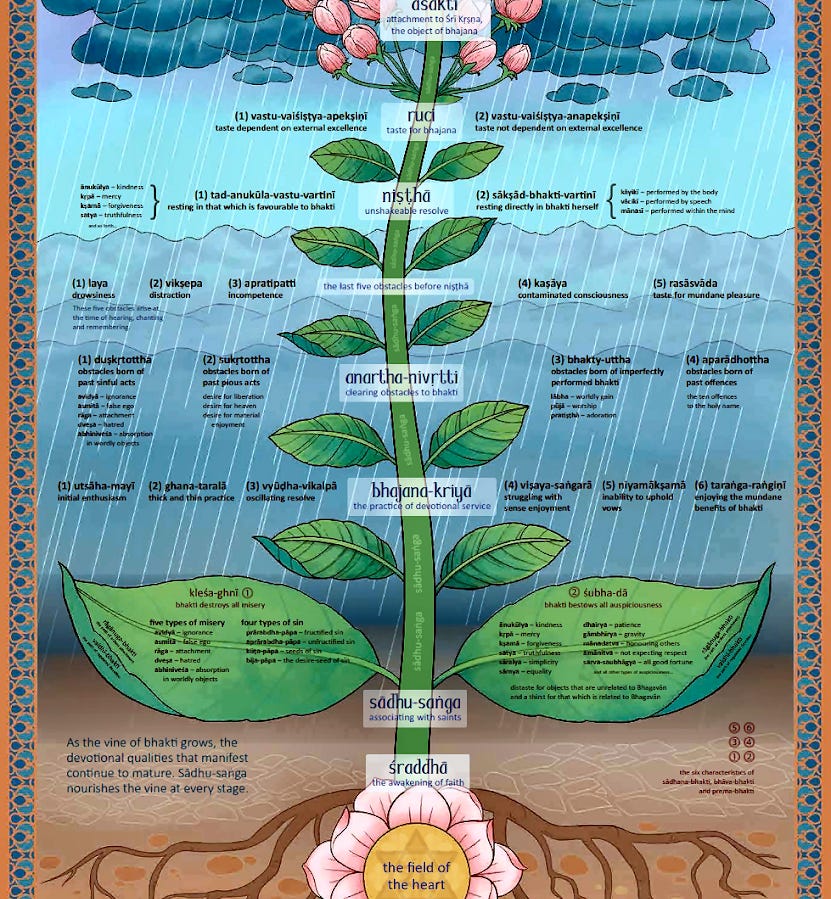
From good company to divine love — Bhakti unfolds step by step.
Are we there yet? With maps and GPS it is possible to see how we are getting incrementally closer to our destination. Having defined that the highest goal is Bhakti, pure devotion to the Divine, Suta begins this next section by showing us the various marking points on that journey. It all starts with the kindness of good company, spiritual saṅga, by that association, we develop an interest in something sublime. With that interest & saṅga, we start spiritual practices, sādhana, such as sacred study and meditation. The practice starts to transform and clear our hearts of the unwanted qualities that hold us back. After some time of being sufficiently transformed by steady, sincere, and heartfelt practice, the traveller finds himself at the marker point of steady faith. This is not the blind faith of a sentimentalist or a fanatic, but the experience-backed trust of a serious seeker, the realized spiritual scientist. After a positive spiritual experience, brought about by practice, a taste begins to emerge in one’s sādhana: before that point, the devotee may have woken early for daily japa, mantra meditations, due to understanding the spiritual benefits. But now he cannot wait to wake up because the taste of his sādhana is so sweet.
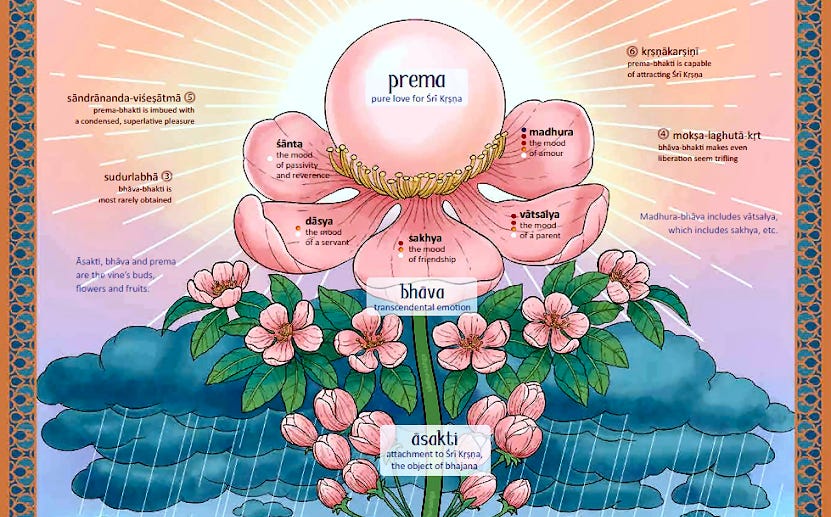
Gradually, this taste turns to a strong attachment not just to the practice, but also to the object of the practice, the sweet Lord himself. At the earlier point of steady faith the devotee was not able to see when his mind somehow sometimes shifted to material topics but now at this later stage of attachment the opposite takes place: he may have some practical things to consider but his mind somehow shifts to the spiritual topics of Krishna, God, without him being aware. This attachment grows deeper and deeper to the point of spiritual madness, intense longing for the Lord's personal association. The final stage, known as prema, is so beautiful, wonderful, and glorious that it attracts the supremely attractive being himself, Krishna.

Transcend the controllers; connect with the one beyond control.
On a journey, we want to see not only how far we have traveled but also if we are going in the right direction. So far in this chapter, the beauty and sublime qualities of the path of devotion have been discussed, but one may still wonder, devotion unto whom? Through ancient literature, we find there are great powers and personalities well beyond the scope of earthly humans. Suta concludes that although beings such as Lord Brahmā and Lord Śiva have unimaginable influence, they are still slightly influenced by what they control. Suta explains by the analogy of three forms of fire, namely the latent fire within wood, smoke, and the fire itself. If one is cooking, then fire is certainly the most useful. Smoke, which is a symptom of fire, but which burns the eyes, is less so, and wood is fire's most hidden form. It takes some work to get fire from smoke, and even more work to get the benefit of the fire hidden in the wood. Similarly, Brahmā and Śiva, although powerful entities, deal with lower energies of this world, but Lord Viṣṇu is the master of tranquility, and like fire is most useful for cooking, this tranquility, sattva guṇa, is most useful for spiritual development. Because Kṛṣṇa/Viṣṇu is transcendental to even sattva guṇa, connecting to Him brings one beyond the modalities of material energy.
The unseen witness becomes the seen beloved to call us home.
Although the common translation of the term avatār is incarnation, that term isn’t very fitting. The Spanish term abajo, which means down, is related to the ava in avatār. Thus, the term avatār means when the Lord comes down in his own form, spiritual, but a form nonetheless. Incarnation literally means to appear in carne, in meat, in a material form. In this last section, Suta Goswami answers the fourth question by explaining how the Lord manifests and maintains millions of universes by his appearance as the three potent avatārs, also known as expansions. These potent avatars are called the three antaryāmī, the supervisors or witnesses within. The first is the supervisor of the collective universes. The second is the supervisor of the individual universes and of the totality of souls. The third is the supervisor of the individual souls, situated with all beings in their hearts. In each feature, he is seated there as the witness and permitter but unaffected by the material environment. Our sage Suta shares the analogy of fire once again. He states that just as the latent form of fire is found in all wood, so similarly, the Lord is within everything but distinct from it all, just as fire is different from the wood itself. Thus, the Lord in these forms permits and facilitates the souls’ experiences of the results of kāma and karma, desires and deeds. Then, in the last verse, Suta begins to answer the third question that was asked in chapter one. Why does the Lord appear in the universe in his form of Kṛṣṇa? This last verse is a precursor to the entire next chapter, wherein 25 incarnations are listed, then after which Kṛṣṇa will be described as their fountainhead. However, in this verse, Suta simply states that the Lord appears out of his love and care in various attractive forms and pastimes simply to invite us back home.
Allowing our material desires, he expands his forms to make our worlds,
but acting on his own desires, he enters these worlds, displaying beautiful pastimes to invite us home with him.
Resources & Inspirations:
Comments
Nothing yet. Say the first thing.
Sign in to join the conversation.