
For too many of my clients, the root cause of most dysfunctions is stress. The challenge with stress is that it’s so challenging to ascertain where it comes from that the solutions that worked for one person may not work for you. In fact, I find that there’s rarely ever one source of stress, leading to it being hard to figure out what key factors move the needle enough to alleviate the stress.
One of the biggest root causes of stress is dysfunctional breathing patterns, and often as a result of sitting too much. Dysfunctional breathing patterns can lead the body into chronic adaptations like tight hips, low back tension, digestive sluggishness, and even anxiety. But too often, people try to treat their low back pain, without understanding the proper root cause of the issue. This can lead to the treatment only working for a few weeks, yet returning worse than before.
This article will explain a few of the reasons why the pelvic floor is often the root cause of these breathing dysfunctions, and a key exercise that helps to not only unlock the pelvic floor, but can restore breathing patterns back to optimal function, and get your body to move from stress back to calm.
Watch the full Youtube video here!
In a well-aligned spine, the thoracic region (mid-back) maintains a gentle kyphotic curve, while the lumbar spine (lower back) holds a natural lordosis. This S-shaped curve is crucial for shock absorption and even load distribution. The thoracic spine’s ability to extend, especially during activities like reaching, standing upright, or walking, is essential for maintaining this balance. It allows the rib cage to stay stacked over the pelvis, reducing excessive demand on the lumbar spine and hip musculature. It also is critical for things like breathing, digestion, and cardiovascular health.
The Sitting Epidemic and Loss of Thoracic Extension
When we sit for hours each day, especially with poor posture, the thoracic spine falls into a flexed forward position. Over time, the muscles and fascia around the chest and upper back adapt to this rounded position. The pectorals shorten, the lats become dominant, and the spinal extensors in the thoracic region weaken. The nervous system adapts as well, reducing motor control and awareness in this part of the spine.
One of the major challenges of being human is that we won’t always notice this loss of extension. After all, the brain only consciously recognizes if we achieved the task or not. Did we sit when we wanted to sit? Yes? No problem. Did we walk from point a to point b? Yes? No problem. The body simply compensates and adapts to allow us to continue to survive in our environment. But, these compensations over long periods of time lead to less and less tolerance in the system, and ultimately pain.
Compensation: Lumbar Extension and Anterior Pelvic Tilt
To understand the compensation, we first need to understand what healthy function of the spine looks like. Your mid back and ribs are supposed to be able to rotate 20 to 50 degrees, depending on genetics. It’s also supposed to flex forward 35 ish degrees, and extend 20-30 degrees. But, when our upper back rounds forward, and becomes rigid from adapting to the chair, all of that motion doesn’t just get lost to us. It goes down into the lower back.
The next important part to understand is that when the mid back is stuck in flexion, the top of the lumbar spine, L1-L3/4 is pulled into flexion. This by itself is no problem if there is no movement requirement, like in sitting. But once we stand up and begin to move, all of the rotation demand from the mid back and the flexion/extension demand of that upper lumbar all gets dumped into the pelvis and hips.
Imagine now that ALL of the rotation/flexion/extension demand of movement that is supposed to be distributed evenly through the entire spine, now rests squarely on the shoulders of L4/5 and L5/S1. The amount of friction created in those two critical joints that are supposed to stay fairly fixed begins a cascade of inflammation and wear that leads to lower back pain being the 5th most common reason people visit their doctor, and lumbar fusions being in the top 3 musculoskeletal surgeries in America.
Recognizing the Signs
People with this compensation pattern may experience chronic tightness in the lower back, especially after standing or walking for extended periods. Relief often comes when sitting or bending forward due to this position temporarily opening the spinal canals that get pinched with excessive localized extension at L4/5 and L5/S1. Over time, this can lead to neurological symptoms, including sciatica, tingling, or even muscle weakness in the lower extremities.
Correcting the Pattern with Movement: Thoracic Extension for Low Back Pain
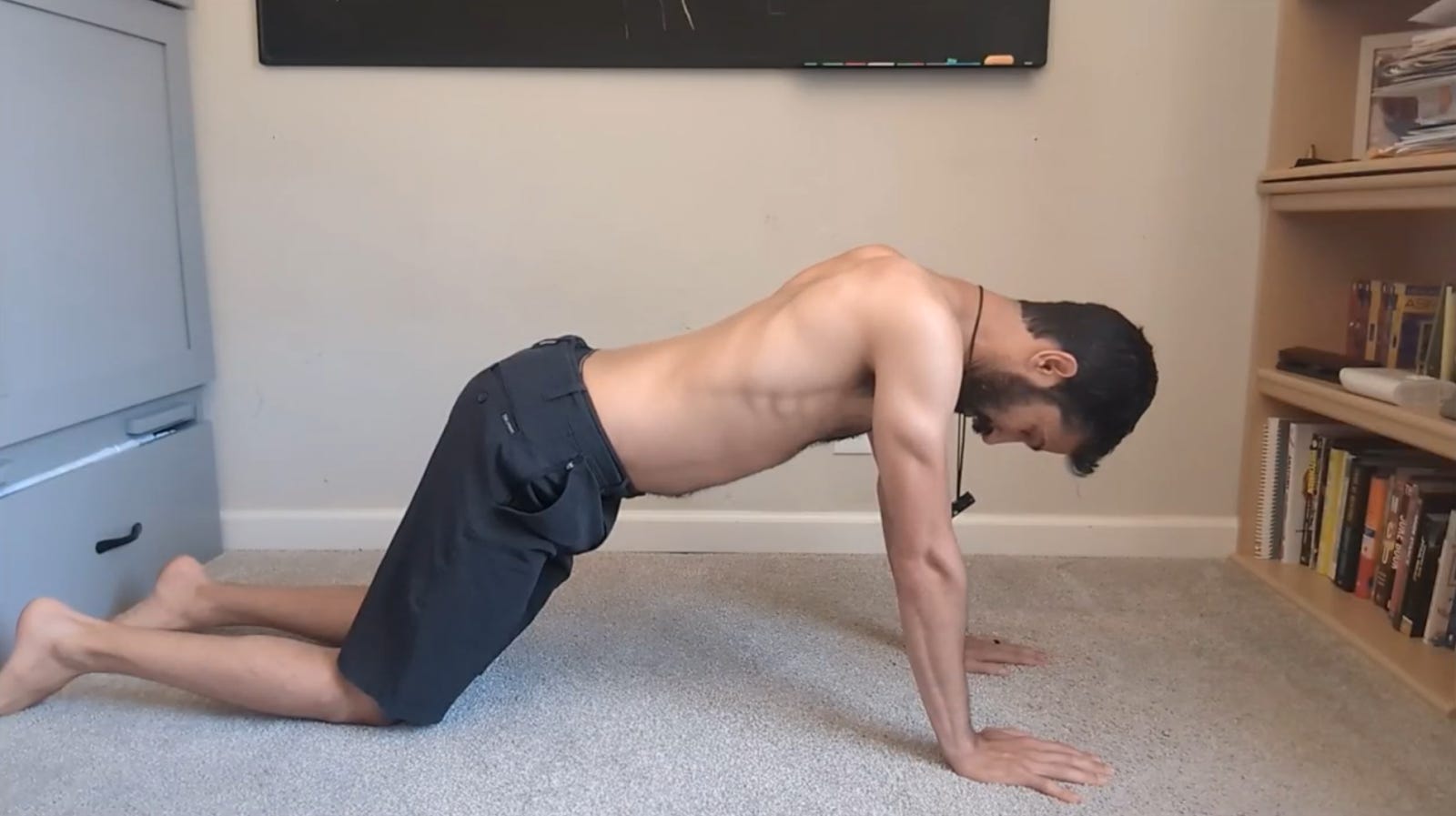
To address the root of the issue, thoracic extension must be restored. One highly effective position is to simply hold thoracic extension statically to allow the body to accept the position again. In this position, the individual starts on all fours, with the shoulders stacked directly over the wrists and the hips about 6 inches ahead of the knees. The arms remain straight while the head falls forward, and allowing the shoulders in the front to open, while allowing the shoulder blades to naturally migrate back behind the rib cage. As the thoracic spine regains its extension, L1-3 begin to follow along, reducing the localized demand at L4/5 and L5/S1.
Practiced daily for 2–5 minutes, this position begins to re-establish thoracic mobility and offload the lower back. It also subtly cues the hips and pelvis to return to a more neutral position, re-integrating better movement patterns throughout the spine. If you’re actively in pain, you can start with 30 seconds at first and work up to the 2-5 minutes.
Prevention and Ongoing Care While corrective exercises are crucial, long-term prevention requires a comprehensive approach:
Frequent Postural Breaks: Stand up and move every 30–60 minutes if sitting for work.
Thoracic Mobility Work: Incorporate foam rolling, open book stretches, and wall slides.
Pelvic Control: Train the glutes and deep core musculature to support a neutral pelvis.
Breathwork: Diaphragmatic breathing can help reset the rib cage and reinforce thoracic extension.
Conclusion The body is a system of interrelated parts, and when one segment becomes restricted, others compensate. A lack of thoracic extension is more than just a postural flaw, it’s a driver of dysfunctional movement and chronic low back pain. By understanding and addressing these compensation patterns, especially through strategic exercises that work on thoracic extension, we can take meaningful steps toward spinal health and long-term pain relief.
If you liked this, check out my course at Four Lights Wellness, where I cover both physical and mental aspects of wellness: Healing (e)Motions: Trauma Release Exercises for People with Stress offers targeted physiological exercises aimed at reducing stress and mental health dysfunctions that can contribute to physical pain.
No posts
Comments
Nothing yet. Say the first thing.
Sign in to join the conversation.