
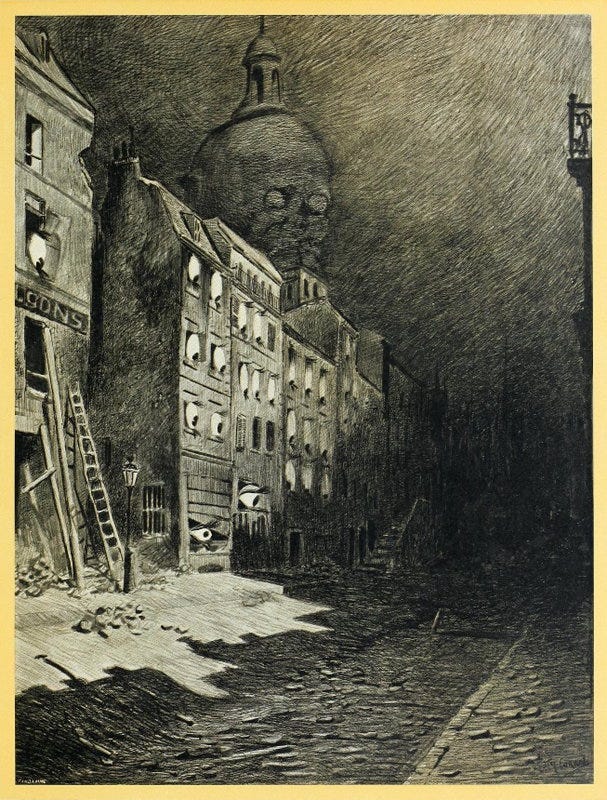
After my teacher explained the metaphor of a wasteland, I’d wake up at night and think about my father’s wasteland. I wasn’t sure what kind of empty place this could be where it was possible to escape from everything, where a person could save himself from something, some problem, some pain, where he could be alone… Does every person have his or her own wasteland? If so, then there would have to be enough empty space on the surface of the Earth for a wasteland where every single person could go and retreat into isolation, as my teacher added. Stefan was sleeping in the other bed, so I didn’t dare get up and pull out the atlas to confirm that there really was enough space on Earth for a wasteland for each inhabitant. But what if my father’s wish to find a wasteland came true? In a wasteland a person is alone, that’s what my teacher said, and with a lump in my throat I concluded that my father also wanted to be alone, without us.
Stefan had almost no relationship with me whatsoever. Either he bossed me around or he ignored me, there was no third option. He considered the room his own and if he could, he would have sent me off to a wasteland so he could toss a ball against the wall beside his bed in peace. He never tossed it over to me, except those times when my mother came into the room and began shouting “That wall’s going to collapse someday, and then you’ll see how great that is! I hope the ball disappears back where you found it.” Then he’d toss it to me for a second. One morning when he left for school, but I didn’t start until later because I was in the second shift, I looked in the Atlas and checked the measurements of the Earth a hundred times, and I realized there couldn’t be a wasteland for every person. And if there already was such a wasteland, it would have to be a collective one for all those who wanted to find it and go there. So, even in his wasteland, my father would bump into other people. But then I thought: maybe the people there are silent like my father normally is. Then, everyone could be alone with their thoughts and far from their problems. Along with his coughing, my father evidently had another problem. Were we his problem? Was I?
The wasteland is an escape. The essence of escape is to go away, to flee, how else would you find a wasteland? Then when you get there, the most important thing is to quench the thirst inside you. In the wasteland you are your own oasis of water. And you must drink only when you are truly thirsty so that you will have water later and not die of thirst. And you must not share a drop with anyone else or expect anyone to share one with you. In the wasteland you die if you live for others, if you think of others. In the wasteland no one thinks of anyone else.
The occasional remarks my mother would mutter aloud to herself when my father wasn’t at home, or muttered under her breath when he was, led me to think that something terrible had happened between her and my closest relations I’d never met—my grandmother, my grandfather, and my uncle. “I am his reward, a reward!” she’d say sometimes almost shouting. “He was lucky that he chose me, I saved his life!” she would add at other times. “They should thank me for bringing him here!” she would continue. “We had a good life here with Tito, but they saw nothing of life!” she would add with relish. “And they tried to turn me into a Greek!” she would angrily add at other times. These declarations, spoken in anger and bitterness, were her favorites. Apparently, Stefan thought it was normal for our father to have no past, so he didn’t react whenever anything about Cyprus turned up on the news. But for me, by ignoring that there was a problem, the idea that there really was a problem took root in me.
Towards the end of my primary school, the conflict between Macedonia and Greece was increasingly talked about. Because of that, I couldn’t rid myself of the idea that everyone in our house, had, in fact, his own problem, his own question: for my father, the Cypriot one, and for us the Macedonian one, but our question also became his, and his became ours. Or at least that’s how it was for me; Stefan didn’t think about it at all, and my mother was only concerned with the question that applied to her. However, the Cypriot question was included in international news, the Macedonian in domestic news.
My parents got married several days after they arrived from Cyprus, after she brought him to the village. My grandfather, angry at first because he thought his daughter had been working in Skopje all summer, not off in some Cyprus or other, and second because of her unexpected arrival with a guy who coughed all the time and didn’t know enough Macedonian even to say “Good morning,” so he had to ask him with gestures whether he was going to marry his daughter. My father just nodded in confusion, and already the next day they got married in the registry office in the nearby town, without an engagement and without a wedding. That’s what my grandmother told me, but I wondered whether even then, perhaps, my father had realized that he had married a woman who never asked him to find out what happened to his parents and his brother and kept repeating how lucky he was that he had chosen her, not them. But he must have wanted her to ask how he felt about leaving and abandoning everything he had, but she remained stubbornly silent. Plus, she muttered stubbornly, as if he couldn’t hear her, how much she hated his family, and that created in him a resistance to such a question ever being asked. Or maybe, he was the one who forbade her to ask such questions? The marriage came about because of a summer affair, not a vacation, but at work. I was sure that Stefan had been conceived in the hotel. Once I calculated how much time had passed before he was born and it worked out that my mother most likely got pregnant some night at the beginning of June, just a few days after she arrived in Famagusta.
When I grew up and discovered love’s pleasures, I often asked myself how my mother was even able to make love with all her hypochondriac pains. Her legs and her arms always ached, so did her back and her head, and often her stomach as well; she was always dizzy, when we drove anywhere, she got carsick, which didn’t stop her from constantly sniping about how badly my father drove. She couldn’t lift anything heavy, carry bags from the market, go with me and my brother to the doctor’s. She always looked for a way to take the easy way out, for someone else to take care of her responsibilities, someone else to drag her through her own life—but under her command. I wondered how it happened that she took on that seasonal labor. It was only because laundry and ironing had already been automated in the deluxe hotels of Famagusta that she was able to survive that month and a half in Cyprus.
She was only a chambermaid for three days, as she told the neighbor. “How could I possibly change so many sheets, everything ached; on our second day Mara found me unconscious and somehow arranged with the boss for me to get transferred to the laundry room.” Yes, I could just imagine it. Throughout her life my mother was falling unconscious, although she never really did. She would always say: “I’m going to collapse, my head is spinning! I’m going to die, I’m fading.” Surely Stefan was as terrified as I was, although he never showed it, surely his heart also pounded thinking she would really die. My father, however, coughing, breathing, gasping for air, and puffing on his inhaler, would go get her and settle her on the couch and then run to the kitchen for a glass of sugar water. When she’d come to, she would just start in again on her complaints that she hadn’t had a moment without pain since then; “since then,” of course, referred to her time in Cyprus. My father would then get up from his dining room chair, muttering, “You just have to find yourself a wasteland,” and go down to the garage. Once I asked Stefan: “Why did dad even come with mom?” “What do you care?” he responded angrily. “Don’t you have anything better to do?” But I really did care, and I thought it was the best thing in the world for me to be doing.
After arriving in Skopje, my father had to learn Macedonian so he could get Yugoslav citizenship, which he did three years later. But that foreign accent of a non-native speaker stayed with him to the end of his life. In the building where my mother bought the apartment on credit, and which she later transferred to his name and he paid it off over the next two decades, everyone, from the very beginning, called him an Aegean, as if he were a Macedonian from Greece. “Hey there, Aegean, how’s it going? Hey, Aegean!” they’d say to him with a smile on the stairs, or more harshly: “Hey, you there, you Aegean, it’s your fault we can’t sleep at night!” An Aegean from Cyprus, I pondered later. People can be so stupid, I thought angrily. How could you be an Aegean from Cyprus? But he didn’t object, and he seemed to prefer that they called him an Aegean than a Greek or Cypriot; this way, no one asked him anything or accused him of being against Macedonia. Sometimes I asked myself whether he sometimes did have his doubts: “Maybe these people really did steal the name Macedonia?” A moment of intense feeling that maybe my mother didn’t love him enough for him to be loyal to her fatherland? How loyal can a foreigner be to a new country? How can a foreigner become nativized? Domesticated? After all, wild animals can seem tame, but at some critical moment wouldn’t they show their true nature and cause a tragedy? How much can the political questions of one’s newly acquired country impact an ordinary worker, a former custodian? Especially since he was lucky that even Yugoslavia needed janitors, and right after his arrival in Skopje he began working in a steel mill, communicating at first with his coworkers through gestures. It’s not as if, because he was a Cypriot Greek, his case didn’t pass through a verification process by the Yugoslav secret police. But what was there to find out about him? In Cyprus he hadn’t finished university, he hadn’t been drafted because of his asthma, and when war broke out, he was working as a custodian in a hotel. The Yugoslav administration followed his actions—at the steel mill, in our neighborhood, even in the building where we lived—at a time when informants kept an eye on every foreigner before he was given Yugoslav citizenship. Maybe they had followed him since his first entry into Yugoslavia on the Lasta bus. And it’s possible that the regional Central Committee enquired about him, and even that he was called in for questioning during those two days in September 1974, when Makarios came from exile to Belgrade, and Tito and non-aligned Yugoslavia expressed support for him, assuring him that the Turkish army would withdraw from the northern part of the island and everything would be resolved for the good of the people. With the help of a translator, maybe they wanted to find out whether he was considered a dissident, a political refugee from Cyprus, so they could demonstrate that it wasn’t only from Yugoslavia that people fled abroad, but someone from abroad could come here seeking refuge. And what did he think about the meeting between Makarios and Tito? But my father, if any of that did happen, would surely have just said: “No, no, I got married here, I don’t understand politics.” My father really didn’t understand politics and wasn’t interested in it, although he watched all the news on television. In all my mother’s monologues, however, whether spoken aloud or muttered under her breath, there was always some political note: “They would turn me into a Greek!” “Well, now that they’ve turned themselves into South Cypriots, let them suffer.” “They should thank me for saving his life.” My father watched everything on television, musical shows, sport matches, Yugoslav films and serials, and American westerns. The television was his best friend, he sat there in front of it with a glass of wine or a cup of coffee, he could be as silent there as much he wanted, in front of it, he was secure. But my mother could overpower the TV, and when she’d make some comment or other, my father would stand up, turn it off, and say as he left: “You just have to find yourself a wasteland!” I asked myself where he learned such a phrase that most Macedonians would never use. He must have heard it at the Macedonian course he took at night school. But in what context could it have been spoken? And why would a teacher teach such a phrase to her students? How would it be useful to them? But my father was probably praised for it because he said it perfectly, without an accent. That phrase became the motto of his life.
No, Big Brother isn’t watching anyone in the wasteland and it’s not the brave new world, and those alienated volunteers inside it are not in Zamyatin’s We. In the wasteland these alienated people live voluntarily, without force, threat, pressure, blackmail, God’s will or science fiction tactics; they live in the same geographic area but each in his own separate territory. The inscription “No entry” is understood, there is no need for a picture of a vicious dog at the gate. For a start, it’s good that not everybody who wants to find a wasteland, and the world is teeming with such people, will opt for a life inside it. First, because they don’t know that such a place exists. Maybe because Macedonia is such a small and unknown country and people want to be known for the good, not the bad, Macedonian citizens outside the wasteland don’t think it’s something a country should be proud of. They consider it shameful, a national betrayal, an investment tainted with bribery and corruption, just like everything else. But it’s only a matter of time before foreigners swarm into the wasteland, craving isolation, solitude and work where there is no teambuilding, overtime hours, stressful meetings, foreigners who have earlier tasted the sweet nectar of individualism, of alienation, the lack of care for connections with family and friends, the beauty of being alone and self-satisfied, with no one standing over your head. It’s a good thing, in any case, that the villages and cities in Macedonia appear empty, so the people who want “to find a wasteland” can take up residence there, too. And that way 50% of foreign revenue can go to the Government.
The fate of a man who, at a critical moment did not go back to his family home to be with his parents and brother the moment they were driven into exile, but instead left with his pregnant girlfriend to Skopje, is the fate of a man who made a decision once and for all. And it was precisely that fate and his silence that marked my childhood and youth, through which my brother passed with incomprehensible ease, but created in me a quest for my father’s past. My father was closed, locked tight, and never spoke about Cyprus, he didn’t mention his parents or his brother, he never spoke Greek. He didn’t have anyone to speak it with. We never went to Greece on vacation, although many others did, especially after the fall of Yugoslavia. What an irony of fate, from being a Greek he dissolved into being a Macedonian. But I would catch a look in the corner of his eye and hear his almost inaudible gulp, I followed the barely visible play in the corner of his mouth, and most of all the constant trembling of his hands. We were all so used to his coughing that when he wasn’t coughing, I was gripped by fear that he might have died.
I often felt pressure pounding in my head from the questions that preoccupied me, but either I didn’t know how, or didn’t dare, say them aloud—what was it like in Cyprus? Were my grandparents alive? Did they know about me and Stefan? Was my uncle alive? Did you have a falling out with them? Was it mom that led to your falling out? Do you know Greek? I’d then reproach myself that the last question was stupid. Of course he knew it, I told myself, it’s his mother tongue. But when someone never speaks the language that’s supposed to be his mother tongue, it seems logical to ask him the question whether he speaks it. Or not? I never asked him these questions; maybe he wanted me to ask them, any one of them. Perhaps he really needed them more than we did? How do you talk about something if you aren’t asked? By my mother’s behavior, I knew that even at night, in the quiet of their bedroom kept apart by his coughing, she didn’t ask these questions. But surely, she must have muttered to herself, cursing his parents for everything they didn’t do or did do, but not asking him what he thought, how he felt. If he turned the lock on his Cyprian life once, she turned the key once more. And then she threw the key, lest there be any chance that lock would open unexpectedly someday, at some fateful hour.
My childhood was different from Stefan’s. Due to our differences in age, I didn’t know what kind of child Stefan was. To me he was always grown up because he had to look after me, bring me to and from kindergarten and then school, always dragging me by the hand, always by the left one, and I often measured my arms to see whether my left was longer than my right. I’m sure he could barely wait for summer holidays when my uncle would take me by bus to the village. I stayed until August, up to the Feast of the Transfiguration, when I’d come back from church with my grandmother, and the green Yugo would already be there in front of the house. My mother, my father, and Stefan stayed for three or four days, at the end of which my mother would argue with my grandmother and my grandfather would shout at her, “Go on, take the bus! Nikos can stay with Stefan and Katerina if he wants to; we’ll finish the field work more easily without you.” But we would all leave together. In the Yugo, my mother hummed to herself; she was never as happy as at those moments—the fact that we all left together, letting her father know that my father obeyed her, and that she wasn’t leaving because she was driven out. The very next day we would go to Lake Dojran for a few days.
I spent every winter and summer holiday until I was eighteen with my grandmother and grandfather. My first memory of being there is seeing a dead person for the first time in my life, in a wooden coffin, laid out in the village church, in the heat that melted its yellowed face. The church bell rang, the women mourned and grieved, the men held their caps in their hands, and the air smelled of incense and basil. I held onto my grandmother’s skirt and stared at the scene that has remained stamped in my consciousness and even much later crystalized into the clarity that, between birth and death, life is simply how it is. That everyone is alone at the end. No, not only at the end. Everyone is always alone, even when they are in the middle of a crowd.
During winter holidays the scenery turned into whitish fields covered with snow as if they’d been plowed. The snow smelled of domestic animals and dung. In the late afternoons, the sheep came down from the mountain pastures hungry. Tucked into my knit vest, I would leave the room with the oven and go to the front of the house and watch them come into the penned yard, as my grandfather drove them with a stick, and my grandmother called them over. Rrrrrr. I also shouted but inside, in my mind. I was an introverted child, with an awareness of the entire outside world, both mine and others, of the sheep, of the cold, of my grandmother’s light clothing, of my vest which didn’t even warm my arms. Even now, when I see someone wearing a sweater vest, even on a fashion runway, I ask myself who came up with such an article of clothing, why are there any vests in the world at all; who wants their back and stomach to be warm, but their arms cold? But in the village, there was not a single woman or girl who didn’t wear a vest, something that later, in my studies, I connected with the patriarchy: a woman shouldn’t be completely warm, she should suffer. Or was it that the village women simply didn’t know how to knit sleeves? But then how could they knit those white woolen sweaters for the men which they later took into town to have dyed but only made vests for themselves and their female children? Was there not enough wool? Then, shaking from the cold in my arms, from my shoulders down to my fingertips, I felt connected with the house, with the sheep, with my grandmother and grandfather, but not with myself. I was theirs, but was I also my own?
As long as my grandmother and grandfather were alive, I returned to their house at least twice a year, feeling that their house belonged to me as well, that it was also mine in some way. Years later, I was no longer even allowed inside, and, like many other things in this life, my sense of ownership had been a falsehood; the lock on the door was changed and the key no longer kept in the crack beneath the doorstep. But that was exactly the house I needed as a haven. If I had wanted to find a wasteland, it could only have been there, in that house in the village, from where, every second day during the summer I went with my grandmother outside the village to our market garden plots. The first thing I’d do when we got there was to pick a bunch of basil and rub it all over my body, and on my bare skin and on my clothes, so the mosquitos swarming in the air didn’t bite me. Only then did I draw water from the two pools into the tin watering can and water the small mini peppers, and the tomatoes, the red ones and the evergreen, and then the beans. Often, I’d start laughing amid the sadness, as if sadness were the tub and laughter the cheese. The cheese gets eaten, but the tub remains and gets refilled with new cheese, each new season. Like the bucket with lard, the lamp with petrol, the barrel with wine—bouts of laughter inside the sadness. The form was eternal, but the contents were spent and replaced. The sadness remained, it wasn’t discarded, but the laughter passed and was gone.
Right there, on our street which had no name tucked at the edge of the village, there was only one house that had belonged to a man who died soon after his wife passed away. The other houses were called by the names of the women who lived in them. But why, when people asked: “Whose are you, whose people are you?” and they couldn’t remember the specific woman, they’d ask my grandma a follow-up question: “Which Vera, whose Vera?” “Whose” wasn’t asking about her parents, but her husband. No, the women belonged to the houses, just as they belonged to the men; they carried them both on their shoulders. Sometimes I wished I could have been a grownup in the years when I was a child, so I could understand grownups more easily, and know somehow how to relate to them, not just mumble a fleeting “good morning” and then rush down the street so no one would ask me anything. They mostly asked me about my father, what the name of his country was, whether he was a Turk, and if we ever went there, whether I knew my grandmother and grandfather. “They’re also your blood,” they’d say. Evidently everyone knew that my father had come from somewhere else, and some knew he was from Cyprus, it was clear to all of them that I was half Macedonian, half Greek. But I didn’t identify with my father’s background; as if it were something outside, something that didn’t relate to me. How can you be conceived by a father without genes?
That is how everything was until the year I turned thirteen. That summer I was once again in the village for my holiday along with my cousin Dunya, when the geography professor who taught my uncle visited my grandparent’s house. He came with his wife in a red automobile which he parked in front of the house and the neighbors gaped, their mouths hanging open, wondering: “Who are those people at Vera’s? Are they related to the son-in-law?” The license plate likely confused them with its Skopje letter code; they were just burning with curiosity to find out who was at Vera’s, where these rich people had come from. My grandmother had been tied in knots all morning; she made them a real feast, hoping to help my uncle earn a top grade in his final exam to ease his path to employment as a geography teacher at the high school in the local town. Pitas, roasted potatoes, two kinds of roasted meat: lamb and pork, salads, the table was overflowing in the room with the iron beds upstairs. My grandmother and cousin only carried in the dishes and arranged them in front of the guests, bread baskets with round loaves and slices of homemade, still warm bread, a soup tureen with hot chicken soup… They took out the most beautiful dishes, spoons, and forks; no knives since at that time they weren’t set out. I didn’t help because my grandmother said to me: “Go sit there, strike up a conversation with those people.” I sat in the room and answered the professor’s questions and his wife’s, who repeated to my grandmother what she herself often said to me: “You’re educated, you’re not like Dunya.” “Aunt Vera, your niece is very well-educated,” she said. Well-educated, at thirteen years old? My grandmother was uneducated, so maybe for her I really did seem educated, with my straight As in school, but how could I seem educated to a university geography professor and his wife, who was also on the faculty, in the Institute for Social Work” And why wasn’t Dunya, just a few months younger than me, educated? She also went to school, though in the evening, when my grandfather would say, “Come on recite us a short poem,” I’d recite by heart, but Dunya would start, get mixed up, go back to the beginning, and then get mixed up again, which would keep happening until my grandfather scolded her. Did that mean only I was educated at thirteen years old? After a while my uncle began to get angry because I didn’t leave, it didn’t occur to me to go help carry the food up from downstairs with Dunya and my grandmother. Later it gnawed at my conscience when I thought about the terrible conditions my grandmother had worked in to prepare that feast for the professor on whose grade my uncle’s future depended. Then, after the bountiful lunch finished and we sent the guests off, water was heated in a large pot, because the taps in the hallway only let out a thin stream of cold water, and they spent a long time rubbing the plates with ash and water, then wiping them with a rag and arranging them in the cupboard. Dunya helped, but I was still acting the scholar walking through the house lost in thought, thinking about everything that the professor and his wife had said at lunch, how his wife had said to me: “University should be your goal,” and even more about what the professor said about Cyprus, that the Cypriot question would never be solved, the Macedonian question wouldn’t be either, but the Cypriot one had even less chance. He also said “So, your father is from Cyprus, right from Varosha? Well, Varosha is now a city of ghosts, everything has stood still and remains just as it was in August of ’74. There’s no one there; doesn’t your father have any relatives?” I stammered and mumbled that he did have relatives, but my uncle, red in the face, added, among other things, that my father no longer had anything to do with Cyprus, and he had alienated himself from it, he said, as if he had never been born there. He had alienated himself, I repeated as I wandered through the house after their departure, he had alienated himself. What did that mean to alienate himself? You’re a native of a place and then you become an alien there? Those are contradictions, it’s as if you were born and then became an outcast.
After two weeks, all my grandmother said was “That professor failed your uncle.” “We did all that for nothing,” Dunya added. Many years later when I thought about that feast, I’d get angry: how could they eat and drink in his house, and then fail him on an exam? How could he do that to my grandmother? Wasn’t he ashamed? But then, sometimes I’d think that my grandmother’s feast for the professor and his wife, and the bag she filled for them to take back to Skopje—eggs, walnuts, a big piece of cheese, and a whole leg of lamb—was a textbook example of a bribe, nothing more. And what my uncle needed to do was to study more to pass. Or, perhaps, my mother gave too little to the guests, too little for them to take home? My grandfather, tired from work in the fields and angry that none of us had gone to the field to help him that day, didn’t even go upstairs. The guests, on the other hand, weren’t allowed to go down to the ground floor; my uncle did everything he could to prevent them from seeing the village poverty that suffused the house. The discomfort of the upper floor was hidden somewhat from the view of the guests with its couch—old, but well-preserved, that my father had transported from Skopje in our Yugo when, after many quarrels, we bought a new one for our living room—and a table with a new tablecloth and a vase of plastic flowers. For many years I would often think with horror about that plastic bouquet, while the surrounding fields were abundant with a variety of aromatic flowers. Then I would immediately reproach myself. I should be ashamed to think that way about my grandmother, that she wanted to bribe my uncle’s professor.
My uncle became an animal feed vendor; he and his wife opened a little shop in the town, and the money they made, they took back to the village. My grandmother hid it in the oven of the electric stove that stood in the room where Dunya and I usually slept when we were there for our holidays. Why did she keep it in that oven which she never used, but which, as in many households, had been bought while waiting for their son to get married, for the young couple to set themselves up in the same house? That didn’t happen with my uncle, he went off to live in his wife’s house and he didn’t take the stove with him; however, the money he made from sales he brought to his old home for his mother to save. And she hid it in the oven perhaps thinking that if she put it somewhere more visible, we might take it, we’d steal it from them. From my uncle, who was even closer to us than our parents, at least to me, likely to Dunya as well. It seems to me that our estrangement began then, because of that money from the animal feed. If people were truly close, if they loved one another like they loved themselves, then they’d be able to take freely from the money of their closest relations and no one would consider it theft, that’s what I thought then. They would gather fruit from each other’s orchards, they would cut tomatoes from each other’s gardens, they would use each other’s bicycles and cars, they’d use everything that wasn’t theirs, but because they were closest kin, it would be the same as if it were theirs. When all is said and done, isn’t that, after all, the ideal of communism? What estrangement comes first: economic or emotional?
In the wasteland no one brings anything sweet or savory to celebrate the family feast in honor of their patron saint, or for a holiday, or for any reason at all. No one invites anyone for lunch or dinner. And, if the situation arose, if it were unavoidable and food had to be served, then the host or hostess would calculate the cost of the ingredients and labor, and would send the guest a bill, not right then, but the next day.
In a wasteland there are no parties, no get-togethers, no discos, no cinemas, no theatres. In the little town there hadn’t been those in any case, just once a year a traveling movie theatre used to come, but then, after it became a wasteland, it stopped coming. There was no reason to. All the inhabitants watch movies alone, either in their own heads or on the Internet. There is a small café, but there are no bar stools along the counter, just small tables for one person. It doesn’t occur to anyone to converse with the waiter or the other patrons, each person just goes there for a drink, though even that’s done rarely.
Lidija Dimkovska born in Skopje, in the Republic of North Macedonia, now resides in Ljubljana, Slovenia, where she works as an author and translator. She has published seven poetry collections, four novels for adults, one for children and young adults. Her novels Скриена камера [Skriena kamera] (Hidden Camera; Magor, 2004) and Резервен живот [Rezerven život] (A Spare Life; Ili-Ili, 2012) both received the Association of Writers of Macedonia’s Stale Popov award; the latter also received the European Union Prize for Literature in 2013. Her novel Но-Уи [No-Ui] (Grandma Non-Oui; Ili-Ili, 2016) was shortlisted for the Stale Popov award and the Balkanika Prize. Five stories from her short story collection Кога заминав од Карл Либкнехт [Koga zaminav od Karl Libkneht] (When I Left Karl Liebknecht; Ili-Ili, 2018) received a Special Mention at the European Heritage Awards. Her latest novel Единствен матичен број [Edinstven matičen broj] (Personal Identification Number; TRI, 2023) received the Novel of the Year Award in North Macedonia and the regional Štefica Cvek award for feminist literature from the Western Balkans, while Dimkovska herself was named Author of the Year at the 2024 Skopje Book Fair. Her novel The Thirteen was shortlisted for the Vanco Nikoleski prize for literature for children and young adults.
Christina E. Kramer is professor emerita of Slavic languages and linguistics at the University of Toronto. She has written numerous articles on Balkan linguistics and a Macedonian grammar. Her novel translations include The Summer without You (PEN UK award) and Fear of Barbarians by Petar Andonovski (Parthian Press); Grandma Non-Oui (Istros Press, long-listed Best Translated Book of the year 2025), A Spare Life, Lidija Dimkovska (Two Lines Press, NEA grant, long-listed for Best Translated Book of the year); Freud’s Sister by Goce Smilevski (Penguin Books, 2012, Lois Roth Prize Honorable Mention) and three novels by Luan Starova: My Father’s Books, The Time of the Goats (University of Wisconsin Press, 2012), and The Path of the Eels (supported by an NEA grant; Autumn Hill Books). She was co-translator with Rawley Grau of the anthology of poetry by Aco Šopov (Deep Vellum, 2023; winner of the International Dragi Prize 2025) In addition to novels, many shorter works and excerpts have appeared in numerous journals including Asymptote, Brooklyn Rail, Chicago Review, Two Line Online, M-Dash, The Punch Magazine, Tin House, Words without Borders, World Literature Today. For more information see christinakramertranslator.ca.
"Incarnate Night" and Two Other Poems by Richie Hofmann
·
Jul 8
Incarnate NightMy lips and teeth were purple. The night was carnal,— I thought: History Is bloody. Thank you for the tenderness. The holy people’s faces Made me think of loneliness. My hair was sticky. I pulled a napkin Out of your basket to wipe my face. I knew a colleague who became a cloistered nun, The …
"heard as though it were two" and Two Other Poems by Ian Pople
·
Jul 18
heard as though it were twoBring the ghosts, the blackberry path beside a playing field a route, bring the fragments of ghosts, out beside the wisteria villas, help stitch them in the soul, that bees’ nest in a blasted tree, butterflies late in September sun, the silence heard a…
Comments
Nothing yet. Say the first thing.
Sign in to join the conversation.