
The first Bond narrative I encountered was a film, as I am sure is the case for most of my generation. I came of age in the late 1980s and early 90s, and it must have been around the turn of those decades that one evening my father mentioned off-handedly that I could remain in the living room while the TV stayed on after the eight o’clock news.
Even today, a boy’s first Bond film is a seminal experience, though compared with our overstimulated times the pre-internet age was one of innocence. The credit montage sequence alone—silhouetted ladies in dishabille before exotic waterscapes, a shoulders-free Sheena Easton singing in her glass-like voice—probably immobilized me on the couch. A Bond film also dramatizes other notions that cast adulthood in a favorable light: 007 is autonomous; yes, he takes his marching orders from M, but we understand he is his own man; he displays what Hemingway called “grace under pressure” and we usually call “cool”; and he competently shapes the world to his liking. Freedom, coolness, competence—qualities probably all teenage males (and females, with occasional changes in the morphology of fantasy) yearn for with the fierce ache of comprehensive lack. And here is Bond, suggesting these qualities are in fact attainable.
The film my father allowed me to watch that evening was For Your Eyes Only of 1981, Roger Moore’s fifth time as 007 and the overall twelfth instalment of the franchise. The plot, derivative but solid, lines up the set pieces of a hunt for an atomic missile launch device that the usual transnational forces of amorality are trying to get their hands on. By the early 80s, the Cold War had emerged from glacial Cuban Missile Crisis days into Brezhnev-era pre-thaw, and so after Bond has dispatched the mercenary killers and the device has shattered in slow motion into myriad fragments at the foot of a rock formation, he and the KGB-general can share a shoulder-shrugging moment of camaraderie: two veteran pros who know they are pieces in a vast game.
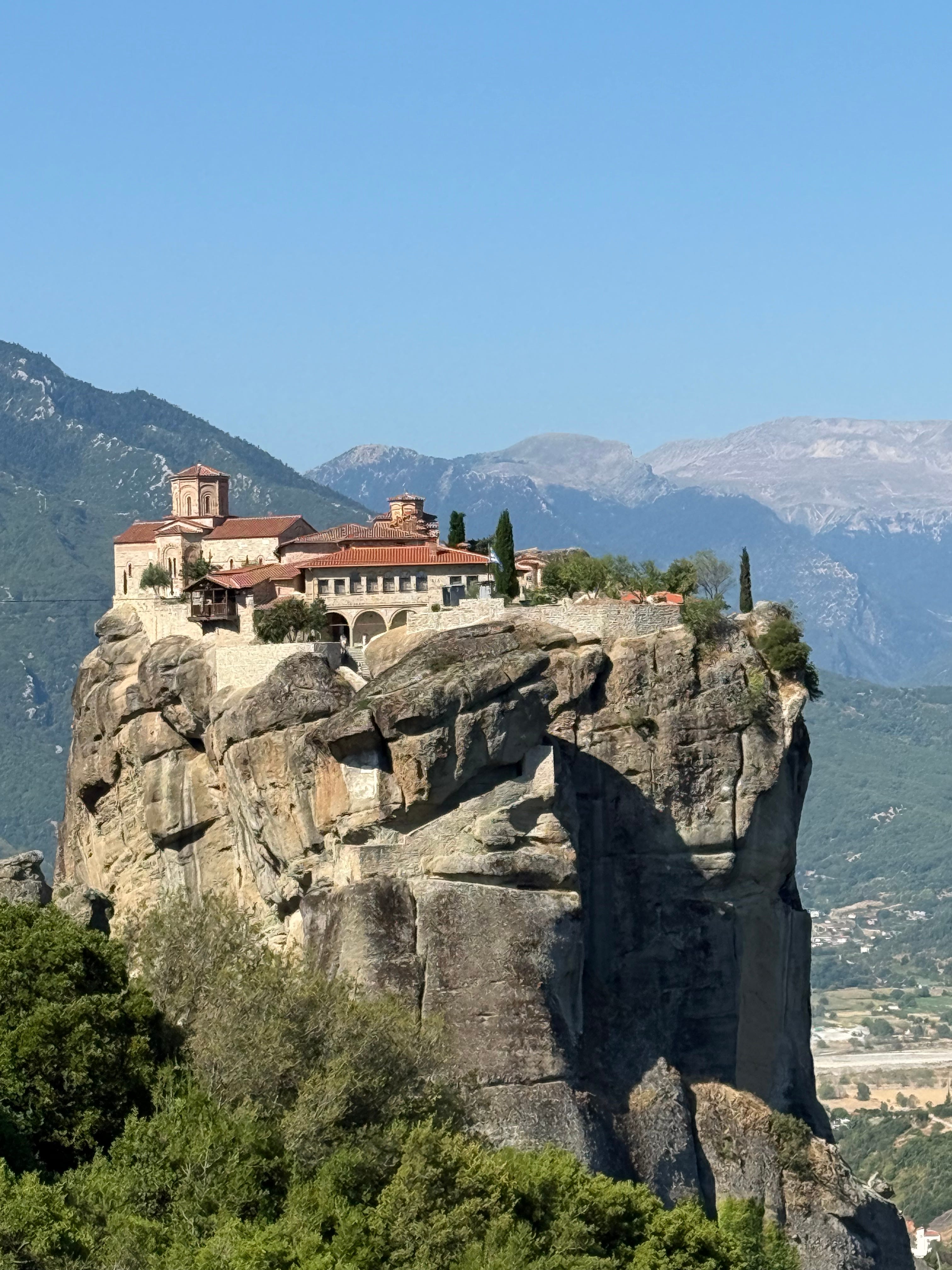
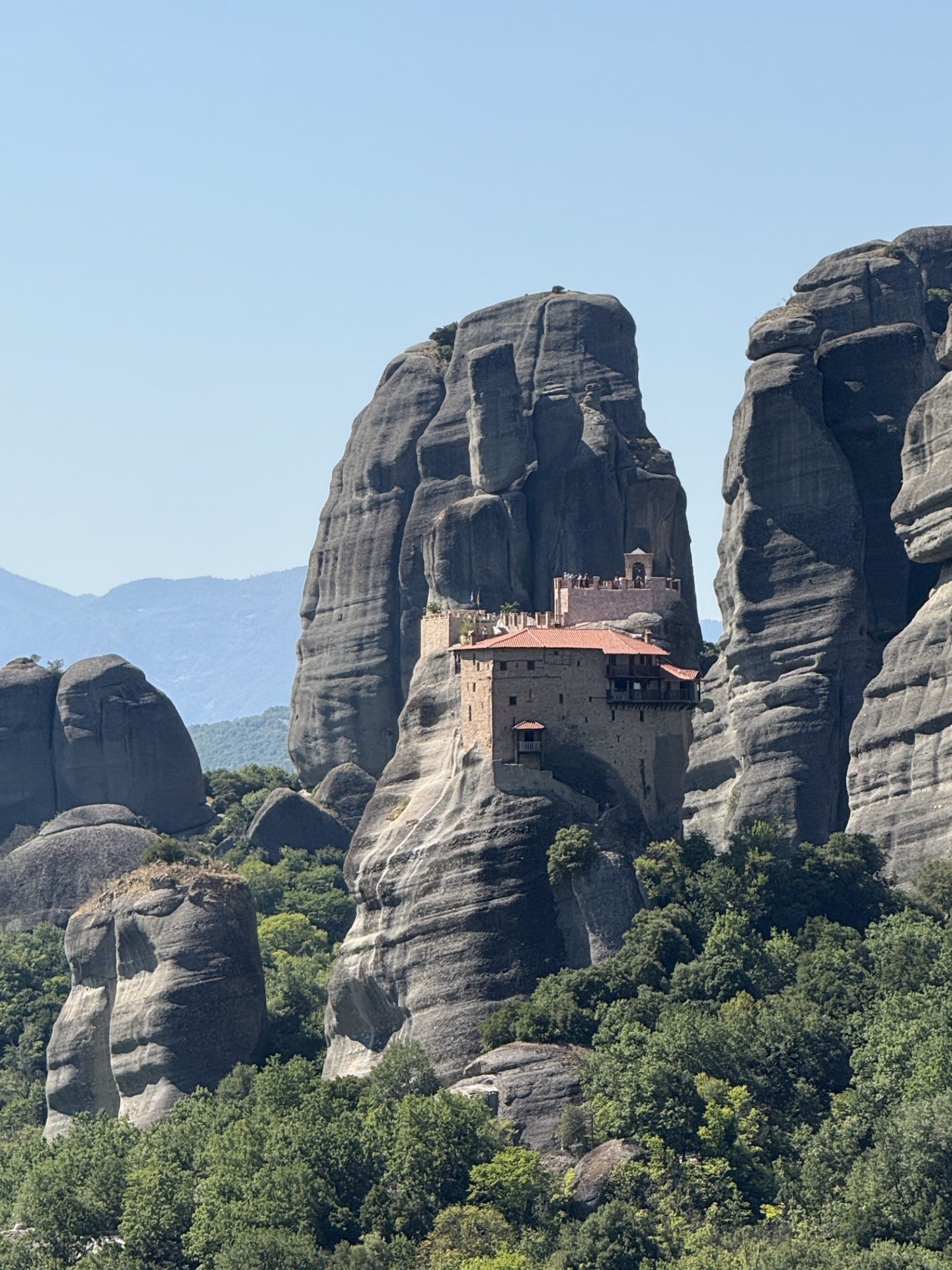
The showdown site, said rock formation, imprinted itself on my memory like a watermark, invisible most of the time, but coming into view when the angle of mnemonic light was right. I always knew that one day I would need to visit. I have noticed this dynamic on a few occasions (with Chandler’s L.A., Greene’s Saigon, and with labyrinthine Venice as depicted in that spooky, Daphne du Maurier-derived 1973 thriller Don’t Look Now), though never quite as keenly: it is as if by encountering a place in a fiction that has been meaningful to us, we incur a debt we can only discharge by stepping into reality. The showdown of For Your Eyes Only was filmed in Meteora in central Greece, where rock towers, in part craggy, in other areas of strangely organic contours, sit at the northern edge of the Thessalian plain. Atop these rocks, orthodox monks, intent on leaving the world behind and below, between the fourteenth and sixteenth centuries erected around two dozen monasteries. One of these, abandoned in the fiction by its erstwhile holy inhabitants (as in fact most of the monasteries are today), serves as the lair of the villain Bond must defeat to save the realm.
*
One late August afternoon, I flew into Thessaloniki, Greece’s second city in the country’s north. After a night in an airport hotel, I got into my rental for the good three-hour drive to Meteora. Outside the city, the E90 took me at a steep incline into the Askio Mountains. The traffic was light that day, the sky blue as the triangles of a Union Jack, my mood anticipatory in the way we feel when a long-open loop is about to close. Pine trees pushed up to the roadside fencing, the grass swayed a dry yellow. Greece is wild here; signs warn of bears crossing. As I cruised along, my mind went back to For Your Eyes Only.
The script was competently stitched together—Richard Maibaum, oldest of Bond hands, was in the lead—from Fleming’s oeuvre: a 1960 short story of the same title provided the core of the plot, some elements came from “Risico,” another story from the same collection, a bit of technical wizardry from Goldfinger; On Her Majesty’s Secret Service yielded a comic relief character plus alpine action sequences, Live and Let Die an episode of marine peine forte et dure. In Fleming’s story, we encounter Bond pondering the morality of vengeance and finding it admissible under the circumstances; Fleming’s 007 is prone to such introspection in ways his unencumbered filmic incarnation is not: “Since no other law was available, the law of the jungle should be visited upon Hammerstein.” Hammerstein is an escaped Nazi (with a name, oddly enough, associated with anti-Nazi resistance) and the instigator of the murder of a British couple, old friends of M. Bond’s chief has now sent him out as “public executioner.” However, the barely present national security angle bothers 007; while he is setting himself up for the kill, his “mind hunted round for more arguments to bolster his resolve.”
Vengeance is perhaps the one motive that can ennoble bloodshed, but vengeance cannot be delegated: only the aggrieved, if anyone, can claim this right. The story finds a neat solution, which the film adopts. It will in fact be the murder victims’ daughter who puts an arrow into the principal agent of her parents’ destruction (the film here collapses two of the story’s villains into one). In the film, she is called Melina, played by Carole Bouquet; in Fleming’s story, she is called Judy, a name Maibaum et al. clearly found unsuitable, and rightly so—Carole Bouquet is no Judy. Unlike Bond himself, Melina/Judy may well be entitled to vengeance since her parents’ murderers can only be reached by the law of the jungle.
For a Bond girl, Melina Havelock’s character is well developed: she has motive and agency, emotional and intellectual reach, a hint of backstory, perhaps even a character arc. Bouquet plays Melina with a pale, brittle ferocity that is only highlighted by the rosy-cheeked foil of Lynn-Holly Johnson’s Bibi Dahl, a blonde ditz who pirouettes from the ice-rink into Bond’s arms. The structural dynamic between the two female characters is different than it has often been in the franchise: “good” Bond girl and “bad” Bond girl, erotic romanticism and lethal, rapacious sexuality. Melina likens herself to ruthless Electra, but to me she is the hunter-goddess Diana, out for revenge with her crossbow (Fleming describes Judy as a “beautiful unkempt dryad” to keep her manageably cute for Bond’s machismo); Bibi is a carefree, twirling sophomore, an American Aphrodite.
*
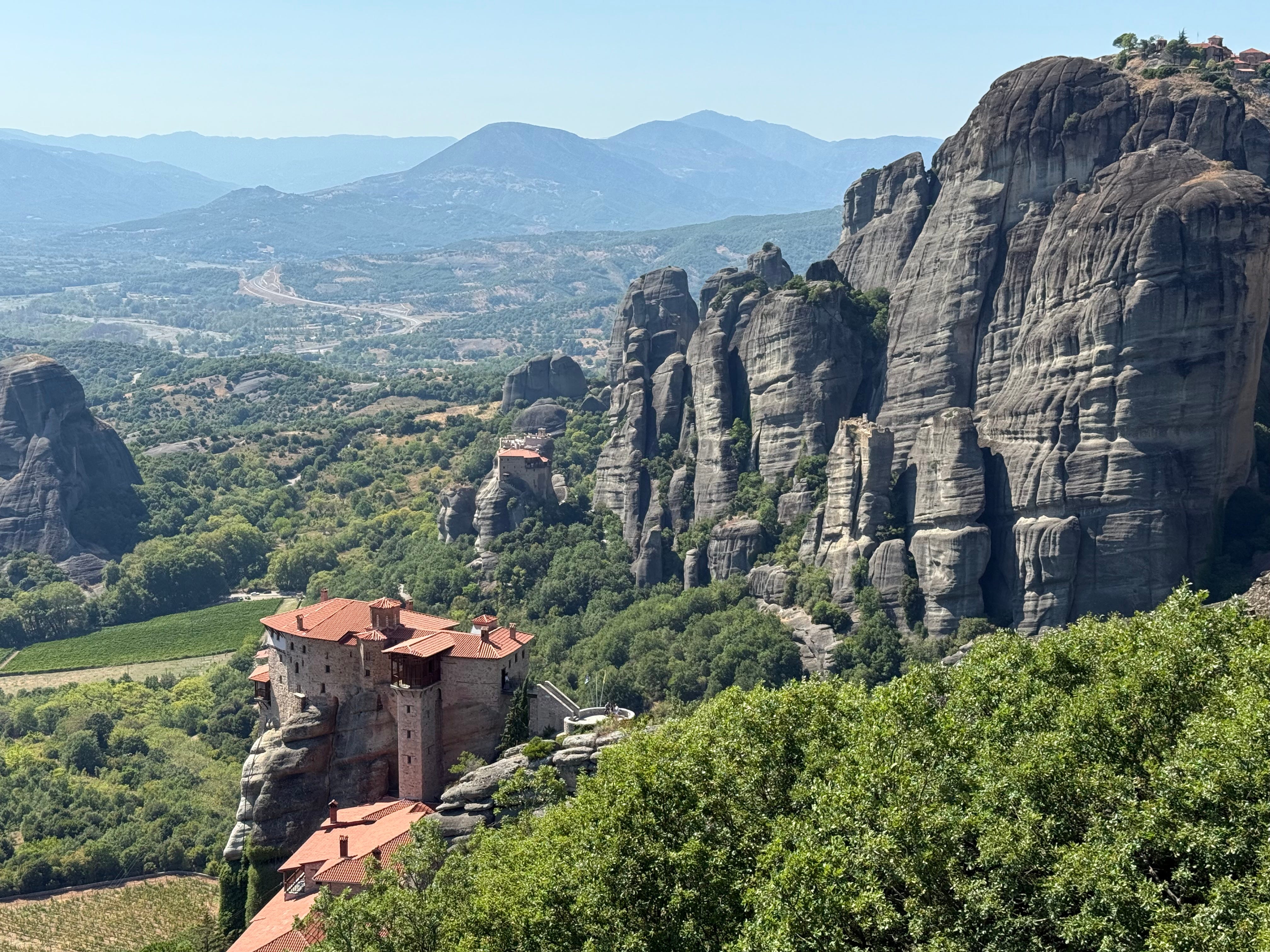
The GPS directed me off the freeway and onto single-lane roads through semi-abandoned mountain villages, with only groups of elders on the verandas of the local taverna, over a series of passes and down serpentines into valley floors with bridges over almost dry riverbeds. I knew I was getting close, but when the Meteora rock formations rose to my left their appearance jolted me. Unsurprisingly, they brought to mind a stage set, yet in fact another kind of unreality hangs Lost Horizon-like over the place, as though it were pushing at the boundaries of what we can accept as being of this world. “Metéōros” is Greek for “suspended in the sky,” and while my metaphysical sensibilities flag rather listless these days, I understood quickly why for anyone with an urge for the sacred this would be a site at which to seek transcendence. The monasteries, two- or three-story buildings, mostly of beige sandstone, perch humbly atop the rocks like petitioners at the entrance to heaven.
I checked into my hotel and ate a late lunch of baked fish in lemon-thyme-garlic sauce, divine in its own way, forgoing the local Batiki since I still had more driving to do. Kalambaka, the village nestling to the foot of the rock towers, has refashioned itself completely—like most places with the ambivalent blessing of a tourist hotspot in their vicinity—to cater to the visiting masses. Almost every other house seems to be a pension, an eatery of some kind, or a shop selling memorabilia. The next morning, I would discover framed reproductions of early twentieth-century photographs on the walls of the hotel’s breakfast parlor; judging from the drawn features of men on donkey carts and old women behind fruit stalls, the village must have been a grindingly poor backwater at the time. This has certainly changed. BMWs and Mercs abound in Kalambaka, more so than in big city Thessaloniki.
After a tar-like espresso, I embarked for the drive up to the ridge. Some weaving and winding through narrow streets precedes the climb. The engine of my little rental struggled as switchback followed switchback, but after around ten minutes the road leveled off, revealing a view of the valley and beyond that of the Thessalian plain. Haze obscured the contours of any modern structures perhaps situated there, and for a moment I thought this view might well be the same as that the monks of the Middle Ages enjoyed. I parked on the side strip, stepped up to the roadside wall, and drew breath. To my right sat the Monastery of Rousanou, one of the two Meteora nunneries, a pristine and self-contained block of amber atop a geological scepter, and below me the swaying forest canopy broke like waves against the rock formations; the dry, oak-scented air carried a heady note, as though I had made it, as though this comfortable drive of mine constituted an accomplishment of sorts. The exhilaration felt, paradoxically, both unearned and deserved.
Back in my car, I started up. The road hugs the ridge side, and soon the Monastery of the Holy Trinity, most lauded of Meteora sites, coalesced in the rich afternoon light. I let the car roll to a stop and sat there with the engine ticking over. The 400-meter column of sheer rock with overhanging tops and crowned by the monastic structures superimposed itself in my mind onto the wide angle shot from For Your Eyes Only of Bond’s puny figure scaling the rockface, and suddenly I was again the boy in his early teens sitting on his parents’ living room couch watching his first Bond film. In the film, Holy Trinity is called Saint Cyril’s, and as 007 is ascending to the showdown Melina Havelock watches from below, part of the support troops that his derring-do will allow to reach the summit. Bond’s confrontation with assembled villainy will conclude this adventure of his, and here was I, as I now understood at the resting place of an arc in my own life, exhaling the last rattling gasp of post-adolescence. Strangely enough, it felt good and right, as though I were experiencing a benign, probably overdue haunting.
There is plenty of irony in the Bond films, particularly the later ones, which of course my boyhood self did not understand. Fleming’s narratives sound the occasional harsh note (unsurprisingly, considering his biography), but the writers, directors, and actors who over decades crafted the Bond films changed their key. By some legerdemain they even blended irony with adolescent innocence. There would have been much opportunity for cynical digs at ecclesiastic authority in the choice of a monastery as the showdown site. For Your Eyes Only makes do with a wink when Bond prior to his departure for Meteora encounters Q in a confessional booth. There is a guilelessness about the film, a knowing surface-level literalness that has made it for me both an item of effortless consumption and nagging preoccupation. In 1955, Swiss critic Email Staiger famously stated that the project of criticism was “to grasp what has gripped us”—For Your Eyes Only no longer grips me the way it once did, but trying to grasp the narrative required stepping into its reality.

Martin Rosenstock studied modern literature at the University of California, Santa Barbara and creative writing at the University of East Anglia. He has taught at universities in the U.S., Kuwait, and Iraq. His fiction and nonfiction have appeared in The Fortnightly Review, Literally Stories, Mystery Magazine, and other venues. When not brooding over narratives, he spends too much time traveling.
"Incarnate Night" and Two Other Poems by Richie Hofmann
·
Jul 8
Incarnate NightMy lips and teeth were purple. The night was carnal,— I thought: History Is bloody. Thank you for the tenderness. The holy people’s faces Made me think of loneliness. My hair was sticky. I pulled a napkin Out of your basket to wipe my face. I knew a colleague who became a cloistered nun, The …
"heard as though it were two" and Two Other Poems by Ian Pople
·
Jul 18
heard as though it were twoBring the ghosts, the blackberry path beside a playing field a route, bring the fragments of ghosts, out beside the wisteria villas, help stitch them in the soul, that bees’ nest in a blasted tree, butterflies late in September sun, the silence heard a…
Comments
Nothing yet. Say the first thing.
Sign in to join the conversation.