
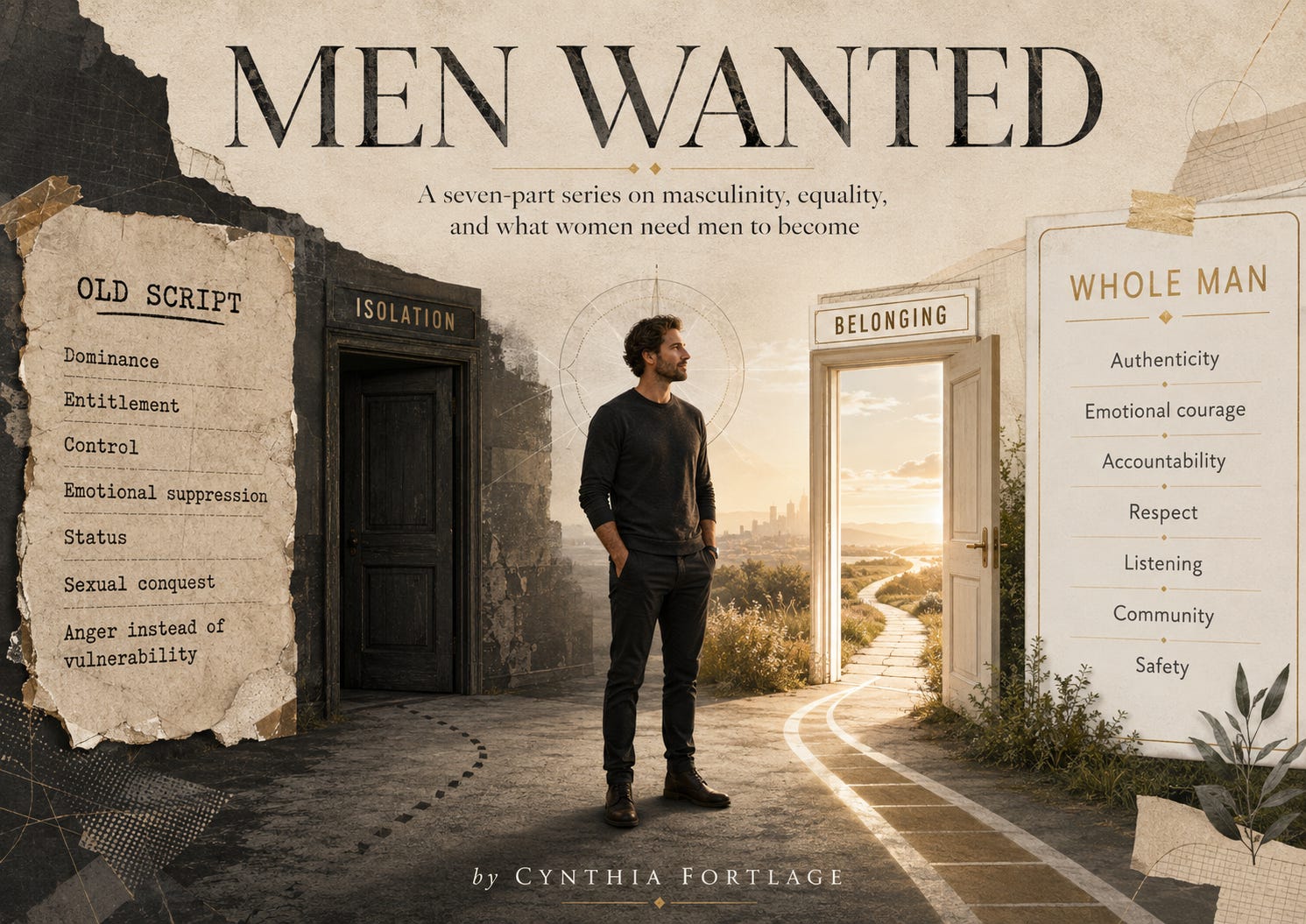
In the first part of this series, I explored the old relationship job description: the man as provider, protector and centre of the household, and the woman as the person who built much of the emotional, domestic and social world around him.
That arrangement did not disappear all at once.
It weakened gradually as women gained education, legal rights, access to paid work, control over our own money and greater freedom to decide whether marriage, motherhood or partnership belonged in the lives we wanted.
But something more profound also happened.
Women began asking questions about ourselves that previous generations had often been denied the freedom to ask.
Who am I beyond being someone’s daughter, wife or mother?
What do I want?
What am I capable of?
What would my life look like if I did not have to organise it around a man?
What parts of myself have I made smaller in order to remain acceptable?
What have I called love that was actually duty, dependence or fear?
Those questions have not been answered equally by every woman. Women are not one collective body moving in perfect agreement. Culture, class, race, religion, sexuality, disability, economic circumstances and personal choice all shape what freedom looks like and how available it is.
Some women continue to choose traditional relationships and find genuine fulfilment within them.
Some women combine independence with convention.
Some reject the old expectations entirely.
Some are still trying to work out which parts of the life they inherited are truly theirs and which were simply handed to them.
But the questions themselves have become unavoidable.
Women have spent generations examining the roles we were given.
Many men have not yet undertaken an equivalent examination of their own.
That is not because men are incapable of introspection, emotional growth or change. Many men have been doing that work for years. Some have challenged traditional masculinity, built emotionally rich friendships, learned to share care and responsibility, and created relationships in which women do not have to disappear.
Those men matter.
They also tend to stand out.
And perhaps they stand out because, for much of history, men did not have the same external pressure to reconsider who they were.
The world already recognised their ambitions.
Their careers were treated as important.
Their authority was assumed.
Their place at the centre of family and public life rarely required justification.
When an arrangement consistently affirms your position, there is less incentive to interrogate it.
Women had to question the role because the role constrained us.
Men could remain inside theirs because it rewarded them.
There is a particular kind of development that happens when life forces you to adapt.
Women have had to learn how to survive systems that were not designed around our freedom. We learned how to read a room, anticipate risk, navigate male authority, make ourselves heard without appearing threatening, and pursue ambition while managing the consequences of being seen as ambitious.
We learned how to become financially independent because dependence made us vulnerable.
We learned how to create community because women’s relationships with one another often became sources of survival.
We learned how to leave because previous generations frequently could not.
We learned to name emotional labour, coercion, harassment, domestic abuse, reproductive control and the many ways a woman can be diminished without anyone ever striking her.
We developed language for experiences that had long been treated as private inconvenience or personal failure.
Again, not every woman has done all of this work. But women’s movements have created a shared cultural vocabulary through which more women can understand their experiences.
Men were not collectively required to undergo the same transformation.
A man could succeed professionally without examining how much domestic and emotional labour made his success possible.
He could be married without learning how to build intimacy.
He could be surrounded by family without knowing how those relationships were sustained.
He could be admired without knowing how to be emotionally honest.
He could move through public space without constantly assessing whether his presence might be interpreted as an invitation, a threat or a provocation.
He could understand himself primarily through what he did, earned and controlled, rather than through how he related.
As long as women remained available to provide the missing emotional and social infrastructure, that model could continue to function.
But what happens when women begin withdrawing from the role?
What happens when a woman has her own income, ambitions, friendships, home, identity and capacity to leave?
What happens when she no longer needs a man to make her life socially legitimate or economically possible?
The old male role begins to lose some of its automatic value.
Not all of its value.
Provision still matters.
Security still matters.
Strength can matter.
Ambition can be attractive.
Competence can be deeply appealing.
But these qualities no longer guarantee that a woman will organise herself around the man who possesses them.
She may admire his success without seeing it as evidence that he can love well.
She may appreciate his confidence while noticing that he cannot listen.
She may be attracted to his ambition but unwilling to subordinate her own.
She may enjoy his company and still choose not to build a life with him.
This is where being wanted becomes different from being needed.
For generations, many women needed men in ways that went beyond intimacy.
A woman might need a husband’s income, legal standing, property, social acceptance or physical protection. Marriage could determine whether she was respected, secure or able to survive.
That created a form of male necessity.
But necessity is not the same as free choice.
As women gain more viable alternatives, men lose some of the automatic security that came from being structurally required.
A woman who can support herself is harder to keep through financial dependence.
A woman with her own community is harder to isolate.
A woman who knows she can leave is less likely to remain simply because the social cost of going feels impossible.
A woman who belongs to herself can ask a more direct question:
Do I actually want this man in my life?
That question is far more demanding than:
Do I need him?
To be needed, a man could often rely on position.
To be wanted, he has to bring something another complete person freely values.
This may explain some of the anxiety we are witnessing.
Men are not necessarily becoming less valuable.
They are becoming less automatically central.
Those are not the same thing.
But when a person has been taught to understand equality as the natural confirmation of his own position, losing centrality can feel like losing worth.
A woman’s independence can be misread as rejection.
Her boundaries can be misread as hostility.
Her success can be experienced as competition.
Her refusal to provide attention can be treated as an insult.
Her ability to leave can feel like betrayal before she has even gone.
Yet her freedom has not diminished him.
It has simply made her choice real.
This is where I think we encounter what might be called a developmental gap.
Women have spent generations learning how to become subjects in our own lives.
Many men are only now discovering that they too must consciously become.
The traditional male role offered a ready-made identity.
Provide.
Protect.
Achieve.
Lead.
Be strong.
Do not show weakness.
Earn respect.
Attract a woman.
Build a family.
These instructions were limiting, but they were clear.
A man could measure himself against them.
Income.
Position.
Possessions.
Sexual success.
Physical strength.
Authority.
The approval of other men.
But if women no longer require those things in the same way, or no longer regard them as sufficient, what remains?
Who is a man when provision does not guarantee love?
Who is he when authority is not automatically accepted?
Who is he when a woman does not need rescuing?
Who is he when sexual experience does not prove emotional competence?
Who is he when strength includes vulnerability rather than denying it?
Who is he when his value cannot be demonstrated through the woman who chooses him?
These are not small questions.
They ask men to develop an identity that is not constructed entirely through status, usefulness, dominance or female validation.
They ask men to build an inner life.
That can be frightening, especially for men who were never given the language, encouragement or safe relationships in which to do it.
Women have spent generations building communities in which we talk about identity, pain, relationships, bodies, ambition, harm and change.
Men’s friendships have often been organised differently.
Many men have deep and loyal bonds. But some relationships between men remain centred on activity rather than disclosure: work, sport, humour, competition, drinking, shared interests.
There may be companionship without emotional exposure.
A man can have friends and still have no one with whom he can say:
I am frightened.
I feel inadequate.
I do not know who I am anymore.
I am lonely.
I am ashamed.
I need help.
If those conversations are absent, a romantic partner can become the only person through whom he accesses emotional intimacy.
Then a woman is not merely his partner.
She becomes his confidante, interpreter, social organiser, emotional regulator and primary source of belonging.
That is an enormous responsibility to place upon one person.
It also makes rejection or separation feel catastrophic, because he may not only lose a relationship.
He may lose his entire emotional infrastructure.
There is a temptation to interpret this conversation as a demand that men become quieter, softer or less masculine.
That is not what I am arguing.
Women’s freedom does not require men’s diminishment.
Equality does not ask men to surrender ambition, strength, sexual desire, leadership or confidence.
It asks men to disentangle those qualities from entitlement and control.
A man can be strong without dominating.
Confident without dismissing others.
Ambitious without treating a woman’s ambition as secondary.
Protective without becoming possessive.
Sexual without assuming access.
A leader without believing he must always be in charge.
Masculinity itself is not the problem.
The problem is a version of masculinity so narrow that a man experiences any expansion of women’s freedom as a contraction of his own.
That version leaves men with very few ways to understand themselves.
If they cannot dominate, they feel weak.
If they cannot provide more, they feel unnecessary.
If they are not desired, they feel humiliated.
If they are challenged, they feel disrespected.
If they experience vulnerability, they translate it into anger.
That is not strength.
It is fragility disguised as certainty.
A healthier masculinity would give men more choices, not fewer.
It would allow a man to be tender without shame, ambitious without domination, emotionally honest without feeling emasculated, and connected to other men without requiring competition to structure the relationship.
It would allow him to belong without having to control.
It is important to say that some men have been doing this work for a long time.
They listen.
They ask questions.
They maintain friendships.
They care for children and relatives without treating that work as exceptional.
They understand that emotional labour is shared labour.
They can apologise without making the apology about their own intentions.
They can be beside a powerful woman without attempting to reduce her.
They can hear a woman describe harm without making her spend the next hour reassuring them that they are one of the good ones.
They do not regard equality as a concession they have generously granted.
They understand it as the starting point.
These men are not perfect.
They still carry inherited patterns.
They still make mistakes.
They may become defensive, misread a situation or fall back into habits they believed they had left behind.
The difference is that they remain teachable.
They do not treat discomfort as proof that the conversation is unfair.
They do not demand a woman’s patience while refusing responsibility for their own growth.
They can recognise that doing the work is not evidence that they were uniquely bad.
It is evidence that they are human beings shaped by a culture they have chosen to examine rather than merely reproduce.
Those men offer proof that change is possible.
They also expose how little of what women are asking is unreasonable.
Women are not demanding perfection.
We are asking for relational competence.
Self-awareness.
Accountability.
Respect.
The capacity to listen.
The willingness to share responsibility.
The ability to hear no without turning it into punishment.
These are not extraordinary demands.
They only appear extraordinary when the old job description did not require them.
When women change and men do not, the gap between them widens.
Women may find that remaining single is preferable to carrying an unequal relationship.
Men may experience that choice as evidence that women have become too demanding.
Women may seek partners who are emotionally present, socially connected and capable of shared responsibility.
Men may respond by insisting that traditional masculinity should still be enough.
Women may describe the harm caused by entitlement.
Men may hear only criticism.
Women may withdraw.
Men may become lonelier.
And then the loneliness itself may be used as evidence that women have caused the problem.
This is where the conversation becomes dangerous.
Because pain that is not examined can easily become blame.
A man who has followed the old instructions may feel cheated when the expected outcome does not arrive.
He was told that if he became successful, confident, financially secure and sexually assertive, women would want him.
If they do not, he has several possible responses.
He can question the instructions.
He can examine what else partnership now asks of him.
He can develop the parts of himself the old model neglected.
Or he can decide that women are wrong.
That they have become entitled.
That feminism has corrupted them.
That they need to be put back in their place.
The first path is difficult because it requires growth.
The second is seductive because it preserves innocence.
Nothing about him has to change.
The problem is women.
This is one reason the manosphere has found such a receptive audience.
It offers men an explanation that does not require self-examination.
It tells them that the old model did not fail.
They simply have not performed it strongly enough.
More wealth.
More dominance.
More discipline.
More sexual conquest.
Less vulnerability.
Less empathy.
More control.
The answer is always to become a louder version of the man women are increasingly refusing.
The story of women’s independence is often told as though men have been displaced from human life.
Women do not need men anymore.
Men have no role.
Men are becoming obsolete.
I do not believe that.
Society needs men.
Families, workplaces and communities need men who are emotionally alive, socially responsible and capable of healthy connection.
Women need men who can share the world with us without treating our autonomy as a provocation.
Other men need friends with whom they can be honest rather than perform strength.
Children need men who show them that masculinity can include tenderness, accountability and care.
Men themselves deserve a life larger than the one traditional masculinity offered them.
But men will not find that life by trying to restore women’s dependence.
They will find it by developing forms of value that do not require women to become smaller.
The question is not whether men are still needed in the old way.
The question is what men might become when they are no longer guaranteed the old position.
There is grief in that transition.
There may also be freedom.
A man no longer has to carry the entire financial burden in order to prove his worth.
He no longer has to hide emotion to be considered strong.
He no longer has to dominate to be respected.
He no longer has to demonstrate masculinity through sexual access, status or control.
He can build an identity that is both more authentic and more expansive.
But he has to be willing to release the promise that the old job description made to him.
The promise that if he performed masculinity correctly, a woman would build her life around him.
Women changing does not automatically make men the enemy.
But it does create a choice.
Men can respond to women’s freedom by trying to restrict it.
They can retreat into nostalgia, resentment and control.
They can blame women for refusing arrangements that no longer serve us.
Or they can recognise that women’s independence offers an opportunity to build something more honest.
A relationship in which both people are present by choice.
A friendship in which emotional support is not one-sided.
A community in which men create belonging rather than waiting for women to provide it.
A masculinity that is not constantly being proven at someone else’s expense.
Women have spent generations asking who we are beyond the role we were assigned.
Perhaps it is now time for more men to ask the same question.
Not:
How do I make women need me again?
But:
Who am I when a woman is free to choose me—or not choose me at all?
And what kind of man do I want to be either way?
In Part Three, I will look more closely at the manosphere and the promise it offers men: that the answer to a changing world is not growth, but a more aggressive return to the past.
Comments
Nothing yet. Say the first thing.
Sign in to join the conversation.