
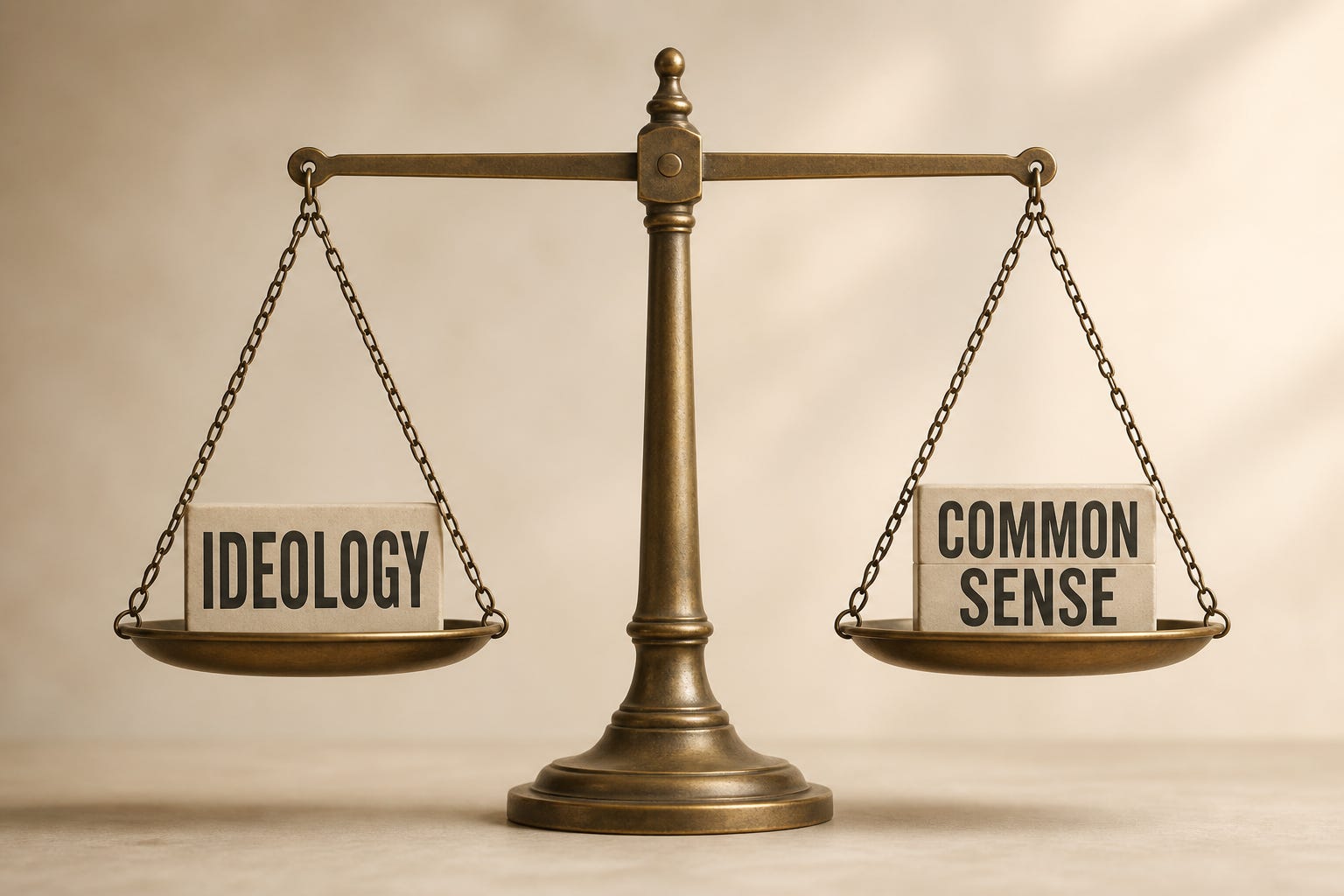
The word ideology is doing a great deal of work at the moment.
It is rarely used neutrally. We seldom describe our own understanding of the world as ideological. Ideology is what other people have. It belongs to those whose beliefs we consider misguided, politically motivated or disconnected from reality.
Our own position, meanwhile, is simply common sense.
Or fact.
But what is an ideology?
In the simplest language, an ideology is an organised system of beliefs and values through which we interpret the world. It helps us decide what is normal, what is desirable and how people ought to behave.
Consider professionalism.
Most of us have some understanding of what it means to be professional. Arrive on time. Dress appropriately. Speak in a particular way. Remain composed. Communicate clearly. Keep personal matters separate from work.
These expectations are so familiar that they can feel like objective standards.
But professionalism is not a fact of nature. It is a framework constructed from beliefs about competence, respectability, authority and appropriate behaviour.
Some parts of that framework serve practical purposes. Arriving when we have agreed to arrive allows people to work together. Communicating clearly reduces misunderstanding. Treating colleagues with respect makes cooperation possible.
But professionalism also supplies meaning.
A person wears a particular item of clothing. That is an observable fact.
Professionalism decides whether the clothing is appropriate.
A person speaks with a particular accent. That is an observable fact.
Professionalism may interpret that accent as polished or unpolished, credible or less credible.
A person communicates directly or displays emotion. Professionalism may interpret that person as confident, aggressive, passionate or unable to cope under pressure.
Those judgements are not contained within the clothing, the accent or the emotion. They come from the framework we use to interpret what we observe.
That does not mean every expectation associated with professionalism is false or harmful. It does not mean workplaces should have no standards.
It means that professionalism takes practical observations, cultural assumptions and social values and organises them into a framework for deciding how people should behave and how they should be judged.
That is what makes it an ideology.
Ideology is often hardest to see when we are standing inside it. If the expectations of professionalism already match how we dress, speak and behave, they may not feel like a belief system at all.
They may simply feel like common sense.
This is an important distinction.
A fact is something we can observe or establish through evidence.
An ideology is the framework through which we interpret that fact, give it meaning and decide what should follow from it.
An ideology may contain facts. It may begin with facts. It may produce useful ideas and conventions.
Its principles may even be ethical and well supported.
Calling something an ideology does not prove that it is false.
But calling something a fact does not make every interpretation attached to it true.
We can recognise an ideology by asking a few simple questions.
Which facts has the framework chosen to emphasise?
What meaning has it assigned to those facts?
Which values are shaping that interpretation?
What does it say people should believe, how they should behave or how society should operate?
And perhaps most importantly, are we applying those questions to our own position—or only to somebody else’s?
The word ideology should help us identify a system of beliefs and values.
Too often, it is used simply to discredit the beliefs of somebody else.
Once I call your position an ideology, I no longer have to engage seriously with it. I have placed you on the side of belief while positioning myself on the side of reality.
The label has replaced the argument.
The power to name somebody else’s worldview as ideology, while leaving your own unnamed, is itself a form of power.
This is particularly apparent in our conversations about sex and gender.
So I am not going to tell you which side possesses an ideology and which side possesses the truth.
I will leave you with a more useful test:
Where does the observable fact end, and where does the belief about what that fact must mean begin?
Apply that test consistently.
Apply it to what is called gender ideology.
Then apply it just as carefully to what might be called gender-critical ideology.
And notice which one you instinctively assumed did not require examination.
Comments
Nothing yet. Say the first thing.
Sign in to join the conversation.