

To be honest, I’ve been waiting for someone else to write this piece – it seems one of the most critical questions facing the future of venture. But, in the absence of anything to read on the subject, I’ll give. The tools required to build a world-changing company have fundamentally shifted, forever. So far, the smallest minted unicorn stands at 6 employees – that’s Flapping Airplanes (SF, 2026) – less than half the employee count of Instagram’s famed unicorn acquisition at 13 employees. Some believe we will see the first single-person unicorn in the not-too-distant future.
What does this mean for the traits and competencies investors look for in founding teams? Are the desired qualities of the SaaS era still relevant? Are some obsolete, and will there be new ones?
Perhaps the lack of commentary indicates consensus that the founder blueprint remains unchanged. Perhaps people think it’s too early to call. Either way, here are some of changes I think AI provokes in founder analysis.
Solo founders?
We recently made our first investment into a company without a CTO. The CEO founder scored highly against our typical criteria (incl: insight, ambition, self-awareness) but scored most strikingly on a criteria we hadn’t yet formalised in our assessment: transformative deployment of AI. This founder holds themself to one of the highest standards we’ve seen for using AI to rework how they think, learn and build. In this context, we were comfortable underwriting the risk that if they didn’t find a suitable CTO, they could lead the company technically until at least the next funding round. I expect it will become increasingly common for sole CEOs to gain funding at pre-seed.
Historically, VCs have both explicitly* and unconsciously biased against solo founders. Because of keyman risk, certainly, but also because it has been difficult to believe that a sole founder could simultaneously master all the leadership functions of: building, selling, hiring, fundraising, while setting the vision and steering the ship. The CEO + CTO combination, while insufficient on its own to gain investment, oiled the wheels of VC pattern-matching.
But the capacity agentic systems can unlock shifts this. As investors look for founders with exceptional AI adoption, solo founding may even become a functional shorthand for being “AI-pilled”; a moniker of the efficiency gain founders can achieve. Where we have previously defaulted to specialisation within founding teams from individuals, this may shift to expecting a CEO to be able to do it all, at pre/seed and even later.
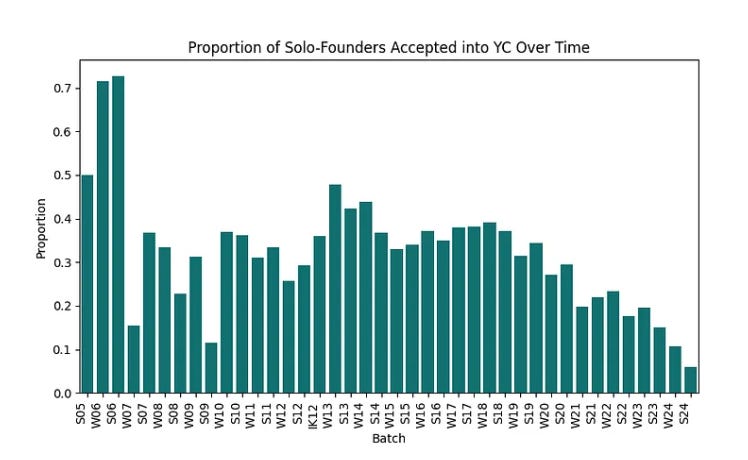
*YC has historically biased against solo founders; comprising just 11% of its latest W26 batch. Observing how this trend changes may be a good proxy for this phenomenon over time.
Team-building?
Relatedly: When interviewed, one of Europe’s top performing VCs shared that they assess a founder’s attitude to team-building as an indicator of success. The thesis is that unicorns aren’t built by problem-solvers, but by founders building institutions that will change the world. Institutions historically required manpower, so building a big company meant building headcount. The team-building assessment explores whether a founder has committed extraordinary depth of thinking to the functions of leadership, culture and hiring, as much as product, market, GTM.
The focus on team-building won’t go away, but the outlier founder’s answer is changing. In broad strokes, away from just human resource and towards agentic capability. Different businesses warrant different resourcing, but many early software founders, newly flush with cash, still default to headcount scaling instead of thoroughly investigating underutilised leverage in tooling. There’s an interesting implication for the desired trait in founders. The historical profile invokes the specific skill of mass alignment – the ability to bring cohesion to large groups and manage significant organisational complexity. If the unicorn teams of the future only require handfuls of people, this skillset becomes obsolete, or reduced to a proxy for another function, like salesmanship, or fundraising ability.
Ageism?
Though a lot has been made of myth-busting the "teen dropout" profile of the Web 2.0 era (the average age of a unicorn founder is actually 35), AI has refuelled this phenomenon. Both early and growth stage companies report that founder/CEOs are trending younger. YC’s median founder age dropped from 30 to 24; Antler tracked a fall in avg. AI unicorn founder’s age from 40 in 2021 to 29 in 2024.
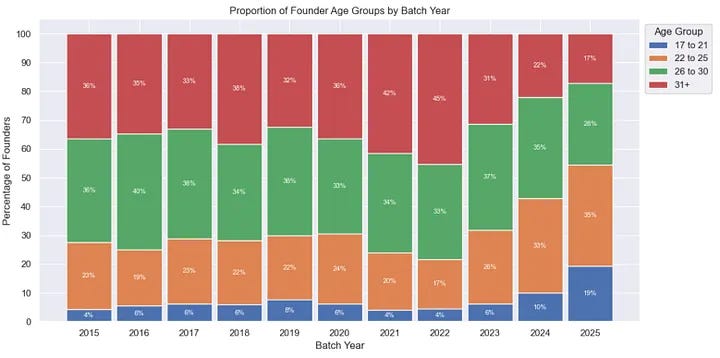
The phenomenon has been attributed to “the blank-slate state” of younger founders, and a “willingness and ability to experiment in the age of AI, [which] probably counts as more important than traditional corporate experience or corporate tenure” (Fridtjof Berge). Another explanation is that more recently trained people have more relevant technical experience for building with AI.
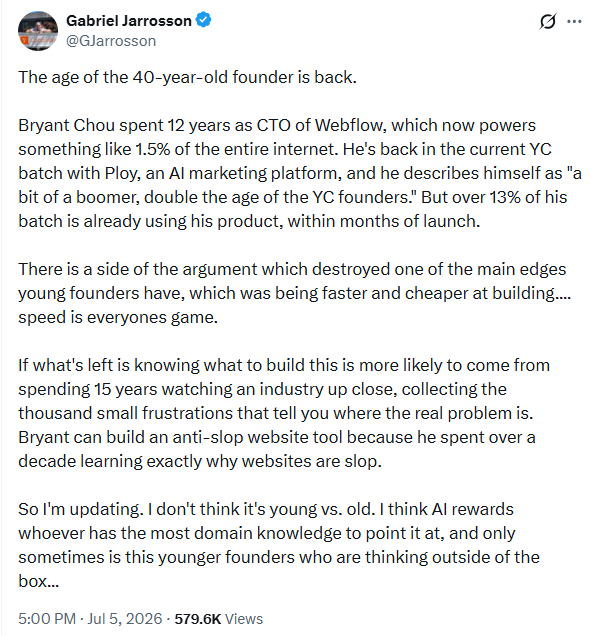
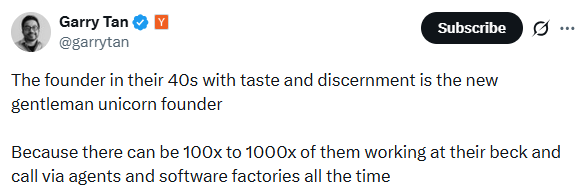
This may be a short-lived change in the cycle, triggered by the immediate democratisation of the ability to build. On the flip side, the well-documented bifurcation of software in response to AI points to the deep moats that deliver long-term defensibility, many of which come from experience and domain expertise (time). Some are beginning to make this case (below), which may neutralise this apparent trend towards younger founders.
Processes?
A meta observation: how will the tools and processes VCs use to assess founders change with AI? One suggestion is that investors will prioritise reference calls. As more market data becomes knowable, summarisable and analysable, more diligence will be assigned to building a complete view of the founding team, upping the number of reference calls. Off-the-shelf tools like Happenstance make networks more searchable for sourcing referees.
VCs also have the opportunity to build their own tooling to assess founders, using observational portfolio data to complement external research. Seb Mafuna (Outward) is building usemasana.com: a system that scores founders across cognitive traits (how they reason, what they’ve staked, what they can see, and what they can shape) drawn from founder materials and call transcripts, with every read traceable to its source. The aim [of the project] is to make the fund’s judgement legible and comparable across deals.
“There is a potential second-order consequence to this kind of tooling, too”, Seb remarks. “Previously VCs required decades of experience and thousands of meetings to build up the “feel” of a good answer or investment. If newer VCs are able to make this accumulated comparison explicit and measurable, it stops being the private property of whoever has been in the room the longest and becomes that of whomever wants it most.”
Unchanged?
Lastly, a note of some of the traits that I presently suspect will remain unchanged in founder analyses – qualities that will always be associated with outlier performance, even as the means of production shifts once more.
Irrational ambition: often derived from a chip on one’s shoulder, trauma or neurodivergence. Derived from this, resilience, or perseverance.
Self-awareness: the top trait correlated with outlier founders, according to their VCs. Broadly measured by the discrepancy between one’s view of themself and others’ view of them.
Insight: David George (a16z) put this best: “the ability to spot non-obvious potential from [their] vantage point”.
Comments
Nothing yet. Say the first thing.
Sign in to join the conversation.