
I found The Timeless Way of Building on a shelf at a residency. The place was called Worlds End, which felt like the right place to be reading about how built worlds appear to end. On tall shelves stacked with books, this was the first one that caught my eye, only moments after I arrived. Long before that arrival, I had been carrying a feeling I couldn’t yet name, something about the way we hold on to old ways of making things, the way we revere them without quite being able to inhabit them anymore. Christopher Alexander was writing about buildings. But the whole time I was reading it, I kept thinking about recipes.

Christopher Alexander was an architect who spent his life trying to understand why certain buildings, certain towns, certain rooms felt alive and others didn’t. His answer was pattern language—not a set of rules, but a generative system, one that allows its users to create an infinite variety of combinations while remaining rooted in the same underlying logic.
He describes a master builder who never needed to instruct his builders on the details, because they already carried the same language in their minds, realizing it each time with their own individual flair. “The building grew slowly, magnificently, guided by that shared language, just as the genes inside a flower’s seed guide and generate the flower.”2 But when that language stops being shared, when it passes into the hands of specialists and fragments into private expertise, something breaks. In our time, he writes, the languages have broken down, and it has become virtually impossible for anybody to make a building live. It is why we stand in old churches or cathedrals and feel something we cannot quite name, the recognition of a pattern language we no longer know how to speak.
“Most people believe themselves incompetent to design anything and believe that it can only be done properly by architects and planners.”3 But the deeper problem is not confidence. It is distance. When the people designing our buildings or our towns no longer live in them, the language is not understood by the people who do.
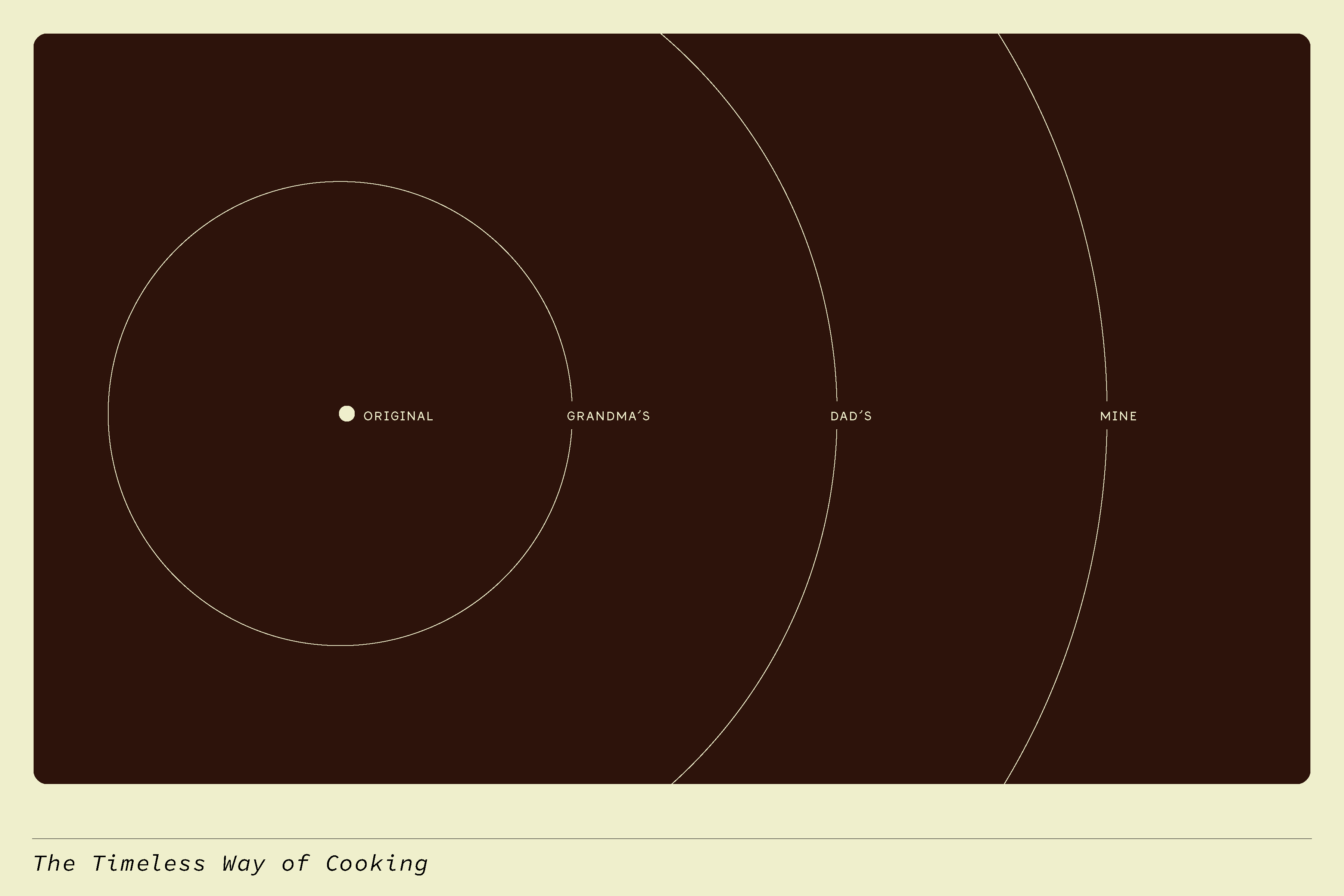
A recipe4 was created because it was right for that moment. Because it answered something true about available ingredients, about the bodies that needed feeding, about the occasion that called for it. If it persisted, it did so not because anyone decreed that it should but because it kept feeling right, and because it could be shared, honoured, integrated and expanded upon. Perhaps this is what we mean, or should mean, when we talk about culinary tradition. Not an archive, nor a canon. A living language, practiced and deepened by the people inside it.
And cooking itself has always been transformation. Not just of ingredients, but of the pattern itself. Every time someone makes a dish, something shifts, slightly, necessarily. That is not corruption. That is the nature of cooking.
I was at a screening last week listening to Fabrizia Lanza, who runs the cooking school in Sicily called Anna Tasca Lanza. She has clearly spent years thinking about what it means to celebrate a culinary culture. What she described was not preservation. It was loss disguised as heritage. Tradition had become, in too many places, a thing you sell, an atmosphere, an authenticity, a brand. The recipes still circulate. The restaurants still open. But something in the loop has been severed.
Ruby Tandoh puts it plainly, “a recipe can be preserved in a cookbook – even recycled across multiple cookbooks, plagiarised, rehashed and yassified over the generations – and never once be cooked.”5 The language keeps moving. The people are no longer inside it. And when platforms like Allrecipes optimized recipes for search engines and rapid consumption, they didn’t just commodify the recipe, they optimized the loop itself, made it faster and more frictionless and more disposable, until the recipe became not something you share but something you sell.
We hold on anyway. We codify national cuisines, we protect their classics, we argue fiercely about authenticity. But what does it mean to hold a cuisine so tightly that it can no longer breathe? Are we protecting something living, or curating something that has already stopped living? A pattern that cannot respond to the present is not a tradition. It is a monument.
And yet we reach. We buy the cookbooks, we seek out the grandmother's version, we travel to eat the original, we pay great prices for what feels most real. We photograph it, we share it, we tell a story about it. Between each and everyone of those acts, we sense that something has been lost without quite being able to name it. What we are sensing is the deadness of the pattern, the pattern that is a recipe. What we are reaching for is its life. Alexander writes, “A pattern language does nothing really, except to wake these feelings once again. It is the gate which leads you to the state of mind, in which you live so close to your own heart that you no longer need a language.” 6 The pattern language does not teach us, only reminds us of what we know already. The knowledge is native to us. It only needs to be released. Finding this book on the shelf was like being reminded of what I already knew.
A living pattern cannot be extracted and preserved. It can only be practiced.
I recently bought a cookbook that I knew would have a great recipe for borscht in it. A dish native to my father’s heritage, yet somehow its pattern hadn’t quite reached me. Not through neglect, not through indifference, just through the particular pressures of diaspora, of displacement, of a life lived far from the kitchen where it would have been carried. I found myself holding a book that was trying to hand me something I should perhaps already have known how to hold. I also found myself feeling, maybe it is not mine to hold anymore.
And yet like the flower that grows from the seed that carries its whole instructions without anyone having to explain them, the logic of borscht persists across every kitchen that has ever made it, every hand that has adjusted it to the season, to what was there, to who needed feeding. A living pattern was never meant to last forever unchanged. It grows, it adapts, it falls away, and something new rises from it.
The question is not which recipe is most authentic, or how closely you need to abide by what came before. The question is whether you are listening closely enough to where you actually are. Your context is not a deviation from the pattern. It might be exactly how the pattern stays alive. Not a betrayal of tradition. A continuation of it.
Christopher Alexander, The Timeless Way of Building, page 237
Christopher Alexander, The Timeless Way of Building, page 217
Christopher Alexander, The Timeless Way of Building, page 232
By “recipe” here I mean any instance of making that was remembered, passed on, or given a form that could be returned to, whether written, spoken, or held in the hands of someone who cooked it again and again.
Ruby Tandoh, All Consuming, page 146
Christopher Alexander, The Timeless Way of Building, page 547
No posts
Comments
Nothing yet. Say the first thing.
Sign in to join the conversation.