
I was explaining to someone recently what I write about. I mostly write about recipes, I said. I mean the semiotics and morphology of them. Their linguistic and graphic architecture, the way a word like mix carries more than it says, the way let rest earns its own line. It’s why this newsletter is named what it is. I am interested in recipes as a form.
But if I’m not writing about recipes, I still use the form to inform my writing. I use a recipe as a receptacle for holding a process, for comprehending a transformation. I take something that has happened to me and lay it in terms of a recipe. I notice the pattern between a technique and a life, between a chemical interaction and a human one. A kind of food synesthesia, the person I’d been explaining this to called it. Cooking is how I think through the parts of life that aren’t about cooking at all, and the recipe is where I make sense of them.
Oil and vinegar are opposites. One is fat, one is acid. One coats, one cuts. One is heavy and slow, one is bright and thin. Shake a jar with both and for a few seconds it looks like agreement, everything clouded and trembling and combined. Then it splits. The oil rises into its own gold layer, the vinegar sinks back to the bottom, both of them perfectly themselves and perfectly apart. Left alone, they will always split.
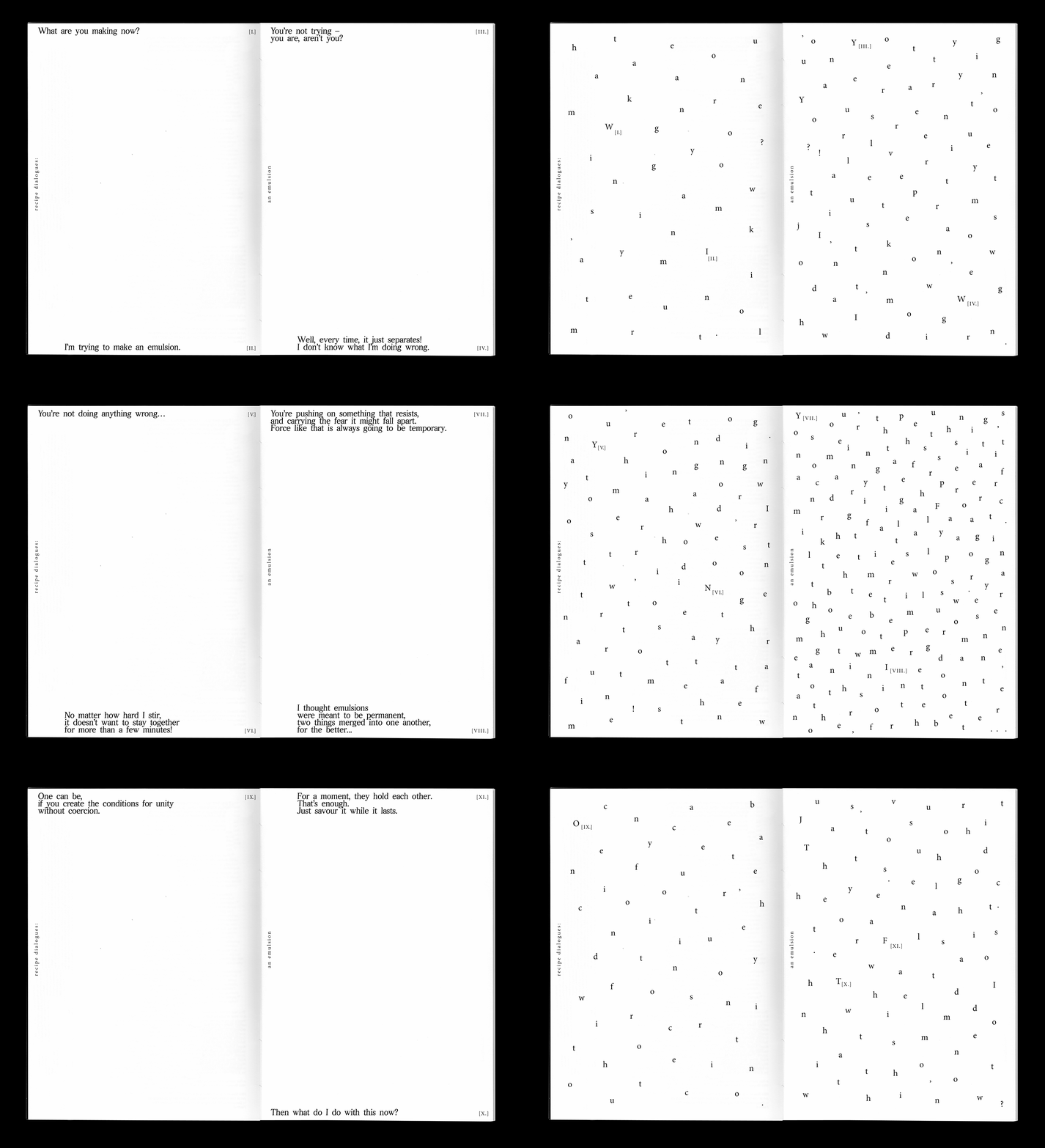
You start with the mustard, as Michèle Roberts in French Cooking for Two2 clearly reminded me. Not the oil, not the vinegar. The binding element in the middle, first. Mustard is an emulsifier. It carries a part of itself that loves water and a part that loves fat, and so it can stand between the two and hold a hand of each. It doesn’t make the oil less oily or the vinegar less sharp. It doesn’t ask either of them to stop being what they are. It just refuses to let go of either one, and because of that, the whole thing holds. The cloud doesn’t separate. I really understood all this while I was understanding the shape of a relationship I was in. I will never forget how to make a vinaigrette now — the technique is welded to a part of my life, and I couldn’t separate them if I tried.
In a jar, the answer is mustard. But what is that third ingredient between two people — what stands in the middle and keeps the bond from breaking? A possible path to an answer came to me in a book about listening. The Poetics of Listening is where I was introduced to Jessica Benjamin’s idea of thirdness: not a compromise struck between two people, not the midpoint where each gives something up, but a third thing they make together that belongs to neither of them alone. A space that holds two minds without dissolving either into the other.
What strikes me is that thirdness is the opposite of merging. The third doesn’t close the distance between two people. Rather, it keeps the distance habitable. It is what lets you stay open to the parts of another person you can’t recognize or absorb, to try on their otherness without needing to make it your own. The mustard never turns the vinegar into oil. That was always the point.
The same pattern turns up when I read about geometry. It turns out the ‘third’ is everywhere once you start counting. The triangle is the first shape that straight lines can close, can make a structure. Before three, there is no enclosed surface, no inside, nothing held. A braid needs a minimum of three strands to weave into anything that stays woven. Two will only twist apart. The old mathematical philosophers gave the number three the names you’d give a good marriage — harmony, friendship, peace4.
Two opposites cannot resolve on their own. They need some third thing between them to become whole. And that this third is not a judge keeping them apart but the very thing that joins them, to each other, and to everything else.
It would be easy to stop here, with everything beautifully held. The emulsion as proof that love wants a third element, that the universe agrees, that balance is the goal and I have found it through a recipe.
But then I read Cameron Borg’s How Life Works, and the whole thing turned over. I had tended to think balance was the thing to want — the still, even, settled state. Cameron makes me wonder whether balance was ever the point.
Because the balance an emulsion is desperately striving for turns out to be the most entropic state there is. Equilibrium is what a system arrives at when it has finished happening. Molecules scattered at random, all the differences spent, nothing left to move toward.
An emulsion is not a settled thing. Left alone, a vinaigrette relaxes back into oil and vinegar — that is its restful state, its equilibrium. The mixed, glossy, suspended version is the improbable one. It has to be made, and made again, because it will not hold itself.
It started in a jar. Then I started finding it everywhere I looked — in how people listen, in the shape of a triangle, in what keeps anything alive. The metaphor refuses to stay in the kitchen, and the further it gets, the more it seems to hold.
So here is the question I actually have, the one I can’t dress up. When a third thing holds two opposites in suspension of each other — neither merged nor cleanly apart, kept in a state that takes constant energy to maintain — is that the most alive a relationship can be? Or is rest what they actually wanted, two people kept from it by the very thing meant to save them — held in suspension by an effort that has to be made again and again?
I don’t know. The emulsion that kept splitting might have been failing. Or it might have been the emulsion telling the truth, that these two things were never going to stay one.
Does the recipe teach me the life, or the life teach me the recipe? I have stopped being able to tell them apart. I have not found the limit of what a vinaigrette can teach me. I have only found that it keeps refusing to settle.
Rebecca May Johnson, Small Fires: An Epic in the Kitchen, Hot Red Epic, p. 59
Michèle Roberts, French Cooking for Two p. 134
Brandon LaBelle, Poetics of Listening, p. 73
Michael S. Schneider, A Beginner's Guide to Constructing the Universe, p. 44
Michael S. Schneider, A Beginner’s Guide to Constructing the Universe, p. 43
No posts
Comments
Nothing yet. Say the first thing.
Sign in to join the conversation.