
Most of the time, I want to write about the right moves to make when leaving USG for tech or another competitive industry. Aren’t there plenty of things not to do as well? So I’ll share some of the main mistakes I see.
These errors are typical and avoidable. There’s really no reason to repeat these. And yet, plenty of aspiring former feds do.
Every person whose post-USG career you admire overcame obstacles to accomplish something novel. They didn’t have a paint-by-numbers guide. There wasn’t someone providing a job tailor-made for their skill set.
They too had the uncomfortable stumbles you’re about to face. Maybe a few months or a couple of years. The struggle and the uncertainty are real, as well as indicators you’re going in the right direction.
Should it seem too easy, it is. Easy means you’re settling and likely in a crowded area. In my experience, easy has been: contracting back to the office you just left, pursuing security and policy roles mainly because that’s where so many other formers are and interviewing for one job at a time. I could list plenty of other easy fallacies, but will stick to breaking these down.
How is returning to your former office as a 1099 instead of a W2 really transitioning? Are you going to be earning that much more? Is there increased fulfillment waiting when serving a mission in a position of less influence? What new talents are you developing? I don’t like this option at all. I dislike it so much that I would recommend staying put if this is all you can imagine doing next.
Make no doubt about it, I believe BD is the way. You want to attach yourself to revenue. Maybe you aren’t selling, but delivering. No problem. This is part of the team that ensures a company stays in business. Security, policy and other cost centers are not essential. Look at the teams of most early tech companies. It’s going to be engineers and maybe a few people on the sales team, often euphemistically described as BD instead. Even legal comes later, despite the need for all kinds of NDAs and contracts.
A job hunt is a numbers game. The best odds you can hope for are 50%, as there is likely at least one other person competing for the role you’re after. No matter how good a match something seems, it’s not yours until you’ve got an offer in hand. Even then, maybe better to keep interviewing until the day you start. Sure, things fall apart all the time.
From these examples, remember, you have to eschew the road well traveled. Put yourself out there. Accept the rejection. Don’t take no for an answer; all you need is one yes.
All those LinkedIn posts announcing you’re leaving government and open to any advice former colleagues are ready to offer. This is an excellent way to head off useful support. Serious people won’t help someone who doesn’t know how to help themselves.
What kind of message are you sending to the world with unanchored requests? Should any help come your way, will it really be what you’re in need of?
A major part of a career transition is introspection. This likely preceded the decision to leave. Use those thoughts to define what you’re after. There’s no requirement to have everything figured out. If you outsource that thinking or assume someone else can do it better, you're setting yourself up for disappointment.
Some of the best members of your network will challenge you. They’ll push back against your assumptions. You’ll have to prove yourself worthy of their assistance. That can never happen if “I don’t know, what do you think” is a constant refrain.
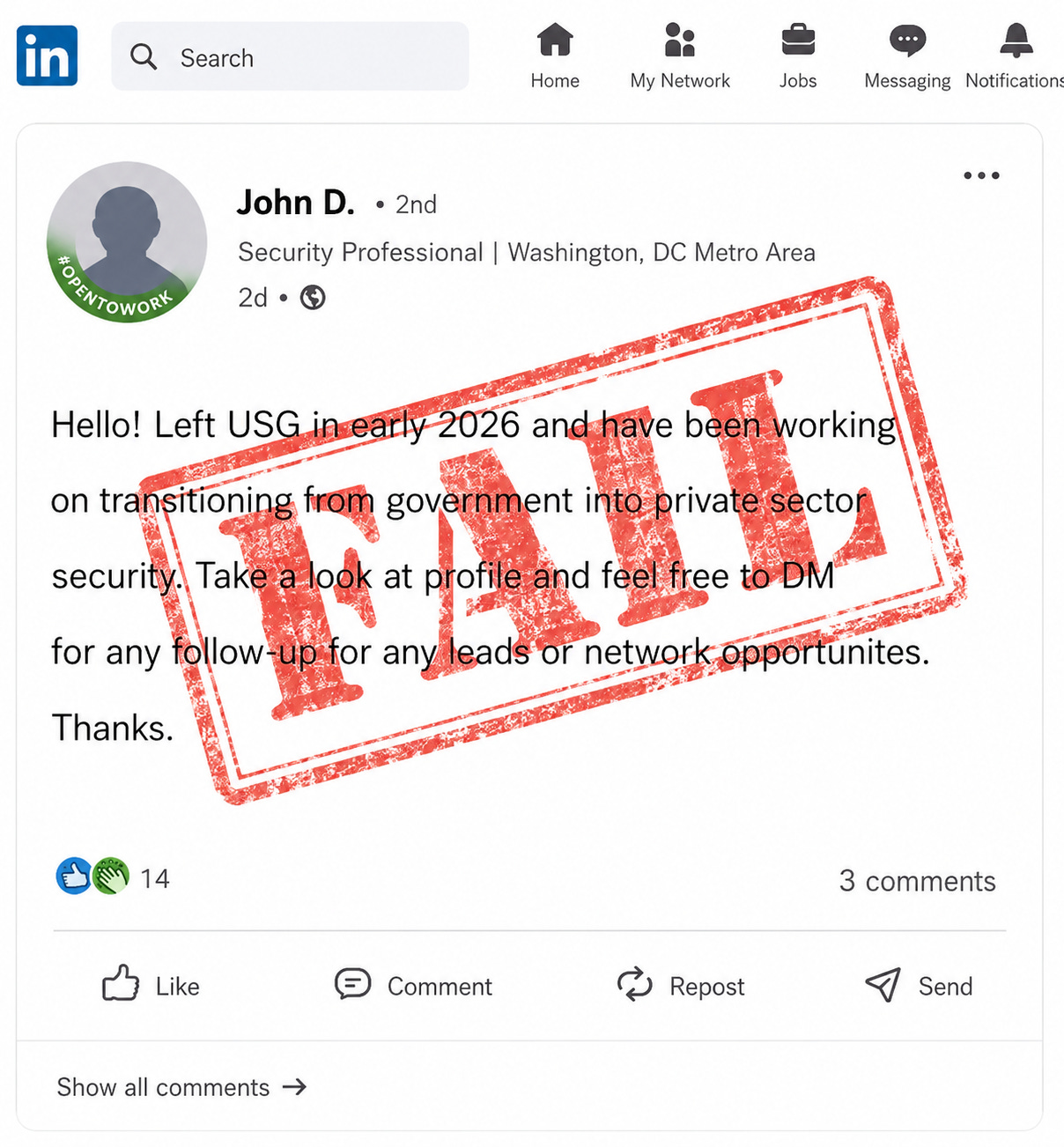
The only thing more likely to fail than these types of posts is using GoFundMe to activate your career transition.
“ Don’t let perfect be the enemy of the good" has to be one of the most repeated truisms in certain USG and USMIL circles. No surprise that it applies equally well to the career-transition world.
There’s no laboratory cooking up the perfect role for a former fed. If anything, you have to do the chemistry on your own. Mixing eye of newt and blood of rat to concoct a new escape plan (remember the need to be extraordinary?).
Don’t fall for the appearance of a perfect role, expecting the hiring manager to hire you on the spot.
If you really do want something customized, then you should just start your own thing. What better way to flawlessly match your experience than hanging out a shingle?
Delaying until you see the right thing just puts off the inevitable. You must start a career transition for it to occur. Otherwise you’re just roleplaying. Start interviewing. The more experience you have, the better you’ll get it. This includes experience finding out if a role or a team is the right fit.
Replace vague requests, one-at-a-time applications and waiting with an executable strategy. My private group, Be More, Earn More, will help you decide where to aim and begin creating opportunities.
Use code for 50% off your first month.
Comments
Nothing yet. Say the first thing.
Sign in to join the conversation.