

In 2010, two researchers measured the smiles in a set of 1952 baseball cards. The players with the widest grins outlived the stone-faced ones by years.
Call that coincidence if you want, but the wider evidence is not ambiguous: how a person envisions the future shapes how long, and how well, they live.
In 2002, the Yale researcher Becca Levy found that older adults with positive beliefs about aging lived 7.5 years longer than those without, more than the gain linked to low blood pressure or cholesterol. Sixteen years later, she showed something stranger: among carriers of APOE ε4, the strongest genetic risk factor for Alzheimer’s, those with positive age beliefs were nearly 50 percent less likely to develop dementia.
The large cohorts agree. Following roughly 70,000 women and 1,400 men, researchers found the most optimistic lived 11 to 15 percent longer and were far likelier to reach 85; a 159,000-woman study replicated it across racial groups. The effect holds after accounting for smoking, diet, and exercise. So what’s happening biologically that could generate these kinds of results? Scientists think it has something to do with inflammaging.
The brain does not treat optimism as an abstraction. When researchers at New York University scanned people imagining future events, picturing positive ones activated the amygdala and the rostral anterior cingulate cortex, a region that modulates the amygdala’s emotional response, and activity there tracked with how optimistic a person scored. Those are the same circuits that show irregularities in depression. “Outlook” shows up as measurable activity in the machinery that appraises threat.
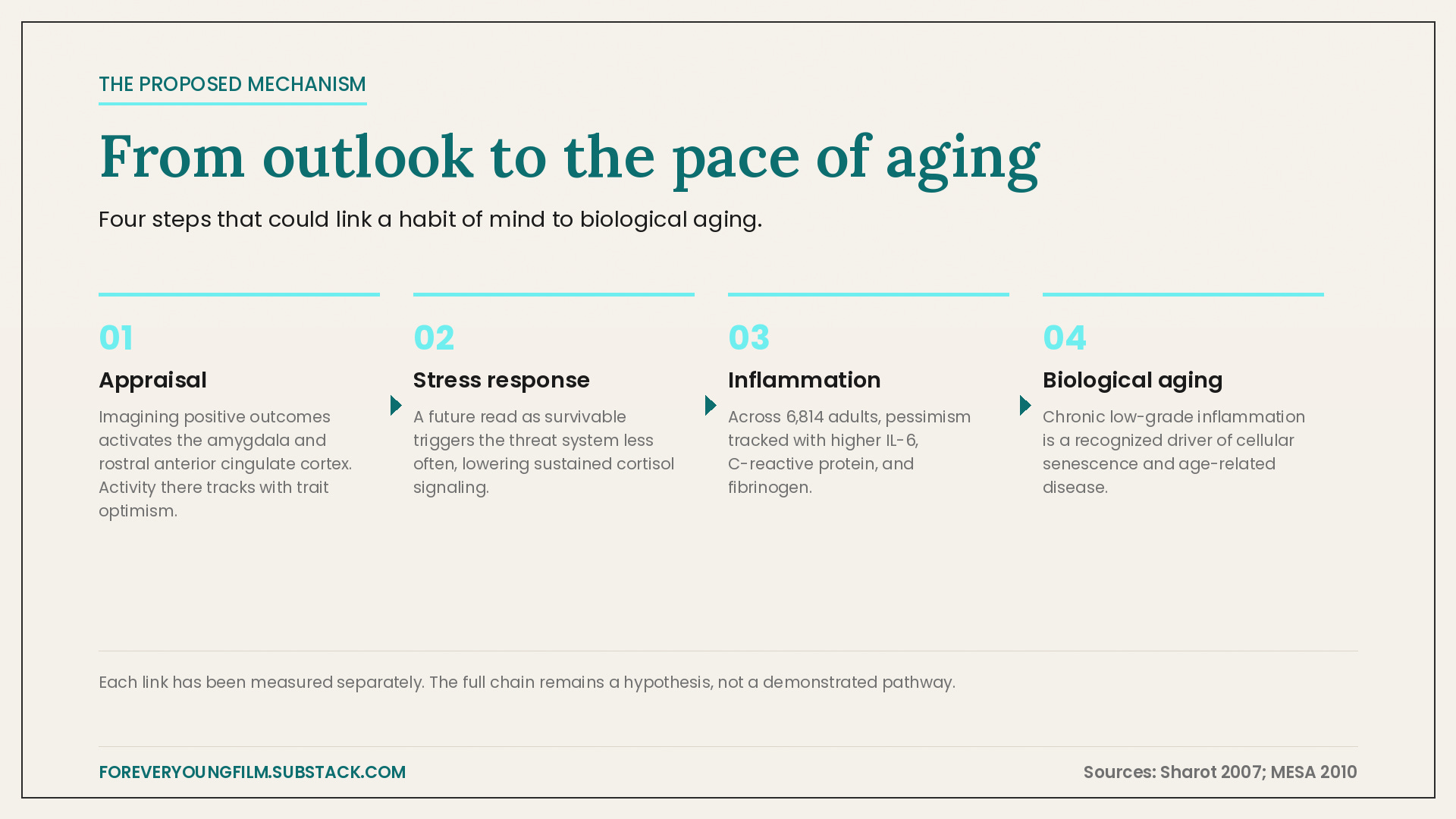
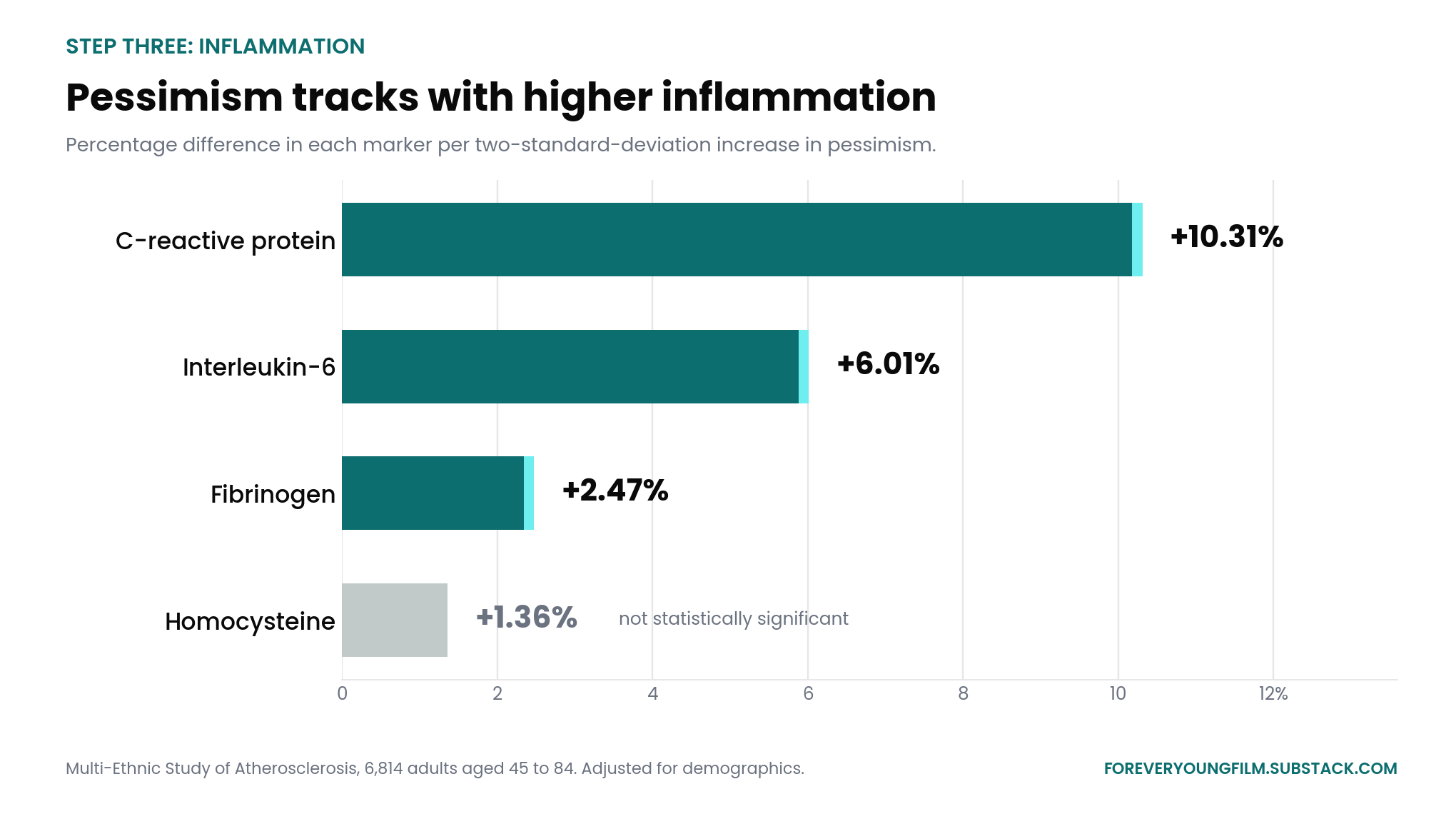
That appraisal has downstream consequences. A brain that reads the future as survivable triggers the stress response less often, and chronic activation of that response keeps cortisol and inflammatory signaling elevated. In the Multi-Ethnic Study of Atherosclerosis, which measured 6,814 adults, pessimism tracked with higher interleukin-6, C-reactive protein, and fibrinogen, while higher optimism tracked with lower levels of several of the same markers. Chronic low-grade inflammation is one of the recognized drivers of biological aging, implicated in cellular senescence, cardiovascular disease, and dementia. That supplies a theoretical route from a habit of mind to the rate at which a body ages: appraisal shapes stress signaling, stress signaling shapes inflammatory load, and inflammatory load shapes how fast tissue wears out.
So what makes an optimist? Genetics plays a part. But when researchers studied more than 3,700 twins, they found the heritability of how long people lived was only about 7 percent, and dispositional optimism itself is only modestly inherited. Most of it is shaped by environment, habit, and experience. Psychologist Martin Seligman called the mechanism learned optimism: pessimism is largely a habit of explanation, the automatic story a person tells about why bad things happen, and that story can be revised. In a controlled trial, briefly training people to imagine good outcomes raised their optimism. The effects are modest and gradual, but consistent. Whatever you were born with, optimism can be learned. The next section explains how.
Mindset meets every test the longevity field uses to decide what is worth tracking: it predicts mortality, it is modifiable, and it can be measured. Here’s a starting point on how to train it:
1. Imagine the life you want, specifically. Picture a future in which your work, relationships, and health have gone about as well as they realistically could, and put a few lines of it into words, on paper or your phone. No timer, no journal. It sounds like a cliché, yet across 29 studies it reliably raised optimism, and briefly holding the mindset has even lowered physical pain in a controlled experiment, evidence that the effect is causal.
2. Do something for someone else. In one experiment, a week of small kind acts measurably raised happiness, and the more acts, the larger the lift, whether aimed at friends, strangers, or yourself.
3. Move your body most days. Averaging at least 7,000 steps a day tracked with a 31 percent lower risk of depression in a 96,000-person meta-analysis, each additional 1,000 steps lowering it about 9 percent. No gym required; frequency does the work.
4. Cut the doom feed. People who stopped using social media for a single week improved on well-being, depression, and anxiety within seven days. Take a defined break, then a daily cap on whatever leaves you most agitated.
5. Get into nature, about two hours a week. Below that threshold, a 20,000-person study found no measurable benefit; above it, people were markedly likelier to report good health and high well-being, whether banked in one visit or several.
6. Treat your close relationships as medicine. The security of your bonds tracks closely with well-being in later life and contributes to an overall positive outlook. Dr. Sarah Centeno, a psychiatrist featured in our documentary Forever Young, calls relationships the fifth vital sign and should be prioritized just like diet, exercise, and sleep.
7. Keep a record. Mindset is the one longevity marker most people never measure. Across 138 randomized studies covering nearly 20,000 people, monitoring progress toward a goal made people meaningfully more likely to reach it, and the effect was larger when the record was physical rather than mental. A few dated lines will do: what you expected, what happened, whether the two matched.
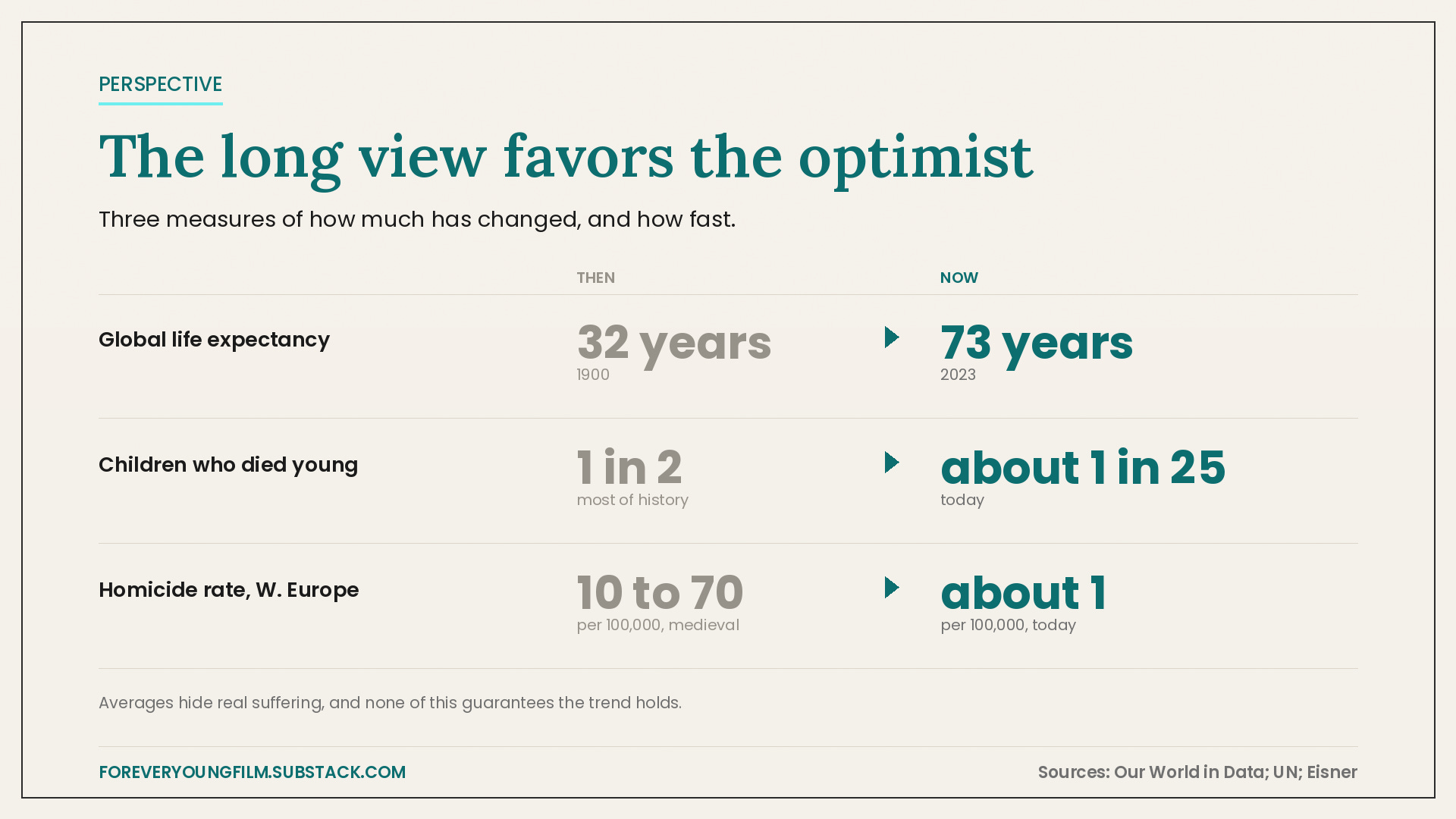
Still struggling to have a positive outlook? Consider this: global life expectancy has more than doubled in a century, from about 32 years in 1900 to 73 today. For most of human history, roughly half of all children died before adulthood; the figure is now around 4 percent. The infections and birth complications that once killed most people have been pushed back so far that smallpox, which killed hundreds of millions in the twentieth century, was eradicated within living memory. Even violence has receded: homicide rates in Western Europe have fallen from as high as several dozen per 100,000 people in medieval times to roughly one today.
As Dr. Thomas Lewis says in Forever Young, “this is the best possible time to be alive.” Agreeing with him won't just brighten your days; it might give you more of them.
Cross item two off the protocol and send this to a pessimist today.
How do we connect with others in the digital era?
·
November 16, 2025

In response to a subscriber question — “How do we find meaning with others in a society moving away from face-to-face interactions?” — psychiatrist Dr. Thomas Lewis offers his thoughts.
Abel EL, Kruger ML. Smile intensity in photographs predicts longevity. Psychol Sci. 2010;21(4):542-544.
Levy BR, Slade MD, Kunkel SR, Kasl SV. Longevity increased by positive self-perceptions of aging. J Pers Soc Psychol. 2002;83(2):261-270.
Levy BR, Slade MD, Pietrzak RH, Ferrucci L. Positive age beliefs protect against dementia even among elders with high-risk gene. PLoS One. 2018;13(2):e0191004.
Lee LO, James P, Zevon ES, et al. Optimism is associated with exceptional longevity in 2 epidemiologic cohorts of men and women. Proc Natl Acad Sci U S A. 2019;116(37):18357-18362.
Koga HK, Trudel-Fitzgerald C, Lee LO, et al. Optimism, lifestyle, and longevity in a racially diverse cohort of women. J Am Geriatr Soc. 2022;70(10):2793-2804.
Sharot T, Riccardi AM, Raio CM, Phelps EA. Neural mechanisms mediating optimism bias. Nature. 2007;450(7166):102-105.
Roy B, Diez-Roux AV, Seeman T, Ranjit N, Shea S, Cushman M. Association of optimism and pessimism with inflammation and hemostasis in the Multi-Ethnic Study of Atherosclerosis (MESA). Psychosom Med. 2010;72(2):134-140.
Walker ER, McGee RE, Druss BG. Mortality in mental disorders and global disease burden implications: a systematic review and meta-analysis. JAMA Psychiatry. 2015;72(4):334-341.
Weitzer J, Trudel-Fitzgerald C, Okereke OI, Kawachi I, Schernhammer E. Dispositional optimism and depression risk in older women in the Nurses’ Health Study: a prospective cohort study. Eur J Epidemiol. 2022;37(3):283-294.
Kim ES, Hagan KA, Grodstein F, DeMeo DL, De Vivo I, Kubzansky LD. Optimism and cause-specific mortality: a prospective cohort study. Am J Epidemiol. 2017;185(1):21-29.
Mosing MA, Medland SE, McRae A, et al. Genetic influences on life span and its relationship to personality: a 16-year follow-up study of a sample of aging twins. Psychosom Med. 2012;74(1):16-22.
Namaky N, Glenn JJ, Eberle JW, Teachman BA. Adapting cognitive bias modification to train healthy prospection. Behav Res Ther. 2021;144:103923.
Carrillo A, Rubio-Aparicio M, Molinari G, et al. Effects of the Best Possible Self intervention: a systematic review and meta-analysis. PLoS One. 2019;14(9):e0222386.
Hanssen MM, Peters ML, Vlaeyen JWS, et al. Optimism lowers pain: evidence of the causal status and underlying mechanisms. Pain. 2013;154(1):53-58.
Harkin B, Webb TL, Chang BPI, Prestwich A, Conner M, Kellar I, Benn Y, Sheeran P. Does monitoring goal progress promote goal attainment? A meta-analysis of the experimental evidence. Psychological Bulletin. 2016;142(2):198-229.
Rowland L, Curry OS. A range of kindness activities boost happiness. J Soc Psychol. 2018;159(3):340-343.
Bizzozero-Peroni B, Díaz-Goñi V, Jiménez-López E, et al. Daily step count and depression in adults: a systematic review and meta-analysis. JAMA Netw Open. 2024;7(12):e2451208.
Lambert J, Barnstable G, Minter E, Cooper J, McEwan D. Taking a one-week break from social media improves well-being, depression, and anxiety: a randomized controlled trial. Cyberpsychol Behav Soc Netw. 2022;25(5):287-293.
White MP, Alcock I, Grellier J, et al. Spending at least 120 minutes a week in nature is associated with good health and wellbeing. Sci Rep. 2019;9(1):7730.
Qi Y, Zhang Y, Ma Y. The relationships between attachment styles and well-being in older adults: a three-level meta-analysis and systematic review. Gerontologist. 2026;66(6):gnag018.
Comments
Nothing yet. Say the first thing.
Sign in to join the conversation.