
About 10.5 million Americans have atrial fibrillation. Among people over ninety, it is closer to one in four. It doubles the risk of death, raises the risk of stroke three to five times, and gets harder to correct every year.
Almost everyone diagnosed gets the same treatment: a blood thinner for life, a second drug to slow the heart, and a third to hold its rhythm that works about half the time and can wreck the thyroid on its way.
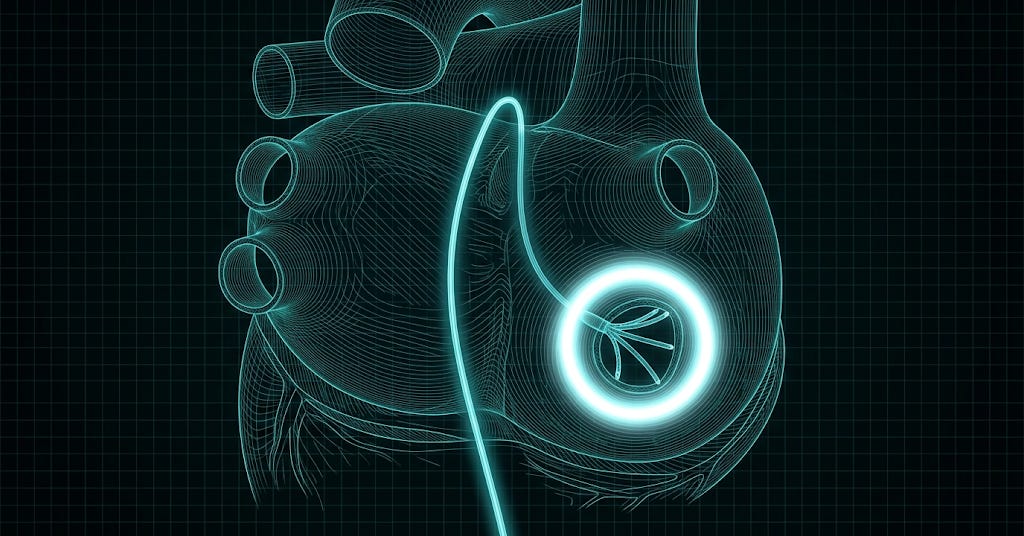
A better option has existed since the late 1990s. An operation called catheter ablation corrects the rhythm rather than managing it: a catheter is threaded up into the heart, and a radiofrequency current is run through a ring of tissue around the pulmonary veins, heating it until it scars over and seals off the patch where the faulty signals begin.
But the esophagus lies a few millimeters behind, and every so often the burn went through, opening a channel between the heart and the food pipe. Doctors call it an atrioesophageal fistula. Most patients who developed one died, so cardiologists held the operation back until the drugs had failed.
Then a Dutch group began testing electrical pulses as an alternative to heat and cold. To see whether the new energy harmed surrounding structures, they went after the phrenic nerve, which drives the diaphragm and runs close enough to the pulmonary veins that freezing catheters sometimes paralyzed it. In 2015 they published the result: the nerve survived almost intact, even at strengths that killed heart muscle outright.
Eight years later, that finding had become a treatment. Pulsed field ablation, cleared by the FDA at the end of 2023, is the same operation with a different energy source. The catheter goes to the same place and kills the same ring of tissue, but the pulses do it with an electric field rather than heat, at a strength the esophagus survives. Across a registry of 17,642 patients, not one fistula occurred, and the ablation itself now takes about thirty minutes. Remarkably, in April it outperformed the rhythm drugs in a head-to-head trial.

Normal sinus rhythm, then atrial fibrillation. The small bump before each beat disappears, and the intervals between beats stop being even.
A pulsed field catheter fires bursts of high-voltage current lasting millionths of a second, punching nanoscale pores in cell membranes until the cells die. Heart muscle dies at a relatively low field strength; nerve, blood vessel, and esophagus require far stronger ones. Some heat is produced, but the electric field rather than the temperature destroys the cells, which is why cardiologists call the method non-thermal.
Four out of five patients go home the same day, against just over half with radiofrequency. More than 500,000 pulsed field procedures have been done worldwide since 2021, and in February the Heart Rhythm Society and its European counterpart issued a joint scientific statement on the technique.
Against the older catheters, pulsed field has never proved more effective, only safer and quicker. AVANT GUARD tested it against the rhythm drugs instead. The trial took patients with persistent atrial fibrillation who had never been treated for it, a group no randomized trial had studied, and randomly gave them either the procedure or antiarrhythmic drugs, most often flecainide or sotalol. At twelve months, 56 percent of the ablation group met the trial’s definition of success, compared with 30 percent on medication, and the risk of failure fell by 54 percent. Serious complications ran at 5.1 percent in both arms. The results were published in the New England Journal of Medicine the same day they were presented.
Among cardiologists, adoption has been fast. Pulsed field went from a fifth of the ablation catheters in use in 2024 to more than half by early 2026. Referral has not kept pace: Americans undergo roughly 200,000 ablations a year against 10.5 million cases of atrial fibrillation.
The evidence is still young but promising. The trials show that the injury that held the operation back for twenty-five years no longer happens, and that as a first treatment it outperforms the drugs. The same electric fields are now being aimed at ventricular tachycardia, the arrhythmia behind most sudden cardiac deaths.
1. Noubiap JJ, Tang JJ, Teraoka JT, Dewland TA, Marcus GM. Minimum National Prevalence of Diagnosed Atrial Fibrillation Inferred From California Acute Care Facilities. J Am Coll Cardiol. 2024;84(16):1501-1508.
2. Oltman C, Kim T, Lee J, et al. Prevalence, Management, and Comorbidities of Adults With Atrial Fibrillation in the United States, 2019 to 2023. JACC Adv. 2024;3(11).
3. van Driel VJHM, Neven K, van Wessel H, Vink A, Doevendans PAFM, Wittkampf FHM. Low vulnerability of the right phrenic nerve to electroporation ablation. Heart Rhythm. 2015;12(8):1838-1844.
4. Reddy VY, Koruth J, Jais P, et al. Ablation of Atrial Fibrillation With Pulsed Electric Fields: An Ultra-Rapid, Tissue-Selective Modality for Cardiac Ablation. JACC Clin Electrophysiol. 2018;4(8):987-995.
5. Ekanem E, Neuzil P, Reichlin T, et al. Safety of pulsed field ablation in more than 17,000 patients with atrial fibrillation in the MANIFEST-17K study. Nat Med. 2024;30:2020-2029.
6. Reddy VY, Gerstenfeld EP, Natale A, et al. Pulsed Field or Conventional Thermal Ablation for Paroxysmal Atrial Fibrillation (ADVENT). N Engl J Med. 2023;389:1660-1671.
7. Joglar JA, Chung MK, Armbruster AL, et al. 2023 ACC/AHA/ACCP/HRS Guideline for the Diagnosis and Management of Atrial Fibrillation. J Am Coll Cardiol. 2024;83(1):109-279.
8. Wazni OM, Chun KRJ, Nair DG, et al. Pulsed Field Ablation as Initial Therapy for Persistent Atrial Fibrillation (AVANT GUARD). N Engl J Med. 2026;394(24):2407-2418.
9. 2026 HRS/EHRA Scientific Statement on Pulsed Field Ablation for Cardiac Arrhythmias. Heart Rhythm. 2026.
Comments
Nothing yet. Say the first thing.
Sign in to join the conversation.