
AI companies have been on an absolute tear recently. Anthropic’s revenue run rate reportedly topped $65 billion by the end of July, up from $47 billion in May. OpenAI is not far behind, with a reported annualized revenue run rate of $40 billion. These growth curves are extremely steep and—if they continue—OpenAI and Anthropic are set to become two of the largest companies on the planet in terms of revenue within just a few years.
That is a big if. Other companies have had periods of very rapid growth only to tail off before crossing $100 billion in revenue. The AI industry also faces headwinds that may slow down infrastructure buildout. In July, New York State passed the first statewide moratorium on hyperscale data centers, while slow electricity interconnections and supply constraints continue to threaten buildout within the US.
Is all of this heading toward a boom or a bust? That is the theme of our latest set of forecasts from the Longitudinal Expert AI Panel (LEAP). We asked our panel of AI experts and superforecasters to forecast the following:
The value of semiconductor and software stock indices
Data center investment in the US
Investment in IT equipment, and electrical and communication structures
The combined annualized revenue run rate of OpenAI and Anthropic
Forecasters expect data center investment to continue growing quickly, despite the prospect of moratoria. They expect more moderate growth in investment in IT equipment and electrical infrastructure, both of which are related to AI buildout but are much broader. The LEAP panel predicts gains for a bundle of stocks covering software and another linked to semiconductors, though it predicts the latter to grow at a somewhat slower pace than the rapid rise of recent years. On frontier-AI revenue, meanwhile, superforecasters predict OpenAI and Anthropic to continue their impressive rise (assuming they exist as independent companies), while we think our elicitation method may have tripped up many experts and members of the public.
Read on for more on these insights. Visit our website for more on Wave 11, including question details and analysis of rationales.
Despite public opposition to data centers, and the recent statewide moratorium on hyperscale data center construction in New York State, experts expect private investment in data center structures to grow by 76% in real terms by the end of 2028 compared with 2025 levels.
In 2025, annual US private fixed investment in data center structures—the physical shells that house data center computing hardware—was $40.8 billion. Experts expect investment in data center structures to rise by 29% by the end of 2026, 76% by the end of 2028, and 120% by the end of 2035, compared with the 2025 level. These translate to total private investment of $52.6 billion in 2026, $71.8 billion in 2028, and $89.8 billion in 2035, all in constant 2025 dollars.
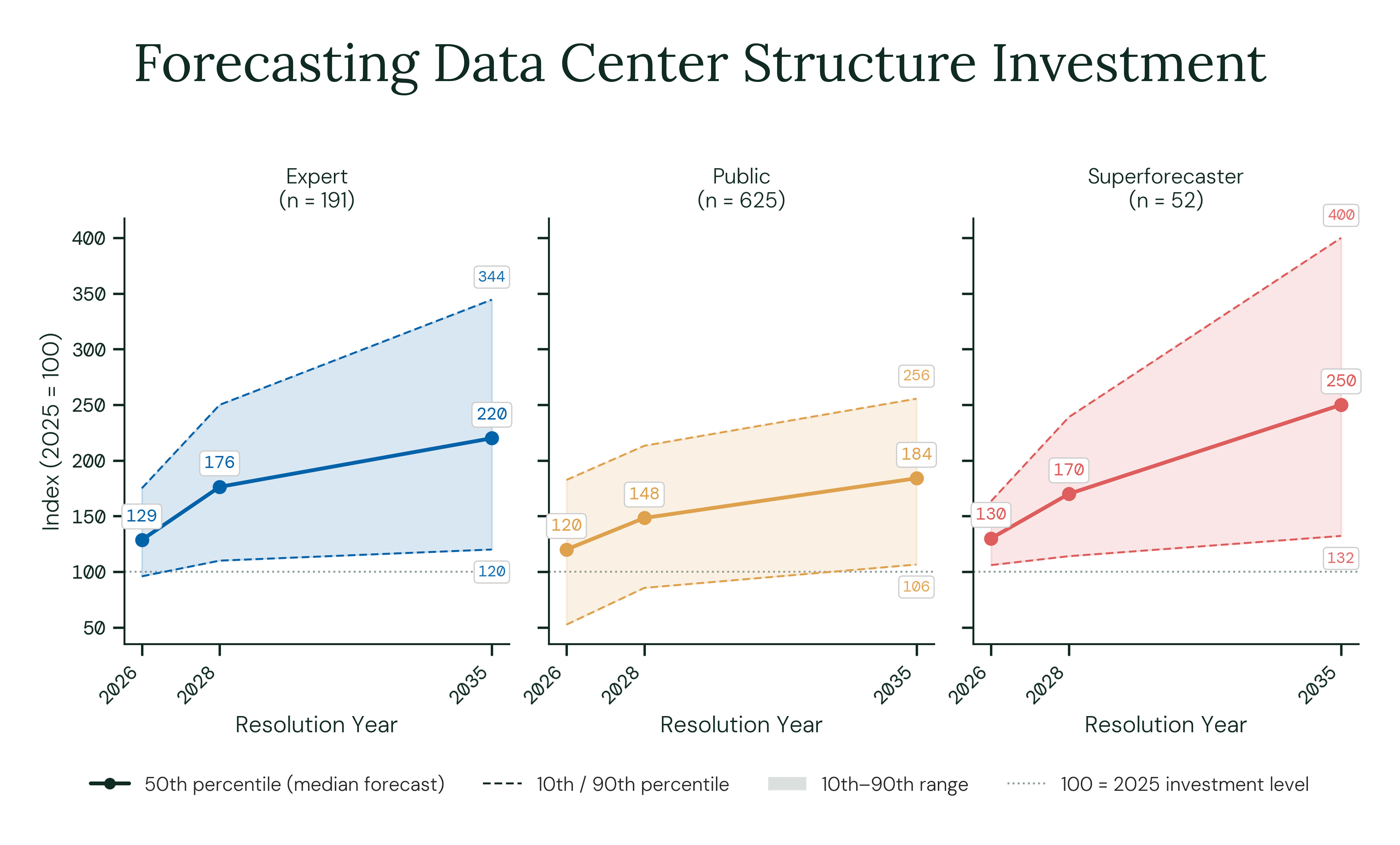
Superforecasters predict a similar trajectory. They expect private fixed investment in data center structures to grow by 30% by the end of 2026 and 70% by the end of 2028, compared with the 2025 level. By 2035 superforecasters expect investment to be 250% of its 2025 level. This translates into expected investment in 2035 of $102 billion for superforecasters versus the $89.8 billion predicted by experts. The public expects considerably lower levels of investment, forecasting a 48% increase by the end of 2028 and an 84% increase by the end of 2035.
In their written rationales, high-investment forecasters argued that announced data center projects are likely to translate into large increases in investment by 2028. Low-investment respondents cited public opposition and state-level moratoria on data center construction, such as the recent moratorium imposed in New York State, as factors that may slow down data center buildout and thus investment.
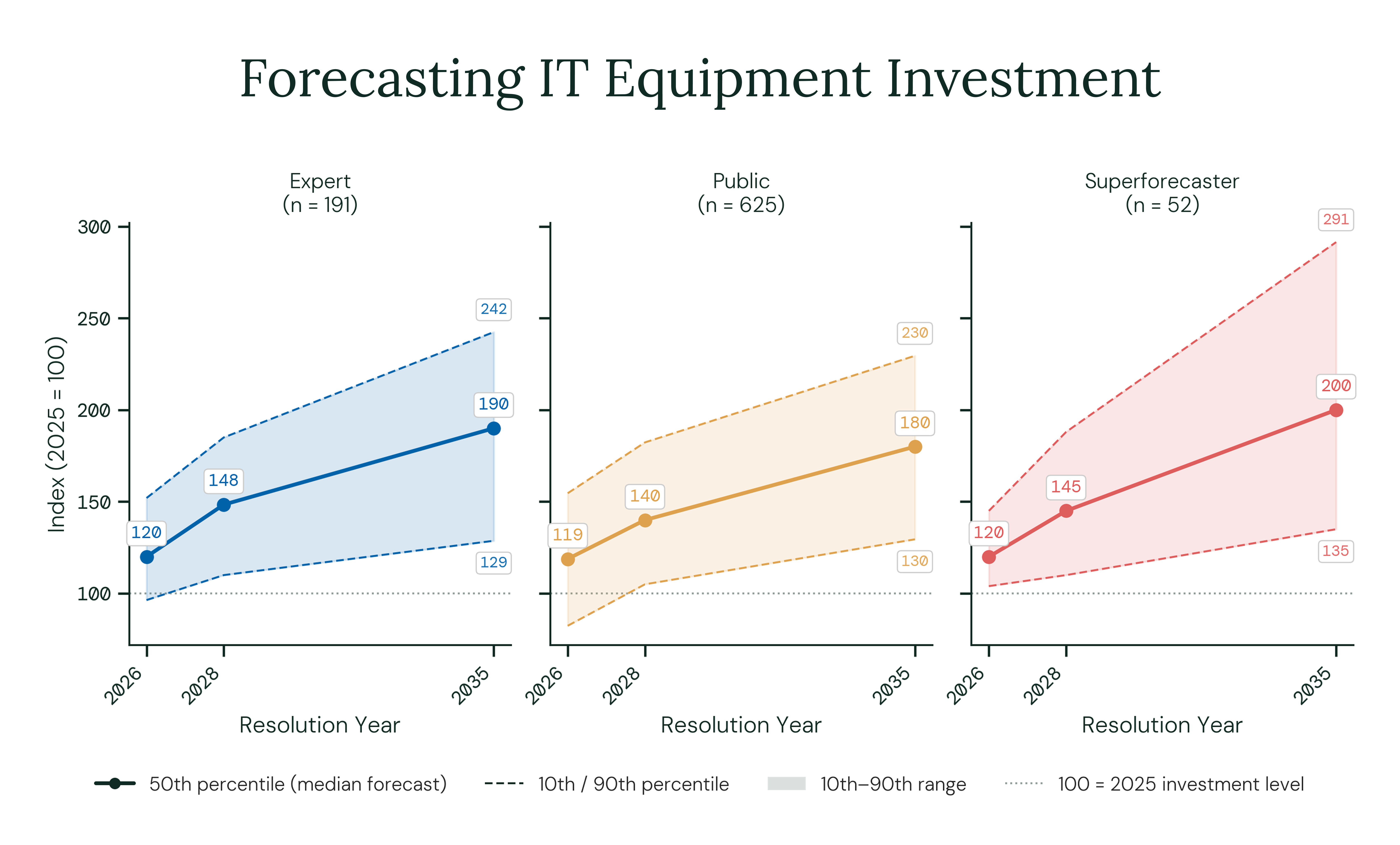
We also asked forecasters to predict total annual US private fixed investment in electrical and communication structures, and IT equipment. These cover the increased electricity generation and transmission needed to power data centers and the servers, networking gear, and other electrical infrastructure that keep them running. Both of these categories are much larger than data center structures: private investment in IT equipment in 2025 was $514.8 billion while for electrical and communication structures it was $146.4 billion.
Experts forecast considerable growth in investment in IT equipment compared with a 2025 baseline of $514.8 billion. They expect this to grow 20% by 2026, 48% by 2028, and 90% by 2035—implying real-terms investment of $978 billion by 2035. Superforecasters have similar forecasts, edging above $1 trillion by 2035.
In contrast, both experts and superforecasters expect slower growth in total annual private investment in electrical and communication structures. From a baseline of $146.4 billion in 2025, experts forecast 5% growth in investment in 2026, 15% growth by 2028, and 32% growth by 2035. Superforecasters forecast similar levels of growth.
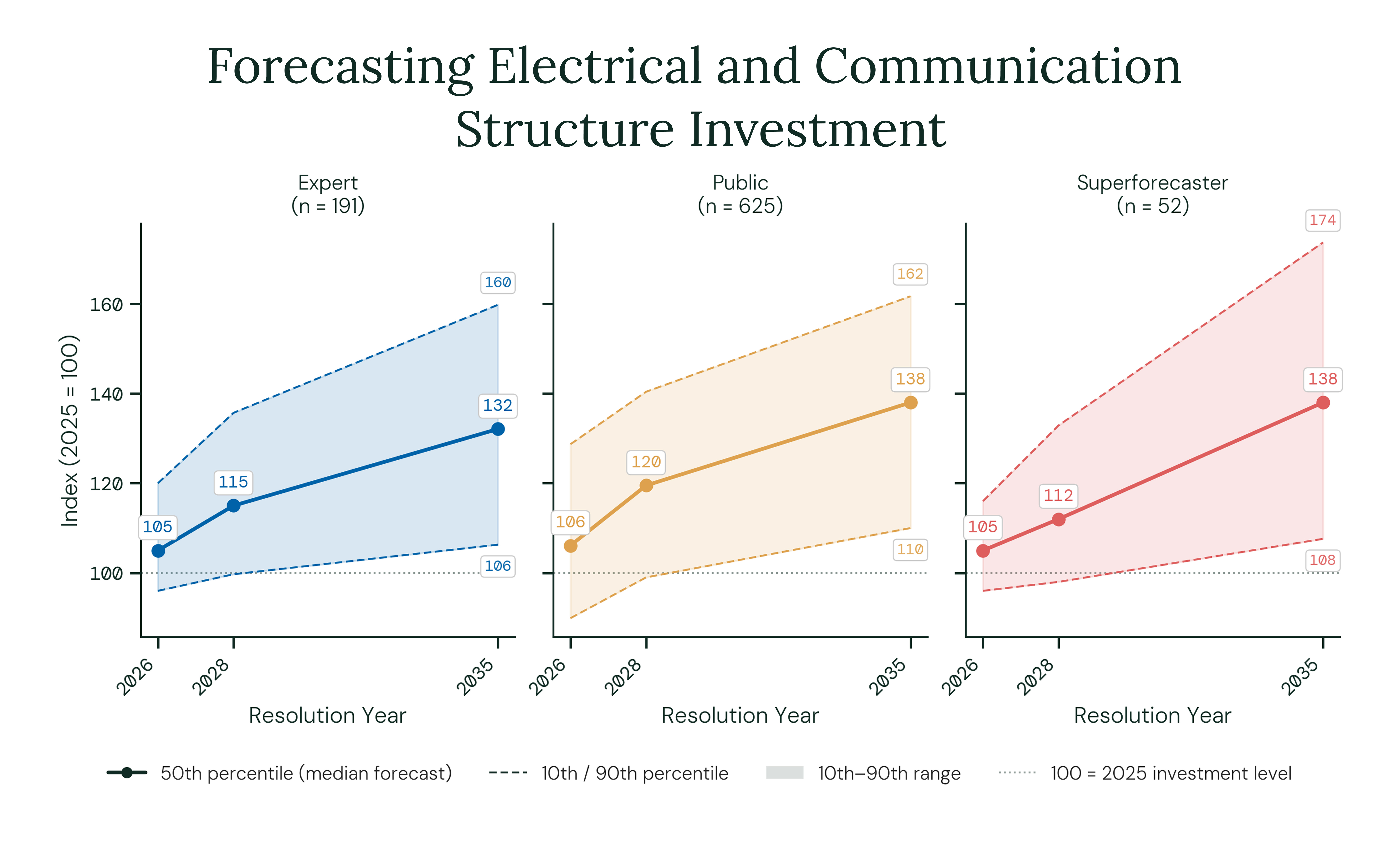
In their written rationales, forecasters noted that the electrical and communication structures category is economy-wide and thus less sensitive to a data center boom, and that investment in this sector has been relatively flat historically. By contrast, forecasters expected the short life of hardware to drive investment in IT equipment, pointing out that data center structures last for decades while servers become outdated after a number of years.
We asked forecasters to predict the change in two exchange-traded funds (ETFs) that track the share prices of semiconductor stocks and software companies. The VanEck Semiconductor ETF (SMH) tracks the 25 largest US-listed semiconductor companies, a proxy for the AI compute buildout. The top five SMH holdings by weight as of July 8, 2026, were Micron Technology, AMD, TSMC, ASML Holding, and Broadcom.
Over the past 2.5 years, SMH has more than tripled in value (rising from $180.31 on January 18, 2024, to $607.73 on July 9, 2026). A simple extrapolation of historical trends would suggest that by the end of 2028, SMH would have a value of roughly $2,048 (3.37 times its level on July 9, 2026).
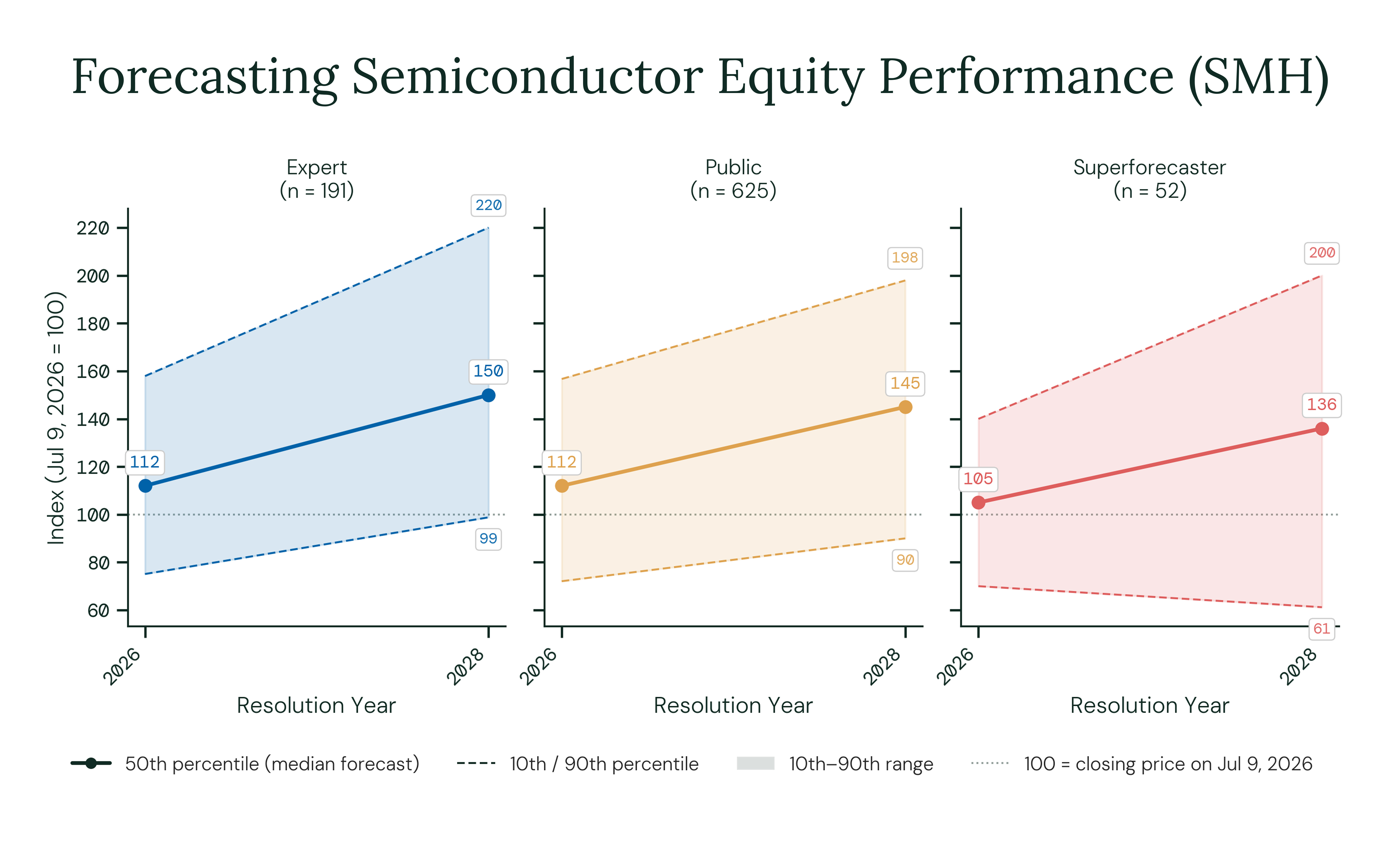
Instead, the median expert forecasts SMH to reach only 1.5 times its mid-2026 value. Superforecasters had similar expectations, predicting SMH would reach 1.36 times its mid-2026 value by the end of 2028. On average, experts and superforecasters forecast less than a 10% chance (8% and 7% respectively) that SMH will reach the trend-extrapolated value of 337 by the end of 2028. In fact, they predict that it’s more likely (experts: 17%, superforecasters: 27%) that SMH will decrease in value than that it will remain at or above its current trend.
Respondents who predicted high SMH growth argued that near-term data center buildout (and thus demand for chips) was showing no signs of slowing down, with much future demand already locked in. Forecasters who predicted slower growth thought that future returns may not match the recent increase in stock prices and that large-scale data center expansion could slow down by the end of 2028.
We also asked forecasters to predict the change in the iShares Expanded Tech-Software Sector ETF (IGV). This fund tracks roughly 110 North American software companies. The top five holdings by weight as of July 8, 2026, were Palo Alto Networks, Palantir Technologies, Microsoft, CrowdStrike, and Oracle.
Over the past 2.5 years, IGV has increased roughly 1.1x in value (the price of a share rising from $82.19 on January 18, 2024, to $93.88 on July 9, 2026). A simple extrapolation of historical trends would suggest that by the end of 2028 IGV would have reached a value of $107.23 per share, 1.14 times its mid-2026 value.
Instead, the median expert forecasts that IGV value will grow faster than its recent historical trend, reaching 1.2-1.3x its mid-2026 value by the end of 2028. Superforecasters predict IGV will reach 1.2 times its mid-2026 value over the same period. In essence, forecasters expect lower absolute growth rates for software stocks compared with semiconductor stocks, but also expect software stocks to show a relative increase over their historical growth trend while growth in semiconductor stocks slows.
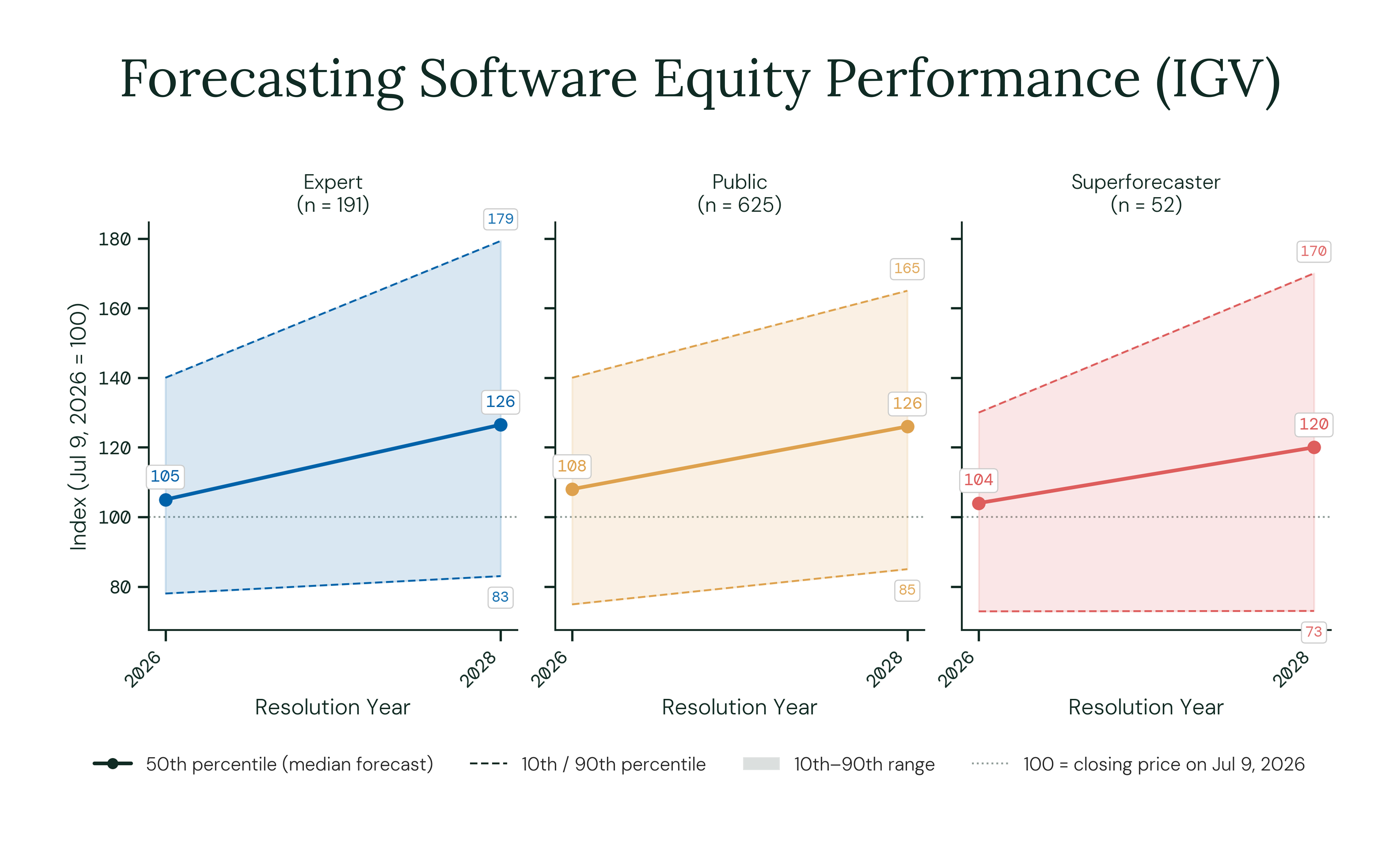
The average expert and superforecaster give a 63% and 58% chance, respectively, that IGV will surpass its trend-extrapolated value by the end of 2028. They also give a 25% and 29% chance, respectively, that the index declines from current values.
In their written rationales, forecasters considered that the key dynamic influencing the value of IGV was whether AI is used to sell software or to replace it. Low-valuation respondents tended to argue that AI is at risk of rendering many software companies obsolete while high-valuation respondents noted the ability of software companies to turn technology threats into profitable opportunities. Forecasters also pointed to IGV’s recent underperformance as a reason to expect better forward returns.
OpenAI and Anthropic are reporting staggering revenue run rates. In February 2026, Bloomberg reported that OpenAI expects revenue to exceed $280 billion by 2030, and in August 2026, Reuters reported that Anthropic is forecasting revenue in 2028 to reach $190 billion. Reaching these figures would immediately put either firm in a very small club: only 30 companies on the Fortune Global 500 list reported more than $200 billion in revenue in 2026.
We asked respondents to forecast the combined annualized revenue run rate of OpenAI and Anthropic, assuming at least one of them exists as an independent company. If one or both companies exist, the median superforecaster expects their combined annualized revenue run rate will be $300 billion in 2030, or roughly four times the $72 billion annualized revenue run rate reported in July 2026 at the time of forecasting. The median superforecaster predicts this will rise to $770 billion by 2040. Since the survey closed, the reported combined annualized revenue run rate has surpassed $105 billion.
Using the 10th, 50th, and 90th percentile forecasts provided by each respondent, along with their forecasted probabilities of at least one company existing independently, we construct an average distribution across all superforecasters. On average, superforecasters predicted a 34% chance that the combined OpenAI and Anthropic annualized revenue run rate in 2030 will exceed $400 billion while forecasting an 18% chance it’s less than $100 billion.
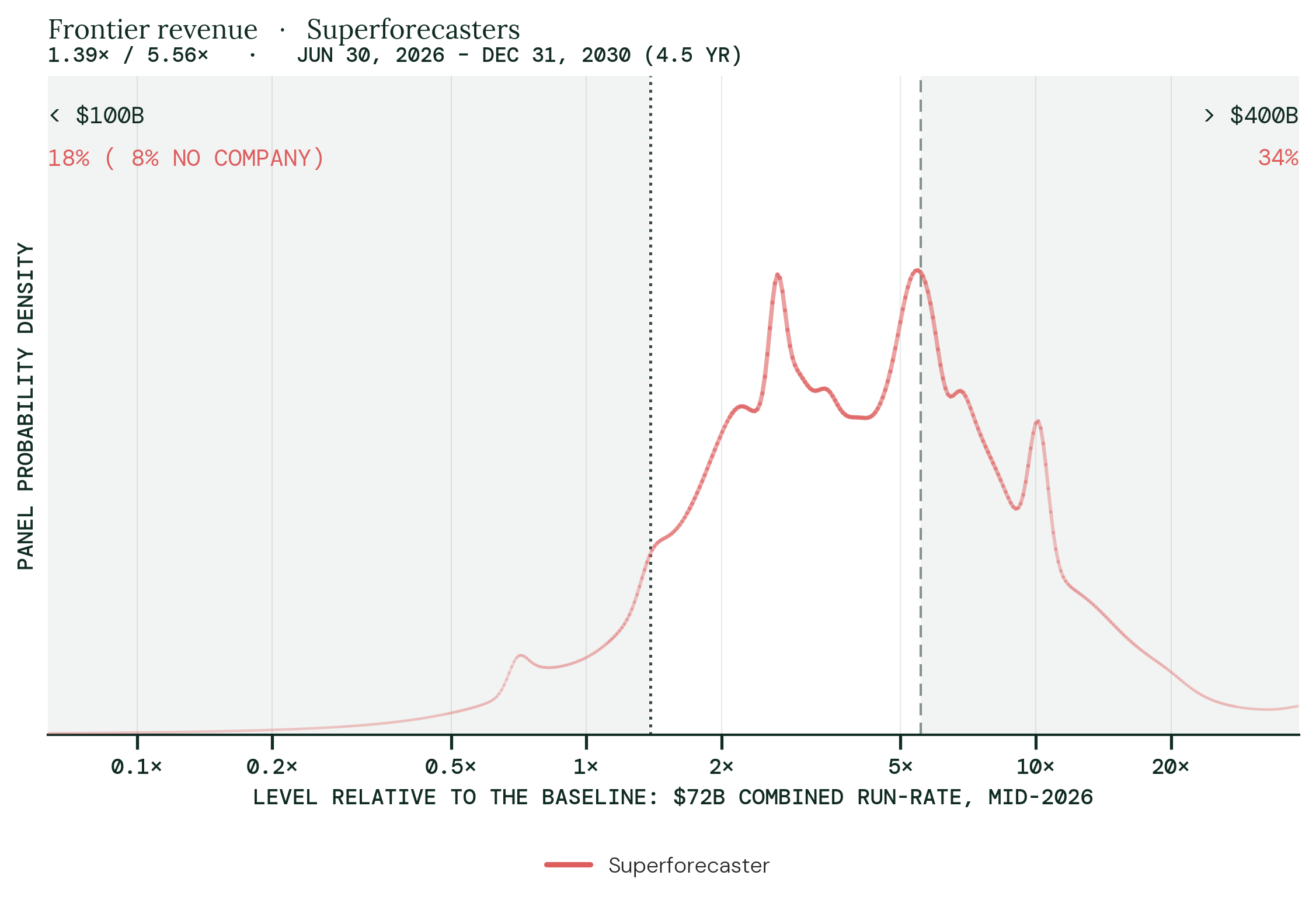
We’re focusing on superforecaster predictions here, as we suspect a number of our expert and public respondents may have erred in forecasting this question such that their responses may not reflect their best judgment. Median forecasts for both groups were below the latest published value available at the time of forecasting. While one might hold the view that either or both companies’ revenue will collapse before year’s end, rationales showed no evidence that a large number of these forecasters intended to predict a reversal of recent trends. Instead, we suspect our elicitation design may have made it easy for forecasters to ignore this most recent data point and anchor on earlier data. While superforecasters used the same interface, their predictions and rationales provide less indication that they missed the latest published value.
We are currently running an accuracy analysis of LEAP forecasts, which will include exploring the effects of elicitation designs and attentiveness on forecast accuracy.
This post covers key highlights from the Wave 11 LEAP survey conducted between July 13 and August 11, 2026. Recent waves covered robotics, the economic effects of AI, AI risks and AI benefits.
No posts
Comments
Nothing yet. Say the first thing.
Sign in to join the conversation.