
In the latest wave of the Longitudinal Expert AI Panel (LEAP), we asked panelists to consider the future of robotics and its labor implications. We elicited forecasts on when robots will be able to pass the "Coffee Test" and perform an appendectomy without physical human help, as well as the future of industrial robots, the share of economic output going to workers, and more.
Every month, LEAP tracks the views of top AI scientists, industry leaders, policy researchers, economists, and high-performing forecasters on the trajectory of the development and use of artificial intelligence. Earlier LEAP waves covered AI research and development, security and geopolitics, using AI for science, and more.
This post covers key highlights from the Wave 7 LEAP survey that we conducted between March 9 and 31, 2026. More information about this wave, including question details and analysis of rationales, is available here.
We’re interviewing a small number of LEAP users to learn how we can make our work more useful for decision-makers. If you’re interested in taking part, please fill out this Google Form.
We’re offering a $50 voucher to everyone we interview.
The “Coffee Test” requires a robot to make a cup of coffee in three different unstructured, unfamiliar environments of equivalent complexity to an ordinary home, without making any mistakes. This test is generally attributed to Apple co-founder Steve Wozniak, who in 2007 predicted that “we will never see a robot that makes a cup of coffee, never.”
LEAP forecasters are more optimistic than Wozniak, but generally do not expect an imminent breakthrough on the Coffee Test. The median expert forecasts that an autonomous robot will first successfully complete the Coffee Test in 2034, with superforecasters predicting 2032 and the general public predicting 2039.
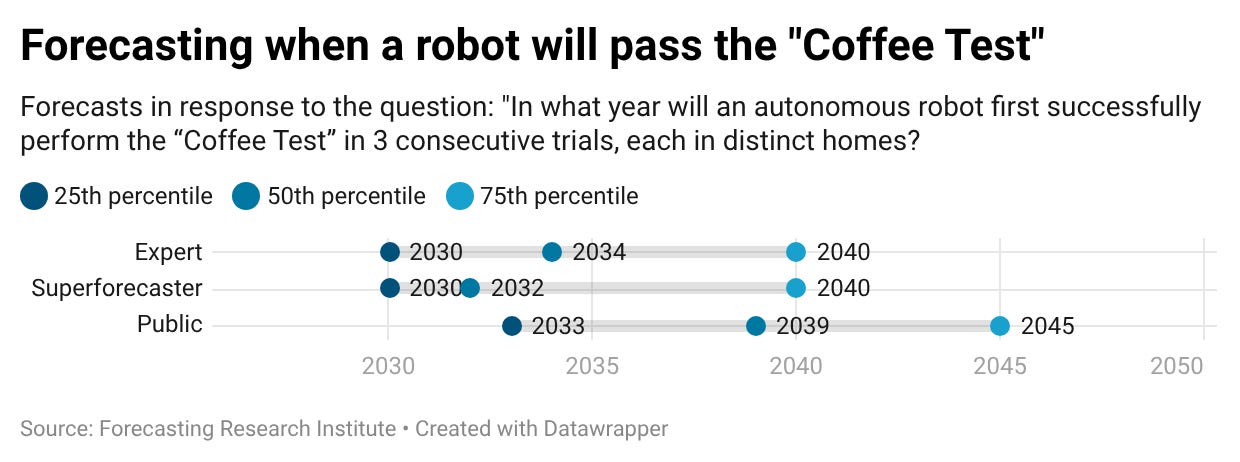
In their written rationales, forecasters disagreed in their assessment of current robot capabilities. Respondents who predicted an earlier resolution tended to argue that the technical ability to pass such a test already exists, while those who had longer timelines typically saw a wide chasm between current systems and the level required to pass the test. Forecasters highlighted robot dexterity and generalization as key barriers to passing the Coffee Test.
Experts forecast that a robot will first successfully perform an appendectomy without physical human assistance around 2040, with superforecasters predicting 2035 and the public 2039. The later timeline for surgery is notable given that, unlike the Coffee Test, the appendectomy test explicitly permits verbal coaching by a human. In rationales, forecasters expecting a later resolution date pointed to regulatory barriers, malpractice liability, and surgeon lobbying as potential multi-decade blockers of an AI appendectomy.1
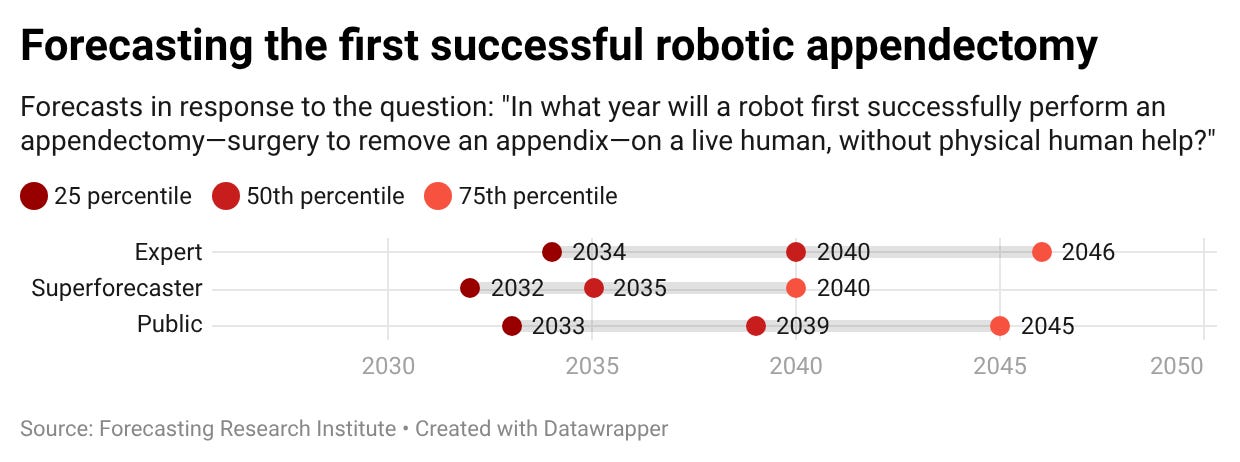
As with responses to the Coffee Test, forecasts show a large amount of disagreement. The interquartile range for experts' 50th percentile forecasts on the autonomous appendectomy spans from 2035 to 2046, while the interquartile range for the Coffee Test spans from 2030 to 2040. Across the 50th percentile forecasts for both questions, superforecasters have the smallest interquartile range while the public has the largest.
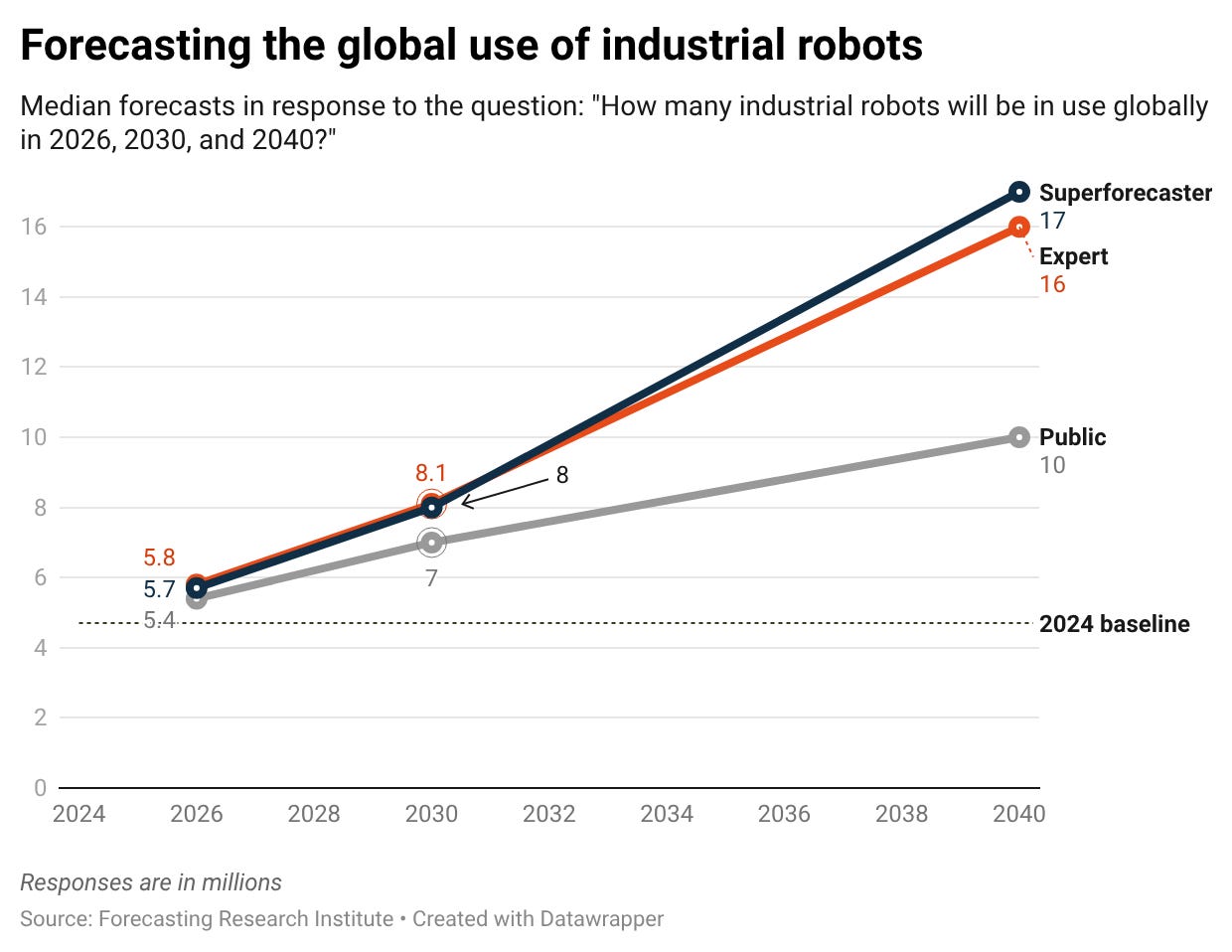
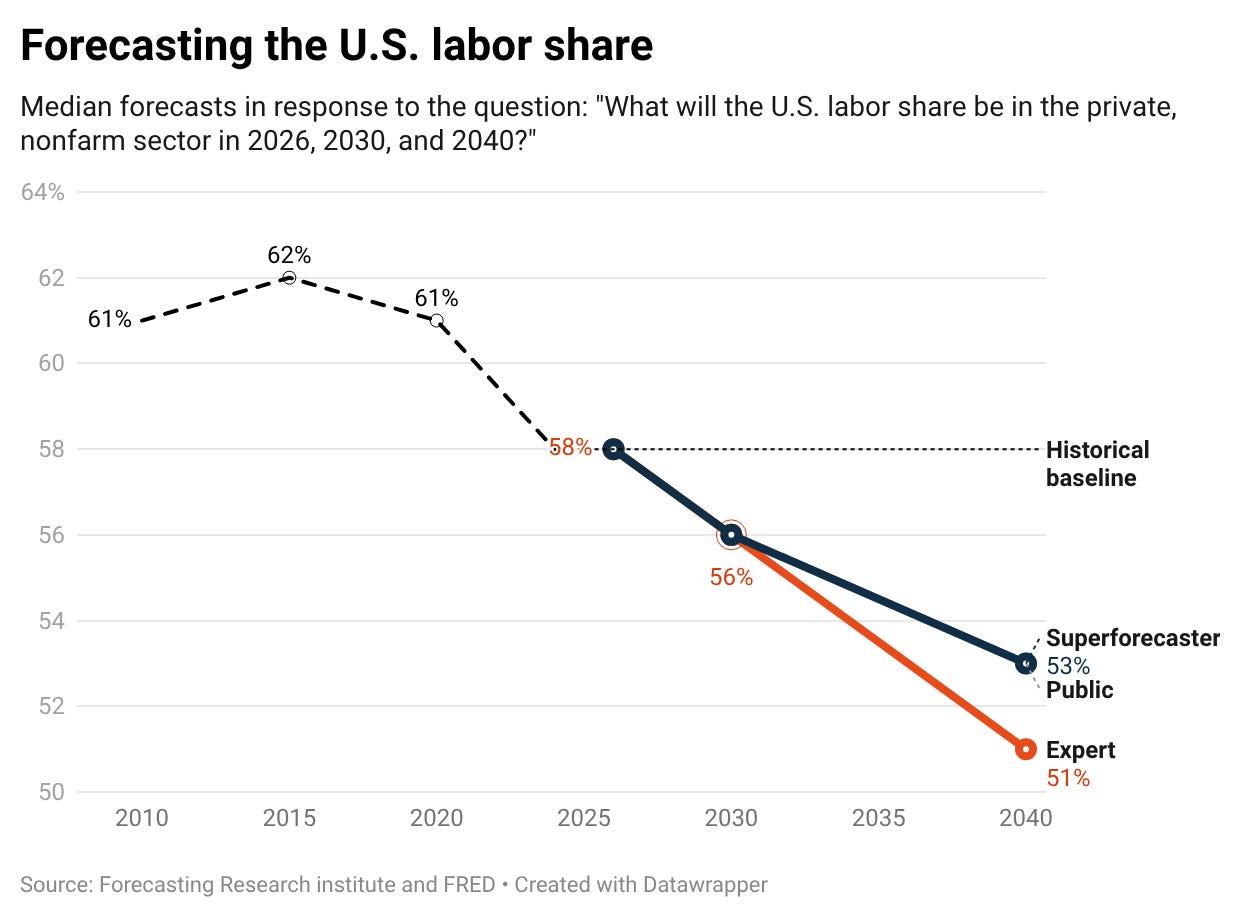
We asked forecasters to predict the U.S. labor share for the private, nonfarm sector in 2026, 2030, and 2040 as well as the number of industrial robots in use globally in those same years. Labor share is the proportion of economic output that goes to workers in the form of income and benefits, rather than to capital. Some AI thought leaders believe that AI will eventually replace many human workers, driving down labor’s share of economic output, and some recent economic studies suggest that automation may have reduced the labor share of economic output.
All participants groups expect the number of industrial robots in use globally to continue to grow from a 2024 baseline of 4.66 million units. The median expert predicts industrial robot stocks will grow to 16 million units by 2040, with superforecasters predicting a similar number.
Despite this, all groups forecast relatively modest declines in labor share. From a 2024 baseline of 58.3%, the median expert forecasts U.S. labor share declining to 51% by 2040—a roughly 7 percentage point drop over 16 years, compared to the roughly 10 percentage point decline that occurred over the previous 23 years.
Forecaster rationales suggest that experts see the growth in industrial robots as important, but many note that labor share changes slowly, and is embedded in institutional and demographic structures that change over decades rather than years. As one moderate-decline respondent put it: “labor share moves like a supertanker.” Even respondents who cite advances in AI in their rationales tend to anchor to the current downward trend in labor share rather than forecast an acceleration.
The median expert forecasts Amazon’s real e-commerce net sales per distribution employee to rise from an estimated 2024 baseline of $464,771 to $480,000 by 2026, $549,842 by 2030, and $800,000 by 2040.2 Superforecasters are more bullish, predicting over $1,000,000 by 2040.
Forecasters cited the suitability of warehouses for robotic deployment, Amazon’s track record in automation and a decoupling of sales from labor as key factors driving their predictions.
To read more about Wave 7 of LEAP, including further questions and rationale analysis, visit the LEAP website. If you would like to participate in LEAP feedback, please fill in this Google Form.
Some respondents appear to have assumed (incorrectly) that no human coaching was permitted for this test, which likely also shifted forecasts later.
Some respondents appear to have misinterpreted this question as including last-mile delivery drivers, who typically are not Amazon employees, which may have introduced a small downward bias to the forecasts.
No posts
Comments
Nothing yet. Say the first thing.
Sign in to join the conversation.