
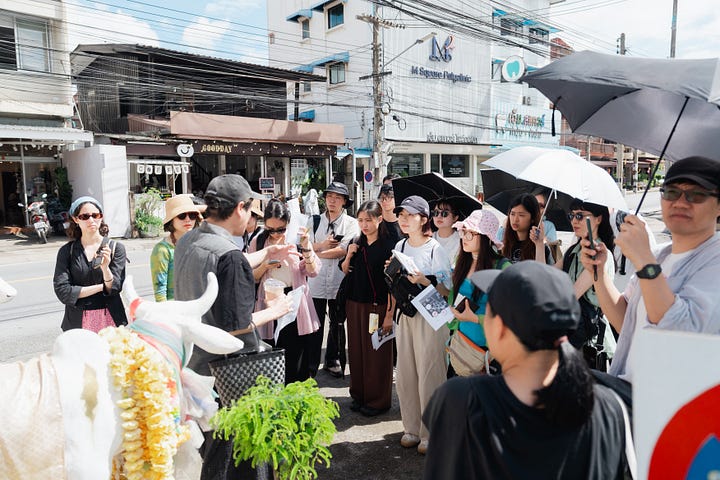

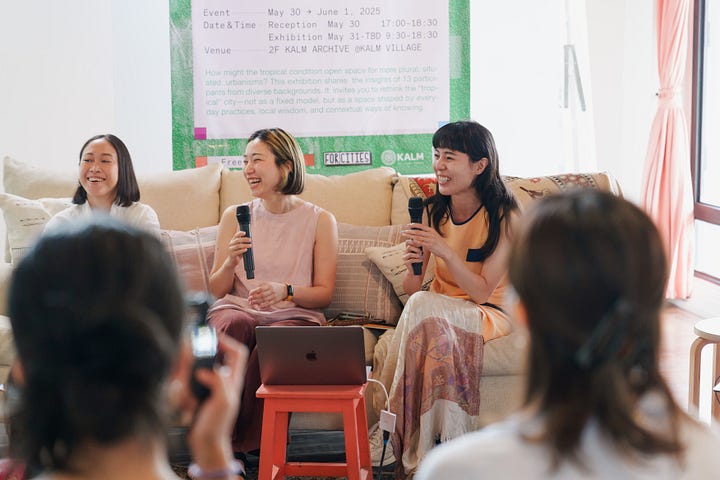
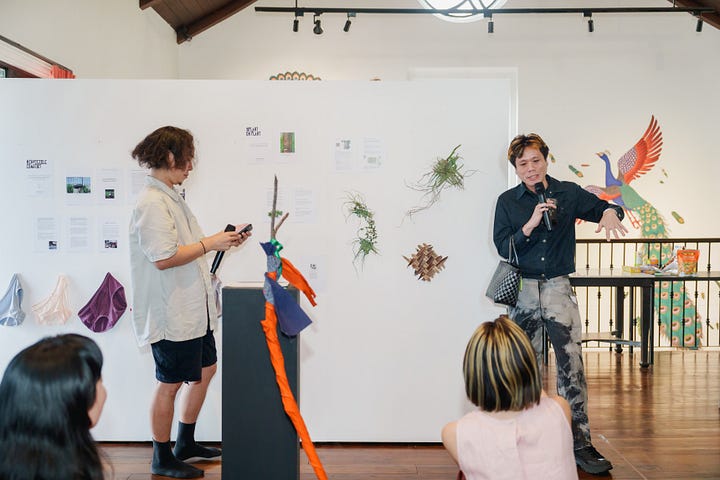
for Cities Week 2025 in Chiang Mai came to a close at the beginning of this month. It was a wonderful time shared with 13 participants from diverse backgrounds, alongside our amazing local collaborators.
We’ll be hosting reflection sessions to share our experiences in Chiang Mai on July 2nd (Japanese) and July 6th (English) — please keep an eye on our Instagram for more details!
This month, Vanessa has picked out some urban news highlights from Singapore. Enjoy! Come join our online meet-up too:)
Hey there! I’m Vanessa Chan, an urban studies major born and raised in Singapore, now based in Tokyo. Having never experienced anything but city and yet more city, I’m interested in ways of looking back from outside the urban (whatever that means!), and reading the city through fiction.
Singapore is commonly described in two ways: island-city or city-state. Even a single hyphen seems to give it an air of ungeneralizability. Yet the island aspect, which I sometimes forget, is often invoked in terms of abstract qualities (enclosure, separation, maritime) more than about any consciousness of island-living. In April, our new Prime Minister said in a speech: “Singapore may be an island. But we cannot have an island mentality.” Singapore actually comprises 64 islands.
In recent years, artists, historians, environmentalists, and urbanists have been interested in the island-city-state, mapping the conflict that happens at the boundary of these definitions. They look at dispossession and dislocation as differentiated experiences, within and beyond (new!) state borders. Islanders who were forced onto the mainland are separated from the ocean as a cultural lifeblood, while coastal communities where we import sand from have their very homes dredged up.
Sand and shore mark the material process of extraction and accumulation, draining communities of their vitality, transmuted in the glass towers of the urban core.
The resources I’m picking out for this issue are thematically limited, but I hope they will be an interesting set to look at how urbanization functions through all three ‘moments’ of the island-city-state.
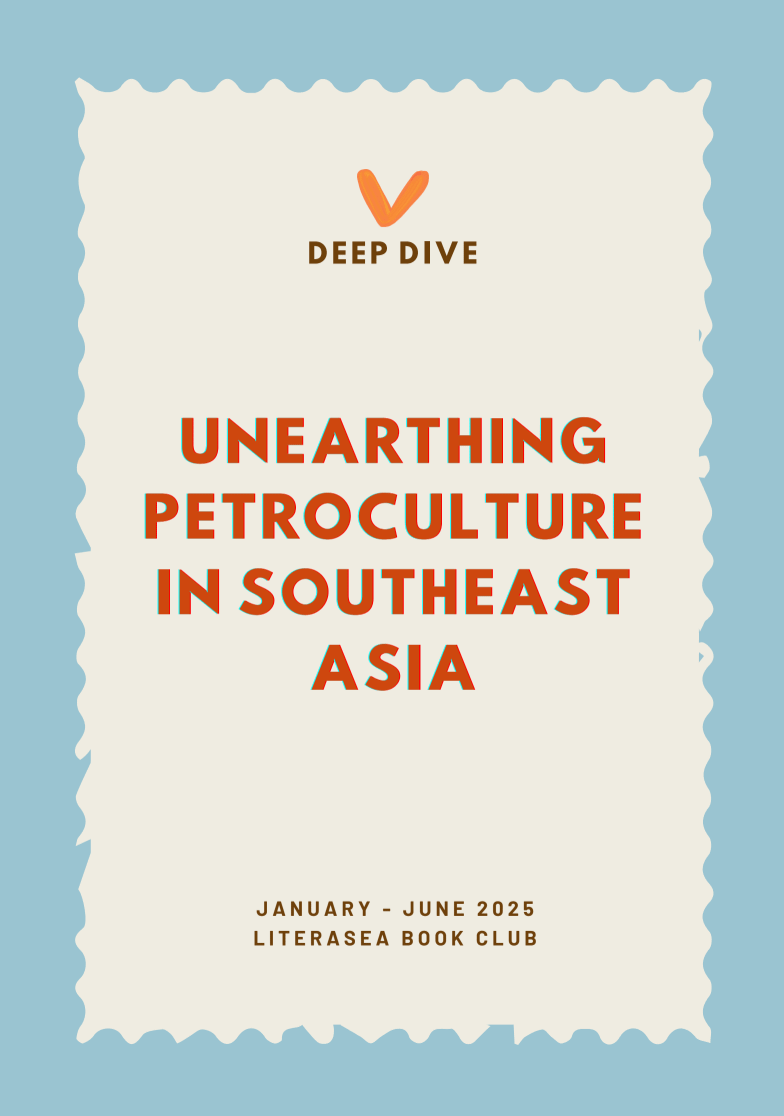
Tangentially, my Southeast Asian book club is currently looking at petroculture as experienced in urban centers; this is a picture of our syllabus:
Orang Laut SG - Orang Laut means ‘sea people’, sea-faring indigenous peoples who lived in the area. Started by Firdaus Sani, a descendant of villagers who once lived on Pulau Semakau, famously known as Singapore’s waste bin. Through food, festivals, and community events, OLSG works to preserve the memory of islanders hailing from Singapore’s 63 other islands, and the cultural practices jeopardised by disconnection from the ocean.
Wan’s Ubin Journal – Syazwan’s journal began as a documentation project of his family’s history on Pulau Ubin, including locating the site of his grandfather’s former home. In a process of “ruralization”, Pulau Ubin’s villages were removed to create green recreational space away from the main city. Wan’s Ubin Journal grew into a wider oral history of the kampungs, history walks, and annual celebrations for the Orang Pulau (island people) and descendants to return to the island.
Coastal Natives – A collective of ocean lovers producing art, film, and science communication to restore Singapore’s relationship to the sea. Last year, they organised the Waves of Change festival at the ArtScience Museum. They also have a podcast on Spotify.
Urbanizing Islands: A Critical History of Singapore's Offshore Islands by Creighton Connolly & Hamzah Muzaini (2022) – This brilliant article is one of the few describing the transformation of the peripheral islands in relation to urbanization, “given their important role in processes of urban metabolism”, locating them in the political economy of socio-ecological inequality.
Resettlement of Bukom Kechil: Southern Islanders and the making of the housing nation in Singapore by Nurhidayahti Mohammad Miharja (2024) – This article expands on the former to discuss dislocation (“un-homing”) of Malay inhabitants as a necessary process in the creation of the racialised “housing nation”, which is often touted as the crown jewel of Singapore’s urban policies.
Rawa by Isa Kamari – A fictional novel following three generations of an Orang Selatar family experiencing the changes described in the article above, a dislocation from their village which turned them into “Malays”.
Extracting Sovereignty: Land Reclamation in Southeast Asia and the Emergence of the Global Sand Crisis by William Jamieson – A great overview of the politics of sand extraction, the insidiously soft metaphor of “reclamation”, and the urban art made in response to violence.
How Have Singapore's Coastlines Changed Over The Years? — Lost Waterfronts, by CNA – As on the label, a history of migrant communities and activities on the coast, shaping the city (or national?) culture, as shorelines were redrawn in sand.
Singapore Is Building $100BN of Artificial Islands—But Will It Work by The Impossible Build – A brief primer on a part of the country’s climate mitigation plan, creating a set of three islands to protect the current East Coast.News
Enjoy My Sand (2013-2015) by Khvay Samnang - a Cambodian multi-media artist, trained in classical Khmer dance, whose tongue-in-cheek work brought him to Singapore and Tokyo, where he carried people he met on his back, buffalo horns on his head, as a free “Cow Taxi”. This was framed against a video of him pouring sand from Phnom Penh’s lakes, which would travel to these destination cities for urban development.
SEA STATE (2005–) by Charles Lim – An archive of ‘ten chapters’ premised on “inverting perceptions of sea and land in the island city-state of Singapore”, presenting works on the sea, shore, and city produced since 2005.
Hari Orang Pulau (Islanders’ Day), 14 June 2025, West Coast Park – Organised by Orang Laut SG, this inaugural event revivifies island life, centering the culture, history, and knowledge of Singapore’s Orang Pulau. The event is open to the public and free to attend!
SIFA Pavillion, 16 May–1 June, Bedok Town Square – A satellite site in a neighbourhood square, this pavilion convenes multi-media artists to reflect Bedok Town’s old coastline, maritime history and “new urban realities”. This includes a participatory workshop, “A Future Untold”, which uses marine debris to ‘paint’; a centerpiece installation and performances “The Sea and the Neighbourhood”, and a multimedia experience “Speculative F(r)ctions”, playing on water boundaries in flux.
For the June meet-up Vanessa will be talking about the urban news picks from Singapore. Come join us!
📅 June 21
🕰️ 19:00-20:30 (JST)/ 12:00-13:30 (CET)
On Discord / Sing-up from here
We aimed to expand our platform of urbanists around the to get together online and share ideas, cooperate and foster a community and we were delighted to have participants from diverse places and discuss topics related to cities and were inspired by these conversations.
If you have any questions please reach out at info@forcities.org
No posts
Comments
Nothing yet. Say the first thing.
Sign in to join the conversation.