
HMCS BONAVENTURE was definitely on the small side compared to contemporary American and British carriers in the 1950s and 60s. That was never more obvious than when the Royal Canadian Navy opted to buy jet fighters.
The aircraft of choice was the McDonnell F2H3 Banshee, which saw service in the RCN from 1955 to 62. The Banshee was not only the first but also the last jet fighter operated by the RCN.
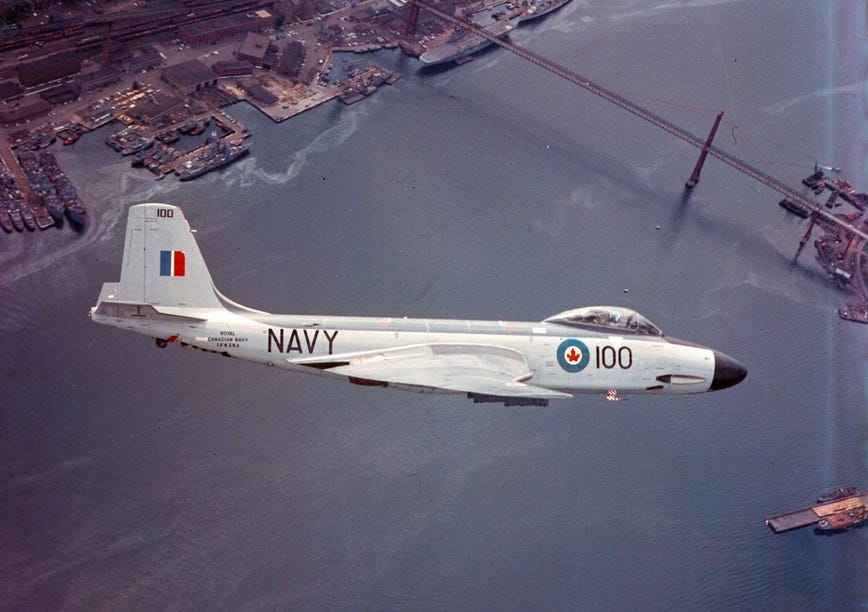
A Banshee over Halifax Harbour (photo courtesy DND)
In 1951 the RCN decided to purchase 60 new Banshees at a price of $40 million. But between the politicians and the bureaucrats, by the time the deal was approved, the McDonnell production line had stopped making Banshees. So in a typical Canadian procurement, the RCN settled for second-hand aircraft already used by the USN, buying 39 of them for $25 million.
A reliable all-weather aircraft, the Banshees were liked by their pilots, but they were aging. Over the years, 12 of the original 39 Banshees were lost to accidents, including such things as brake failures and a wing folding when in the air. (They had wings designed to fold, so as to fit in smaller spaces when on board a ship.)
Many a yarn did the rounds in those days, and some may even be true, about US Navy Banshee pilots. As part of a training exercise the Yanks were to fly from their own aircraft carrier, rendezvous with BONAVENTURE, and land on her. They took one look at the relatively diminutive BONNIE and flew straight home.
Here’s a photo of my friend George Plawski, which was probably taken in 1960 or thereabouts. George was then a young RCN officer at Pensacola, Florida, qualifying as a naval fixed-wing pilot.
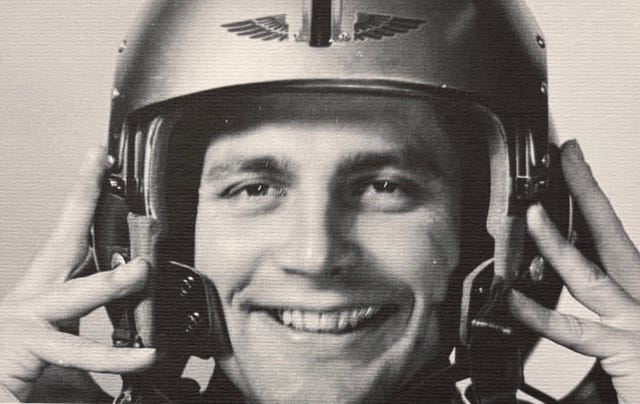
In 1962 George, still training in the US, did well enough that he was selected as one of four out of the class of 24 to go on to become jet fighter pilots. On the very night that he and his three friends celebrated their selection, they received word that Canada was grounding its Banshees, never to fly them again. It was undoubtedly an understatement when George told me the character of the celebration changed.
George went on to become a successful pilot of the RCN’s anti-submarine Tracker aircraft, although his naval career was cut short. For details, and the rest of his exciting story, I highly recommend his book, NEVER A DULL MOMENT subtitled “A Memoir of Canadian Naval Aviation, Firebombing and Theatre.”
No posts
Comments
Nothing yet. Say the first thing.
Sign in to join the conversation.