
In 1966 I was a Sub-Lieutenant and bridge watchkeeper in HMCS SAGUENAY, a St. Laurent-class Destroyer Escort which had recently been converted as a helicopter-carrying DDH.
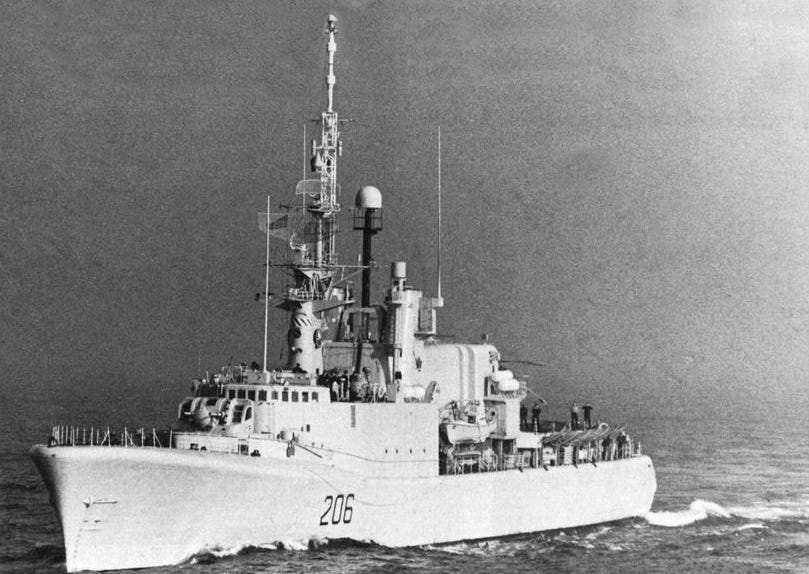
During Operation Maple Spring 1966, we were somewhere off the coast of South America; during the morning watch, I was sound asleep down in a cabin I shared with Mike Morres. At some point, the ship shuddered violently and woke me up, but thereafter all seemed normal, so I went back to sleep. At the end of the watch, Mike burst into our cabin, saying, “Bob, Bob, wake up, wake up!”
Mike had just been relieved off the morning watch. Here’s the story as I understood it from Mike and talking to other people since:
For most of the watch, SAGUENAY was stationed 12 or 15 miles ahead of the main body, which consisted of HMCS BONAVENTURE and various other ships. A signal was received telling us to take up station as plane guard, a thousand yards or so astern and probably on BONNIE’S starboard quarter. At that point, the Officer of the Watch (OOW) would have called the captain and passed the signal on to him. No doubt the CO said to carry on and that he would be on the bridge shortly. SAGUENAY would then have altered course 180 degrees to close on BONAVENTURE.
* *
The normal maneuver would be to proceed down BONAVENTURE’S side, then turn to port or starboard as appropriate, and take up station in her wake. (This might be more complex, if, for example, BONNIE had altered course in the meantime.) SAGUENAY’S stationing speed, that which is used to achieve any ordered position, was probably 21 or 24 knots. She would be closing on the carrier, which would be steaming toward her at, say, 15 knots. Thus, the closing speed of the two ships would be 36 or 39 knots, equal to 41 or 45 miles per hour. Nothing significant if you’re driving a Mercedes-Benz on a freeway, but ships, when they’re underway, have a lot of momentum. Thus, the manoeuvre of passing BONAVENTURE and tucking into station in her stern as she goes flying by calls for a keen sense of timing. Turn too late, and you end up way astern of the carrier and embarrassingly out of station. Turn too early, and…
* *
The captain arrived on the bridge. The OOW informed him of the tactical situation and location of BONAVENTURE, the radar picture, etc. As SAGUENAY closed on BONNIE, the captain took charge. “Alter course now,” he told the OOW, who questioned the order, as it would put the ship dangerously in front of the carrier. At some point, the captain gave a direct order to alter course. That course caused SAGUENAY to cross directly in front of the onrushing BONAVENTURE’S bow.
I’ve since spoken to two officers who were on BONNIE’S bridge. Her OOW ordered full astern, then watched SAGUENAY disappear under her bow, convinced they were about to cut her in two.
SAGUENAY went to Full Ahead, an emergency order. (That caused the shuddering that woke me up.)
Somehow SAGUENAY escaped and took up her station. Our captain was required to report on board BONAVENTURE, wearing sword and medals, to have a chat with the Commodore. PEDRO, the carrier’s rescue helicopter, hovered over our flight deck and picked him up in a harness and transported him to BONNIE’S flight deck. I’m sure he hardly drew a breath until he was delivered back to his ship a short time later.
As many of you already realize, comments are welcome, and they are always interesting. I suggest, though, that rather than hitting “Reply,” you go to “Like” then put your comments in the Substack page at the bottom. That way other readers will be able to see and appreciate them!
For those of you keeping score, there was no Forces with History # 254, due to an error in the editing room.
No posts
Comments
Nothing yet. Say the first thing.
Sign in to join the conversation.