

The website has disappeared into the mists of time.
Despite earnest searching, I can’t find any trace of it. We built it nearly three decades ago, my friend Pete and I did, naming it “The Loophole,” for reasons I no longer remember. We were not quite teenagers, so it was a website of the time: a fan page for the strategy card game Magic: The Gathering, the era’s quintessentially nerdy tween-boy hobby, of which we were both obsessed, burning our weekend afternoons (and the bulk of our allowance money) on playing the game.
We made the site on Express Page, one of several low-fi web hosting services popular in the mid 1990s. The two of us spent weekends huddled around our family computers, which sat in household living rooms like a communal resource, an informational pantry shared by all.

I remember the site’s black wallpaper, red accents, and GIFs of 8-bit flaming torches. Pete and I added these to dance on both sides of the headline and evoke the card game’s fantasy atmosphere. The dancing torches are also gone now—likely forever, not even captured on Wayback Machine—purged along with the site when the ROI finally ran out and the servers were taken offline.

What did we do with the site?
We wrote, feverishly. We wrote about our favorite players. We wrote up game strategies. We wrote on recent card expansions. We wrote to experiment, fiddling with layouts, type, design elements, and content.
We shared blurbs about favorite cards, ideas about deck construction, and tips we’d read in other magazines. We read as much Magic: The Gathering media as we could get our hands on to create our own content ideas.
It was my first experience of writing on the Internet. That first exhilarating rush of being writer, editor, publisher all at once. We cheered when our page-visit counter bumped up a few digits and celebrated when one of the game’s lead designers wrote an encouraging comment on our homepage. (Thanks, Mark Rosewater, your small kindness had more impact than you know!)

I love its unmediated nature, the sense that what you create hits directly. I love how words, conjured from nothing, from mere acts of the mind, get caught within a global flow of ideas and conversation. I love how a single creative act of imagination might in turn capture some of that flow, inducing action and reaction.
I love the organic, animal nature of writing for an online audience. I love that it is living, breathing, shifting, fickle, loving, hating, and potentially dangerous. I can’t get enough.
It took me a while to realize that making and sharing things on the internet—might be the way I actually make a living. Eventually I got there a few years ago, when I joined the design team at PayPal as a content designer.
Working in tech is many things, not all of them great. It is certainly a large commitment in time; the job can be totalizing as “opportunities,” to use the corporate lingo, are never-ending: there are always opportunities for improvement, iteration, and updates.
That also means the work taps into the same excitement and velocity that I first felt with that first website—the realization that we could just … write things. There is teamwork: the richness of collaboration, the excitement of debate, the risky balance of tradeoffs in quality with pace of development, and the need to learn on the fly after being tossed into hyper-specialized projects without context or preparation.
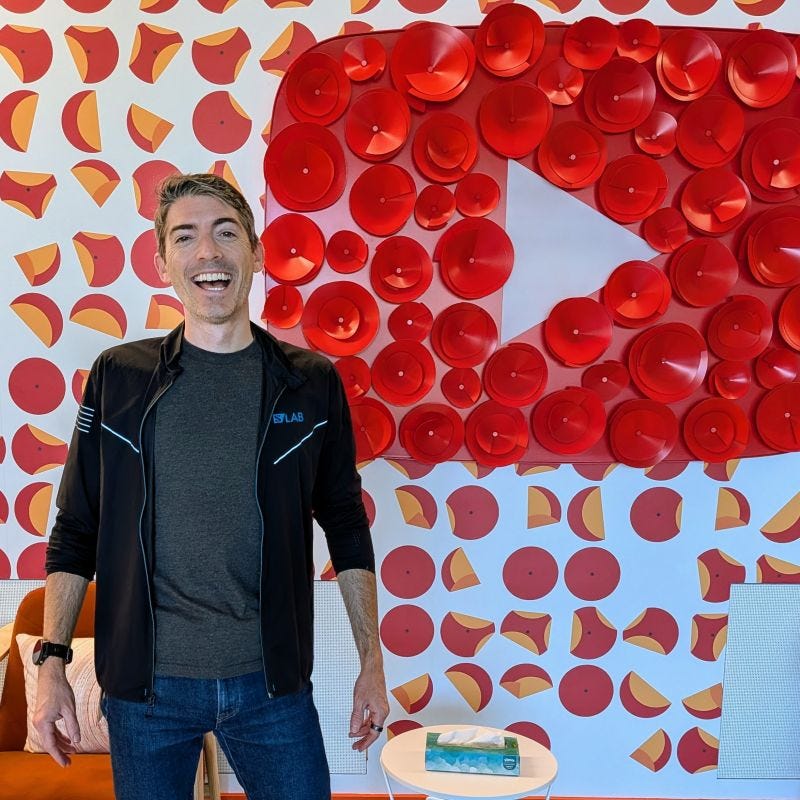
Last month I took a new role on YouTube’s UX team, as a staff content designer and UX writer.
I’m still somewhat in shock. It’s an opportunity to not only work in service to creators, but to do in support of one of the world’s largest media platforms. Moreover, I’m joining as artificial intelligence shifts how digital products are designed even as it lowers barriers of entry for new creators. These are interesting times.
If you’ve read my writing over the years, you know my beat is not the front of the pack, but rather how human movement and embodiment are shaped by history and culture. That includes how technology, internet culture, and communication have influenced how we run, walk, train, and focus.
Being immersed in a new set of design and collaborative challenges will naturally influence what I’m thinking about from day to day. New ideas and problems will shape my ideas and writing.
You can also expect topical continuity. This letter remains centered on the intersections of history, culture, endurance sport, and human movement. Posts will continue their usual publication cadence every 2-3 weeks.

Anyway, that’s my little life update! Read on for more Footnotes.
Last month I sat down with Zoë H Rom—co-host of Your Diet Sucks and a longtime fixture of outdoor and environmental journalism—for a livestream conversation about food culture, politics, and endurance sport.
We covered a lot of ground, from weaving climate coverage into sports journalism, to athletes’ vulnerability to pseudoscience, to our thoughts about The Enhanced Games. Give it a listen!
Vincent’s Very Good Day at Western. What the heck, is it 2015? Or did Mario Fraioli just make race reports great again? In fairness, that’s not hard when you’re writing about the magical Western States Endurance Run, and crewing an athlete you coach who wins the whole damn thing.
My favorite line comes in the postscript:”I’ve been asked a lot since Saturday how Vincent pulled off such a performance, and the short answer to that question is that we trained for it.”

Should we be human-maxxing? Ross Douthat with Christian Angermayer, founder of The Enhanced Games, on Interesting Times discusses enhancement, optimization, and well … a whole lot of drugs. The conversation’s swerve into a discussion of psychedelics, spirituality, and mystical religious experience surprised me … but maybe it shouldn’t have?
For a counterpoint, listen to Panic World’s take on the Enhanced Games: the games were less about sport and more about breaking the Overton Window around everyday use of enhancement supplements and performance drugs.
We Are Arguing on the Wrong Political Axis. So writes Marlene Laruelle in this post about the burgeoning imaginative divisions eclipsing the Left and Right. While the old economic and cultural divides still define current partisan alignments, Laruelle argues the real dichotomies are increasingly over abundance versus limits, living versus machines (see above), and dwelling versus exit.
While I’m not convinced these axes are as linear or clean as Laruelle proposes, her framing elucidates tensions within the current Left/Right coalitions on both sides of the Atlantic. Indeed, reading this might help you better understand your own discomfort with whatever political party you tend to vote for!
Changing the Narrative Around the San Francisco Marathon. Katherine Douglas, megha, Katherine Britt, and Kimberlee Howley are on a mission to turn the SF marathon from a race that happens to be in San Francisco to a race that is of San Francisco. I mean, why not? Why shouldn’t San Francisco be an iconic marathon?
Calvin and Hobbes and the Price of Integrity. When is the last time you saw a kid carrying around a Hobbes tiger stuffed toy? Or watched a trailer for the latest CGI movie reboot of Calvin and Hobbes?
The answer is never.That’s because cartoonist Bill Watterson refused to compromise, even when it stood to earn him millions. Watterson stared in the face of capital and capital blinked. Read the story in Matthew Morgan’s deeply researched piece on the moral integrity behind Calvin and Hobbes.

That’s it for this week. Thanks for reading! If you liked this post, consider sharing it with a friend. Word of mouth helps folks discover my work.
No posts
Comments
Nothing yet. Say the first thing.
Sign in to join the conversation.