
Last week Ben Sasse, former U.S. senator from Nebraska and recently diagnosed with stage-four pancreatic cancer, was in conversation with The New York Times’ Ross Douthat on the podcast Interesting Times.
He has a grim prognosis. During the conversation, Sasse explains that experimental treatments have extended his life expectancy; however they’ve only given him a bit more time.
Cancer has spread all over Sasse’s body. It will eventually overwhelm him and he will die.
So he has chosen to die in public.
Look, I know a million things are calling for your attention—even at this very moment—but if you read or listen to this conversation, it might grab you like it did me.
Shakespeare had a theory. In Richard II, the playwright depicts John of Gaunt as approaching his deathbed when he observes:
O, but they say the tongues of dying men
Enforce attention, like deep harmony:
Where words are scarce, they are seldom spent in vain,
For they breathe truth that breathe their words in pain.
With few words remaining, the dying spend them wisely, writes Shakespeare. So we’re more inclined to listen.
The Douthat conversation is wide-ranging, covering Sasse’s time in the Senate and perspective on what’s ailing American institutions, especially with regard to education. What resonated with me were more fundamental thoughts about his own death: what the experience is teaching him and how he’s spending his remaining time.

Since the diagnosis, Sasse has begun a podcast, Not Dead Yet (from the Monty Python and the Holy Grail joke), where he and co-host Chris Stirewalt chat with famous folks like Conan O’Brien, Caitlin Flanagan, and Mike Rowe about work, raising families, and big life questions.
I listened to a few episodes and noticed Sasse often repeats a question: how do we “redeem the time” we have left?
The phrase caught my ear. ‘Redemption’ is a foundational concept in the Christian theological tradition, which Sasse embraces as a Calvinist. Yet the word has multiple meanings: atonement for wrongdoing; deliverance from captivity; or even repurchasing something or paying off a debt.1
I’m fascinated by this conceptual slipperiness and, until last week, never thought to apply it to time. What would it mean to redeem time? Is time something we must spend wisely (atone the time itself)? Or is time like a credit, one used to make our lives more worthy? For that matter, what, exactly, would redeemed time look like? Death only raises the stakes of such questions.
I was thinking about this as I jogged around Oakland last week. My mind wandered to the work of the late Lee Lipsenthal, a physician from Marin County, who passed away from esophageal cancer in 2011.
Lee was a friend of my father, also a physician; they met through the medical conference scene, where Lee had become an advocate for healthcare providers’ physical and emotional wellbeing.
I didn’t meet Lee until he was dying. We grabbed a coffee in Berkeley in the fall of 2009, not long after his cancer diagnosis. As we chatted at an outdoor table at a coffee spot on Euclid Avenue, I was struck by his calmness and bearing. I’d come braced to meet with someone reeling in the wake of a death sentence, and yet, to my surprise, Lee was in many ways the healthier of the two of us—reconciled with his own impermanence, appreciative of the joy in everyday moments.
Before he passed, Lee wrote a book, Enjoy Every Sandwich, drawn from the late rock star Warren Zevon’s reflection during his final public appearance on the Late Show with David Letterman:
“You’re reminded to enjoy every sandwich and every minute playing with the guys, and being with the kids.”
In his book, Lee argued that our underlying fear of death can cause us to live smaller lives: fearful of loss, we play it safe, living with less joy. For him, redeeming the time means living with mindful gratitude, something that’s easier when we cultivate close relationships with family, friends, and communities of both place and practice—what Ben Sasse refers to as “communitarian thickness.”
So how should we redeem the time? I’m not convinced that there is a qualitative answer to this, that one should live one’s life in any particular fashion—though Sasse or Lipsenthal might disagree.
For me, time’s redemption rests in the tension between striving toward meaningful things and enjoying the process of manifesting those intentions. It’s a constant balancing act because our relationship to time is necessarily unfurling toward the future, even as we’re forced to make meaning within the present and by casting our consciousness back to the past.
Turning 40 last year certainly didn’t make me wiser or smarter. But it did clarify one thing: the shot clock of life only ticks down. Even if we’re lucky to avoid threatening illness or injury, the seconds move in one direction.
That makes me grateful for folks like Sasse and Lipsenthal who choose to spend their last moments weaving reminders to cultivate joy and meaning with our limited time, to knit intentionality into our work, creativity, and relationships with the family, friends, and neighbors who make up the meaningful fabric of our lives.

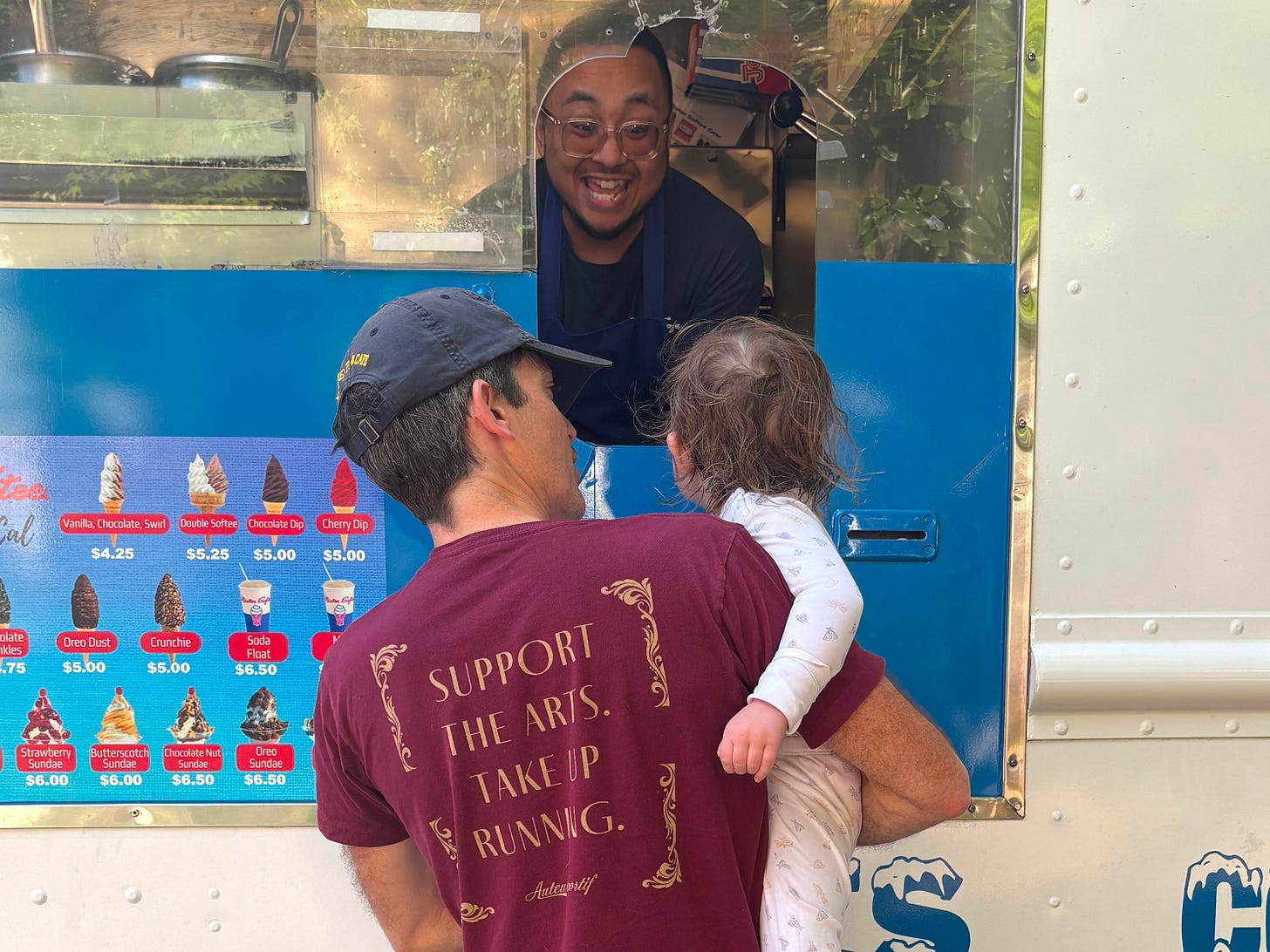
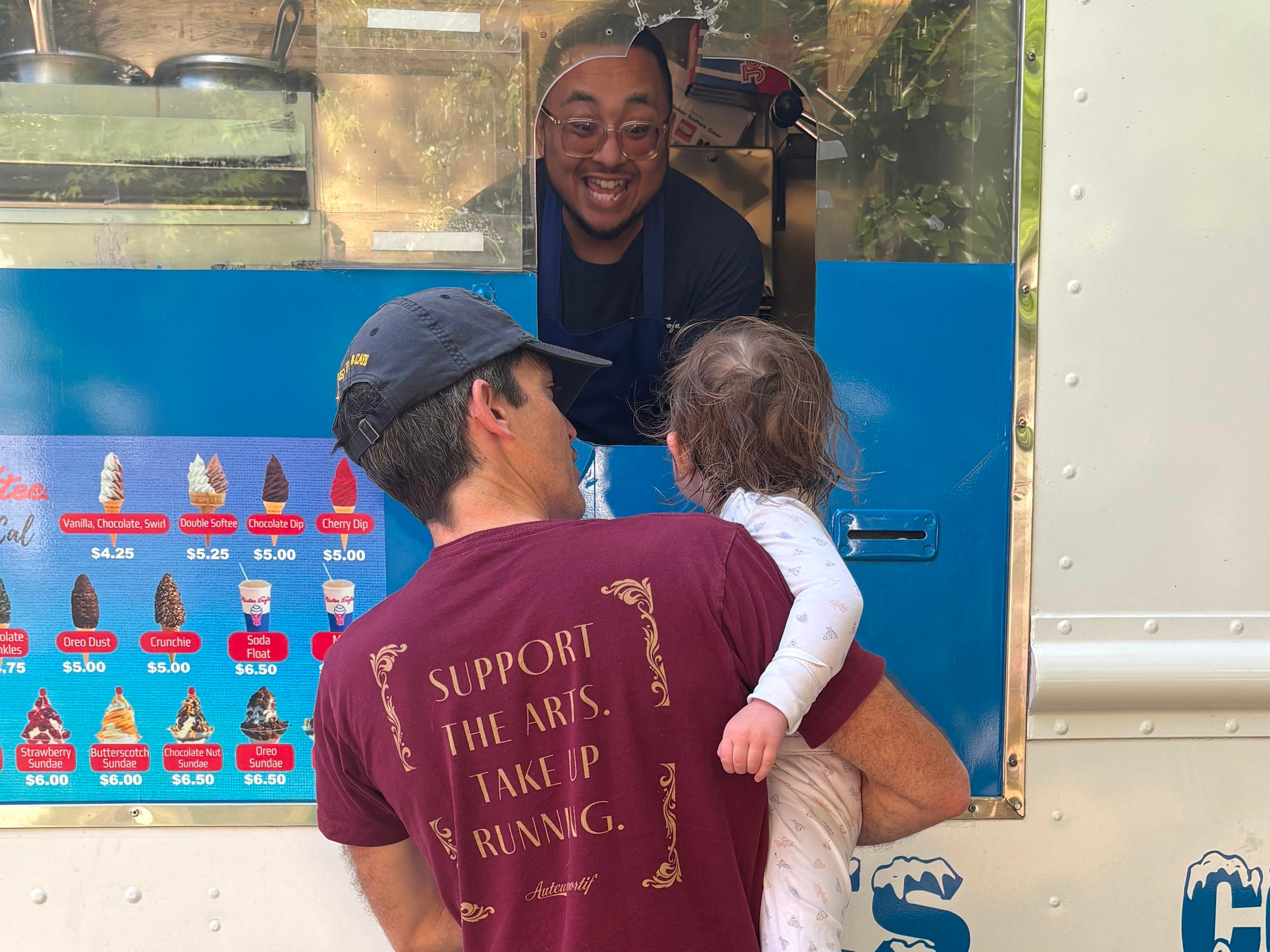
My daughter enjoying her first ice cream cone. (Thanks for the shirt, Matt Trappe!)
Hu Anyan’s memoir, I Deliver Parcels in Beijing. I was walking through Pegasus Books in Oakland with my daughter when I stumbled upon this memoir, recently translated into English. It’s a collection of stories from Anyan’s blog about working in the Chinese gig economy, mostly documenting his time as a courier in the 2000s and 2010s.
As I read, I found myself searching Google Maps for the neighborhoods in the various megalopolises where Anyan made DoorDash-type deliveries, stunned by the sheer scale of dense housing. Scanning bird’s-eye images of ominous fields of apartment towers heightened the impact of his quiet prose, which searches for humanity amid the soul-draining cruelties of Chinese capitalism.

Chatting with Raziq Rauf about his new book, This Is Running. What a fun convo! If you missed it, the link’s below. The most interesting insights for me were Raz’s reflections on using feedback on Substack to shape the book and why everyone should have to raise money for charity to run in a marathon major.

“Time Go Fishing” from the Project Hail Mary soundtrack. If you’ve read this newsletter for a while, you know I froth over a good movie soundtrack. I haven’t even seen the Gosling film yet (movies are hard with a toddler!). Even still, this has become my “lock-in” track of late. I could lift a truck when the climax hits.

Next week! Terrell Johnson of The Half Marathoner and I will have what’s sure to be a fun convo about balancing performance, family, and career on Substack Live. We’ll start around happy hour, so we’ll be enjoying a beer or spritzy water. Grab your favorite beverage and join us at 6:30 ET / 3:30 PT on Tuesday, April 28.
“In my own lifetime, nothing has been clearer or more unremitting than the inflexible and man-eating current of time.”
—Pat Conroy, My Losing Season
That’s it for this week. Thanks for reading.
In his letter to the Ephesians, Paul writes that one’s own time needs redemption: “See then that ye walk circumspectly, not as fools, but as wise, Redeeming the time, because the days are evil. Wherefore be ye not unwise, but understanding what the will of the Lord is.” (Ephesians 5:15–17, KJV)
No posts
Comments
Nothing yet. Say the first thing.
Sign in to join the conversation.