
Walk into any modern supermarket, and you’re met with a cornucopian abundance: aisles packed with cereals, snacks, beverages, meats, and produce from around the world. It feels like the best time to be alive. It feels like choice. It feels like competition. But look a little closer, and that illusion begins to dissolve.
Many of those seemingly distinct brands are owned by the same handful of multinational corporations. Beneath the surface lies a deeply consolidated system that stretches from patented seeds and chemical inputs to farmland, processing plants, global commodity traders, and retail giants.
The story of the modern food system is often told as one of efficiency and productivity. But beneath that story is one about the consolidation of power. Power over land and markets. Power over what is grown, how it is produced, and who benefits.
This concentration of power has contributed to environmental degradation, economic inequity, and systemic fragility. It has created a system that is highly efficient at extraction but increasingly disconnected from the ecological foundations that sustain it.
But just how concentrated is the food system? How do we measure it, and what are its consequences for ecosystems, farmers, and consumers?
Let’s quickly define some key terms:
Consolidation refers to the process by which a smaller number of firms increasingly control a market. It takes different forms, and understanding those distinctions is key.
Market concentration is a measure of how much control the largest players have over a given market.
Horizontal integration occurs when firms merge with competitors at the same stage of the supply chain (e.g., one food processor acquiring another).
Vertical integration, on the other hand, happens when companies expand across stages (e.g., a poultry company controlling everything from hatcheries to feed mills to processing plants).
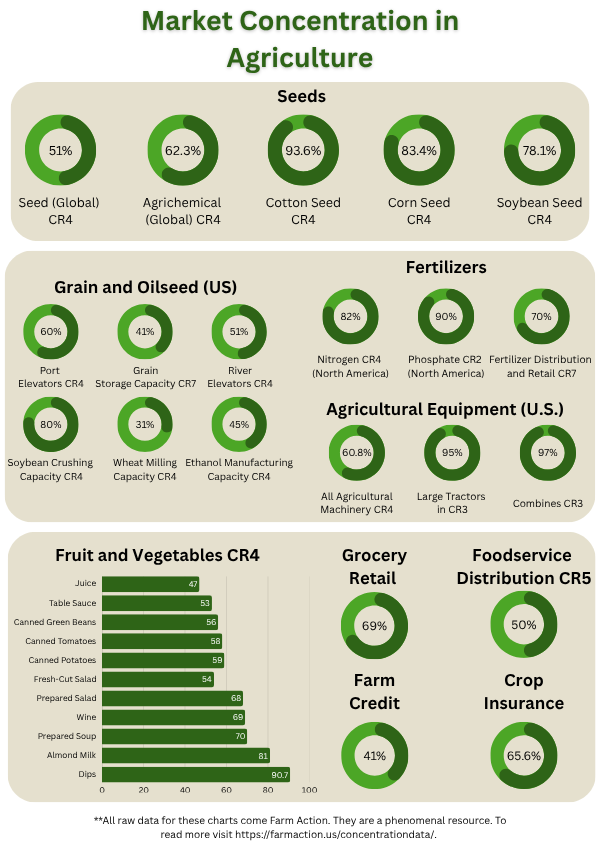
Economists often quantify concentration by using concentration ratios, particularly the CR3 and CR4, which measure the share of a given market controlled by the top three or four firms. A CR4 above 60 percent typically signals a highly concentrated market.
These metrics point to market power, the ability to set prices, dictate terms, shape supply chains, influence policy, and ultimately externalize environmental and social costs onto others.
Thanks for reading Food for a Sustainable Future! If you like our articles, share and comment below.
Over the past 40 to 50 years, the food system has undergone a dramatic shift toward consolidation. This trend has been driven by deregulation, declining antitrust enforcement, and the globalization of supply chains.
Across nearly every stage of the food system, the top four firms often control 50 to 80+ percent of the market, placing much of the system firmly in the highly concentrated category.
At first glance, some might assume consolidation benefits consumers. Large firms are able to produce food at scale, and lower production costs can translate into lower prices at the checkout counter.
But this is only part of the story.
Although economies of scale can reduce prices in the short term, reduced competition over time allows dominant firms to gain price-setting power. This can lead to higher prices, less transparency, and greater volatility.
More importantly, the price of food rarely reflects its true cost. Environmental damage, public health burdens, and climate impacts are externalized and paid for by ecosystems and society rather than included in the price tag. Cheap food, in this sense, is heavily subsidized, just not in ways that are visible at the register.
Consumers also face a more subtle loss: the erosion of genuine choice. As mentioned before, despite the appearance of diversity on grocery store shelves, many products are owned by the same parent companies. At the same time, smaller producers face significant barriers to entry, limiting both competition and innovation.
So, the outcomes of consolidation for consumers are, at best, mixed. For producers, the impacts are more consistently negative.
Farmers increasingly operate in markets with very few buyers, creating what economists call monopsony conditions. This shifts bargaining power away from producers, who are often left with take-it-or-leave-it contracts and now only earn just 14 cents for every dollar spent on food.
Farmers also face a tightening income squeeze. Input costs, including for seeds, fertilizers, and equipment, continue to rise, in part due to consolidation upstream, while the prices farmers receive for their products often stagnate or decline.
In sectors like poultry and pork, contract farming has become the dominant model. Farmers take on significant debt to build facilities, while corporations retain control over inputs, pricing, and distribution. Risk is pushed onto farmers, while control remains centralized. Over the past half-century or so, this dynamic has contributed to the loss of roughly one in three farms and the hollowing out of rural communities.
Workers also often face wage suppression and difficult working conditions in highly consolidated processing industries. Recent strikes in the meatpacking industry highlight that efficiency gains have not translated into equitable outcomes for labor.
Yet consolidation in the food system has not only reshaped markets. It has reshaped the entire planet.
When fewer firms dominate, production systems tend to become more standardized and uniform. This means fewer crop varieties, widespread monocultures, and reduced genetic diversity. In the United States, soy and corn on their own occupy nearly 180 million acres, or more than half of all cropland. For context, the USDA estimates that urban and residential land covers roughly 145 million acres. The result is a system that is less resilient and more vulnerable to pests, disease, and climate shocks.
Large consolidated firms tend to favor industrial-scale production systems, which set off cascading environmental impacts. Monocultures degrade soil health, making crops more susceptible to pests and disease, which in turn drives increased reliance on synthetic fertilizers and biocides. Over time, this creates a cycle of dependency, locking farmers into input-intensive systems. These increasingly entrenched systems may be highly productive under ideal conditions, but they are brittle and heavily reliant on fossil fuels.
When a small number of firms control key points in the supply chain, disruptions can have outsized consequences. During the pandemic, the closure of just a handful of major meatpacking plants created bottlenecks that rippled across the entire food system. Farmers were left with animals they could not process, grocery stores imposed meat limits, and consumer prices rose.
This reflects a broader structural issue. Modern food systems are built on just-in-time logistics and global supply chains. They are optimized for efficiency when conditions are stable, but their scale and complexity ensure that when disruptions occur, failures can cascade quickly.
Much of the food we consume travels thousands of miles before reaching our plates. While the logistics of this system are impressive, it also operates with remarkably little buffer. Research has shown that US retail food stores hold, on average, roughly ten days’ worth of food at any given time and that the system depends on a constant, precisely timed flow of goods across regions and continents.
We have, in many ways, built a food system that is too big to fail and too complex to be truly resilient. Meanwhile, on an individual level, we are increasingly disconnected from the most basic components of how and where food is produced, meaning that if the system were to fail, we would be helpless to respond.

If consolidation is the result of policy choices and economic incentives, can it also be addressed by them? Yes. We could take many steps to improve this system:
Stronger antitrust enforcement and more rigorous scrutiny of mergers could help limit excessive concentration. Greater market transparency would improve accountability and oversight.
Building more diversified food systems, through regional supply chains and smaller-scale processing infrastructure, would enhance resilience.
Alternative business models, such as cooperatives and producer alliances, offer pathways to redistribute power within the system.
Public-interest supply chains could prioritize social and environmental outcomes alongside profit.
Regenerative and agroecological approaches reduce dependence on consolidated input industries while restoring biodiversity and resilience.
Because in the end, efficiency is impossible on a dead planet. There can be no economy without ecology. No humanity on a planet devoid of life.
The current food system is not producing these outcomes by accident. Environmental degradation, public health crises, and the erosion of rural communities are the entirely predictable, logical consequences of a system organized to maximize extraction and profit.
If we want different outcomes, we cannot simply tweak the existing system. Rather, we need to fundamentally rethink it, with a greater focus on regeneration, resilient distribution, and care.
Where do you land on this topic? Do you think that we should be worried about current levels of consolidation in the food system? What examples have you seen that have impacted your views on consolidation? Leave a comment below.
This article is part of a series that explores the systems behind our food. Together, these articles trace the systems that have allowed for food to become a leading driver of climate change, biodiversity loss, and mass extinction; how food access has become increasingly unequal and concentrated, leaving more than two billion food insecure and threatening more than one billion with obesity and diet‑related disease; how current systems incentivize vast food waste and routinely externalize environmental and social harms; how a highly globalized food system has become fragile and vulnerable to sudden shocks; and, ultimately, what it would take to intentionally build food systems that nourish people while supporting a functioning biosphere.
No posts
Comments
Nothing yet. Say the first thing.
Sign in to join the conversation.