
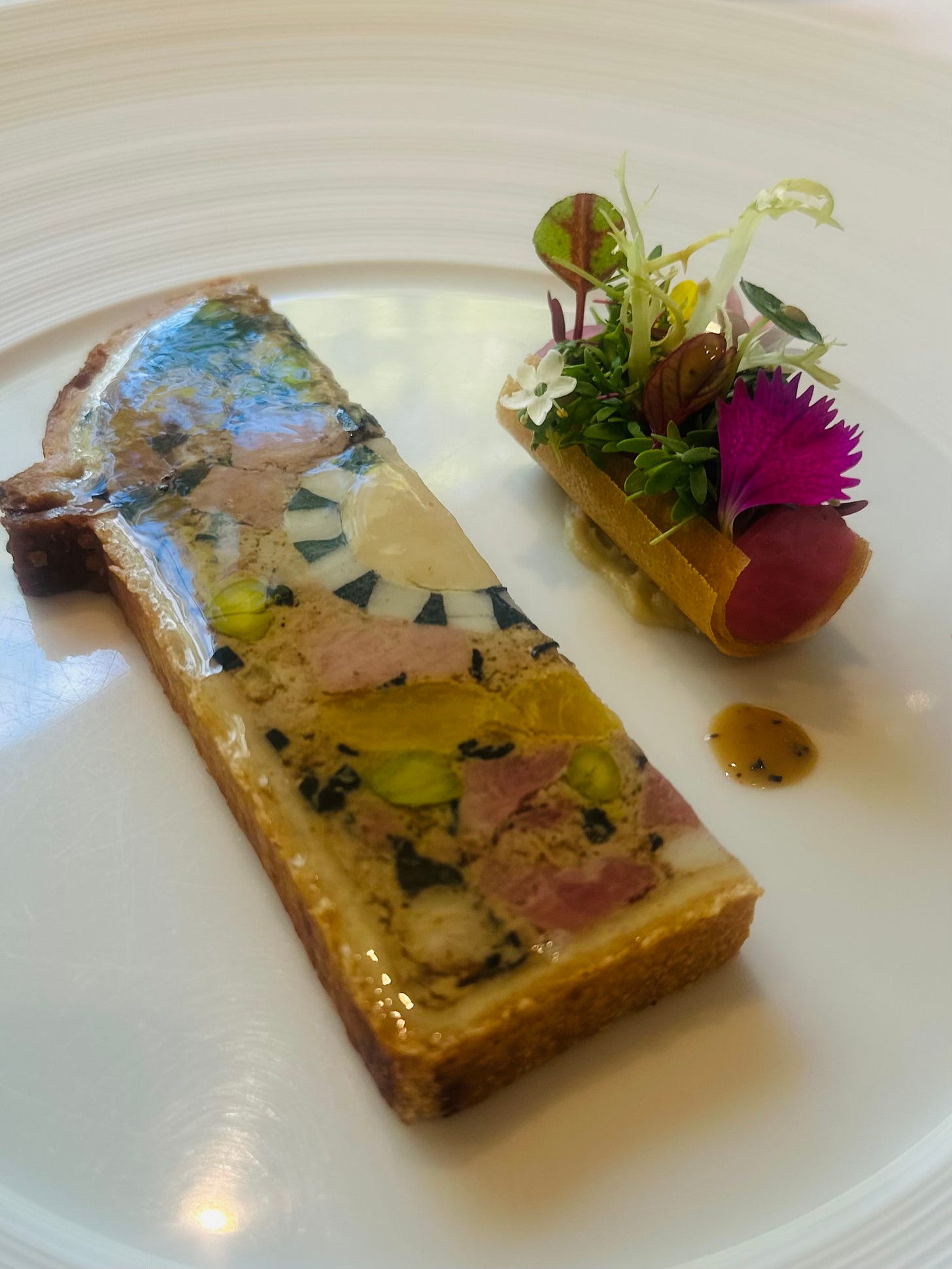
I never thought I’d read a paragraph that placed Salt Lake City in the same sentence as the Michelin Guide, but that’s the point at which humanity arrived this week when it was revealed that the US Southwest region including Arizona, Nevada, and New Mexico will be the latest territory conquered by the French tire company’s geographically advancing global restaurant rating system, which now covers most of the US map, or at least most of the places you’d want to go out to eat.
How quickly things change.
A few years ago, Michelin North America was something relegated to just a handful of US cities and California’s Napa Valley, and now, just a few years later, you may consult Michelin to eat your way through Mississippi, Texas, Georgia, Colorado, Massachusetts, North Carolina, and now Utah too. This forces the question here in the Pacific Northwest, and namely in Portland and Seattle, two important US dining capitals of a region that is now officially the biggest hole on the Michelin map.
Is it a problem that Michelin still isn’t here?
Does that omission make us look cool or clueless?
That’s an important question, and a complicated one too. And like most important and complicated questions, it’s easy to get the answer wrong.
The most wrong answer is pretending that Michelin doesn’t matter.
It does. Not because it’s flawless or modern or even especially comprehensive, but because more than any other platform, the Michelin Guide functions as global shorthand. For international chefs, investors, editors, and travelers, Michelin is more than ever a baseline reference point, and as the map grows, absence is noted. This is particularly true for diners outside the United States, to whom local context matters less than legibility. No disrespect to my friends at Vox Media, but diners in Tokyo aren’t planning vacations around Portland’s Eater 38.
There are other wrong answers too, and allowing accolades alone from Michelin, 50 Best, or even the James Beard Awards to become the organizing metrics around what makes for a healthy food, beverage, and culinary ecosystem is equally misguided. All of these things are important platforms, but there’s more to the story than accolades alone.
Plus, Portland’s food culture doesn’t suffer from lack of attention. Quite the opposite. For nearly two decades, Portland has punched far above its weight in national food media and, as much as any city, helped shape what modern American dining looks like: diverse, interesting, seasonal, producer-driven, informal, serious without being precious. That story traveled widely, and deservedly so.
What’s changed isn’t our credibility. It’s the context.
Many of the ideas that once made Portland distinctive are now table stakes across the country. And this has happened while American food media has consolidated, local media has weakened, national magazine lists have far less impact, and global validation systems, Michelin included, have become both more powerful and geographically expansive, and perhaps more transactional too. In that environment, absence doesn’t always read as philosophical restraint. It might read as a missing translation layer.
Michelin, at its core, is an evaluative system. It arrives, assesses restaurants one by one, and moves on with the attention. It’s not perfect, but at least it’s consistent, and very hard to influence. As we’ve seen in cities like Dallas, Boston, and Philadelphia, dropping money to pay for Michelin’s expansion gets you a guide, but it’s not a quid pro quo for stars. So the argument that it’s pay for play is just not that simple.
Their model has value, but it’s also limited. Michelin tells you who is excellent, but it does very little to explain why a place produces excellence, or how that excellence is achieved or sustained over time. The greatest culinary regions globally are reflections of place, and place is the sum total of talent, legacy, landscape, agriculture, innovation, business climate, and political and cultural support.
That’s why the differentiator isn’t rejecting Michelin, and it also isn’t chasing it at all costs. It’s focusing on the systems that support excellence before, beneath, and beyond any individual restaurant. And here is where I think the real opportunity lies for Portland, and for Oregon more broadly.
Things like:
Talent pipelines and real training pathways
Deep, durable producer–restaurant relationships
Research and innovation that actually reaches working kitchens
Access to capital, technical assistance, and shared infrastructure and knowledge
Programming that lifts the broader community, not just a handful of superstars
Political and cultural support that results in an environment favorable to small business and culinary culture
And caring about these things is not the same thing as being anti-Michelin.
In the right framing, Michelin becomes one signal among many, not the thing that defines a place, but something that can recognize what’s already been built. And yes, Michelin may very well be a smart investment for Oregon if it’s implemented thoughtfully, inclusively, and at the right time. But adopting a Michelin Guide or any big move shouldn’t be mistaken for the work itself.
The real risk isn’t that Michelin hasn’t arrived. The risk is letting the conversation collapse into a binary, either chase stars or dismiss them. Both positions are reactive. Neither builds the culture nor the outcomes we need to succeed.
Locally, I have been impressed by how our tourism leaders have approached this topic, and it’s reassuring that a broader desire to strengthen our structure has been the through line in how such conversations are currently being framed.
What actually strengthens a food culture, and what makes it legible internationally and durable locally, is sustained investment in institutions, relationships, and programming that raise the floor while still allowing the ceiling to rise.
If Michelin shows up someday, it should be additive. Not defining. Not our savior nor our validator, but something a strong system has already made possible.
That’s the work worth doing.
No posts
Comments
Nothing yet. Say the first thing.
Sign in to join the conversation.