
Welcome to Mental Garden, a newsletter about creativity, focus, and systems for writing and building projects on the internet. To explore the full library, go here.
The following letter is part of our “Notes on Giants” collection, in which we explore the thoughts and lives of humanity’s greatest minds.
🏷️ Categories: Zettelkasten, Creativity.
Saving an idea is not having it.
Consulting it is not understanding it.
At most, it’s an administrative process that feels intellectual. That’s why your “for later” folder is a cemetery and your notes app holds 4,000 entries you never open. Screenshots you never look at again? Threads saved in a folder you don’t even remember exists anymore? A “read later” list that you know, deep down, is infinite? A saturated phone gallery?
It’s a design problem. It’s built for storing, not for combining and creating.
There’s a man who solved this 350 years ago without even being aware of it.
His name was John Locke (you may know him from his role in philosophy). In his first year at Oxford University he had the problem of every curious mind: too much information and no way to connect it. He ran an experiment. Without knowing it, it would become the basis of every note-taking system that has proven to work.
That idea is so simple it’s infuriating that almost no one applies it.
Let’s look at it in depth.


When everyone has access to an advantage, it’s no longer an advantage.
Having access to information no longer has value.
Nowadays everyone has all of knowledge one click away. That doesn’t give you value and doesn’t produce understanding. Understanding appears afterward, in the connection with another idea you saved three years ago without knowing that one day they would need each other. It also happens in the friction, in the effort of breaking down the idea and thus escaping the illusion of fluency.
Think of the compulsive reader.
They save thirty notes a week. They say it’s “pure gold,” and there it stays, buried, gathering dust. You need to separate the act of capturing information from the act of processing it. For this, Locke created a system that he published in his small treatise “A New Method of Making Common-Place-Books.”
“I communicated this method voluntarily, as I have done with many others to whom I thought it would not be unwelcome.” — John Locke, letter to Monsieur Toinard (1685)
He wasn’t trying to understand anything at the moment of writing. He was only making sure that idea could find its way back to him, guided by the index, not by luck.
Notice the twist. Not the other way around.
You weren’t going to go looking for the idea. The idea was going to appear again, on its own, when your index led you to it without you having to remember why you’d saved it in the first place. This is the opposite of how almost any modern system works. Today we save with the logic reversed: we classify first, understand later (if the later ever comes). We open the app, create a new folder called “Productivity” or “Philosophy” or “Business Ideas,” and put the fragment in there assuming that we already know, at that exact instant, which domain that idea belongs to and where it’s going to live forever.
That attitude changes, at the root, how you think.
How does this work in practice?
Locke divides the first two pages of his notebook (the ones that face each other when you open it) into twenty-five equal parts, with parallel lines drawn in pencil. Then he cuts them vertically with more lines, from top to bottom. He marks every fifth line of those twenty-five in ink. At the start of each of those five spaces he places one of the twenty letters of the alphabet that he reserves for this use, and a little further along, within the same space, a vowel.
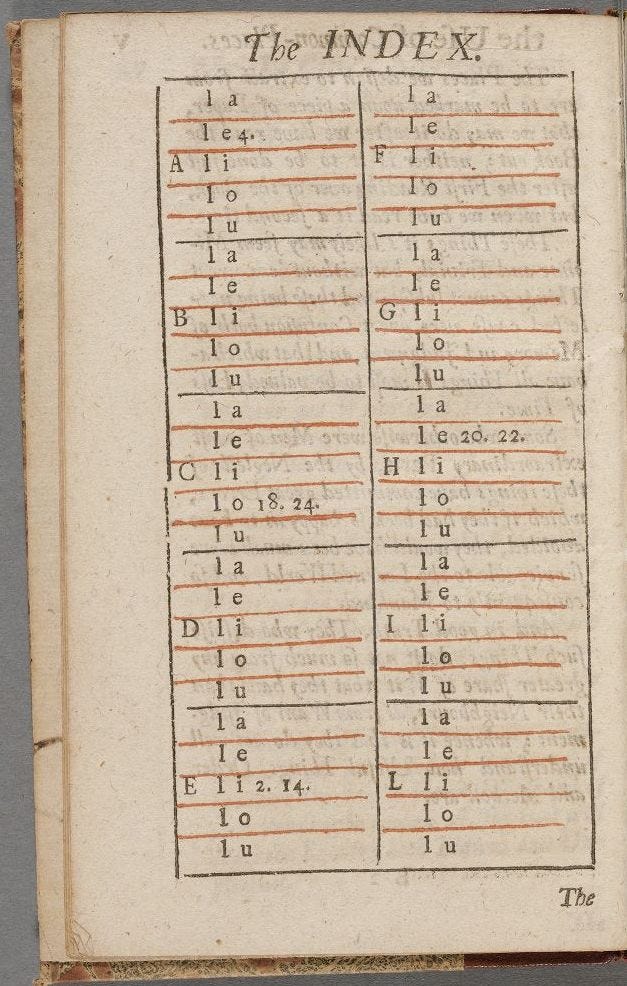
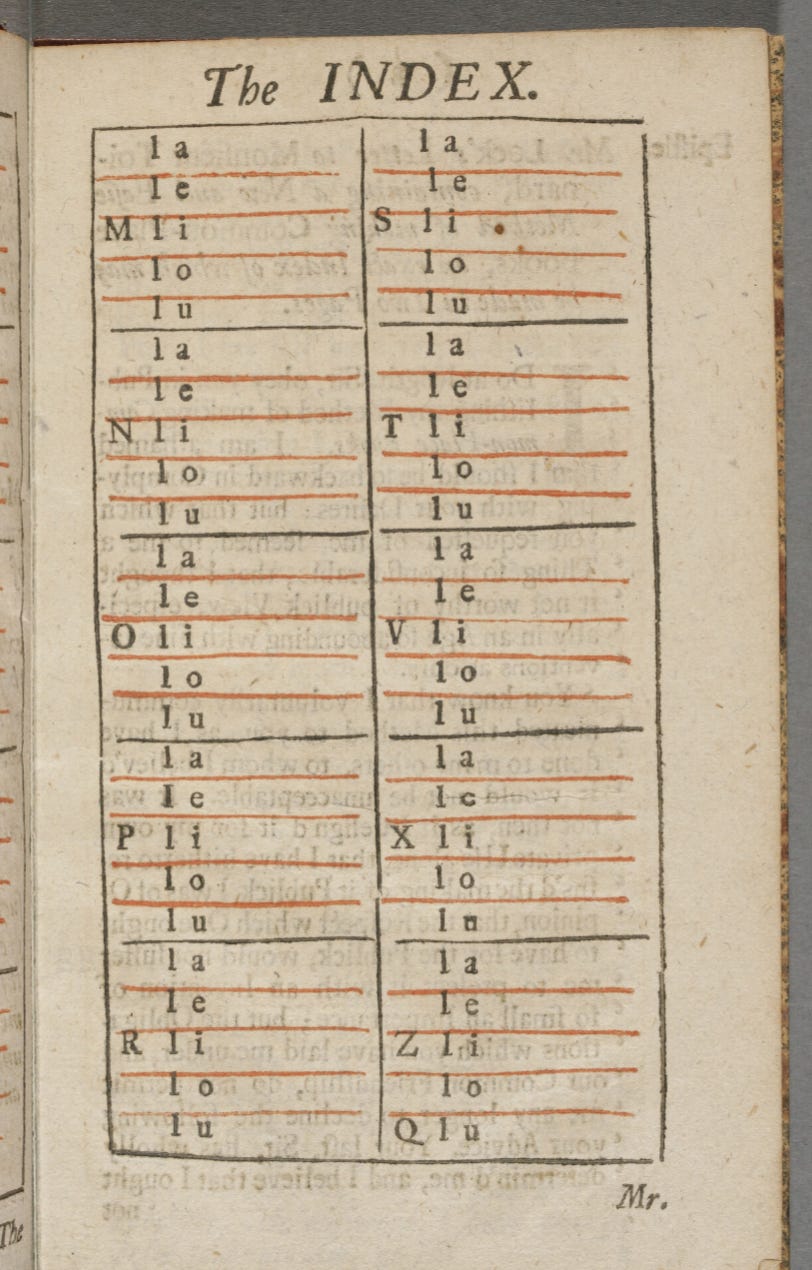
The result is a grid of 100 coordinates (20 letters by 5 vowels).
“When I find something worth noting down, I immediately look for a suitable heading.” — John Locke
Each time he finds something to note down, he calculates the coordinate (letter + vowel) of its heading and goes to that box in the index. From there, there are only two possible paths. Take the word “Epistle.” First letter, E. First vowel that follows, I. Coordinate: E I.
That coordinate has already been used before (perhaps weeks or years earlier, with a completely different word). The number tells him which page to go to. He writes the new entry right after whatever was already there, with the heading clearly visible in the margin. If “Epistola” already generated the entry E I → page 34, and months later he notes down “Enigma” (which also starts with E and whose first vowel is I), he goes straight to page 34, even though the two words have no relation to each other. They share a page by pure mechanical coincidence.
That coordinate has never been used. He takes the next blank page (the next one available, with no other criterion), writes his entry there, and notes the number in the index box. From that moment on the coordinate is registered: next time the first path applies.
Notice the most intriguing detail of the whole system.
For a monosyllabic word starting with a vowel, like “Ask,” the coordinate collapsed into a single box: A a (its own initial vowel doing double duty as letter and vowel). Isaac Newton, on the other hand, fell into the trap that Locke had avoided. In a notebook he titled “Certain Philosophical Questions” (Cambridge, 1664), he distributed 37 headings in advance and calculated how many pages each one would need. He guessed wrong on almost all of them: some ran out within a few weeks, others stayed empty forever.
Locke’s method is unusual because it pursues something that is underexploited today in any note-taking system: unforeseen combinatorics.
The place where an idea lived had nothing to do with its meaning. That separation, which at first glance seems like a whim, is the very same mechanism, copied exactly, that three centuries later a German sociologist named Niklas Luhmann would rediscover when developing the Zettelkasten.
Meaning lives in the network of connections that you weave afterward.
Locke jotted down loose entries (”Epistle,” for example) without knowing which others they would end up sharing a page with. When rereading neighboring entries, like “Epistle” and “Helium,” he was forced to look for the connection between two ideas that, on the surface, had nothing to do with each other.
It was, in the most literal sense, an idea-generating machine, using the reading of a book as an infinite quarry of creative material.
How does this translate to your life?
First. Stop creating folders by topic. Assign, instead, a neutral coordinate: a date, a sequential number, an identifier that says nothing about the content. That replaces Locke’s letter and vowel.
Second. Keep a single index (a list, a table, a master note) that connects keywords to those coordinates. The index doesn’t explain the idea, it only points toward it. There lies the crucial difference between indexing and classifying.
Third. When an idea “runs out of page,” link it to a new page, the way Locke did by hand with a number at the foot of the page indicating the next page where that coordinate continues.
Fourth (the step everyone skips). Go back to the index from time to time without looking for anything in particular. Just to notice which coordinates, saved years apart, start to rhyme with each other.
A personal note: if you’re like me and prefer not to write on top of a book, apply the same method in a separate notebook. Assign that notebook to a book you’re reading and use its blank pages (starting from the first) the way Locke used his own. You can even share several books within the same notebook.
Almost no truly new idea is born from pure inspiration. Everything is born from fragments that used to live in separate worlds and that, thanks to a system like Locke’s, end up sharing the same sentence years later.
You’re not short of ideas. You’re short of the system that combines them.
Austin Kleon summed it up in his work steal like an artist. That’s how the history of ideas works. Everyone remixes what already existed, with the only difference being that some do it with a system that allows that mixing to happen, and others leave it to the luck of memory (which, as you know, is the worst possible database). Mark Twain went further: for him, all writing was, to some extent, plagiarizing.
If the system you use today to save your ideas forces you to know what they’re about before saving them, you don’t have a thinking system. You have a filing cabinet. That’s fine. But a filing cabinet doesn’t generate new ideas. It only stores them.
Try Locke’s system.
You’ll have endless ideas, I promise you.
— Álvaro
P.S. I also offer 1:1 consulting to help you grow on Substack.
If you’re just starting out and don’t know how it works, or if you’ve been at it for a while but are stuck, this will help you. I’ll help you find your direction, position yourself as a leader in your niche, and build a system tailored to your needs for sustainable growth.
My credentials? Over 100,000 global readers in 2 years, 100% organic growth, with 300,000 monthly visits. All from scratch, writing all by myself in my spare time.
If you’re interested, email me at: jardinmental@proton.me
Lock, J. (1685). A new method of making common-place-books. URL
No posts
Comments
Nothing yet. Say the first thing.
Sign in to join the conversation.