
Welcome to Mental Garden, a newsletter about creativity, focus, and systems for writing and building projects on the internet. To explore the full library, go here.
🏷️ Categories: Decision making and biases, Continuous improvement.
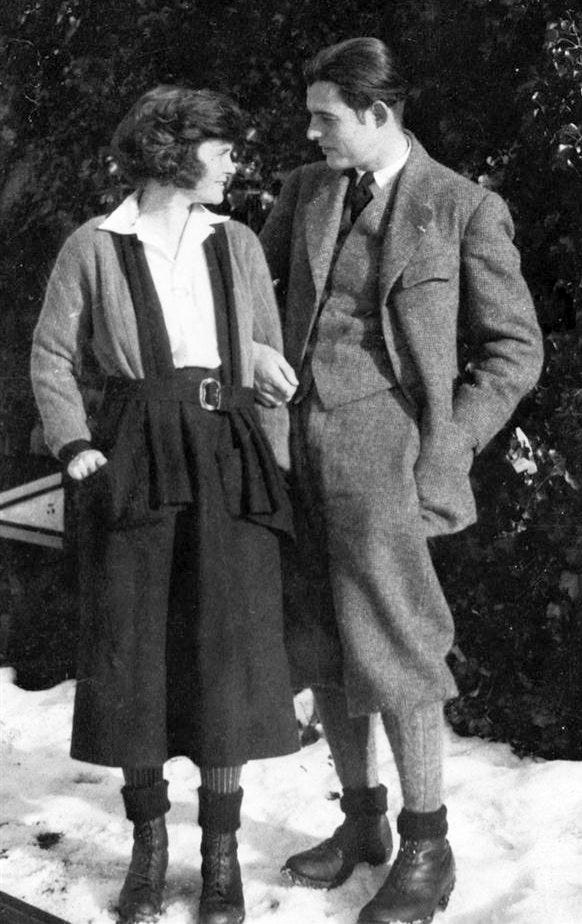
In December 1922, a woman was at a train station in Paris.
Her name was Hadley. She was in a hurry and felt somewhat unwell. She was alone in a foreign country, somewhat overwhelmed. She was carrying a bulky suitcase in which she carried numerous writings of her husband: original manuscripts, copies, notes for an unfinished novel… In an instant, Hadley felt thirsty and got off the train to buy water. When she came back, the suitcase was gone.
Her husband’s name was Ernest Hemingway, and that day he lost years of work.

At bottom, the error did not occur at the station, it occurred much earlier.
The error occurred much earlier.
It occurred the day Ernest did not separate the copies from the originals, it occurred because of the fragility of having as the sole backup of years of work a suitcase traveling across half the world under uncertain conditions. The “moment of failure” was long before the instant the suitcase went missing on the platform, but we don’t usually see that. 99% of people don’t operate under that logic, they only see the tip of the iceberg.
What failed was the system.
That’s the key idea: to think like a strategic genius you don’t need to be able to make sharp decisions under maximum pressure… it’s enough not to have to make them.

We always blame the instant because it’s what’s visible.
“She got distracted.” “She wasn’t paying attention.” “She had a bad day.” All of that happened to Hadley, yes, but a bad day is the coincidence of several small vulnerabilities, sometimes uncontrollable. Tiredness, hurry, an unfamiliar environment... it all adds up.
None of those three things causes a disaster on its own. Together, they do.
This has a name in systems engineering: the Swiss cheese effect. No serious accident is caused by a single failure, that doesn’t exist. What is caused is a chain of small failures (each insufficient on its own) that one day line up like the holes of several stacked slices of cheese, letting the entire disaster pass through from one side to the other with no way to stop it.
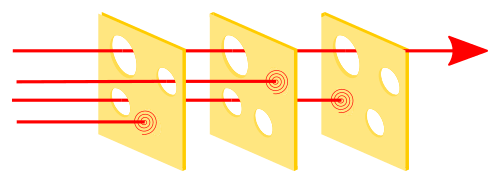
Your life works the same way. It happened to me with the car.
The night before I went to bed late. I woke up with just enough time, left in a hurry (though carefully) and arrived at a stretch of curves I know by heart and that just going slowly is enough for. Except that morning. That morning the ground was damp from the night dew, there was loose gravel on the asphalt and I had ten minutes of accumulated delay in my head.
I braked. The car didn’t.
It slid a few meters and ended with a light impact against the vehicle coming uphill on that two-way road. Nothing serious: a scratch, a small dent, we hit each other in slow motion, but four factors that never coincide, coincided: humidity, gravel, hurry, the sharpest curve of the whole route.
The question is: what part of your life depends on that bad Tuesday going well?
Every time you have to think about what to do in the moment, you spend a scarce resource, which is your concentration. But even more so if it’s with the clock running and your brain already occupied with ten other things. You need a well-designed protocol that shifts that expenditure to a different moment: one in which you are calmer, with more time and no one waiting for your answer, thus securing the process.
I’ll tell you about this with something of my own, because it’s where I’ve verified it best.
I have a written protocol (literally, in a document, with numbered steps) for turning any loose idea into a Substack article. How to think of the initial idea. How to raise the quality of the idea before writing it. How to cross-check sources. How to expand that outline paragraph by paragraph. How to review gaps and contradictions in my own argumentation before publishing. There is no step where I have to ask myself “now what do I do?”
Just follow the script and the result will turn out well.
My writing protocol saves me time, energy, and guarantees a minimum, even on my worst creative day. Design protocols for any activity you carry out frequently and that has numerous steps. Protocols prepare you to have all the decisions made in advance, when your energy is at its maximum and you are not sick, exhausted, angry or anything like that.
The protocol ensures you get the expected future decisions right…
and the unexpected ones?
Redundancies.
The protocol serves to order foreseen decisions. Redundancy assumes that, even so, something is going to go wrong, and builds margin before that failure has a real cost. I’m talking here about a broken alarm clock, an unforeseen traffic issue, a corrupted file on your hard drive, these things we all hate. They are going to happen, the question is how antifragile we will be. That’s the word, and it was what failed Ernest Hemingway that day at the Paris station.
“Some things benefit from disturbances; they thrive and grow when exposed to volatility, randomness, disorder, and stressors.” — Nassim Nicholas Taleb
Build a system that shocks don’t affect.
I apply it as simply as this.
I usually wake up without an alarm clock, but just in case, I don’t have one, or two, I have three alarms programmed to go off with a 5-minute gap between each one.
According to Hofstadter’s Law (2007), we tend to be very optimistic about how long things take us, so I always leave for every place with 10% extra time just in case. The law states: “It always takes longer than expected, even when taking into account Hofstadter’s Law.”
One of the ones that helped me the most was this one. My car’s tank never goes below half, so a real emergency never depends on whether “today was the day” to stop by the gas station.
And all my writings published in Jardín Mental have two separate backup copies, one on a hard drive at home and another in the cloud.
Think about it. No engineer builds a bridge for the exact weight it expects to cross it. Bridges are built with a much greater margin to survive everything that could happen. Apply that same idea to your daily life and you’ll see how much time, money, problems and stressful decisions you’ll save yourself.
What happened to Hemingway was a matter of time before it happened.
Carrying the copies in the same place as the original documents was reckless, everything that happened to Hadley was a simple conjunction of factors, like the holes in the Swiss cheese I was telling you about. Like the day I had the accident.
You are going to have bad days, the question is whether your protocols and redundancies will save you.
“A competent general always draws up his battle plan before facing the enemy.” — Charles E. Hummel, Freedom from Tyranny of the Urgent
— Álvaro
P.S. I also offer 1:1 consulting to help you grow on Substack.
If you’re just starting out and don’t know how it works, or if you’ve been at it for a while but are stuck, this will help you. I’ll help you find your direction, position yourself as a leader in your niche, and build a system tailored to your needs for sustainable growth.
My credentials? Over 100,000 global readers in 2 years, 100% organic growth, with 300,000 monthly visits. All from scratch, writing all by myself in my spare time.
If you’re interested, email me at: jardinmental@proton.me
Hofstadter, D. R. (2007). Gödel, Escher, Bach: un eterno y grácil bucle.
The Hemingway Society. (2023). The Lost Suitcase. URL
No posts
Comments
Nothing yet. Say the first thing.
Sign in to join the conversation.