
Editor’s Note: I am happy to share today a post by our Guest Author, Kurt Dietrich. Kurt hails from Long Island, New York, and has been collecting slide rules for 9 years. A Mechanical Engineer by training and profession, Kurt recently became the Custodian for the International Slide Rule Museum. He is particularly interested in Log Log slide rules that would have been used in the engineering profession before electronic calculators. He is also a Trustee of the Leffert’s Tide Mill in Lloyd Harbor, NY, helping with the preservation of the 1794 mill building and dam as the chief engineer. His hobbies include timber framing, woodworking, and he is a hobby machinist. Today’s presentation is of a rare 100-year-old slide rule with a novel scale arrangement.
-Mike Syphers
As a collector, I had many of the typical slide rules used by engineers and scientists. I had focused mainly on Log Log duplex rules, as that is what the engineering world used before electronic calculators. This really piqued my interest and I started investigating the history of slide rules. This led me to become interested in rare and hard-to-find slide rules. I started searching the International Slide Rule Museum website galleries and found that by reading through the descriptions and histories in the galleries, an interesting story of the development of slide rules could be found. This is about one of those slide rules.
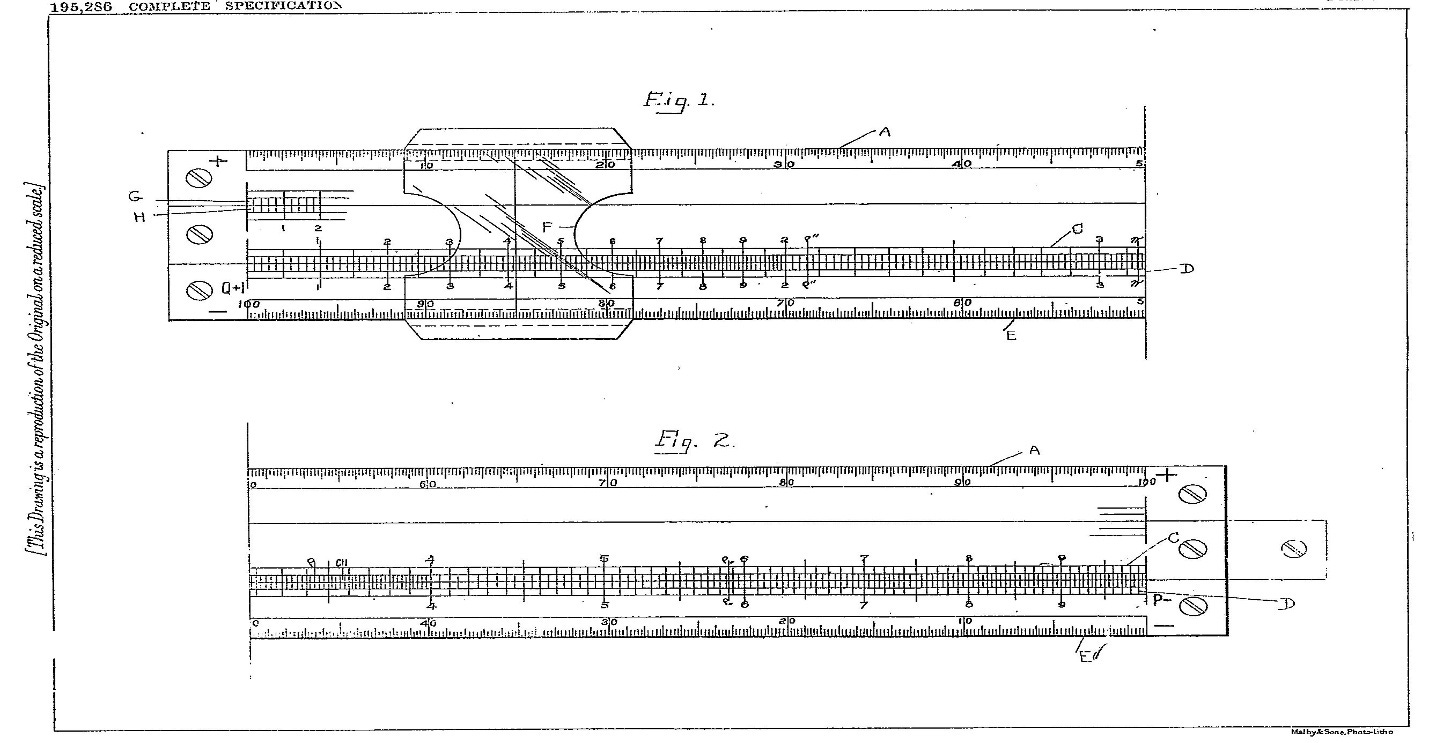
I obtained this slide rule from the International Slide Rule Museum about 10 months ago. It is the Anido Slide Rule, made in England in 1923. I had seen it in the galleries and noticed the different set of scales from the typical Rietz slide rule. It had a set of scale labels and trig functions in the well under the slide. As I had been looking for the rare and unusual, this fit the bill. It was designed by Albert John Anido and patented on March 29, 1923, patent No. GB195286.1
Scan of the Anido slide rule, from ISRM:2
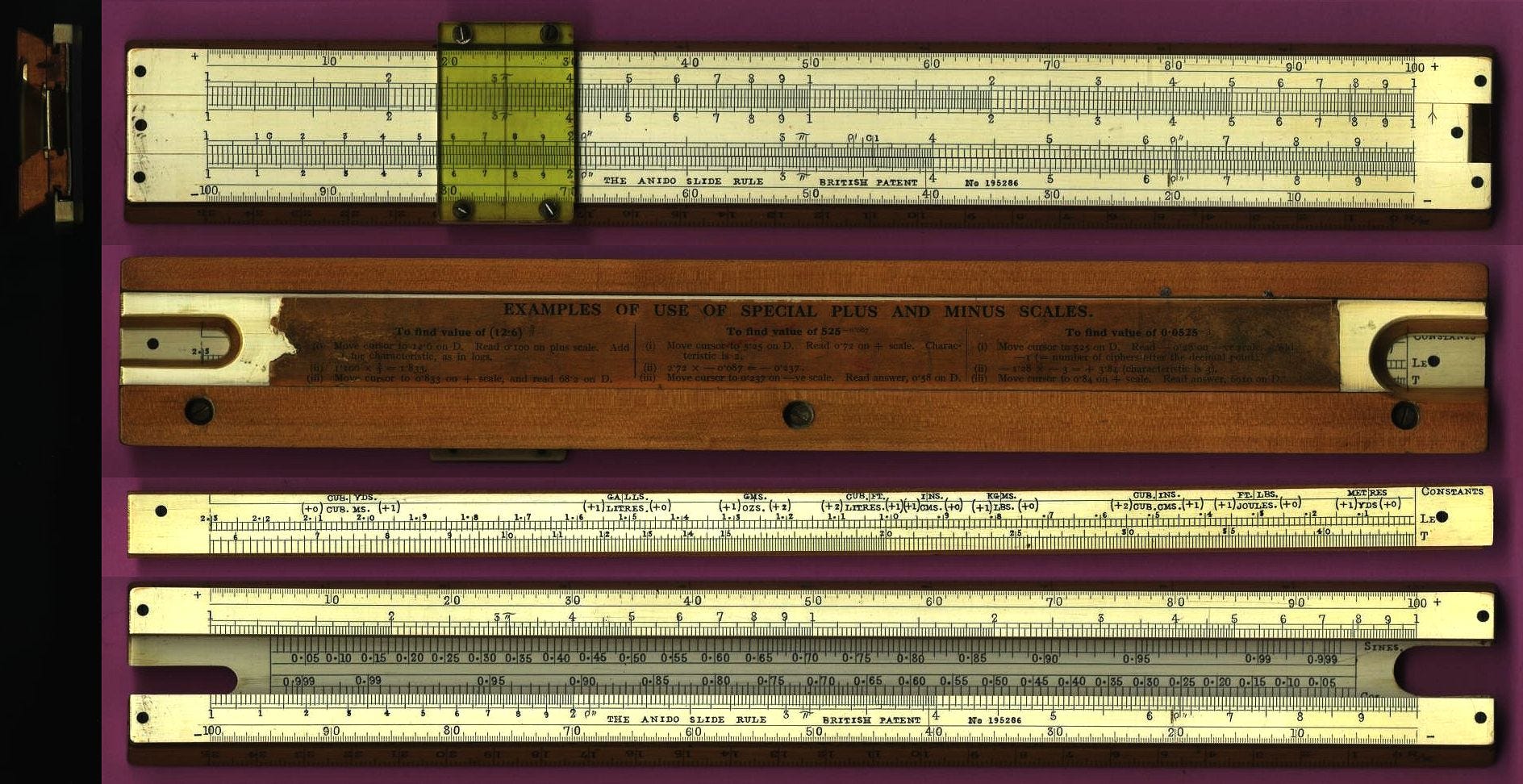
Image of figures from the Anido patent, from ISRM:3
Albert John Anido was born in 1883, in Montevideo, Uruguay. At some point the family moved to England, where he attended Victoria College, in Jersey, England. After serving an engineering apprenticeship with Messrs. W.H. Allen, Sons & Company, Ltd. of Bedford, from 1904 to 1907, he then took a three-years’ course at the City and Guilds Engineering College, University of London, in South Kensington, where he obtained his Bachelor of Science with honors in Engineering. From 1911 to 1914 he was engaged in training students in engineering subjects.4
At the outbreak of the Great War, he enlisted in the Royal Engineers and eventually rose to the rank of Major. In 1921 he resumed his work as an engineering tutor and continued this work until 1939. He then joined the firm of Messrs. Stewarts and Lloyds as a structural engineer in the research and development staff. However, the second war called, and he joined the Royal Air Force Volunteer Reserve, where he was granted the rank of Flight- Lieutenant. He was also an Associate Member of the Institution of Electrical Engineers. Mr. Anido passed away on January 22, 1949, in Sussex, with his last profession being an engineering tutor.5
The list of scales are as follows:
Front Scales: 10in (10ths) // (+), A [ B, C ] D, (-) \ 25cm
Reversed Slide Scales: [ Constants Conversions, Le, T ]
Well (using beveled end of slide as indicator): Sines, Cos
Back: Example calculations
[ ] - indicates scales on the slide
The first thing that jumps out from the scale set is the (+) scale along the top and the corresponding (-) scale along the bottom of the front face. The (+) scale is from 0 to 100, from left to right. The (-) scale is an inverse scale from 0 to 100, right to left. The (+) scale is a typical L scale and the (-) scale is an inverse L scale. These scales are used to calculate exponential functions, similar to using an L scale, or Log Log and inverse Log Log scales.
Next is the Le scale on the back of the slide. This is a Natural Log scale representing Le = Ln(1/x). It is especially useful for calculations of exponential decay.6 Also on the back of the slide is a T scale for tangents up to 45o. Additionally, there are scales for conversion of common physical properties from Imperial to SI units.
In the well under the slide are scales for Sines and Cosines, which run from 0o to 90o. The beveled end of the slide is used as the indicator for obtaining a reading.
Directions for using the (+) and (-) scales are located on the back of the slide rule.
At the time this slide rule was developed, there were many changes happening to scale sets, trying to keep up with the engineering mathematics needed for a fast-developing world. Science, technology, and engineering were making great strides in developing systems and building more complex structures and machinery. At this time, Keuffel & Esser (K&E) had the patent on duplex Log Log slide rules. So, other manufacturers went about trying to develop other scale arrangements that would provide similar calculating power. A discussion of this is in a previous article called ‘Scale Wars’, which may be read here.
The Darmstadt rule did not come out until 1934, by Dennert & Pape and Nestler, and 1935 by A.W Faber. Earlier European slide rules with Log Log scales were typically ‘Electro’ rules, with LL3 and LL2 scales added to the front face of the body. Unique slide rules, made in England had LL and Lu scales, which were the same as LL3 and LL2 scales.
During the early decades of the 20th century, slide rules were manufactured as Simplex rules, with the exception of the duplex rules made by Keuffel & Esser, protected by their patent. The machinery used to make these rules produced standard sized bodies, with their standard Mannheim and Rietz scale sets. For a Mannheim rule, these typically consisted of A, B, C, D scales on the front face, and S, L, T scales on the back of the slide.
For a Rietz rule, which was a little wider than the Mannheim rule, these typically consisted of K, A, B, CI, C, D, and L scales on the front face, and S, S&T, T scales on the back of the slide.
If a maker was to add Log Log scales, the slide rule body would have had to have been made wider. Given the machinery already in their factories, having to develop and produce additional machinery for rules with wider bodies, including possible expansion of manufacturing floor area, this would have been a significant investment, especially coming during and after World War I.
One of the variants to come out of these ‘Scale Wars’ was the Anido slide rule, which appears to be an attempt to use all of the available space on the slide rule for scales, including the well. The (+) and (-) scales are on the front face, directly read with the C/D scales. Sines and Cosines may be calculated with the scales in the well under the slide. Natural logarithms and Tangents may be calculated with the Le and T scales on the back of the slide. All of this fits on a typical Rietz body slide rule.
My question regarding this slide rule was whether this scale set provided an advantage over the standard Mannheim and Rietz slide rules of the period. I set about performing various calculations through the entire scale set using the Anido rule and performed similar calculations using a ‘Sun’ Hemmi No. 64 slide rule.
My interest in this slide rule was to see if this scale set speeded up calculations over other similar slide rules. When performing these calculations,7 one must keep track of “characteristics” and “mantissas”. Here are step-by-step calculations using the various scales:
Example #1: 12.65/3 >>> 5/3 log 12.6
Anido Slide Rule
1) set cursor to 12.6 on D, read 0.100 on (+), add 1 for characteristic;
= 1 + 0.100 = 1.100
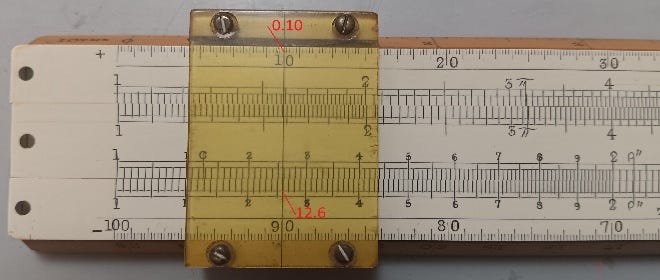
2) multiply 5/3 × 1.100 = 1.834
3) set cursor to 0.834 on (+), read 6.81 on D
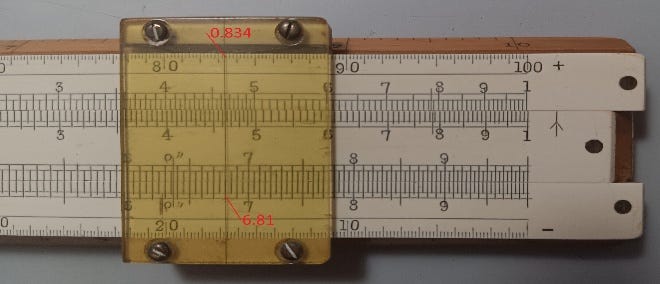
4) 6.81 × 101 = 68.1; answer (exponent 1 is the characteristic)
Hemmi No. 64
1) set cursor to 12.6 on D, read 0.100 on L, add 1 for characteristic;
= 1 + 0.100 = 1.100
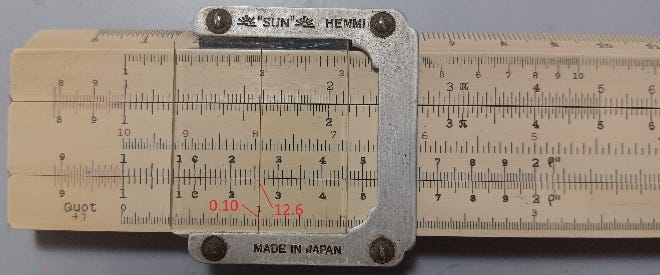
2) multiply 5/3 × 1.100 = 1.834
3) set cursor to 0.834 on L, read 6.81 on D
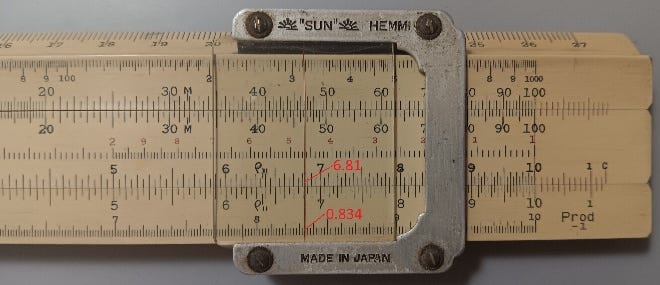
4) 6.81 × 101 = 68.1; answer (exponent 1 is the characteristic)
Example #2: 525-0.087 >>> -0.087 log 525
Anido Slide Rule
1) set cursor to 5.25 on D, read 0.72 on (+), add 2 for characteristic
= 2 + 0.72 +2.72
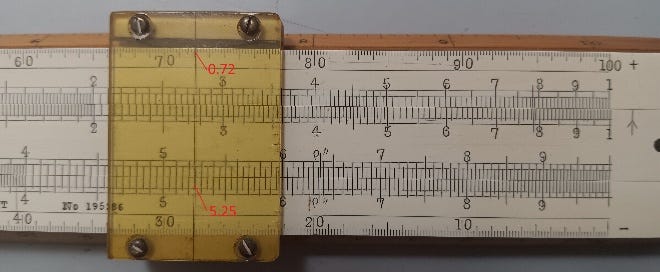
2) multiply 2.72 × (-0.087) = -0.237
3) set cursor to 0.237 on (-), read 5.8 on D
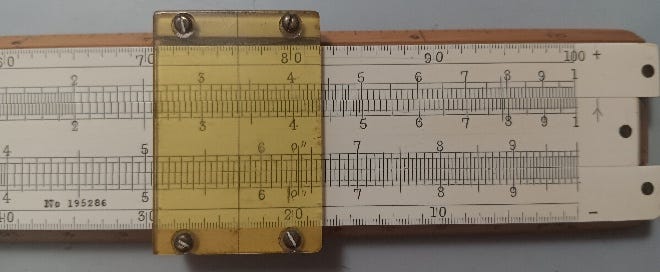
4) 5.81 × 10-1 = 0.58, answer (exponent -1 is the characteristic)
Hemmi No. 64
1) set cursor to 5.25 on D, read 0.72 on L, add 2 for characteristic
= 2 + 0.72 = 2.72
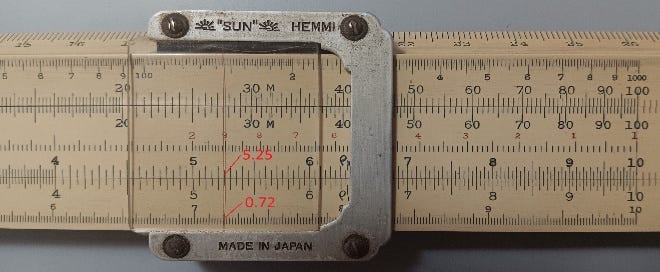
2) multiply 2.72 × (-0.087) = -0.237
3) set cursor to 0.237 on L, read 5.8 on CI
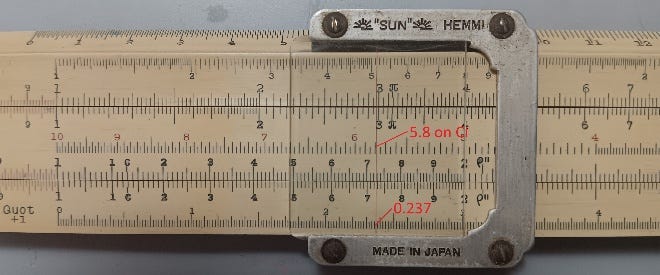
4) 5.8 × 10-1 = 0.58, answer (exponent -1 is the characteristic)
The (-) scale is just like using the CI scale on the Hemmi 64. The (-) scale is a reversed scale such that CI = 1/C = C-1, then log CI = -log C
Example #3: 0.0525-3 >>> -3 log 0.0525
Anido Slide Rule
1) set cursor to 5.25 on D, read -0.28 on (-), add -1 for characteristic
= -1 – 0.28 = -1.28
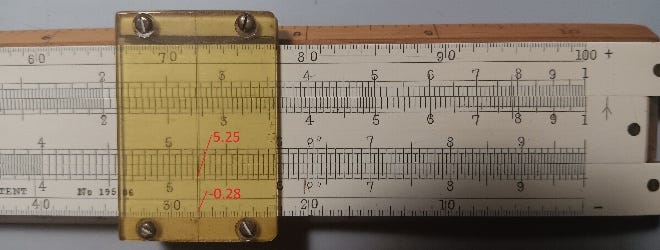
2) multiply -1.28 × -3 = 3.84, (characteristic is 3)
3) set cursor to 0.84 on (+), read 6.91 on D
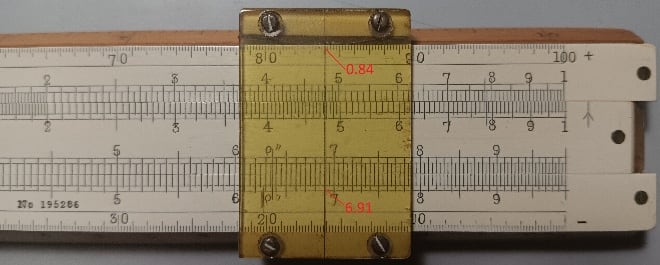
4) 6.91 × 103 = 6910, answer (exponent 3 is the characteristic)
Hemmi No. 64
1) set cursor to 5.25 on D, read 0.72 on L, add -1 for characteristic
= -2 + 0.72 = -1.28
or; you could also align the C and D scale indices, then move the cursor to 5.25 on CI and read (-)0.28 on L. Add -1 to get -1.28.
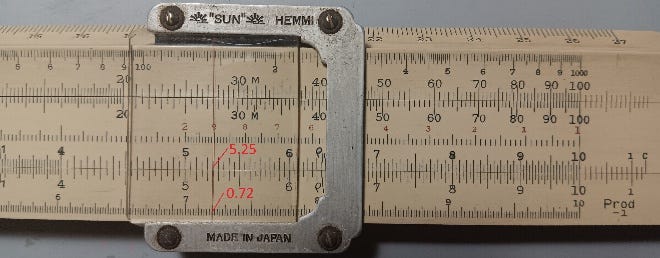
2) multiply -1.28 × -3 = +3.84
3) set cursor to 0.84 on L, read 6.91on D (characteristic = 3)
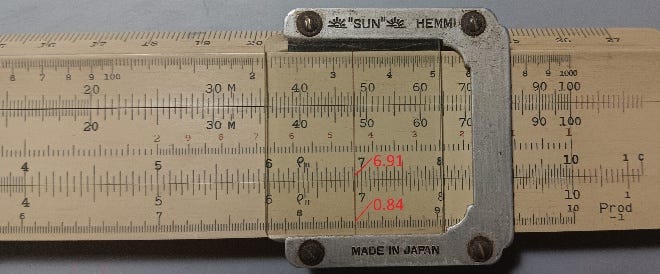
4) 6.91 × 103 = 6910, answer (exponent 3 is the characteristic)
Based upon these examples, the calculations for exponentials were almost exactly the same procedure. Using both slide rules required the same number of steps, so there was no time savings using the Anido slide rule. I may assume that because the scale convention was non-typical, it may have been easier to use the conventional scale set for the average person, rather than trying to learn an uncommon scale set.
Reciprocals are the inverse of a number. On a typical slide rule, reciprocals may be found using the D scale and the CI scale. If you want to find 1 / 4.25. set 4.25 on the D scale and read 235 on the CI scale ---> 235 = 0.235 = 1 / 4.25.
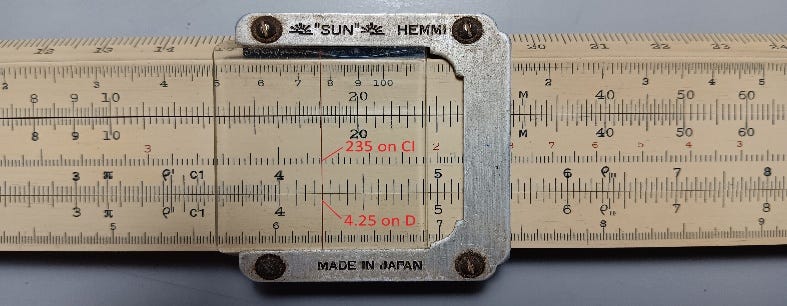
On the Anido slide rule, set 4.25 on the D scale and read 628 on the (+) scale. Set 628 on the (-) scale and read 235 on the D scale ---> 235 = 0.235 = 1 / 4.25
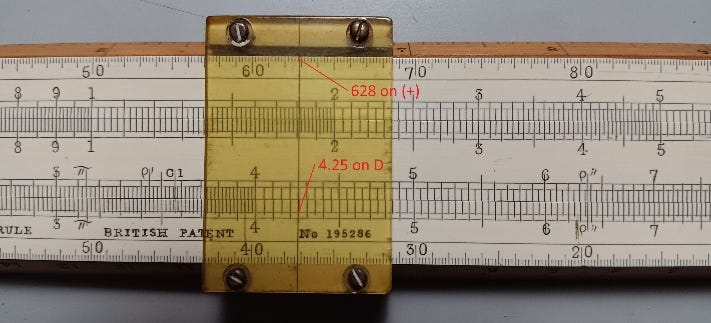
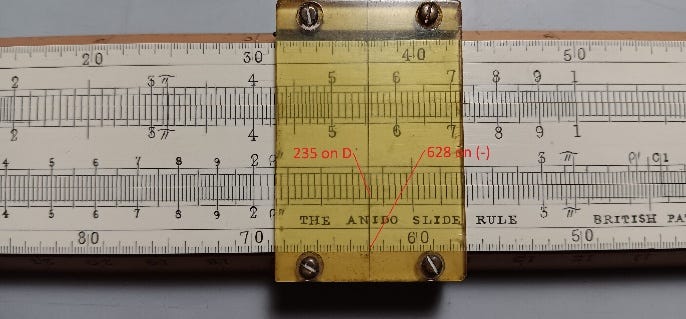
Not really a time savings and the Anido takes two settings of the cursor to get the same answer read directly on a Rietz scale layout with a CI scale.
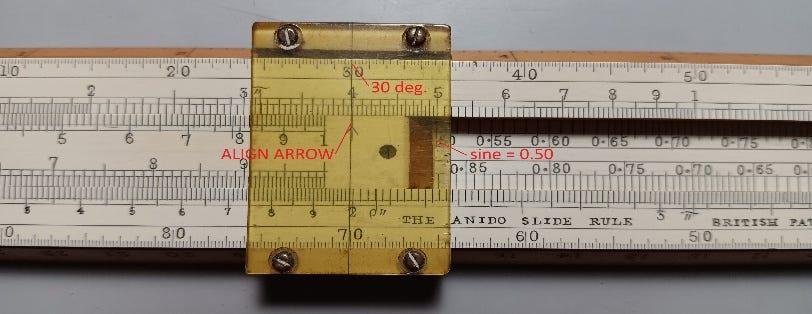
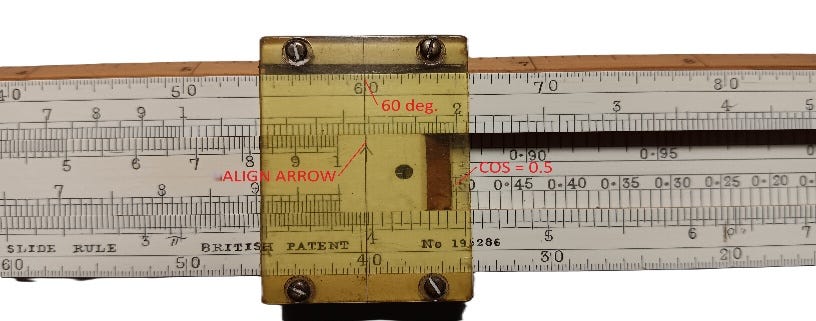
Continuing on, we can do trigonometric calculations. Sines and cosines can be read from 0 to 90 degrees with the Anido slide rule, using the (+) scale and the sine and cosine scales in the well under the slide. The beveled end of the slide is used as the indicator for reading sines and cosines. The steps are as follows:
Sine:
Set the angle 30 degrees on the (+) scale;
Align the arrow on the slide to the angle;
Read the sine = 0.5 on the sine scale
Cosine:
Set the angle 60 degrees on the (+) scale;
Align the arrow on the slide to the angle;
Read the cosine = 0.5 on the cosine scale
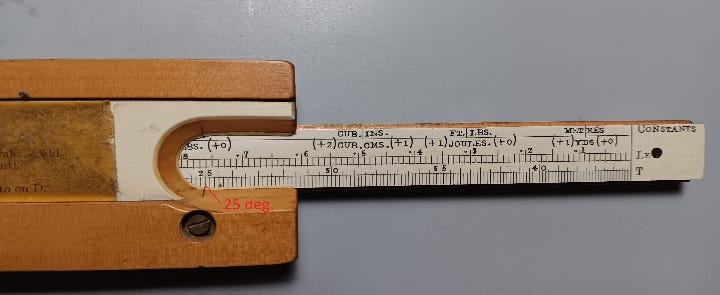
Tangents are calculated the same way as on a Rietz slide rule, using the Tangent scale on the back of the slide and the D scale on the face, as follows:
Tangent:
Set angle 25 degrees on the T scale, on the back of the slide;
Turn over the rule and read 0.466 on the D scale.
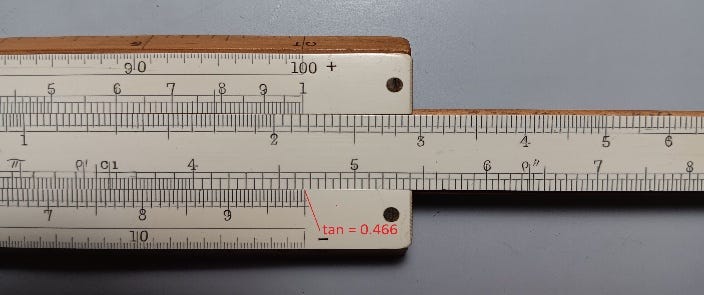
These sine and cosine scales are beneficial in trigonometry calculations in that they cover the full range from 0 degrees to 90 degrees, without needing a separate S&T scale, although with some sacrifice to accuracy. Readings are good to 2 significant figures on the left end and 3 significant figures on the right end. An added benefit is that both sine and cosine values may be obtained with one setting. A drawback to these scales is that sine and cosine values are not directly related to the A, B, C, or D scales. Sine and cosine values would have to be written down and transferred to the A, B, C, or D scales to use those values in a calculation.
Tangent calculations are very similar to the standard Rietz slide rule and are good for 3 significant figures.
There is also an Le scale which represents the function --- > Le = ln(1/x). This is especially helpful in performing calculations involving exponential decay. The Le scale is on the back of the slide and is indexed to the D scale on the front face, for the range 0.1 < x < 2.3.
Example: ln (1/x)
1) x = 1.3
2) set 1.3 to left index on the back of the rule
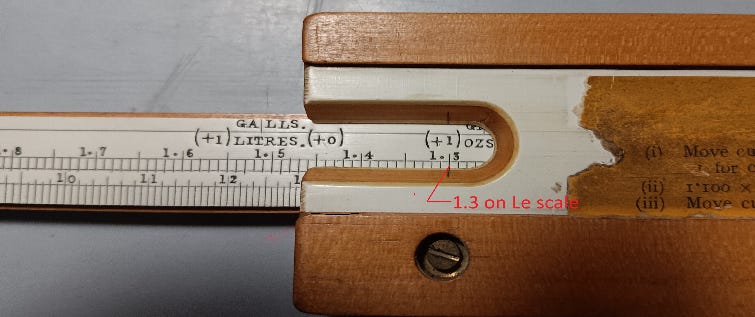
3) flip rule to front face and read 272 on the D scale --- > = 0.272
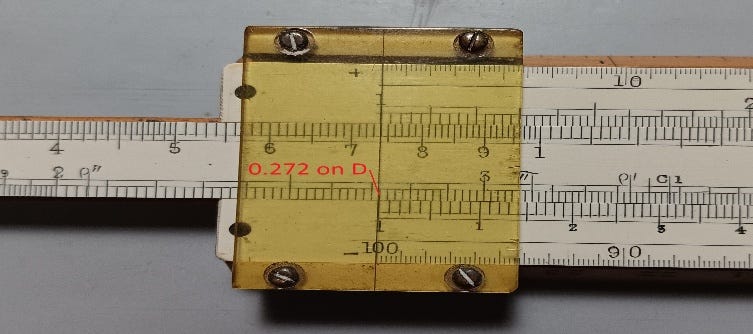
The combination of the Le scale and the C/D scales behave like the combination of the C/D scales and LL scales on a Log Log rule for computing ex. The calculations are done by placing the ‘x’ on the Le scale and reading the result on the D scale. On a Log Log slide rule, the ‘x’ is found with the cursor on the D scale and the answer is read on the appropriate LLscale.
An advantage of the Le scale is that it works with values of x all the way down to ‘0’; allowing e0 = 1 to be calculated. LL scales get closer and closer to ‘0’, but never reach it. This advantage is offset to some degree by the loss of resolution for small values of x as they approach ‘0’ as compared to LL scales. Also, the maximum value that the Le scale is useful to is 2.3, which is e2.3 = 10.
Additionally, if the slide is not flipped and the indicator line in the back window is used, Le = e-x may be found on the C/D scales. Basically, 1/e-x = ex. In this way, it allows the user to find ex on D and multiply it by a value ‘y’ on the C scale and find the product of (y)(ex) on the D scale below ‘y’.
In an era when LL scales were not typically available, this scale would have been very useful in calculating interest rates and payments for loans. A simple example of an exponential decay would be depreciation of an asset; as follows:
What would be the value of an asset presently valued at $10,000, depreciated at a rate of 8% for 5 years.
The formula for that is --- > N(t) = N0 × e-rt; where t = 5 years
r = 8% per year
N0 = $10,000
rt = 0.08 × 5 = 0.40
N(5) = $10,000 × e-0.40
Set the left index to 0.40 on the Le scale, turn the rule over and read 666 on the C scale. This is 0.666. Multiply $10,000 × 0.666 = $6,660.
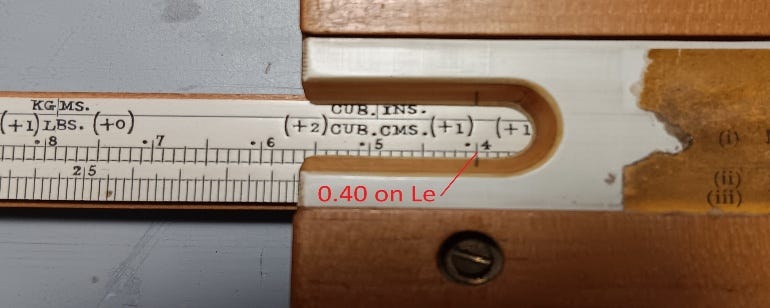
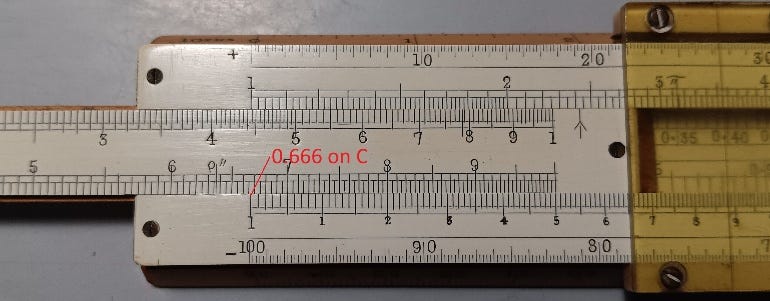
On a Log Log slide rule the answer is $6,600 and on a calculator the answer is $6,590.
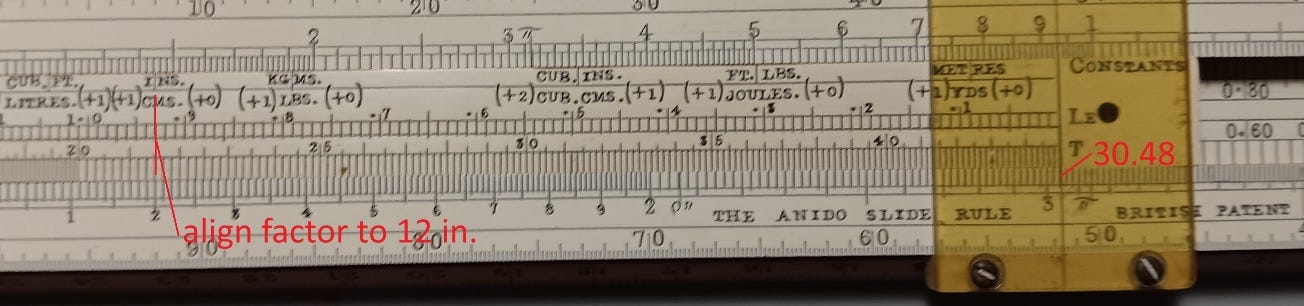
There is also a scale on the back of the slide for typical unit conversions of the day, from Imperial to metric measurements. This scale is labelled ‘Constants’. For clarity, the slide is flipped to the face, as the gauge marks are partially obscured in the reverse position.
Inches to centimeters: convert 12-inches to centimeters
1) align conversion factor gauge mark to 12-inches on D
2) at right index read 30.48 cm on D
Ounces to Grams: convert 3 ounces to grams
1) set the left index to 3 ounces
2) read 85.05 grams on D at the conversion factor gauge mark

This is a simple way to convert common imperial to metric, and vice versa, without a table of conversion factors on the back of the slide rule. No math calculations were needed, nor any special gauge marks. This would have been a benefit in a business application.
This scale set did not become popular and seems to have been an evolutionary dead-end. It seems more suited to business applications rather than mathematical applications. Banking calculations for loans, value depreciation, and interest rates would have benefitted from the Le scale. Businesses selling or buying merchandise from England to the rest of Europe would have benefitted from the conversion factor ‘Constants’ scale.
The more modern duplex log-log rules of the 1930’s and 1940’s basically made this slide rule obsolete. All of these calculations could be performed easily and quickly on a log-log duplex rule, or even a Darmstadt rule.
It is an interesting slide rule from the logic used in the scale layout. It is evidently fairly rare with not many examples still in existence.
United Kingdom Patent Office; No. 195,286; dated March 29, 1923
Institution of Mechanical Engineers – ImechE, www.imeche.org; 1950 Obituaries
The Ln scale (here, called Le) is not very common on slide rules. This is almost the second ever slide rule produced with a Ln scale - the first was the Davis-Pletts Hyperbolic slide rule. Ln scales later appeared on many Pickett rules, as well as one or two others.
Example calculations from the back of the slide rule.
Comments
Nothing yet. Say the first thing.
Sign in to join the conversation.